





Does Meditation Increase IQ? What the Studies Actually Show
Does meditation increase IQ? The best reviews find small gains in working memory and executive function, not in IQ, and no benefit over an active comparison. See the adult and child meta-analyses, the famous two-week study, the Transcendental Meditation claims and the brain-imaging trial.

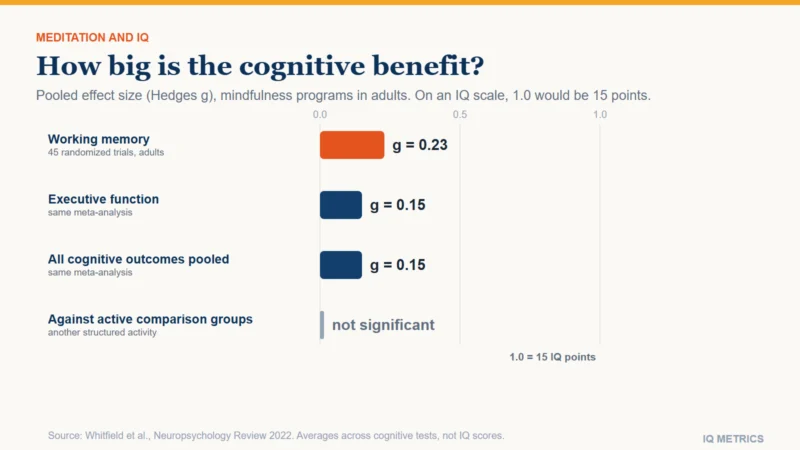
Does meditation increase IQ? The best reviews do not show that it does. Pooled across randomized trials in adults, mindfulness programs improve working memory and executive function by small amounts (effect sizes of about 0.15 to 0.23), no other cognitive area showed a significant benefit, and the advantage disappears when the comparison group does something active. The famous “two weeks of meditation, 16 percentile points” result came from 48 students and a reading test, not an IQ test. This guide goes through what each major study measured, what the reviews conclude and what that means for your own scores.
- Adults: a 2022 meta-analysis of 45 randomized trials (2,238 people) found a pooled effect of g = 0.15 on cognition, with significant benefits only for executive function (0.15) and working memory (0.23).
- The comparison matters: mindfulness programs beat inactive comparison groups but not active ones.
- Children: a 2022 review of 66 trials found benefits against passive controls and no significant positive effects at follow-up.
- Transcendental Meditation: a 2003 review found that the trials with large positive results recruited people favorable to TM and used passive controls.
- Brain structure: an 8-week program produced no detectable change in gray matter in 218 adults in a large controlled trial.
What do the best reviews say about meditation and cognition?
Whitfield and colleagues (2022) published the first meta-analysis of objective cognitive outcomes across several domains from randomized trials of mindfulness-based programs in adults. They searched seven databases, found 56 unique studies (2,931 people) and pooled 45 of them (2,238 people). The pooled effect was small: g = 0.15 (95% CI 0.05 to 0.24). Only two areas improved significantly, executive function (0.15) and working memory (0.23). Effects were significant in non-clinical samples and in adults over 60.
Two limits matter for anyone asking about IQ. First, mindfulness programs outperformed inactive comparison groups but not active ones, such as another structured activity. Second, the authors rated most studies as having an unclear risk of bias, and statistical constraints made some p-values unreliable. The outcome is “cognitive function” sorted into domains, not an IQ score. For what those two abilities are, see our guides to executive function vs IQ and memory and IQ.
| Outcome | Pooled effect (g) | Reading |
|---|---|---|
| Working memory | 0.23 (0.11 to 0.36) | Significant, small |
| Executive function | 0.15 (0.02 to 0.27) | Significant, small |
| All cognitive outcomes pooled | 0.15 (0.05 to 0.24) | Significant, small |
| Other cognitive domains | Not reported as significant | No clear benefit |
| Versus active comparison groups | Not significant | No benefit over another activity |
For scale, the usual IQ scale has a standard deviation of 15 points, so an effect of 0.15 standard deviations would be roughly 2 points if it were measured on an IQ test. It was not, and a difference that size is within the usual margin of error on a single sitting. Our guide to the margin of error in an IQ score shows how large that noise is.
What did the "two weeks, 16 percentile points" study find?
Mrazek and colleagues (2013, Psychological Science) randomly assigned 48 undergraduates to a mindfulness class (26 students) or a nutrition class (22). Each met for 45 minutes four times a week for two weeks. Before and after, students took a reading-comprehension section of the GRE and an operation-span working-memory task. The mindfulness group improved on both and reported fewer task-unrelated thoughts. The paper estimates the GRE change as analogous to 16 percentile points, and improvements were mediated by less mind wandering among students who were prone to distraction at the start.
Read carefully, that is a result about attention lapses on a reading test. The sample was small, the training was short, and the outcome was a GRE section whose pre-test scores correlated at r = .45 with the students’ own SAT reading scores from college application. Nothing in it measures general intelligence. If your attention drifts during a timed test, fewer lapses can raise a score; that is a different claim from raising IQ. See our guides to test anxiety and IQ scores and to how to prepare for an IQ test.
Can four days of meditation help?
Zeidan and colleagues (2010) gave meditation-naive adults four sessions of mindfulness training or listening to a recorded book, then tested mood, verbal fluency, visual coding and working memory. Both groups improved in mood, but only the meditation group showed less fatigue and anxiety and significantly better visuo-spatial processing, working memory and executive functioning. It is a short, small study, and the later meta-analysis is the better guide to how large such effects are across many trials. The fluency task is covered in our guide to the verbal fluency test.
What about meditation for children?
Dunning and colleagues (2022) updated their meta-analysis of randomized trials of mindfulness programs for people under 19: 66 trials with 20,138 participants. Compared with passive controls, the programs improved anxiety and stress, attention, executive functioning and behavior, with effect sizes from 0.12 to 0.35. Compared with active controls, they were better only for anxiety and stress (0.11) and mindfulness itself (0.24). In studies with a follow-up, there were no significant positive effects. The authors conclude that enthusiasm for these programs has arguably run ahead of the evidence, and that the evidence is of low quality and inconclusive. Our guides to whether you can improve your IQ and to growth mindset and intelligence cover what the evidence says about changing scores.
Where would your own score land?
Take the IIF-certified assessment and get your score with the scale it was measured on, the percentile it corresponds to and the confidence range around it — the three figures most online tests leave out.
Find your IQ score now! →Does Transcendental Meditation raise IQ?
The strongest-sounding claims come from Transcendental Meditation (TM). A 1991 study in Personality and Individual Differences followed 100 college students for two years: 45 at a university whose curriculum includes twice-daily TM practice and 55 at another university. The TM-university group improved significantly on Cattell’s Culture Fair Intelligence Test, and the paper presented the results as improved performance on intelligence-related measures. Several of its authors were affiliated with the TM university, and students were not randomly assigned to the two schools.
Canter and Ernst (2003) later reviewed the randomized evidence. Of 107 articles on TM and cognitive function they found, only 10 met its criteria (randomized, with objective measures of cumulative effects). Four reported large positive effects, four were completely negative and two were largely negative. All four positive trials recruited people favorably predisposed toward TM and used passive control procedures; the other six recruited people with no special interest and mostly used structured controls. The review concluded that the claim of a specific, cumulative effect on cognitive function was not supported, and read the positive trials as an expectation effect. For another popular route to a sharper mind, see our guide to whether brain-training apps work.
Does meditation change the brain?
A common step in the argument is that meditation visibly grows the brain, and so must raise intelligence. Kral and colleagues (2022) tested the structural claim in two combined randomized trials of meditation-naive adults (n = 218): 75 were assigned to an 8-week mindfulness-based stress reduction program, 73 to an active control and 70 to a waitlist. They found no change in gray matter volume, gray matter density or cortical thickness compared with either control group, either across the whole brain or in regions taken from earlier studies. Brain imaging results from small, uncontrolled studies should be read with that in mind.
How should you read a headline about meditation and IQ?
A review of the field by Van Dam and colleagues (2018) warned that misinformation and poor methodology around mindfulness may leave people misled and disappointed, and set out an agenda for stronger research, including attention to possible adverse effects. Four questions help with any headline:
- Was there an active comparison group? A waitlist can only show that doing something beats doing nothing.
- How many people, and who ran it? 48 students is a small trial; studies run by people who teach or sell the method deserve extra scrutiny.
- Was the outcome an IQ test? Reading, attention and working-memory tasks are not the same as a full-scale score.
- Was there a follow-up? Effects that fade after the program ends are not lasting changes.
None of this means meditation is pointless. Reductions in stress and anxiety, and small gains in attention and working memory, are reasonable benefits to want. It means the honest answer to the IQ question is that the evidence does not show a rise, and that you should use the IQ test for what it is: a snapshot of reasoning, not a tracker for a habit. If test-day performance is the goal, our guides to sleep and IQ and sleep loss and test performance cover another factor.
Quick answers
- Does meditation increase IQ? Not according to the best reviews. They find small gains in working memory and executive function, not in IQ.
- How big is the benefit? A pooled g of 0.15 on cognition in adults, and 0.23 for working memory.
- Does mindfulness beat other activities? In adults, programs beat inactive comparison groups but not active ones.
- Does Transcendental Meditation raise intelligence? A 2003 review of randomized trials found no support for a specific effect; the positive trials used passive controls and favorable recruits.
- Does meditation grow the brain? An 8-week program showed no structural change in 218 adults.
- Is it worth doing anyway? For stress, anxiety and attention, perhaps; for IQ, there is no evidence.
Sources
- Whitfield, T. et al. (2022): The effect of mindfulness-based programs on cognitive function in adults: a systematic review and meta-analysis, Neuropsychology Review, 32(3), 677-702.
- Mrazek, M.D. et al. (2013): Mindfulness training improves working memory capacity and GRE performance while reducing mind wandering, Psychological Science, 24(5), 776-781.
- Zeidan, F. et al. (2010): Mindfulness meditation improves cognition: evidence of brief mental training, Consciousness and Cognition, 19(2), 597-605.
- Dunning, D. et al. (2022): Do mindfulness-based programmes improve the cognitive skills, behaviour and mental health of children and adolescents? An updated meta-analysis of randomised controlled trials, Evidence-Based Mental Health, 25(3), 135-142.
- Canter, P.H. and Ernst, E. (2003): The cumulative effects of Transcendental Meditation on cognitive function: a systematic review of randomised controlled trials, Wiener Klinische Wochenschrift, 115(21-22), 758-766.
- Cranson, R.W. et al. (1991): Transcendental Meditation and improved performance on intelligence-related measures: a longitudinal study, Personality and Individual Differences, 12(10), 1105-1116.
- Kral, T.R.A. et al. (2022): Absence of structural brain changes from mindfulness-based stress reduction: two combined randomized controlled trials, Science Advances, 8(20), eabk3316.
- Van Dam, N.T. et al. (2018): Mind the hype: a critical evaluation and prescriptive agenda for research on mindfulness and meditation, Perspectives on Psychological Science, 13(1), 36-61.
Keep reading
All articles →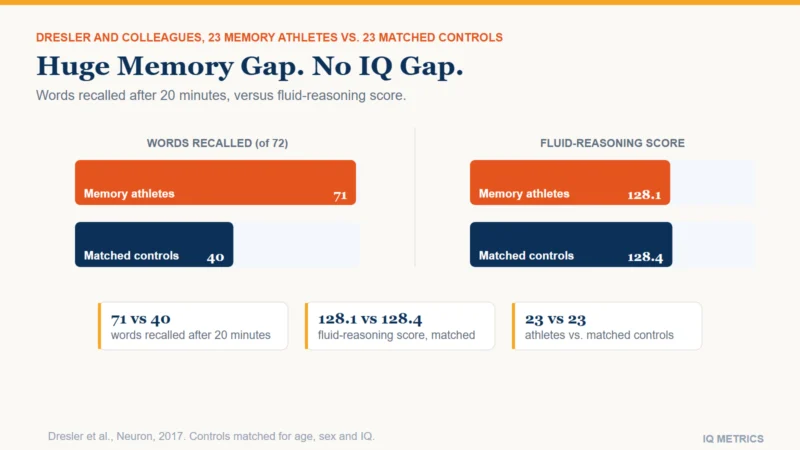 Understanding IQ
Memory and IQ
The world's best memory athletes can memorize 71 shuffled words in twenty minutes. Their IQ scores are not measurably different from a matched control group who could only manage 40. If a spectacular memory is not the same thing as a high IQ, what actually is the difference?
 Research & Evidence
Sleep and IQ
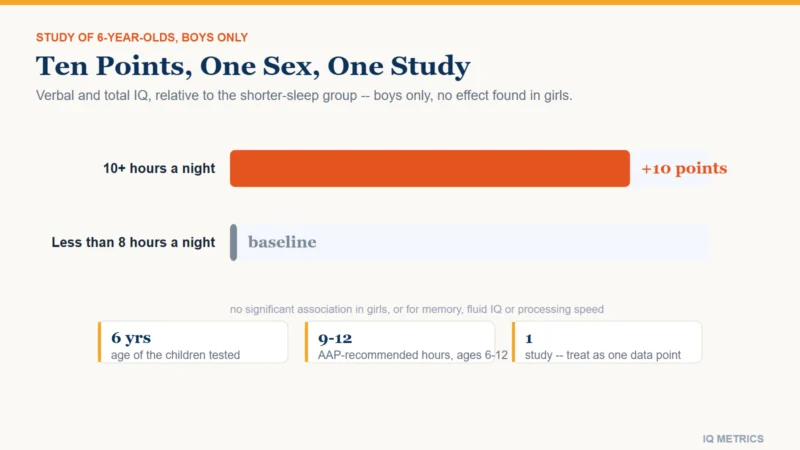
This site's news desk has already covered what one bad night does to a test score on the day it is taken. This is a different and, for children especially, more consequential question: what years of too little sleep do to the cognitive systems an IQ test measures in the first place.
 Taking a Test
Verbal Fluency Test
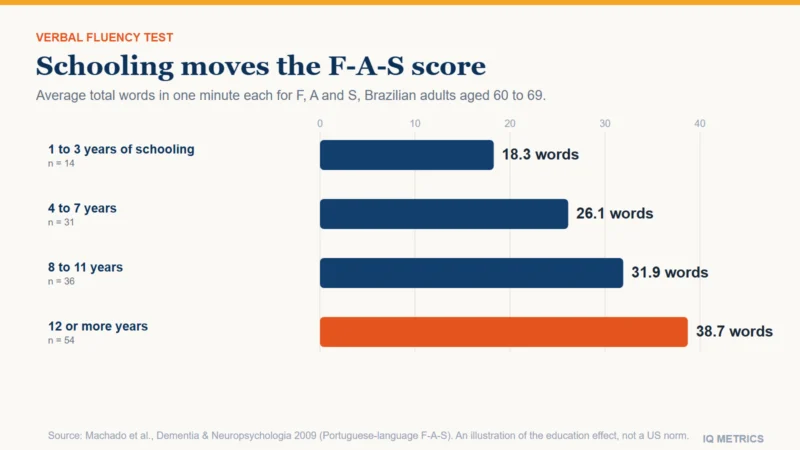
A verbal fluency test asks you to name as many words as you can in 60 seconds, by letter (F-A-S) or category (animals). See how it is scored, why education can move the score by about 20 words, what the task really measures and what a low count can and cannot tell you.