





Does Depression Lower IQ? What the Studies Show
Does depression lower IQ? It lowers performance on attention, memory, speed and planning tasks while an episode lasts, and some executive and attention differences remain after recovery. A permanent loss of intelligence is not shown, and two large cohorts suggest the arrow also runs the other way.

Does depression lower IQ? It lowers performance on tests of attention, memory, processing speed and planning while an episode lasts, and some attention and executive-function problems can remain after mood recovers. The research does not show that depression permanently lowers a person’s underlying intelligence, and the long-term cohort data point the other way as well: a lower childhood or teenage IQ predicts a higher risk of later depression. This guide separates the questions that usually get blurred together and says what each study actually measured.
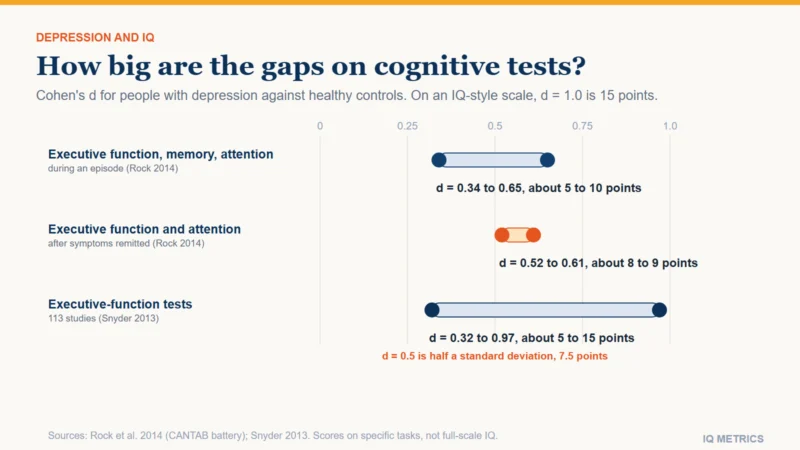
- During an episode: moderate deficits on tests of attention, memory and executive function, with effect sizes of about 0.3 to 0.65 standard deviations in one meta-analysis of a single test battery. These are the kinds of tasks that overlap with parts of an IQ test.
- After recovery: executive-function and attention deficits (about 0.5 to 0.6 standard deviations) were still present in people whose symptoms had remitted; memory deficits were smaller and not statistically significant.
- Severity matters: across studies, more severe depression went with worse episodic memory, executive function and processing speed, but not with stored knowledge.
- The other direction: in a Swedish cohort of 50,087 men and a New Zealand cohort of 1,037 people, lower earlier IQ predicted more depression later.
- Not shown: a permanent loss of IQ points caused by depression. The reviews measured specific tasks, not full-scale IQ.
The topic touches several pages we already publish. The reverse claim, that high intelligence brings mood problems, is covered in high IQ and mental health and IQ and happiness. How nerves and mood distort a single sitting is covered in test anxiety and IQ scores and ADHD, autism, dyslexia and IQ test scores. This page asks the direct question about depression.
What does depression do to test performance?
The most useful evidence comes from meta-analyses, which pool many small studies. Rock and colleagues (2014) combined studies that used one computerized battery, the Cambridge Neuropsychological Test Automated Battery (CANTAB), to compare people with depression with healthy controls. They found moderate deficits in executive function, memory and attention, with effect sizes (Cohen’s d) from 0.34 to 0.65. Executive function is the set of skills for planning, switching between tasks and holding rules in mind; our guide to executive function versus IQ explains how it relates to intelligence.
Another review focused on executive-function tests. Snyder (2013) pooled 113 studies and found that major depressive disorder was reliably associated with impaired performance, with effect sizes from 0.32 to 0.97 depending on the test. People with depression also had slower processing speed, but slowed movement alone could not account for the results, and there was some evidence that the deficits were larger when current symptoms were more severe.
McDermott and Ebmeier (2009) asked a different question: does severity matter? Across the studies they pooled, more severe depression went with worse episodic memory, executive function and processing speed, but not with semantic memory (stored knowledge) or visuospatial memory. That pattern echoes what a bad night of sleep does to a score, as described in our piece on sleep loss and test performance: the speeded, attention-heavy parts take the hit and stored knowledge holds up.
| Review | What it combined | Main finding |
|---|---|---|
| Rock et al. (2014) | Studies using the CANTAB battery, people with depression versus controls, during episodes and in remission | Moderate deficits in executive function, memory and attention (d from 0.34 to 0.65); executive function and attention deficits persisted in remission (d from 0.52 to 0.61) |
| Snyder (2013) | 113 studies of executive-function tests, major depressive disorder versus healthy controls | Reliable impairment, effect sizes 0.32 to 0.97; slower processing speed too; larger deficits with more severe current symptoms |
| McDermott and Ebmeier (2009) | Correlations between depression severity and test performance | Worse severity went with worse episodic memory, executive function and processing speed; no link for semantic or visuospatial memory |
A Cohen’s d of 0.5 means half a standard deviation, which on an IQ-style scale with a standard deviation of 15 is 7.5 points. The ranges above therefore correspond to very roughly 5 to 10 points in the CANTAB review and 5 to 15 in the executive-function review if they were put on that scale. They are not IQ points. They are scores on specific tests, the reviews did not measure full-scale IQ, and the conversion is only there to give a sense of size.
Do the problems go away when the depression lifts?
Not entirely, on average. In the same 2014 meta-analysis, people whose depressive symptoms had remitted still showed moderate deficits in executive function and attention (d from 0.52 to 0.61). Memory deficits were smaller and not statistically significant (0.22 to 0.54). The authors concluded that cognitive impairment is a core feature of depression rather than a side effect of low mood alone.
Two cautions apply. These are comparisons of groups at one point in time, so they cannot show whether the differences were caused by depression or were already there before it began. And an average gap of half a standard deviation leaves a large overlap between the groups, so plenty of people who have recovered score within the usual range.
For IQ testing the practical point is timing. The tasks in these reviews resemble the working-memory, processing-speed and reasoning parts of a full IQ battery, so a score taken in the middle of an episode may understate what the same person scores when well. That is our inference, not something the reviews tested directly. It fits what our guides say about how a single sitting can be pulled down; see processing speed and IQ and the factors that affect an IQ test result.
Does a lower IQ raise the risk of depression?
Two long-running cohorts suggest the arrow also runs this way. Zammit and colleagues (2004) followed 50,087 Swedish men who took an IQ test at military conscription in 1969 and 1970, using hospital records over 27 years. A lower IQ was associated with a higher risk of later hospital admission for severe depression, and also for schizophrenia and other non-affective psychoses. There was no association with bipolar disorder, a contrast we unpack in bipolar disorder and IQ.
Koenen and colleagues (2009) used the Dunedin birth cohort in New Zealand: 1,037 people who took the WISC-R at ages 7, 9 and 11 and were assessed for mental disorders at ages 18, 21, 26 and 32. Lower childhood IQ was associated with a higher risk of adult depression and anxiety, with more than one disorder at a time, and with depression that persisted. The authors framed this as lower “cognitive reserve”.
Neither study shows that a low IQ causes depression. Childhood IQ can also stand in for things that raise risk on their own, such as early adversity, health problems or schooling, and the Swedish outcome was depression severe enough to need hospital admission, which tells us little about milder cases. Our overview of childhood IQ and later-life health describes the same causal puzzle for physical health. The safest reading is two-way: depression can lower performance while it lasts, and lower earlier ability is a marker of higher risk.
Does a high IQ cause depression?
The popular version of this claim leans on a 2018 survey of 3,715 American Mensa members, in which about 27% reported a mood disorder, against roughly 10% in the general population. We cover that study and its limits (self-reported diagnoses, a sample drawn from the far tail of the distribution) in high IQ and mental health. In the two population cohorts above, higher IQ went with a lower, not a higher, risk of depression, and our summary of IQ and happiness finds no strong, consistent evidence at the population level that smarter people are more likely to be depressed. One finding runs the other way, and it concerns mania rather than depression: in the Dunedin cohort, higher childhood IQ predicted a higher risk of adult mania.
Where would your own score land?
Take the IIF-certified assessment and get your score with the scale it was measured on, the percentile it corresponds to and the confidence range around it — the three figures most online tests leave out.
Find your IQ score now! →What about depression in parents and the IQ of their children?
One small study looked at this directly. Miller and colleagues (2024) followed 209 mother-child pairs from a multicenter trial and compared depression screens during pregnancy and one year after birth with the child’s WPPSI-III score at age 5. Children of mothers with a positive screen during pregnancy were more likely to have an IQ below 85 (35% versus 18%), and the same held for a positive screen after birth (47% versus 21%). But once the analysis accounted for social determinants of health and clinical characteristics, the associations were no longer statistically significant (adjusted odds ratios 1.4 and 2.1, with confidence intervals that include 1).
The sample was small and came from a trial of pregnant women with subclinical hypothyroidism, so it is a caution against over-reading the raw numbers rather than a final answer. It does fit a pattern familiar from other topics on this site, where an association shrinks sharply once family circumstances are counted: the link between waiting for a treat at age 4 and teenage achievement fell by about two thirds in our grit versus IQ guide.
Should you take an IQ test while depressed?
An IQ score is a snapshot, and its margin of error is already 2 to 3 points on a well-built test (see the margin of error explained). In the middle of a low period, poor sleep and trouble concentrating can pull the speed- and attention-heavy parts of a score down further. A sensible approach is to wait, to compare scores only when they were taken under similar conditions, and to read an unusually low result from a bad stretch as a statement about that day. The same logic applies to anyone retesting after a long gap; see can your IQ change over time.
Our IQ test gives a total score for curiosity. It cannot diagnose or rule out depression, and how much any online score can be trusted depends on the conditions it was taken in (IQ test accuracy). If low mood is lasting, a doctor or mental health professional is the right place to start. In the United States, anyone in crisis can call or text 988 to reach the Suicide & Crisis Lifeline.
For a neighboring condition with a very different pattern in the IQ data, where higher ability shows up as a risk marker in some cohorts, see bipolar disorder and IQ.
Quick answers
- Does depression lower IQ permanently? The studies reviewed here do not show that. They show lower performance on specific tests of attention, memory and executive function during episodes, and some executive and attention differences that persisted in remission.
- Can depression lower your score on an IQ test? It can, mostly on the speeded and attention-heavy parts, and more so when symptoms are more severe.
- Do depressed people have lower IQs? On average they score lower on some cognitive tests, and in two cohorts lower earlier IQ predicted later depression. The groups overlap heavily, so a person with depression can have any IQ.
- Does a high IQ cause depression? Neither population cohort found that. The claim rests mainly on a 2018 survey of Mensa members that relied on self-reported diagnoses.
- How big is the effect? About 0.3 to 0.65 standard deviations for attention, memory and executive tasks in one review, roughly 5 to 10 points if put on an IQ-style scale, and larger with more severe symptoms.
- Should I retest after recovering? If an earlier score came during a hard period, a retest under better conditions is reasonable; expect the usual test-to-test variation of a few points as well.
Sources
- Rock, P.L. et al. (2014): Cognitive impairment in depression: a systematic review and meta-analysis, Psychological Medicine, 44(10), 2029-2040.
- Snyder, H.R. (2013): Major depressive disorder is associated with broad impairments on neuropsychological measures of executive function: a meta-analysis and review, Psychological Bulletin, 139(1), 81-132.
- McDermott, L.M. and Ebmeier, K.P. (2009): A meta-analysis of depression severity and cognitive function, Journal of Affective Disorders, 119(1-3), 1-8.
- Zammit, S. et al. (2004): A longitudinal study of premorbid IQ score and risk of developing schizophrenia, bipolar disorder, severe depression, and other nonaffective psychoses, Archives of General Psychiatry, 61(4), 354-360.
- Koenen, K.C. et al. (2009): Childhood IQ and adult mental disorders: a test of the cognitive reserve hypothesis, American Journal of Psychiatry, 166(1), 50-57.
- Miller, E.S. et al. (2024): The association between perinatal depressive symptoms and child neurodevelopment, American Journal of Obstetrics & Gynecology MFM, 6(11), 101488.
- Karpinski, R.I. et al. (2018): High intelligence: a risk factor for psychological and physiological overexcitabilities, Intelligence, 66, 8-23.
Keep reading
All articles →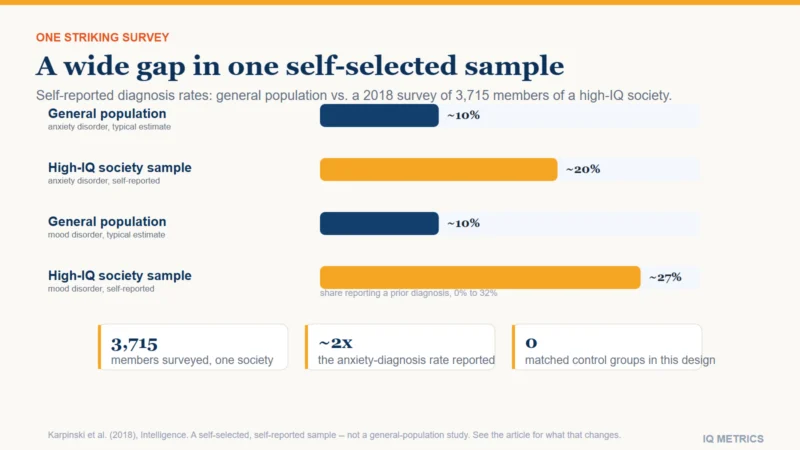 Understanding IQ
High IQ and Mental Health
A widely cited 2018 study found sharply higher rates of anxiety and depression among members of a high-IQ society. Why that finding is far from the whole story, what a century of gifted research actually shows, and what seems to matter more than IQ itself.
 Mind & Everyday Life
Bipolar Disorder and IQ
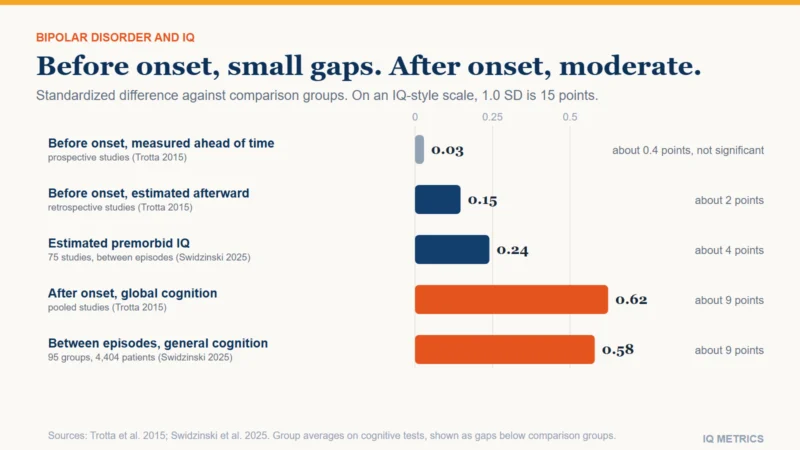
Are bipolar people smarter? Not on average, but the evidence is more interesting than yes or no. Swedish data on a million men show a reversed-J pattern, excellent school grades carried nearly four times the risk in males, and after diagnosis cognitive scores run about 0.6 standard deviations lower.
 Research & Evidence
IQ and Happiness
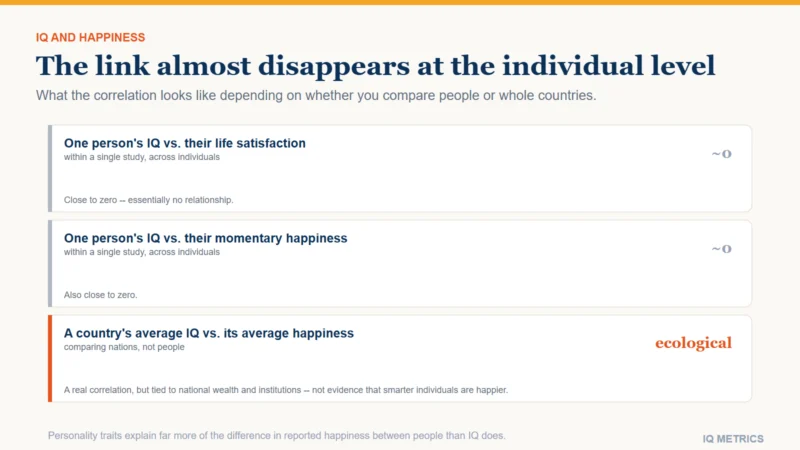
IQ and happiness are almost unrelated at the individual level, though smarter countries do report higher average happiness. What the research actually finds, why national comparisons mislead, and what predicts happiness better than IQ.