





OCD and IQ: Is Obsessive-Compulsive Disorder Linked to Intelligence?
Is OCD a sign of high intelligence? A 2018 meta-analysis of 98 studies found people with obsessive-compulsive disorder score slightly lower than comparison groups, though still in the normal range. Here is what slows the scores, and where the high-IQ idea may come from.

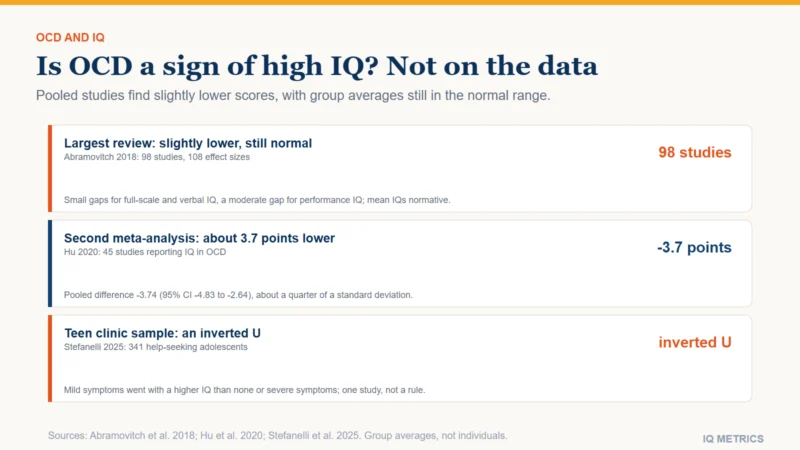
OCD and IQ are not linked the way the popular claim says. A 2018 meta-analysis of 98 studies found that people with obsessive-compulsive disorder score slightly lower than comparison groups on IQ tests, not higher, although their average scores still fall in the normal range. The idea that OCD goes with unusually high intelligence has been speculated about for a long time, the authors of that meta-analysis note, but the pooled data do not support it. This guide explains what the largest reviews found, why the scores run slightly lower, where the myth may come from, and how a recent study of teenagers with mild symptoms complicates the picture.
- The largest review: 98 studies and 108 effect sizes (verbal IQ 55, performance IQ 13, full-scale IQ 40) found small gaps for full-scale and verbal IQ and a moderate gap for performance IQ, all favoring the comparison groups.
- Still normal range: mean IQ across the OCD samples was in the normative range.
- A second meta-analysis (2020): OCD samples scored about 3.7 points lower (95% CI 2.6 to 4.8).
- Speed, not reasoning: the authors discuss reduced processing speed as a possible contributor.
- Mild versus severe: in 341 help-seeking teenagers, mild obsessive-compulsive symptoms went with a higher IQ than no symptoms or severe symptoms, an inverted U.
- No shortcut: an IQ score cannot show whether someone has OCD, and OCD does not fix a person’s IQ.
OCD often travels with other anxiety problems, which we cover in anxiety and IQ. Related guides look at depression and IQ, autism and IQ and ADHD and IQ.
Is OCD linked to high intelligence?
No, not on the pooled evidence. Obsessive-compulsive disorder is a condition in which unwanted, intrusive thoughts, images or urges (obsessions) lead to repetitive behaviors or mental acts (compulsions) that a person feels driven to perform, and that take time or interfere with daily life. It is a clinical diagnosis, distinct from being tidy, careful or a perfectionist.
The belief that it signals unusual intelligence has long been repeated. When researchers pooled the IQ data, they found the opposite direction, if only slightly. The next section shows the numbers.
What do the largest reviews find?
| Review | What it pooled | Result |
|---|---|---|
| Abramovitch et al., 2018 (Neuropsychology Review) | 98 studies, 108 effect sizes: verbal IQ (55), performance IQ (13), full-scale IQ (40); OCD against non-psychiatric comparison groups | Small gaps for full-scale and verbal IQ, a moderate gap for performance IQ, all lower in OCD. Mean IQ in OCD samples in the normative range. No significant moderators among the clinical and demographic variables tested. |
| Hu et al., 2020 (Medical Hypotheses) | 45 studies reporting IQ in OCD, inside a review of 108 studies and 8,049 people that also covered treatment trials | OCD samples significantly lower, by 3.74 points (95% CI -4.83 to -2.64). |
Both reviews drew on the published IQ literature, so they are not fully independent, but they agree on the direction and rough size. A note on the second one: its abstract labels the pooled figure an odds ratio, although for a continuous measure such as IQ it can only be a difference in score, and we read it as points.
What does a gap of 3.7 points mean in practice?
On a scale with a standard deviation of 15, 3.74 points is about a quarter of a standard deviation (our arithmetic). If the comparison group averaged 100, a group averaging about 96 would sit near the 40th percentile of the general population, so the typical person with OCD would still be in the middle of the distribution. You can check any score on our IQ percentile calculator or against the IQ bell curve. Averages also hide the spread: if scores in OCD samples spread out like the general population (an assumption, with a standard deviation of 15), roughly four in ten people with OCD would still score above 100. That is part of why the myth survives: a high-scoring person with OCD is easy to notice, while a small downward shift in a group average is not.
What verbal and performance IQ mean
The meta-analysis used the older Wechsler labels. Verbal IQ draws on word knowledge and verbal reasoning. Performance IQ draws on visual puzzles and hands-on tasks, many of them timed. Full-scale IQ combines the two. Newer Wechsler editions report index scores instead, but earlier research, including most of the studies pooled here, used these three.
Why do OCD samples score slightly lower?
The meta-analysis authors discuss reduced processing speed as a possible contributor: OCD is associated with moderate underperformance on cognitive tests, including slower processing speed, and they note that the IQ gap is largest on the performance scale. Their conclusion was that OCD goes with normative full-scale and verbal IQ but a relatively lowered performance IQ.
Here is a plausible reading, and it is ours rather than a tested result: many performance subtests are timed, so a person who double-checks answers or hesitates over decisions can lose points on speed without any weakness in reasoning. That would fit a bigger gap on the performance scale than on the verbal one. For background on what these subtests reward, see processing speed and IQ and verbal vs non-verbal IQ scores.
Where would your own score land?
Take the IIF-certified assessment and get your score with the scale it was measured on, the percentile it corresponds to and the confidence range around it — the three figures most online tests leave out.
Find your IQ score now! →Where might the OCD and high IQ idea come from?
Nobody has traced it with certainty, but the studies suggest three ingredients. The first is mild symptoms. In 2025, Stefanelli and colleagues gave full IQ tests (WISC-IV or WAIS-IV) to 341 help-seeking adolescents (65% female, mean age 15.4) with a mix of psychiatric problems, and measured obsessive-compulsive symptoms (OCS) across a range of severity. The link between OCS and IQ was an inverted U: mild OCS went with a higher IQ than either no OCS or severe OCS. The association stayed significant after controlling for sociodemographic variables and other psychopathology.
Read that carefully. The sample was a clinical one with mixed problems, so the “no OCS” group is not a healthy comparison group; the data are cross-sectional; and symptoms are not the same as a diagnosis. Still, one possible reading, again ours, is that a mild, high-scoring end and a severe, lower-scoring end would average out to a slightly lower IQ in a group defined by a full diagnosis, which is what the meta-analyses found.
The second ingredient is overlap with admired traits. Carefulness, orderliness and perfectionism are ordinary traits, and in the Big Five model the related trait of conscientiousness predicts school and work outcomes; our guide to the Big Five personality traits explains it. OCD is not simply the high end of those traits. The third is who ends up in studies: people who reach a clinic, receive a diagnosis and take part in research are not a random draw from everyone with obsessive-compulsive symptoms.
Does a lower childhood IQ predict OCD?
A little, and not specifically. In the Dunedin birth cohort, Grisham and colleagues compared 36 people diagnosed with OCD at age 26 or 32 with 613 healthy controls and 310 people with other anxiety problems. Childhood neurodevelopmental, behavioral and personality risk factors were associated with an adult OCD diagnosis and with symptoms. A lower IQ non-specifically predicted increased risk for most symptom dimensions, meaning it was not special to OCD; social isolation, retrospectively reported physical abuse and negative emotionality were the specific predictors of a diagnosis. With only 36 cases, treat the details cautiously.
This matches the wider pattern in large cohorts, where a lower IQ goes with a higher risk across many categories of mental disorder, as we describe in anxiety and IQ.
Taking an IQ test when you have OCD
- A test cannot diagnose OCD. It measures cognitive performance. A diagnosis comes from a clinical interview.
- A diagnosis does not set your score. The OCD samples averaged in the normal range, and individuals vary widely.
- Time pressure can matter. If checking, doubt or slowness affects you on timed items, tell the examiner before a formal assessment and ask what adjustments are available. How to read the result is explained in how to read an IQ test report.
- Keep online results in proportion. A one-off online quiz is a rough guide; see IQ test accuracy for the limits.
If obsessive thoughts or rituals are taking up your time or causing distress, that is a reason to speak to a doctor or mental-health professional, whatever any score says. If you simply want a baseline of your reasoning, you can take our IQ test.
Quick answers
- Do people with OCD have higher IQs? No. Pooled across 98 studies, they score slightly lower on average, with means in the normal range.
- Is OCD a sign of low intelligence? No. The gap is small, and averages stay normative.
- Why do OCD samples score a little lower? Reduced processing speed is the explanation the authors single out; the performance scale showed the biggest gap.
- Do mild obsessive traits go with higher IQ? In one clinical teen sample, mild symptoms went with a higher IQ than none or severe symptoms. That is one study, not a rule.
- Can IQ predict OCD? Lower childhood IQ predicted most adult symptom dimensions in one cohort, but not specifically OCD.
Sources
- Abramovitch, A. et al. (2018): Meta-analysis of intelligence quotient (IQ) in obsessive-compulsive disorder, Neuropsychology Review, 28(1), 111-120.
- Hu, L. et al. (2020): Intelligence quotient level and treatment of obsessive-compulsive disorders: meta-analyses, Medical Hypotheses, 144, 109995.
- Stefanelli, R. et al. (2025): IQ and socio-occupational functioning in relation to obsessive-compulsive symptoms severity in a clinical sample of adolescents, Scientific Reports, 15, 14021.
- Grisham, J.R. et al. (2011): Risk factors prospectively associated with adult obsessive-compulsive symptom dimensions and obsessive-compulsive disorder, Psychological Medicine, 41(12), 2495-2506.
Keep reading
All articles →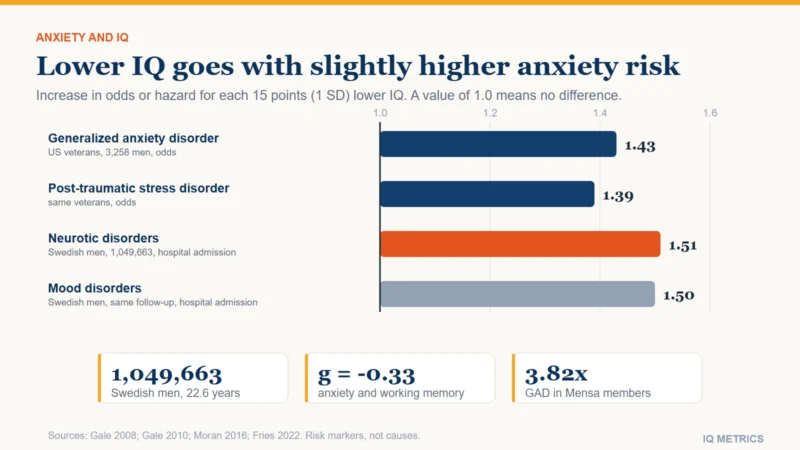 Mind & Everyday Life
Anxiety and IQ
Does anxiety lower IQ, or do smart people worry more? Large cohorts link a lower IQ to more anxiety disorders, Mensa surveys report the reverse, and anxiety weakens working memory on test day. Here is what each study measured and where selection bias may explain the gap.
 Understanding IQ
High IQ and Mental Health
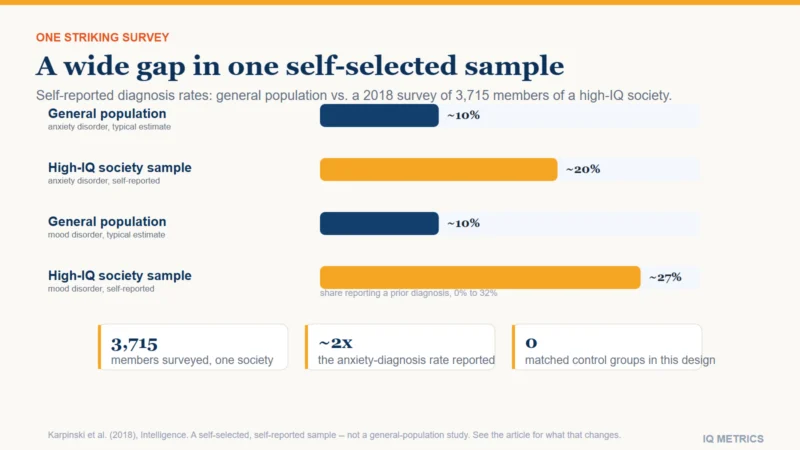
A widely cited 2018 study found sharply higher rates of anxiety and depression among members of a high-IQ society. Why that finding is far from the whole story, what a century of gifted research actually shows, and what seems to matter more than IQ itself.
 Understanding IQ
Processing Speed and IQ
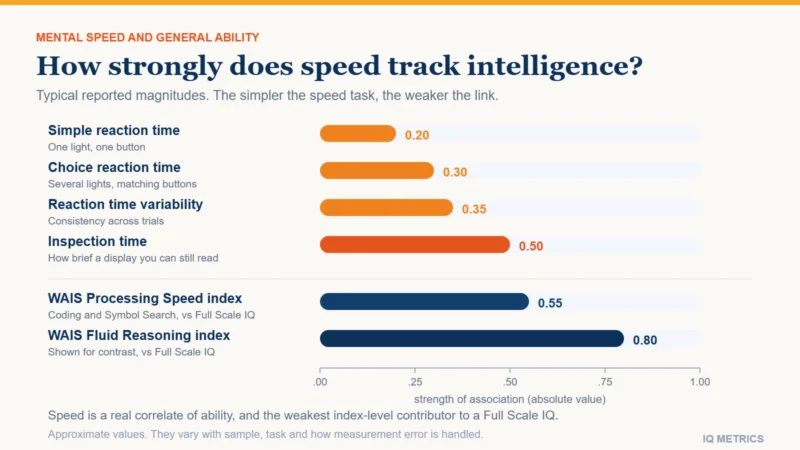
Fast thinkers are assumed to be smart thinkers, and there is a real finding underneath the stereotype: people who score higher on IQ tests do respond faster on tasks with no reasoning content at all. But the link is weaker than the folklore, and on a professional battery the speed index is the least g-loaded.