





Dyscalculia and IQ: Why a Maths Learning Disorder Can Occur at Any IQ
Can you have dyscalculia and a high IQ? Yes: it is a specific difficulty with numbers, not a low-IQ condition. Estimates of how common it is run from 3.4% to over 9% depending on the definition. Here is what the studies say, how it is assessed and how it differs from maths anxiety.

Dyscalculia and IQ are separate things: dyscalculia is a persistent, unexpected difficulty with numbers and arithmetic that can occur in children of average or high IQ, so a child can have dyscalculia without having a low IQ. In one classic study, children selected for dyscalculia alone were clearly impaired on basic number tasks despite high-average scores on tests of IQ, vocabulary and working memory. This guide explains what dyscalculia is, why it is not a low-IQ condition, why estimates of how common it is run from 3.4% to more than 9%, how it is assessed, and how it differs from maths anxiety.
- What it is: a specific difficulty with number sense and arithmetic. Researchers describe a core deficit in understanding sets and their numerosities.
- Not low IQ: children with dyscalculia alone had high-average IQ in one study of 31 children aged 8 and 9.
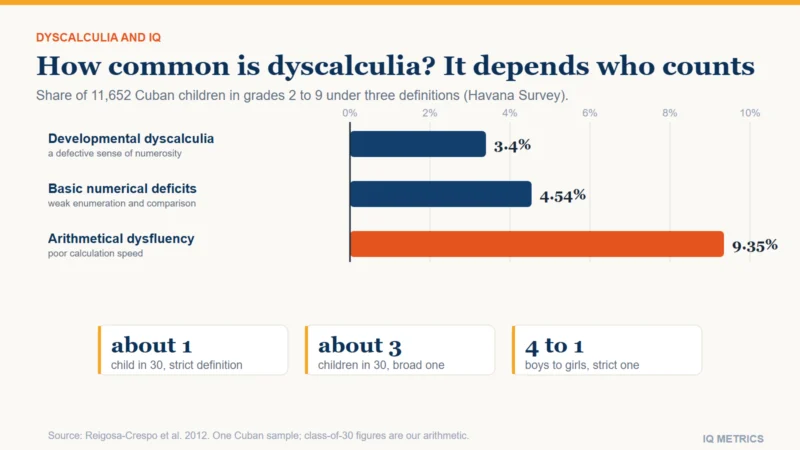
- How common: 3.4% under a strict definition, 9.35% for poor calculation fluency, in a survey of 11,652 Cuban children.
- Official name: DSM-5 uses specific learning disorder with a mathematics specifier; its work group judged the word dyscalculia unhelpful as a disorder name.
- Not maths anxiety: in 3,410 twin pairs, maths anxiety was only weakly related (-0.10) to the basic sense of quantity.
Dyscalculia is the maths counterpart of dyslexia, which we cover in dyslexia and IQ. The wider difference between a learning disorder and a low score is in low IQ vs learning disability, and how conditions that affect movement are measured is in cerebral palsy and IQ.
What is dyscalculia?
Dyscalculia is a specific, lasting difficulty with understanding and using numbers. In a 2011 review in Science, Butterworth and colleagues describe it as a core deficit in understanding sets and their numerosities, the quantities that numbers stand for, which is fundamental to all aspects of elementary school mathematics. Neuroimaging studies have identified neural markers of that impairment. The APA lists difficulties remembering number facts and inaccurate mathematical reasoning among the symptoms of a specific learning disorder in mathematics.
Is dyscalculia an official diagnosis?
Not under that name. The American Psychiatric Association’s fact sheet on DSM-5 says the manual now uses a single diagnosis, specific learning disorder, with detailed specifiers for reading, mathematics and written expression, and that the DSM-5 Neurodevelopmental Work Group concluded the many definitions of dyslexia and dyscalculia meant those terms would not be useful as disorder names or in the diagnostic criteria. Clinicians, researchers and parents still use the word dyscalculia, and a report may describe the same thing as a specific learning disorder with impairment in mathematics.
Dyscalculia and IQ: why a high IQ does not rule it out
Landerl, Bevan and Butterworth (2004) compared 31 children aged 8 and 9, selected for dyscalculia, reading difficulties or both, with controls. The children with dyscalculia only were impaired on a range of basic number-processing tasks despite high-average performance on tests of IQ, vocabulary and working memory. The authors concluded that dyscalculia is the result of specific disabilities in basic numerical processing rather than a consequence of deficits in other cognitive abilities. It is a small study, but it shows the key point: the difficulty can sit beside strong general ability.
This is what “unexpected” means. Maths skills are far below what the child’s age, teaching and other abilities would predict. The APA fact sheet adds that the difficulties must not be better explained by developmental, neurological, sensory or motor disorders, and must significantly interfere with school, work or daily life. A full-scale IQ blends many abilities, so a weak spot in number processing can sit beside a typical or high total (our reading). When a low IQ and a learning disorder both occur they are two separate findings; our guide to the difference explains how each is assessed.
How common is dyscalculia? Why estimates range from 3% to 9%
There is no single figure, because studies draw the line in different places. The Havana Survey (Reigosa-Crespo and colleagues, 2012) tested 11,652 Cuban children from grade 2 to grade 9 on enumeration and number comparison. Those basic numerical capacities alone predicted more than 25% of the variance in a timed arithmetic test, at younger and older ages. The researchers then estimated three prevalences:
| Definition | Share of children | Boys to girls |
|---|---|---|
| Developmental dyscalculia (defective sense of numerosity) | 3.4% | 4 to 1 |
| Basic numerical deficits | 4.54% | 2.4 to 1 |
| Arithmetical dysfluency (poor calculation speed) | 9.35% | 1.07 to 1, no gender difference |
In a class of 30, our arithmetic gives about 1 child under the strict definition and about 3 under the broad one. The authors conclude that dyscalculia defined as a defective sense of numerosity could be a distinctive disorder that affects only a portion of the children who are poor at calculation. It is one Cuban sample, so treat the percentages as illustrations of the range, not national figures.
Two more studies show how much the rule matters. Devine and colleagues (2013) assessed 1,004 British primary school children: with absolute thresholds, the prevalence of dyscalculia was the same for boys and girls whatever cut-off was used, but a gender difference appeared when dyscalculia was defined as maths performance falling below reading. Murphy and colleagues (2007) compared children scoring below the 10th percentile on an early maths test (22 children) with those between the 11th and 25th percentile (42 children) and a comparison group above the 25th (146 children). The groups differed in their profiles of related skills from kindergarten to grade 3, so a looser cut-off need not simply capture a milder version of the same problem. When you read a prevalence figure, check which percentile cut-off it used.
What goes wrong: number sense and working memory
The numerosity account says the weakness lies in grasping quantity itself, for example judging which of two groups has more or enumerating a small set at a glance, rather than in memory for facts or in general intelligence. Butterworth’s review adds that new interventions to strengthen numerosity processing, including adaptive software, promise effective evidence-based education, which is a promise rather than a proven cure.
Working memory plays a supporting role. Our write-up of a 2022 meta-analysis, working memory and maths underachievement, reports a pooled correlation of 0.31 with arithmetic in 11,224 typical children. That is a medium link, explaining under a tenth of the variation, and it also describes earlier evidence that children with both reading and maths difficulties show the most severe working-memory deficits. For the executive-function side, see executive function vs IQ.
Where would your own score land?
Take the IIF-certified assessment and get your score with the scale it was measured on, the percentile it corresponds to and the confidence range around it — the three figures most online tests leave out.
Find your IQ score now! →Dyscalculia vs maths anxiety vs finding maths hard
- Dyscalculia: a persistent difficulty with number processing that continues despite adequate teaching.
- Maths anxiety: tension and fear around maths. In a Twins Early Development Study sample of 3,410 twin pairs aged 16 to 21, maths anxiety correlated about -0.35 with maths performance but only about -0.10 with approximate number sense, the basic sense of quantity. That weaker link hints, in our reading, that anxiety and a core number-sense problem are different things. For how general anxiety relates to test performance, see anxiety and IQ.
- Finding maths hard: many children score below average without a disorder. As the Murphy study shows, where the cut-off falls decides who is counted.
How dyscalculia is assessed
The APA fact sheet describes the diagnosis as a clinical review of the person’s developmental, medical, educational and family history, reports of test scores and teacher observations, and response to academic interventions. An educational or clinical psychologist usually looks at both ability and attainment. A cognitive test such as the WISC-V shows the wider profile (see WISC-V index scores explained), while an achievement test measures maths directly (see achievement tests vs IQ tests and the Woodcock-Johnson). An online quiz cannot make the diagnosis, and our numerical IQ test is a reasoning test, not a screen for dyscalculia.
What to do if you suspect dyscalculia
- Start with the school. Ask the teacher or the school psychologist about an evaluation. The APA fact sheet stresses that early identification and intervention are particularly important.
- Ask what was measured. A good report separates number sense, calculation fluency and reasoning, and says which percentile cut-off it used.
- Keep the IQ question separate. A strong IQ does not make the maths difficulty imaginary, and a weak maths result does not lower the IQ. Both findings belong in the same report.
- Be wary of promises. Adaptive software that trains numerosity is promising, but a promise is not a proven treatment.
For adults who want a baseline of their reasoning, you can take our IQ test. It does not replace an assessment by a qualified professional.
Quick answers
- Is dyscalculia a sign of low IQ? No. Children with dyscalculia alone had high-average IQs in one study; it is a specific difficulty with number processing.
- Can you have dyscalculia and a high IQ? Yes. The condition is defined by maths skills far below what other abilities and teaching would predict.
- How common is dyscalculia? 3.4% in one large survey under a strict definition, and more than 9% for poor calculation fluency. The answer depends on the definition.
- Is dyscalculia the same as maths anxiety? No. Maths anxiety is fear of maths and was only weakly related to the basic sense of quantity.
- Is dyscalculia in the DSM-5? Not as a named diagnosis. The manual uses specific learning disorder with a mathematics specifier.
Sources
- Butterworth, B., Varma, S. and Laurillard, D. (2011): Dyscalculia: from brain to education, Science, 332(6033), 1049-1053.
- Landerl, K., Bevan, A. and Butterworth, B. (2004): Developmental dyscalculia and basic numerical capacities: a study of 8-9-year-old students, Cognition, 93(2), 99-125.
- Reigosa-Crespo, V. et al. (2012): Basic numerical capacities and prevalence of developmental dyscalculia: the Havana Survey, Developmental Psychology, 48(1), 123-135.
- Devine, A., Soltész, F., Nobes, A., Goswami, U. and Szűcs, D. (2013): Gender differences in developmental dyscalculia depend on diagnostic criteria, Learning and Instruction, 27, 31-39.
- Murphy, M.M., Mazzocco, M.M.M., Hanich, L.B. and Early, M.C. (2007): Cognitive characteristics of children with mathematics learning disability (MLD) vary as a function of the cutoff criterion used to define MLD, Journal of Learning Disabilities, 40(5), 458-478.
- Malanchini, M. et al. (2020): Genetic factors underlie the association between anxiety, attitudes and performance in mathematics, Translational Psychiatry, 10, 12.
- American Psychiatric Association: DSM-5 Fact Sheet, Specific Learning Disorder (diagnostic review, the single diagnosis with a mathematics specifier, and the work group’s view of the terms dyslexia and dyscalculia), read 8 October 2026.
Keep reading
All articles →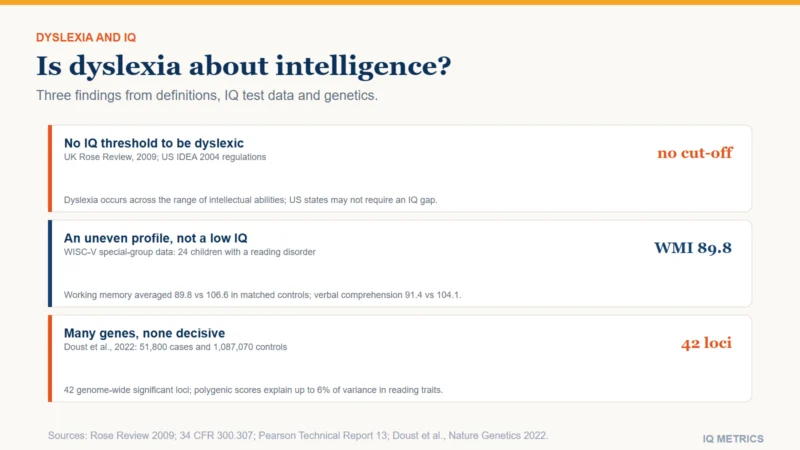 Understanding IQ
Dyslexia and IQ
Dyslexia is a reading and spelling difficulty that occurs at every level of IQ, and the IQ-gap rule was dropped as a US requirement in 2004 and from the IDA definition in 2025. See what IQ tests show for readers with dyslexia, and what the genetics and myths add.
 Understanding IQ
Low IQ vs Learning Disability
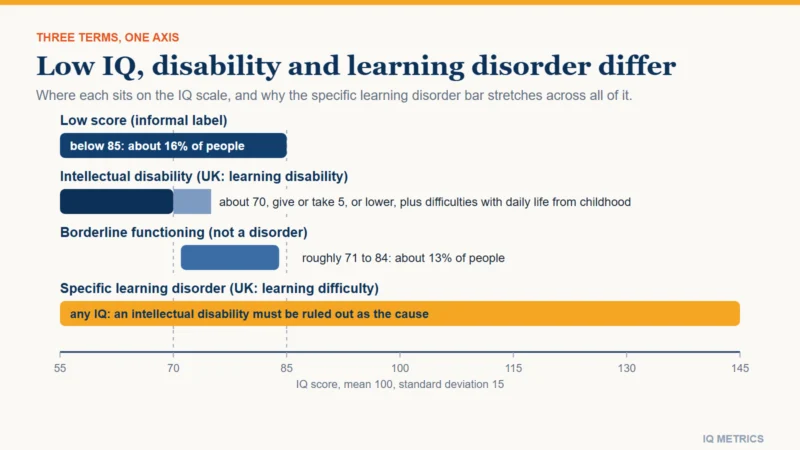
A low IQ, an intellectual disability and a specific learning disability are three different things, and the UK uses "learning disability" for the second. What each requires, how each is assessed, the US and UK terms, and what to do if you are worried.
 Understanding IQ
Cerebral Palsy and IQ
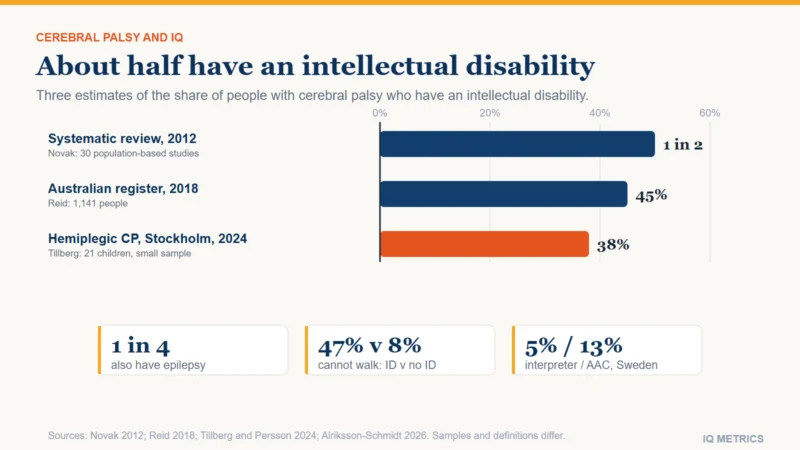
What is the IQ of someone with cerebral palsy? There is no single level: about 1 in 2 children has an intellectual disability and about half do not. Here is how common it is, what predicts lower scores, why testing is hard, and why the headline figure may overstate it.