





Cerebral Palsy and IQ: What Research Shows About Intelligence in CP
What is the IQ of someone with cerebral palsy? There is no single level: about 1 in 2 children has an intellectual disability and about half do not. Here is how common it is, what predicts lower scores, why testing is hard, and why the headline figure may overstate it.

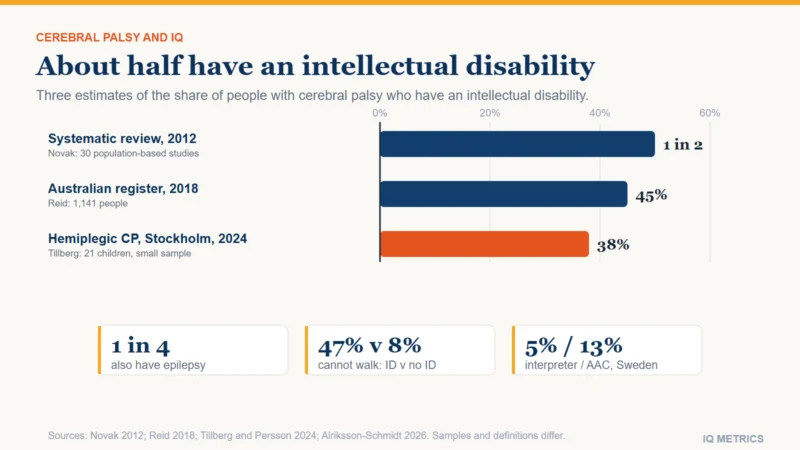
Cerebral palsy and IQ are not the same thing: cerebral palsy is a disorder of movement and posture, and the intelligence of people with it spans the whole range, from intellectual disability to well above average. In a systematic review of population-based studies, about 1 in 2 children with cerebral palsy had an intellectual disability, which also means about half did not. The headline figure comes with a caveat: a 2020 review argues it may overstate the true rate, because the thinking skills of children with the most severe motor and speech impairments are often assumed rather than tested. This guide covers how common intellectual disability is in cerebral palsy, what predicts lower scores, why testing is hard, and what an IQ score can and cannot tell a family.
- One in two: a 2012 systematic review found 1 in 2 children with cerebral palsy had an intellectual disability, 1 in 4 had epilepsy and 1 in 4 could not talk.
- A register says 45%: of 1,141 people on an Australian population register, 45% had an intellectual disability.
- Severity matters: intellectual disability went with not walking (47% against 8%), epilepsy (52% against 12%) and a quadriplegic pattern (42% against 5%).
- The number may be too high: cognition in the most severely affected children is often assumed, not assessed, and an IQ below 70 has been confused with intellectual disability.
- Profiles are uneven: 12 of 21 children with hemiplegic cerebral palsy showed uneven cognitive profiles.
- Adapting the test: in a Swedish register, interpreters were used in 5% and augmentative communication in 13% of assessments.
Cerebral palsy is much more likely after very early birth, which we cover in premature birth and IQ. For the definition of intellectual disability used throughout, see what an IQ of 70 means and low IQ vs learning disability. A different kind of specific difficulty, with numbers, is the subject of dyscalculia and IQ.
What is cerebral palsy, and does it affect intelligence?
Cerebral palsy (CP) is a permanent disorder of movement and posture caused by a non-progressive problem in the developing brain. The defining feature is physical, not cognitive. But the same injury or maldevelopment that affects movement can also affect thinking, and CP often comes with other conditions such as epilepsy, vision problems and difficulty with speech. So intelligence in CP is best described as a wide range, not a single typical level.
How common is intellectual disability in cerebral palsy?
| Study | Who | Intellectual disability |
|---|---|---|
| Novak et al., Pediatrics, 2012 | Systematic review: 30 population-based studies in the meta-analyses; children with CP | 1 in 2 |
| Reid et al., Developmental Medicine and Child Neurology, 2018 | 1,141 people on an Australian population CP register (study team in Melbourne) | 45% |
| Tillberg and Persson, Seizure, 2024 | 21 school-age children with hemiplegic CP in northern Stockholm (47 invited) | 38% (8 of 21); 62% had a normal IQ |
Novak and colleagues searched 1,366 papers, appraised 82 and meta-analyzed 30, and turned the prevalence figures into plain messages: among children with CP, 3 in 4 were in pain, 1 in 2 had an intellectual disability, 1 in 3 could not walk, 1 in 4 could not talk and 1 in 4 had epilepsy. CP is not one condition but a pattern of overlapping ones.
The Stockholm figure comes from a very small group: only 21 of the 47 invited children took part, so it illustrates a subtype, hemiplegic or unilateral CP, in which most of these children had a normal IQ, rather than giving a rate for everyone with CP.
Why the headline number may be too high
Stadskleiv’s 2020 narrative review in Developmental Medicine and Child Neurology searched for original studies of cognition in children with CP and found 81 unique hits, and few had a representative sample in which every child was assessed individually. Cognitive functioning in the children with the most severe motor impairments was often assumed and not assessed. The review also found that an IQ below 70 had been confounded with intellectual disability, which may overestimate the prevalence: a diagnosis of intellectual disability needs difficulty with daily life as well as a low score.
Bias can run the other way too. In the Swedish register study by Alriksson-Schmidt and colleagues, children with less affected gross motor, manual and communication function, and those with spastic CP, were more likely to have been assessed. Samples of assessed children therefore lean toward the less severely affected, which pulls the average up. With assumption pushing one way and selection the other, the honest summary is a range: somewhere around 4 in 10 to 1 in 2 in the studies above.
What predicts lower IQ scores in cerebral palsy?
In the Australian register study, intellectual disability was strongly tied to how severe the physical picture was. The table gives the share of people with each feature among those with and without an intellectual disability.
| Feature | With intellectual disability | Without |
|---|---|---|
| Not able to walk | 47% | 8% |
| Epilepsy | 52% | 12% |
| Quadriplegic pattern of motor impairment | 42% | 5% |
| Average age of first walking, in those who walked | 2 years 7 months | 1 year 9 months |
Brain imaging told a similar story: grey matter injuries (13% against 6%) and malformations (18% against 6%) were more common in people with intellectual disability. In Stockholm, children with extensive brain lesions had more severe intellectual disability. The Swedish register data added that children with spastic unilateral CP scored higher than children with ataxic CP on verbal, performance and full-scale IQ, and that the ranges of scores were wide within every subtype and motor level. A motor label does not give an IQ.
Uneven profiles: one number can hide a lot
In the Stockholm group, 57% of the children (12 of 21) had uneven cognitive profiles, meaning some abilities were much stronger than others, and the authors recommend an individual cognitive assessment to ensure an optimal school start. A full-scale IQ averages across abilities, so an uneven profile can leave the total looking unremarkable while hiding a real strength or a real need. This is why the index scores matter; see WISC-V index scores explained and how to read an IQ test report.
Where would your own score land?
Take the IIF-certified assessment and get your score with the scale it was measured on, the percentile it corresponds to and the confidence range around it — the three figures most online tests leave out.
Find your IQ score now! →How IQ is tested when movement or speech is affected
Standard IQ tests assume a child can speak, point, handle materials and answer within time limits. When movement or speech is affected, the test may measure the disability as much as the thinking. The Swedish register study (Alriksson-Schmidt and colleagues, Child Neuropsychology, 2026) looked at Wechsler scores from two cohorts of children with CP (WPPSI-III/IV and WISC-IV/V). Psychologists reported using interpreters in 5% of assessments and augmentative and alternative communication (AAC) in 13%. Adapted assessments went with lower mean verbal, performance and full-scale scores. The abstract does not explain why; a likely reading, and ours, is that adaptation marks children with greater needs rather than that adaptation lowers scores.
Stadskleiv’s review calls for longitudinal studies that include very young children and those with the most severe speech and motor impairments. For families, the practical points are to look for a psychologist experienced with CP, to ask how the test was adapted, and to treat a score from an unadapted test as a minimum estimate when movement or speech is limited (our advice; the studies do not prove it). Online tests, ours included, depend on clicking or tapping within time limits and are not suitable substitutes; see IQ test accuracy.
Cerebral palsy, prematurity and IQ
The risk of CP is high after extremely early birth. In the Extremely Preterm Infants in Sweden Study, which covered all Swedish children born before 27 weeks in 2004 to 2007, outcomes were identified for 467 children alive at 1 year. Forty-nine (10.5%) had a lifetime diagnosis of CP; 76% of them could walk, 29% were diagnosed after the age of 2.5, and 55% had severe disability overall. That is why the diagnosis can come late and why repeat assessments matter. Prematurity affects IQ on its own as well; see premature birth and IQ.
What an IQ score can and cannot tell a family
- It describes performance on particular tasks at one time. Every score has a margin of error; see the IQ score margin of error explained.
- It is only half of an intellectual-disability diagnosis. The other half is how a person manages daily life, which is why Stadskleiv warns against equating an IQ below 70 with the diagnosis.
- It can change with age and context. In the Swedish data older age was associated with lower performance and full-scale scores; a single snapshot cannot say whether individual children changed, which is why the review asks for longitudinal work.
- It does not measure the person. It says nothing about humor, friendship, determination or what a person can learn with the right supports.
Quick answers
- Do people with cerebral palsy have a low IQ? Many do not. About half have an intellectual disability in the studies above, so about half do not.
- What is the average IQ in cerebral palsy? No single average describes it; the ranges of scores were wide within every subtype and motor level.
- Does a more severe movement disorder mean a lower IQ? It makes it more likely, but is not proof: some children with severe motor impairment have typical cognition that is hard to test.
- Why do estimates of intellectual disability in CP differ? Because of who was assessed, and because a low score has sometimes been counted as the diagnosis.
- Can a standard IQ test be used? Sometimes, with adaptations. Without them it may measure movement and speech as much as thinking.
Sources
- Novak, I., Hines, M., Goldsmith, S. and Barclay, R. (2012): Clinical prognostic messages from a systematic review on cerebral palsy, Pediatrics, 130(5), e1285-e1312.
- Reid, S.M., Meehan, E.M., Arnup, S.J. and Reddihough, D.S. (2018): Intellectual disability in cerebral palsy: a population-based retrospective study, Developmental Medicine and Child Neurology, 60(7), 687-694.
- Tillberg, E. and Persson, J.K.E. (2024): Hemiplegic (unilateral) cerebral palsy in northern Stockholm: intellectual disability and epilepsy, Seizure, 120, 110-115.
- Stadskleiv, K. (2020): Cognitive functioning in children with cerebral palsy, Developmental Medicine and Child Neurology, 62(3), 283-289.
- Alriksson-Schmidt, A.I. et al. (2026): Cognitive functioning in children and adolescents with cerebral palsy living in Sweden, Child Neuropsychology, 32(3), 386-414.
- Hafström, M. et al. (2018): Cerebral palsy in extremely preterm infants, Pediatrics, 141(1), e20171433.
Keep reading
All articles →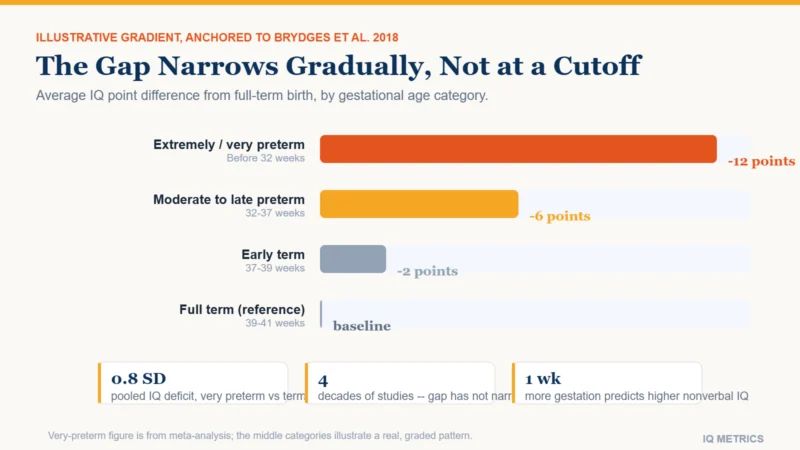 Research & Evidence
Premature Birth and IQ
Children born very preterm score, on average, about 0.8 of a standard deviation lower on IQ tests than children carried to term. Here is what a 2018 meta-analysis and the studies since actually found: the gestational-age gradient, what is really driving the gap, and what it does not tell you about one specific child.
 Scores & Scales
What an IQ of 70 Means
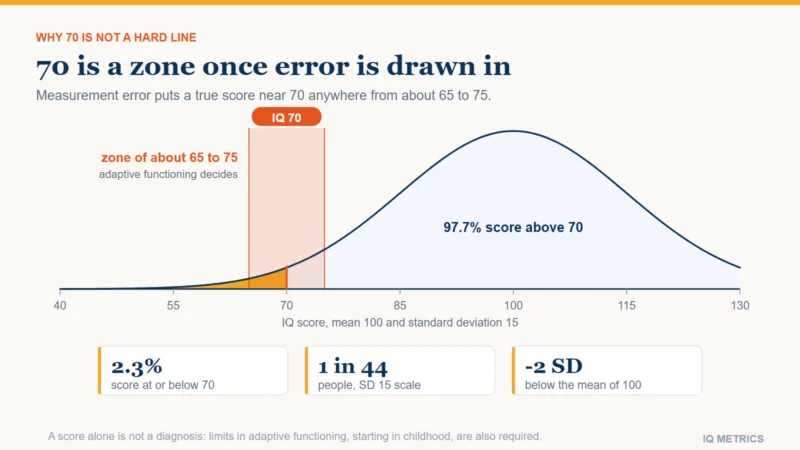
An IQ of 70 sits two standard deviations below the mean, at about the 2nd percentile. It is the score most often linked with intellectual disability, but a diagnosis never rests on the number alone: measurement error turns the line into a zone, and adaptive functioning decides who is inside it.
 Understanding IQ
Dyscalculia and IQ
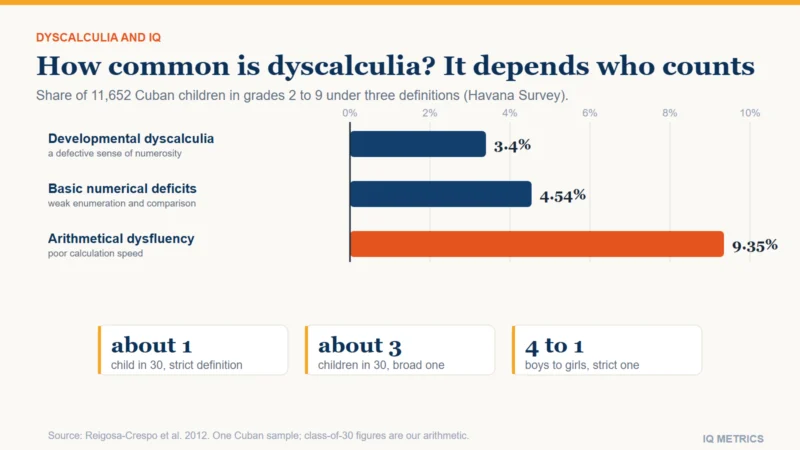
Can you have dyscalculia and a high IQ? Yes: it is a specific difficulty with numbers, not a low-IQ condition. Estimates of how common it is run from 3.4% to over 9% depending on the definition. Here is what the studies say, how it is assessed and how it differs from maths anxiety.