





Epilepsy and IQ: Does Epilepsy Lower Intelligence? What the Studies Show
Does epilepsy lower IQ? Not in most children: in a 613-child cohort, 73.6% had normal cognition and about 1 in 4 did not. Early onset, a known cause and continuing treatment predicted lower scores, and valproate in pregnancy went with an age-6 IQ of 97. Here is what the studies show.

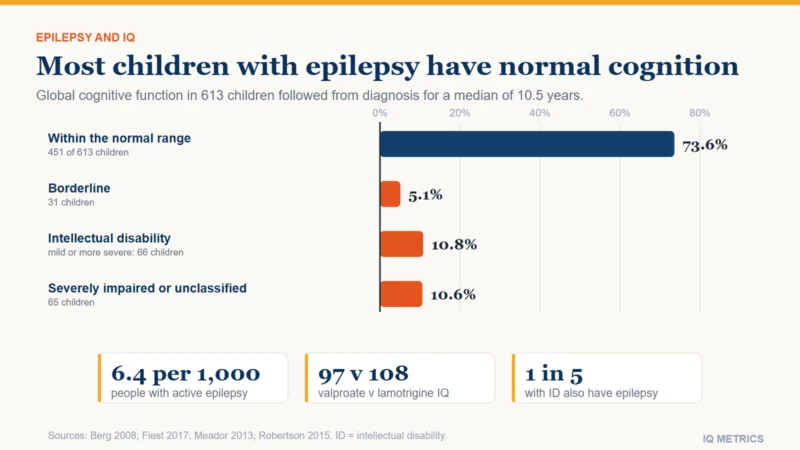
Epilepsy and IQ are less tightly tied than many assume: epilepsy does not by itself mean a low IQ. In a community-based study that followed 613 children from the time epilepsy was diagnosed, 73.6% had global cognitive function in the normal range, and about 1 in 4 had subnormal function. Onset before age 5, a known underlying cause, an epileptic encephalopathy and continuing medication were each strongly linked to lower scores. Seizure medicines matter too: children whose mothers took valproate in pregnancy had a mean IQ of 97 at age 6, against 105 to 108 after other drugs. This guide covers how common epilepsy is, what the childhood and adult studies show, what predicts lower scores, and how to read an IQ test when seizures or medicines are part of the picture. It is general information, not medical advice.
- Common: 6.38 per 1,000 people have active epilepsy, pooled across 222 studies.
- Children: 73.6% normal, 5.1% borderline, 10.8% intellectual disability and 10.6% severely impaired or unclassified in a community-based cohort.
- Predictors: onset under 5 years, a symptomatic cause, epileptic encephalopathy and current treatment were each strongly associated with lower cognitive function.
- The other direction: 22.2% of people with intellectual disability have epilepsy.
- Medicines in pregnancy: age-6 IQ was 97 after valproate, 105 after carbamazepine and 108 after lamotrigine or phenytoin.
- Adults: in chronic temporal lobe epilepsy, 20% to 25% showed adverse cognitive change over four years, mainly in memory.
Epilepsy is common alongside other conditions we have covered: about 1 in 4 children with cerebral palsy had it in a systematic review (cerebral palsy and IQ), and it is more frequent in people with Down syndrome. For a very different brain-based condition where the timing of onset also shapes the thinking changes, see schizophrenia and IQ. After a head injury, see can a concussion lower your IQ.
What is epilepsy, and how common is it?
Epilepsy is a condition in which the brain has a lasting tendency to produce unprovoked seizures. It is not one disease: the cause, the type of seizure and the age at which it starts all differ, which is why no single IQ describes people with it. Fiest and colleagues pooled 222 population-based studies and found a point prevalence of active epilepsy of 6.38 per 1,000 people (95% CI 5.57 to 7.30), a lifetime prevalence of 7.60 per 1,000 and an incidence rate of 61.44 per 100,000 person-years. Prevalence and incidence were higher in low- and middle-income countries, and prevalence did not differ by age group, sex or study quality. Epilepsies of unknown cause and those with generalized seizures had the highest prevalence.
Does epilepsy lower IQ? What a community-based study found
Berg and colleagues followed children from the moment epilepsy was diagnosed, in a community-based sample rather than a specialist clinic, which tends to see more severe cases. Over a median of 10.5 years they classified cognitive function from neurologists’ and school records, repeated parent interviews and, for over half the children, standardized neuropsychological testing.
| Level | Children | Share |
|---|---|---|
| Within the normal range | 451 | 73.6% |
| Borderline | 31 | 5.1% |
| Mild intellectual disability | 21 | 3.4% |
| More severe intellectual disability | 45 | 7.3% |
| Neurologically devastated | 29 | 4.7% |
| Impaired, not further classified | 36 | 5.9% |
The paper uses the older term mental retardation for the two disability categories, and the six groups add up to 613 children. The authors summarize the result as subnormal global cognitive function in approximately one of four children; for their statistical models, subnormal meant a full-scale IQ below 80. Note what the table also says: nearly three quarters had cognition in the normal range, and the abnormal group is itself varied.
What predicts lower scores in childhood epilepsy?
Five features were each strongly associated with level of cognitive function (all p < 0.0001): age at onset under 5 years, a symptomatic cause (a known underlying brain problem), epileptic encephalopathy (a syndrome in which the epileptic activity itself is thought to contribute to cognitive and behavioral problems), remission status and current anti-seizure medication. In the multivariable model all but remission status contributed independently.
Be careful with the last one. The authors point out that these factors are strongly intercorrelated. Children who are still taking medicine are, on average, children whose epilepsy has not settled, and the study cannot say that the medicine lowers their scores (our reading).
Intellectual disability and epilepsy: the other direction
The link also runs from the other side. A systematic review by Robertson and colleagues pooled 38 studies in general samples of people with intellectual disabilities and found epilepsy in 22.2% (95% CI 19.6% to 25.1%), with prevalence rising with the level of intellectual disability. For people with Down syndrome the pooled figure from 13 studies was 12.4%, and it increased with age. Both conditions can come from the same underlying brain problem, which is one reason the symptomatic-cause group above scored lower (our reading). A person with epilepsy and a person with an intellectual disability are different groups with an overlap.
Where would your own score land?
Take the IIF-certified assessment and get your score with the scale it was measured on, the percentile it corresponds to and the confidence range around it — the three figures most online tests leave out.
Find your IQ score now! →Seizure medicines and thinking
Eddy, Rickards and Cavanna’s 2011 review concluded that anti-seizure drugs can affect cognition, with effects that vary with the drug, the dose and the patient; some agents may even help, and the evidence is hard to compare because studies differ in design, groups and tests. The clearest evidence on IQ concerns exposure before birth.
In the NEAD study, Meador and colleagues followed pregnant women with epilepsy taking one drug (carbamazepine, lamotrigine, phenytoin or valproate) at 25 centres in the UK and USA; the primary analysis included 305 mothers and 311 children. Age-6 IQ, adjusted for maternal IQ, drug, dose, gestational age and folate use, was lower after valproate (mean 97, 95% CI 94 to 101) than after carbamazepine (105, 102 to 108), lamotrigine (108, 105 to 110) or phenytoin (108, 104 to 112). Higher valproate doses went with lower IQ (r = -0.56); the other drugs showed no such dose relationship.
| Drug | Mean IQ (95% CI) |
|---|---|
| Valproate | 97 (94 to 101) |
| Carbamazepine | 105 (102 to 108) |
| Lamotrigine | 108 (105 to 110) |
| Phenytoin | 108 (104 to 112) |
This is a risk to discuss with a doctor before and during pregnancy. It is not a reason to stop any medicine alone, because stopping can bring seizures back, and seizures carry their own risks. The study was observational, with assessors masked to drug exposure, and it describes groups of children, not any one child.
Adults: what happens to thinking in long-standing epilepsy?
Hermann and colleagues followed 46 adults with chronic temporal lobe epilepsy and 65 healthy controls for four years. The patients’ cognitive trajectory differed from the controls’: lack of practice effects, the small gain that comes from taking a test again, was common, and frank adverse change appeared in a subset of 20% to 25%, particularly in memory. Decline went with abnormalities on the baseline MRI, lower baseline intellectual capacity, longer duration of epilepsy and older age. So the headline for adults is the subset: most patients did not show frank decline over the four years.
An earlier study of 53 people with temporal lobe epilepsy and 62 controls found that onset in childhood, before age 14, but not in adulthood, went with smaller total brain tissue and lower intellectual and memory scores, and that longer duration went with worse scores in the childhood-onset group. The authors proposed that early-onset temporal lobe epilepsy reduces cerebral reserve and puts people at risk of progressive decline if it is chronic and unremitting. For the practice-effect idea, see practice effects on cognitive tests.
Taking an IQ test with epilepsy
- A score reflects performance on the day. Fatigue and poor sleep can lower anyone’s result (see sleep loss and test performance). Tell the psychologist about your seizures and medicines.
- The profile matters. Clinical assessment looks at memory, speed and attention as well as the total; memory was the domain that most often changed in the adult study.
- Repeat tests carry practice effects and error. See the margin of error explained.
- An online test is not a clinical tool. It should not guide decisions about schooling or support; a clinical assessment can. See professional IQ tests.
Quick answers
- Does epilepsy lower IQ? Not in most children: 73.6% in a community-based cohort had normal global cognitive function. Early onset, a known cause, an epileptic encephalopathy and continuing treatment predicted lower scores.
- What is the average IQ of someone with epilepsy? There is no single average. The studies describe ranges and subgroups, and the group is very varied.
- Can seizure medicine lower IQ? Effects vary by drug and dose. The clearest finding concerns valproate taken in pregnancy (age-6 IQ 97 against 105 to 108). Do not stop medicine without medical advice.
- Is epilepsy common in intellectual disability? Yes: 22.2% in a pooled review.
- Does temporal lobe epilepsy cause memory decline? In a subset, 20% to 25% over four years in one study; most patients did not decline.
Sources
- Fiest, K.M. et al. (2017): Prevalence and incidence of epilepsy: a systematic review and meta-analysis of international studies, Neurology, 88(3), 296-303.
- Berg, A.T. et al. (2008): Global cognitive function in children with epilepsy: a community-based study, Epilepsia, 49(4), 608-614.
- Robertson, J., Hatton, C., Emerson, E. and Baines, S. (2015): Prevalence of epilepsy among people with intellectual disabilities: a systematic review, Seizure, 29, 46-62.
- Eddy, C.M., Rickards, H.E. and Cavanna, A.E. (2011): The cognitive impact of antiepileptic drugs, Therapeutic Advances in Neurological Disorders, 4(6), 385-407.
- Meador, K.J. et al. (2013): Fetal antiepileptic drug exposure and cognitive outcomes at age 6 years (NEAD study): a prospective observational study, The Lancet Neurology, 12(3), 244-252.
- Hermann, B.P. et al. (2006): Cognitive prognosis in chronic temporal lobe epilepsy, Annals of Neurology, 60(1), 80-87.
- Hermann, B.P., Seidenberg, M. and Bell, B. (2002): The neurodevelopmental impact of childhood onset temporal lobe epilepsy on brain structure and function and the risk of progressive cognitive effects, Progress in Brain Research, 135, 429-438.
Keep reading
All articles →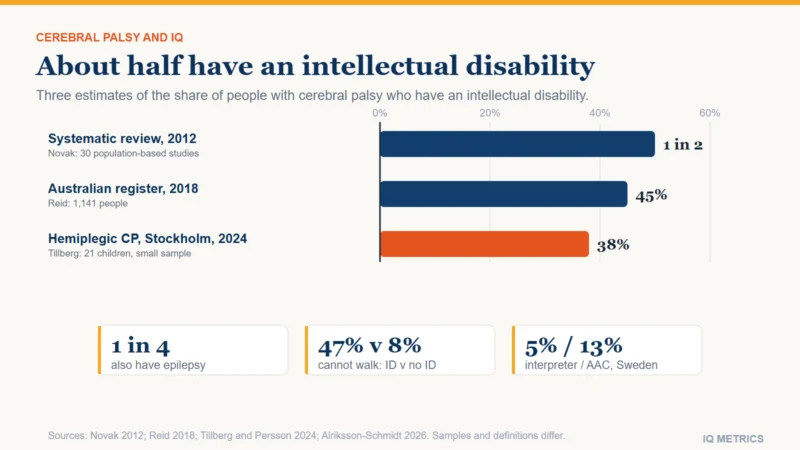 Understanding IQ
Cerebral Palsy and IQ
What is the IQ of someone with cerebral palsy? There is no single level: about 1 in 2 children has an intellectual disability and about half do not. Here is how common it is, what predicts lower scores, why testing is hard, and why the headline figure may overstate it.
 Understanding IQ
Down Syndrome and IQ
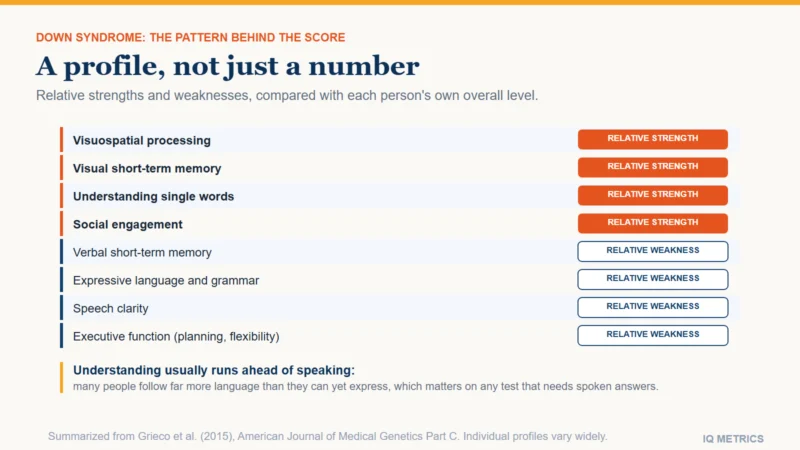
Most people with Down syndrome score in the mild to moderate range of intellectual disability, with an average IQ of around 50 and a typical range of about 30 to 70. The number hides a wide spread, a consistent profile of strengths, and test limits that matter more here than almost anywhere else.
 Research & Evidence
Can a Concussion Lower Your IQ?
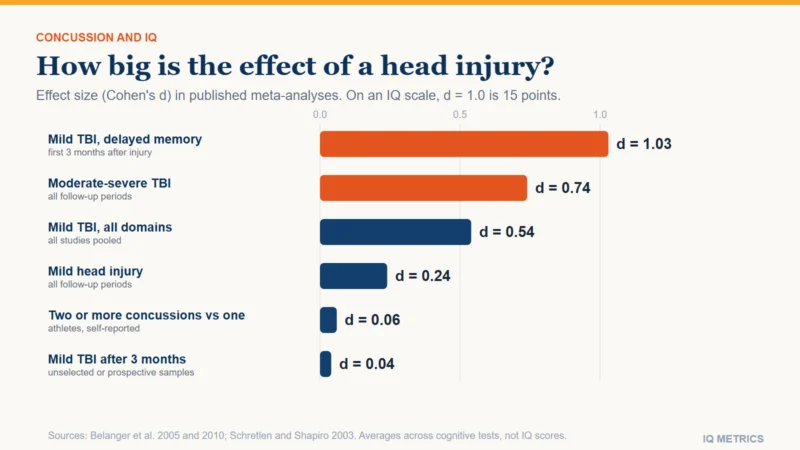
Can a concussion lower your IQ? Meta-analyses of mild and severe head injury show scores dip in the first days, recover within weeks for most people and stay lower after moderate or severe injury. See the effect sizes in IQ points, why clinic samples look worse and why a baseline is rarely available.