





PTSD and IQ: Does PTSD Lower Intelligence, or Does Lower IQ Raise the Risk?
PTSD and IQ: does PTSD lower intelligence? The best evidence says lower ability before a trauma raises the risk, with the top quarter at 48% lower risk in a 2,386-twin study. After PTSD, gaps appear in verbal learning and speed. Here is what the studies show.

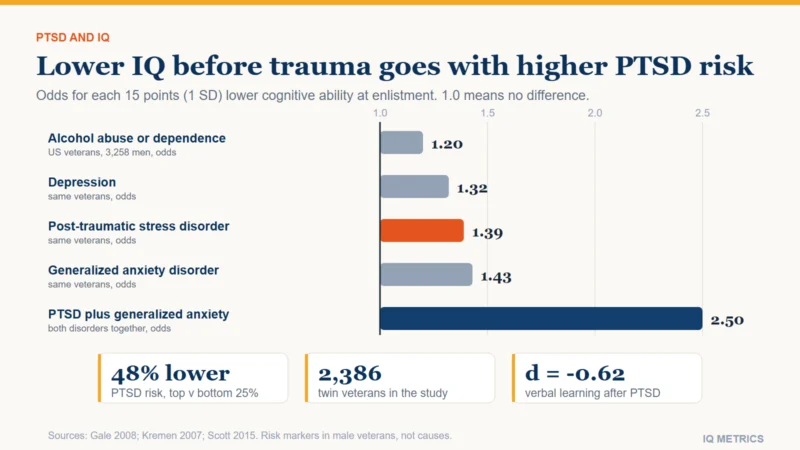
PTSD and IQ are linked, but the best evidence points mostly one way: a lower IQ before a trauma goes with a higher risk of developing PTSD, rather than PTSD mainly lowering IQ. Among 2,386 Vietnam-era twin veterans tested at about age 20, the top quarter on cognitive ability had a 48% lower risk of PTSD than the bottom quarter. After PTSD develops, studies do find weaker verbal learning, processing speed and attention (group gaps of about 0.5 to 0.6 standard deviations), but those are averages from 60 studies, not a number of IQ points lost. This guide sets out what the studies that tested people before and after trauma found, what the twin studies add, what childhood trauma changes, and how to read an IQ score when PTSD is part of the picture. It is general information, not medical advice.
- Before the trauma: in 3,258 US veterans, each 1 standard deviation lower cognitive ability at enlistment went with an odds ratio of 1.39 for PTSD about 18 years later (unadjusted).
- Twins: pairs with no PTSD scored highest, pairs where both twins had PTSD scored lowest, and the link ran through shared genes.
- After the trauma: a meta-analysis of 60 studies (4,108 people) found the largest gaps in verbal learning (d = -0.62), processing speed (-0.59), attention and working memory (-0.50) and verbal memory (-0.46).
- Children: on the WISC-III, children with PTSD scored lower on verbal subtests, while trauma-exposed children without PTSD did not differ from unexposed children.
- Childhood violence: in two birth cohorts (2,232 and 1,037 people), the lower scores of victimized children were largely explained by deficits that predated the victimization.
PTSD rarely appears alone in this research. The same enlistment data link lower scores to anxiety and depression, and after a head injury the question changes shape again (can a concussion lower your IQ). For the long-term effects of early stress on scores, see toxic stress and IQ, and for a condition where thinking changes begin before diagnosis, see schizophrenia and IQ.
What is the PTSD and IQ question really asking?
Post-traumatic stress disorder is a condition that can follow exposure to a traumatic event. People with PTSD, as a group, tend to score lower on thinking tests than people without it. That fact has three possible explanations, and they lead to very different conclusions:
- Trauma or PTSD lowers scores. The illness (or the stress it brings) interferes with attention and memory, so scores fall after the event.
- Lower scores raise the risk. People who start with weaker thinking skills are more likely to develop PTSD after the same event, so the difference was already there.
- A third factor drives both. Shared genes or a difficult childhood could affect scores and PTSD risk independently.
Only a design that measures people before the event can tell these apart, and such data are rare. Military induction testing provides it: recruits sit an aptitude test at about age 18 to 20, years before anyone knows who will see combat. Much of the strongest PTSD and IQ evidence comes from that source, which also means it concerns mostly men, the United States and one war era (our reading of the samples below).
Does a lower IQ raise the risk of PTSD? The studies that tested people first
Macklin and colleagues (1998) obtained military aptitude test results for 59 Vietnam combat veterans with PTSD and 31 without, and then tested their intelligence again. People with lower precombat intelligence were more likely to develop PTSD symptoms, even after adjusting for how much combat they saw. The link between current intelligence and PTSD stopped being significant once precombat intelligence was accounted for. The authors concluded that lower pretrauma intelligence increases risk, rather than PTSD lowering performance on intelligence tests.
Gale and colleagues (2008) followed 3,258 male veterans in the Vietnam Experience Study. Cognitive ability was measured at enlistment (mean age 20.4) and psychiatric disorders by structured interview at mean age 38.3. For each 1 standard deviation (about 15 IQ points on most scales) lower, the unadjusted odds ratio for current PTSD was 1.39 (95% CI 1.18 to 1.67), against 1.43 for generalized anxiety disorder, 1.32 for depression and 1.20 for alcohol abuse or dependence. PTSD together with generalized anxiety disorder had an odds ratio of 2.50 (1.41 to 4.55). If the effect were the same at each step (an assumption), two standard deviations lower would multiply the odds by about 1.9 (1.39 x 1.39, our arithmetic). That is a real but modest shift, and an odds ratio is not a probability.
Parslow and Jorm (2007) took a different route. They tested a random sample of 2,097 young adults on word recall, digit span, coding speed and vocabulary in 1999–2000, then retested them in 2003–2004 after a major fire in their region. Among the 1,599 who were exposed, higher reexperiencing and arousal symptoms were more consistently linked to poorer pretrauma scores on all five measures than to later change.
| Study | Who | Main finding |
|---|---|---|
| Macklin et al., 1998 | 59 PTSD and 31 non-PTSD combat veterans | Lower precombat intelligence predicted PTSD symptoms after adjusting for combat exposure |
| Kremen et al., 2007 | 2,386 male Vietnam-era twin veterans | Top ability quartile had 48% lower PTSD risk than the bottom quartile |
| Gale et al., 2008 | 3,258 male veterans, tested at mean age 20.4 and interviewed at 38.3 | Odds ratio 1.39 for PTSD per 1 SD lower ability (unadjusted) |
| Parslow and Jorm, 2007 | 1,599 young adults exposed to a major fire | Poorer pretrauma scores on all five measures went with more PTSD symptoms |
What the twin studies add
Twins let researchers separate genes from the event itself. Kremen and colleagues (2007) studied the 2,386 twin veterans using their Armed Forces Qualification Test percentile before induction. There was a dose-response pattern: the higher the pre-exposure ability, the lower the PTSD risk. Pairs in which neither twin had PTSD had the highest scores, pairs in which both had it had the lowest, and discordant pairs fell in between. In the authors’ analysis, genetic influences on pre-exposure cognitive ability explained 5% of the variation in PTSD, and all of that relationship was explained by common genes.
Gilbertson and colleagues (2006) went further with identical twin pairs in which only one brother was exposed to combat. When the exposed brother developed PTSD, his unexposed twin largely performed the same on the cognitive tests, and both did worse than non-PTSD veterans and their brothers. A twin who never saw combat cannot have been affected by combat, so the lower performance looks like a pre-existing characteristic rather than a result of the trauma (the authors’ interpretation: such functions may be premorbid risk or protective factors).
Does PTSD itself change thinking test results?
Probably a little, in specific domains, which is a different claim from lowering IQ. Scott and colleagues (2015) pooled 60 studies with 4,108 participants: 1,779 with PTSD, 1,446 trauma-exposed comparison participants and 895 healthy comparison participants with no trauma exposure. The effects ranged widely. The largest were in verbal learning (d = -0.62), speed of information processing (-0.59), attention and working memory (-0.50) and verbal memory (-0.46). Gaps were larger in treatment-seeking than community samples, and they were affected by IQ differences between the groups being compared. For scale: a gap of -0.6 standard deviations would be about 9 points if it were expressed on an IQ-style scale with a standard deviation of 15 (our arithmetic), but these are single-skill tests, so that is a yardstick for size, not a measured loss of IQ.
The same pattern shows up in smaller studies. In Parslow and Jorm’s fire sample, higher reexperiencing and arousal symptoms went with less improvement in word recall at the second interview. The authors suggest that PTSD symptoms may cause a relative decline in some measures of verbal memory, but call the vulnerability finding the more robust one. Saigh and colleagues (2006) compared WISC-III scores in traumatized youth with PTSD, trauma-exposed youth without PTSD and nonexposed controls, none of whom had other major childhood psychiatric disorders. The PTSD group scored lower on verbal subtests but not on performance subtests, and the trauma-exposed group without PTSD did not differ from controls. Trauma exposure alone was not what went with lower verbal IQ; PTSD was. A single comparison like that cannot show which came first (our reading), which is why the before-and-after designs above carry more weight.
Speed, attention and working memory are among the skills a timed test samples, so a person with active symptoms may score lower on a given day than their usual level (our reading, not a finding of these studies). See our guides on processing speed and IQ and executive function versus IQ for how those skills relate to the score.
Where would your own score land?
Take the IIF-certified assessment and get your score with the scale it was measured on, the percentile it corresponds to and the confidence range around it — the three figures most online tests leave out.
Find your IQ score now! →Childhood trauma and IQ: a separate question
Danese and colleagues (2017) used two population cohorts: the E-Risk Study (2,232 children followed to age 18) and the Dunedin Study (1,037 people followed to age 38). Children exposed to violence had pervasive impairments in general intelligence, executive function, processing speed, memory, perceptual reasoning and verbal comprehension. However, those deficits were largely explained by cognitive deficits that predated the victimization and by confounding genetic and environmental risks; the design included comparisons of twins discordant for victimization. The authors call the association largely noncausal and suggest that cognitive deficits are individual risk factors for victimization as well as complicating features during treatment. “Largely” is not “entirely”, and the study does not say that severe, prolonged adversity never affects a child.
Our news desk covered the brain-scan side in a PNAS study on adversity and cognition, where the links were small and one did not replicate. Koenen and colleagues (2009) add that in Dunedin, lower childhood IQ predicted adult depression and anxiety, which fits the wider pattern of lower scores marking vulnerability to several conditions.
What these findings do not mean
- They do not mean PTSD reflects low intelligence. The effect is a shift in average risk, and people across the whole range of scores develop PTSD.
- They do not mean a score can predict PTSD in one person. An odds ratio of 1.39 per standard deviation is a population statistic, and an IQ score is not a screening tool for PTSD (our reading).
- They do not apply to everyone. The core samples are male veterans or a regional fire sample; whether the pattern is the same for other traumas and groups is less certain (our reading).
- They do not show what recovery does to scores. The studies described here do not tell us whether treatment or symptom relief changes test results.
Taking an IQ test when you have PTSD
Treat any single score as a snapshot. Every full-scale IQ score carries a margin of error (see IQ score margin of error), and attention, speed and memory are the areas where the research shows the biggest PTSD-related differences. If a score will be used for school, work or a legal or disability decision, a psychologist can assess it in context; our guide to reading an IQ test report explains what the pieces mean, and professional IQ tests covers what clinicians use. An online test such as the IQ Metrics test is not a clinical assessment. Use the IQ percentile calculator to see where a number sits on the bell curve. If trauma symptoms are affecting your life, a doctor or mental health professional can help.
Related health-and-IQ research from the same cohorts is covered in do smart people live longer.
Quick answers
- Does PTSD lower IQ? The strongest evidence says pre-existing lower ability raises PTSD risk. After PTSD develops, group gaps appear in verbal learning, speed and attention, but they are not a measured loss of IQ.
- Does a low IQ cause PTSD? It is a risk factor, not a cause: top-quartile ability had 48% lower risk than the bottom quartile in one twin study.
- Are smart people less likely to get PTSD? On average, somewhat (odds ratio 1.39 per standard deviation lower), but people at every level develop it.
- Does childhood trauma lower IQ? Victimized children score lower, but in two cohorts much of the gap predated the victimization.
- Is there a typical IQ for people with PTSD? No; the studies report group differences, not a typical score.
Sources
- Macklin, M.L. et al. (1998): Lower precombat intelligence is a risk factor for posttraumatic stress disorder, Journal of Consulting and Clinical Psychology, 66(2), 323-326.
- Kremen, W.S. et al. (2007): Pretrauma cognitive ability and risk for posttraumatic stress disorder: a twin study, Archives of General Psychiatry, 64(3), 361-368.
- Gale, C.R. et al. (2008): Cognitive ability in early adulthood and risk of 5 specific psychiatric disorders in middle age: the Vietnam Experience Study, Archives of General Psychiatry, 65(12), 1410-1418.
- Gilbertson, M.W. et al. (2006): Neurocognitive function in monozygotic twins discordant for combat exposure: relationship to posttraumatic stress disorder, Journal of Abnormal Psychology, 115(3), 484-495.
- Parslow, R.A. and Jorm, A.F. (2007): Pretrauma and posttrauma neurocognitive functioning and PTSD symptoms in a community sample of young adults, American Journal of Psychiatry, 164(3), 509-515.
- Scott, J.C. et al. (2015): A quantitative meta-analysis of neurocognitive functioning in posttraumatic stress disorder, Psychological Bulletin, 141(1), 105-140.
- Saigh, P.A. et al. (2006): The intellectual performance of traumatized children and adolescents with or without posttraumatic stress disorder, Journal of Abnormal Psychology, 115(2), 332-340.
- Danese, A. et al. (2017): The origins of cognitive deficits in victimized children: implications for neuroscientists and clinicians, American Journal of Psychiatry, 174(4), 349-361.
- Koenen, K.C. et al. (2009): Childhood IQ and adult mental disorders: a test of the cognitive reserve hypothesis, American Journal of Psychiatry, 166(1), 50-57.
Keep reading
All articles →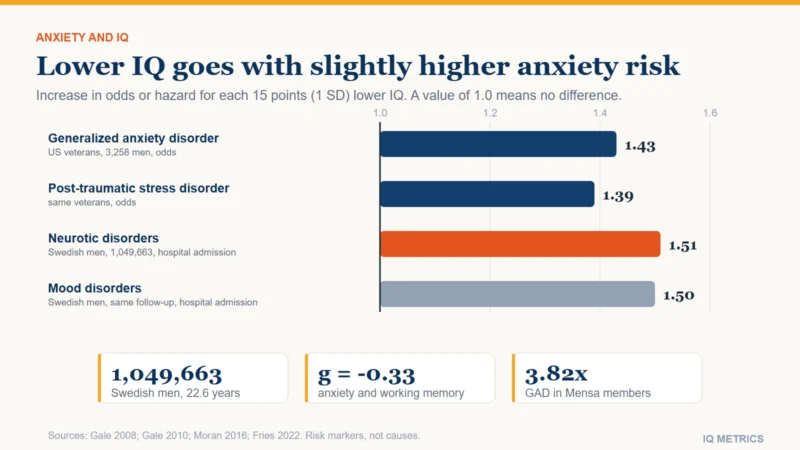 Mind & Everyday Life
Anxiety and IQ
Does anxiety lower IQ, or do smart people worry more? Large cohorts link a lower IQ to more anxiety disorders, Mensa surveys report the reverse, and anxiety weakens working memory on test day. Here is what each study measured and where selection bias may explain the gap.
 Research & Evidence
Toxic Stress and IQ
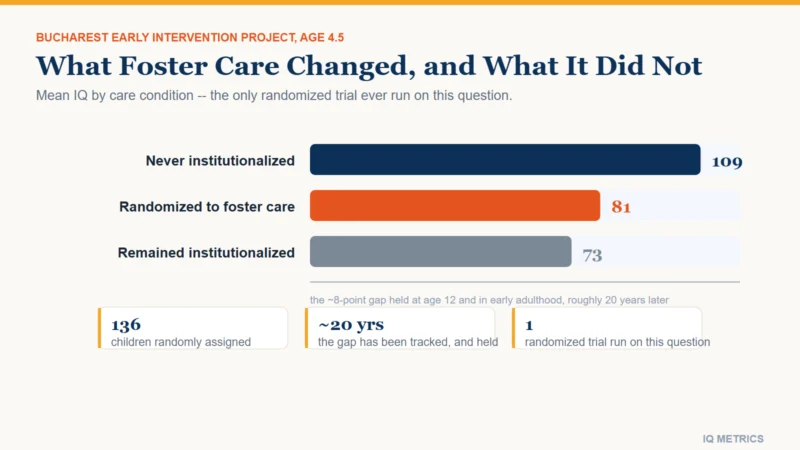
Researchers in Romania did something that can never be done again for ethical reasons: they randomly assigned some institutionalized children to foster care and left others in the institution, then followed both groups for twenty years. The IQ gap that opened up has held at every check-in since. What has not held up as cleanly is the famous claim about exactly when the window closes.
 Understanding IQ
Do Smart People Live Longer?
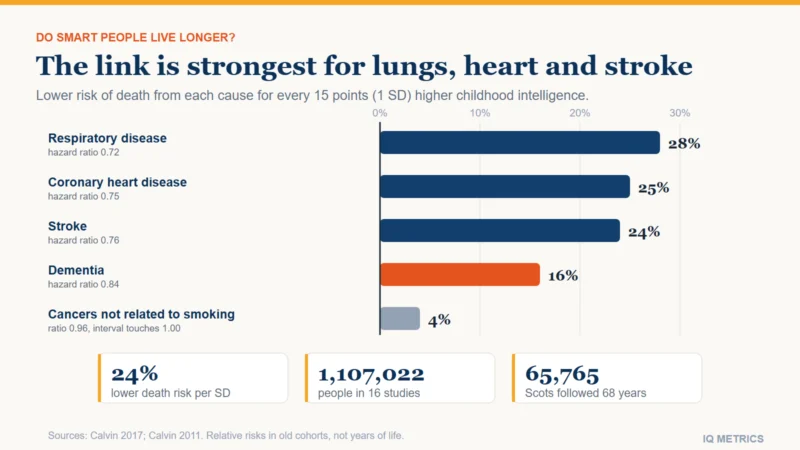
Do smart people live longer? On average, modestly: 16 studies of 1,107,022 people found a 24% lower risk of death per standard deviation of early-life intelligence. In 65,765 Scots the link was strongest for respiratory disease, heart disease and stroke. Here are the numbers.