





Music Lessons and IQ: Does Learning an Instrument Raise IQ?
Do music lessons raise IQ? One 2004 trial of 144 children found a 2.7-point edge, but a meta-analysis of 54 studies finds no overall effect once study quality is controlled, and a study of more than 10,500 twins finds the link vanishes within pairs. Here is the evidence.

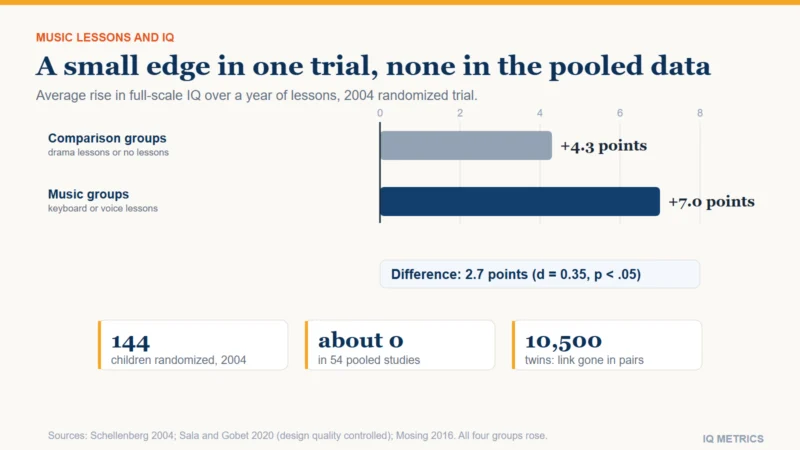
Music lessons and IQ are linked, but the lessons are probably not the main reason. The best-known randomized trial (144 children, 2004) found that a year of keyboard or voice lessons went with an IQ gain of 7.0 points against 4.3 in the comparison groups, a difference of 2.7 points that only just reached statistical significance. A 2020 meta-analysis of 54 studies found the overall effect on children's cognition is about zero once study quality is controlled, and a study of more than 10,500 twins found the link disappeared when a trained twin was compared with an untrained co-twin. So does learning the piano raise IQ? The evidence says a little in one trial, little or nothing in the pooled data, and that the families who choose lessons differ before they start. This guide explains each piece.
- The 2004 trial: 144 six-year-olds, 36 weeks of keyboard, voice or drama lessons, or no lessons; music groups gained 7.0 IQ points on average, comparison groups 4.3 (Schellenberg, 2004).
- Pooled evidence: 54 studies, 254 effect sizes and 6,984 children: no overall effect once design quality is controlled; small effects only without random assignment and with passive controls (Sala and Gobet, 2020).
- Twins: the music-IQ association (r = .10 to .11) vanished within twin pairs, and was mostly shared genetic influence (Mosing and colleagues, 2016).
- Who takes lessons: children's personality, and parents' openness, predicted years of training (Corrigall and Schellenberg, 2015).
- What music may do: a 2018 study found better phoneme processing and vocabulary after music classes, but no gain in non-verbal reasoning.
This is a companion to our guide on music taste and IQ and to the news piece on the Mozart effect, which covers short-term listening. Here the question is long-term lessons. For the personality side of who practises, see introverts and IQ.
What did the famous 2004 trial find?
Glenn Schellenberg's 2004 paper in Psychological Science, titled “Music lessons enhance IQ”, is the study behind most headlines. Parents answered a newspaper advertisement offering weekly arts lessons for 6-year-olds, and 144 children were randomly assigned to one of four groups: standard keyboard lessons, Kodály voice lessons, drama lessons or no lessons (the no-lessons group received keyboard lessons the following year). The lessons ran for 36 weeks at the Royal Conservatory of Music in Toronto. Children took the WISC-III, a standard children's IQ test, before and after, and 132 completed both rounds.
All four groups gained IQ points, and every gain was statistically significant. The author attributes this to the usual rise that follows starting school. The question was whether music added anything. Averaged over the two music groups, the gain was 7.0 points (standard deviation 8.6); over the two comparison groups it was 4.3 (standard deviation 7.3). That 2.7-point difference corresponds to an effect size of d = 0.35, midway between what are usually called small and medium, and was statistically reliable at p < .05 (t = 1.99 with 130 degrees of freedom). It is a narrow pass, since the cut-off for that sample size is about 1.98 (our reading). The drama group, meanwhile, improved in adaptive social behavior, which the music groups did not.
The paper does not say music made children smarter in a lasting, general way, and it was one trial of about 130 children, run once. Our reading of the numbers: a gain of 2.7 points is less than the 95% band around any single child's score (see what an IQ of 115 means for how wide that band is).
What happened when researchers pooled many studies?
The strongest test of a claim is whether it survives when many studies are combined. Sala and Gobet (2020, Memory & Cognition) ran a multilevel meta-analysis of music training and children's cognitive and academic outcomes: 6,984 children, 254 effect sizes from 54 studies. They found that once the quality of study design is controlled, the overall effect is null and highly consistent across studies. Small statistically significant effects, about 0.20 standard deviations, appeared only in studies that did not assign children at random and used non-active controls, meaning comparison children who did nothing instead of a similar activity. Music training was ineffective whatever the outcome, age group or training duration they looked at, and they concluded that optimism about its cognitive benefits is empirically unjustified.
Individual randomized trials with preschoolers tell the same story. Mehr, Schachner, Katz and Spelke (2013, PLoS ONE) ran two trials of a six-week music class against visual arts and against no classes, testing spatial-navigational reasoning, visual form analysis, numerical discrimination and receptive vocabulary. A difference in Experiment 1 did not replicate in Experiment 2, and combined, children who took music classes did no better on any assessment.
| Evidence | Who and how many | Result |
|---|---|---|
| Randomized trial (Schellenberg, 2004) | 144 six-year-olds, 36 weeks of lessons | IQ gain 7.0 vs 4.3 points: +2.7, p < .05, d = 0.35 |
| Pooled studies (Sala and Gobet, 2020) | 54 studies, 254 effect sizes, 6,984 children | About zero once design quality is controlled |
| Preschool trials (Mehr et al., 2013) | Two randomized trials, six-week classes | No consistent benefit on four cognitive measures |
| Twin design (Mosing et al., 2016) | More than 10,500 twins | Association r = .10 to .11 vanished within pairs |
Do twins and personality explain the link?
If lessons do not raise IQ, why do people who play instruments tend to score higher? Mosing, Madison, Pedersen and Ullén (2016, Developmental Science) used a co-twin control design on more than 10,500 twins. The raw association between music practice and IQ was r = .11 in men and .10 in women. But when a highly practised twin was compared with their less-practised co-twin, who shares genes and upbringing, the practised twin did not have the higher IQ. The authors concluded that the link was mostly due to shared genetic influences and that associations between music practice and IQ in the general population are non-causal. Our guide to whether IQ is genetic explains twin designs more fully.
Another route is self-selection. Corrigall and Schellenberg (2015, Frontiers in Psychology) tested 170 children aged 7 to 9. Children's personality traits predicted how long they stayed in music training, even with demographics and intelligence held constant, and parents' openness to experience predicted the child's duration of training too. The authors describe this as passive and active gene-environment correlation: genetic predispositions influence who gets which experiences. Children who take lessons for years are not a random draw, which is a problem for any study that does not randomize.
Where would your own score land?
Take the IIF-certified assessment and get your score with the scale it was measured on, the percentile it corresponds to and the confidence range around it — the three figures most online tests leave out.
Find your IQ score now! →Does music help with anything else?
Not helping IQ is not the same as not helping. Linnavalli, Putkinen, Lipsanen and Huotilainen (2018, Scientific Reports) followed 66 children aged 5 to 6 in kindergartens, testing them four times over two school years. A weekly music playschool improved phoneme processing and vocabulary compared with similar dance lessons or no activity, but not non-verbal reasoning or inhibitory control. That pattern, a gain on closely related language skills and none on general reasoning, is what researchers expect from near transfer rather than a rise in general intelligence. In the 2004 trial the drama group, not the music groups, improved in social behavior. Learning an instrument also has its own rewards, skill, discipline and enjoyment, none of which depend on an IQ effect.
Should you still sign a child up for music lessons?
If the reason is to raise a score, the pooled evidence says do not count on it. If the reason is that the child enjoys music, wants to play, or you value the skill, nothing in this research argues against it. Practical points from the evidence: pick an activity the child will keep up (duration is what personality predicts); expect skills close to the activity, such as listening and language, before expecting anything general; and keep in mind that school itself is a strong influence on scores, which we cover in does school raise IQ and preschool and IQ. Other popular “brain boosters” show a similar pattern of small effects in pooled data: chess and IQ, video games and IQ and exercise and IQ, while talent versus practice covers how skill itself is built.
Quick answers about music lessons and IQ
- Do music lessons raise IQ? One randomized trial found about 2.7 extra points after a year; pooled studies find no overall effect once design quality is controlled.
- Does playing the piano make you smarter? Pianists and other instrumentalists score higher on average, but twin data suggest shared genes, not lessons, explain most of that.
- Do musicians have higher IQs? In the general population the association is about r = .10 to .11 and it vanished within twin pairs.
- Is the Mozart effect real? That is a different claim, about listening, not lessons; see our news piece.
- Are music lessons worth it? Yes for music and related skills, but not as an IQ intervention.
Sources
- Schellenberg, E.G. (2004): Music lessons enhance IQ, Psychological Science, 15(8), 511-514.
- Sala, G. and Gobet, F. (2020): Cognitive and academic benefits of music training with children: a multilevel meta-analysis, Memory & Cognition, 48(8), 1429-1441.
- Mehr, S.A., Schachner, A., Katz, R.C. and Spelke, E.S. (2013): Two randomized trials provide no consistent evidence for nonmusical cognitive benefits of brief preschool music enrichment, PLoS ONE, 8(12), e82007.
- Mosing, M.A., Madison, G., Pedersen, N.L. and Ullén, F. (2016): Investigating cognitive transfer within the framework of music practice: genetic pleiotropy rather than causality, Developmental Science, 19(3), 504-512.
- Corrigall, K.A. and Schellenberg, E.G. (2015): Predicting who takes music lessons: parent and child characteristics, Frontiers in Psychology, 6, 282.
- Linnavalli, T., Putkinen, V., Lipsanen, J. and Huotilainen, M. (2018): Music playschool enhances children's linguistic skills, Scientific Reports, 8, 8767.
Keep reading
All articles →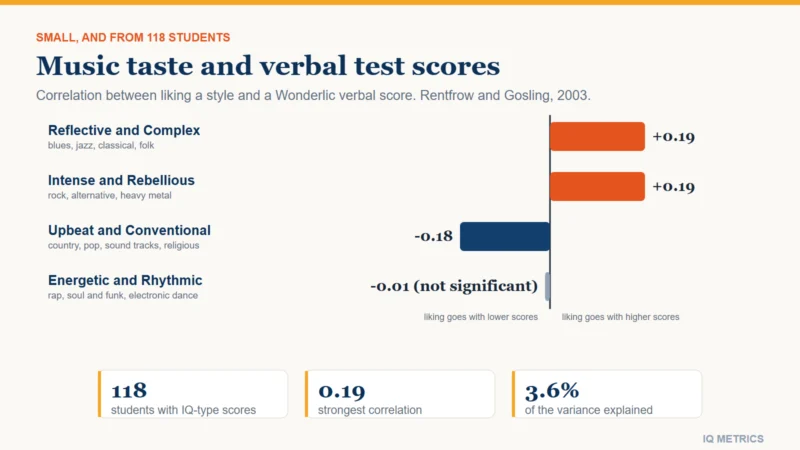 Research & Evidence
Music Taste and IQ
Music taste and IQ are linked only weakly: the best-known study found a correlation of 0.19 with verbal ability, from 118 students. See which genres showed what, what 2026 listening data adds, and why a playlist cannot reveal IQ.
 Research & Evidence
Talent vs Practice
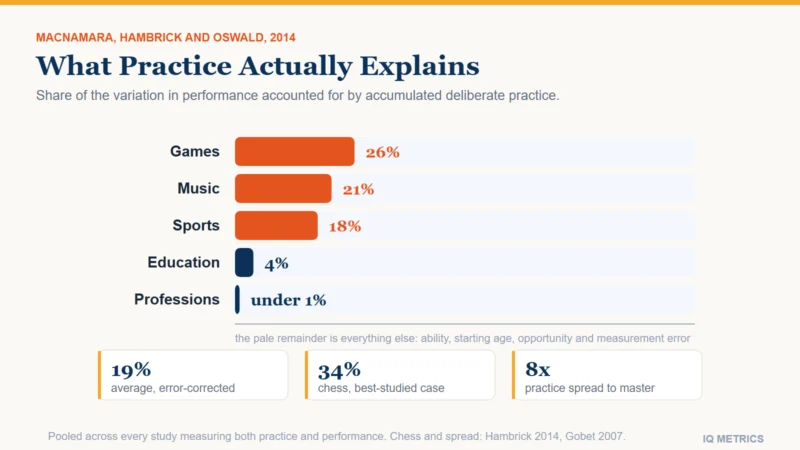
The 10,000-hour rule made a strong claim: expert performance is built by practice, not given by talent. When researchers pooled the studies that had actually measured it, practice explained about a quarter of the difference between people in games and almost none in professional work. Here is what fills the rest of the gap.
 Mind & Everyday Life
Introverts and IQ
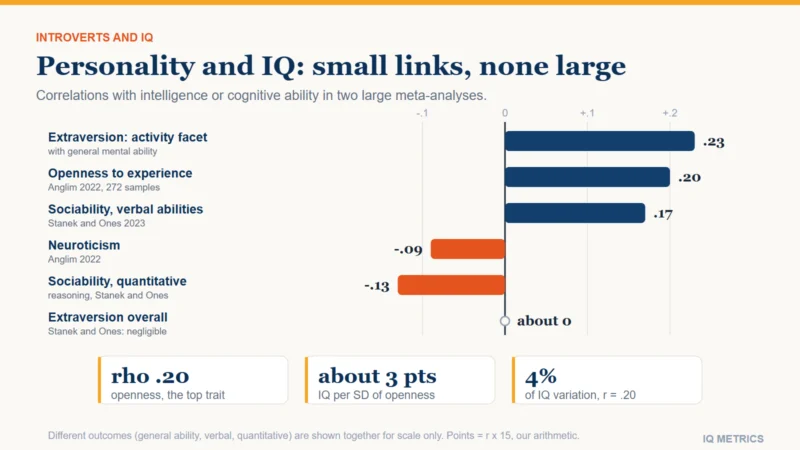
Do introverts have a higher IQ? Not in the data. Two large meta-analyses find openness is the Big Five trait most tied to IQ (rho = .20), while overall extraversion is negligible. Here are the numbers, what they mean in IQ points, and where the introvert charts come from.