





Music Taste and IQ: Does Your Playlist Reveal Intelligence?
Music taste and IQ are linked only weakly: the best-known study found a correlation of 0.19 with verbal ability, from 118 students. See which genres showed what, what 2026 listening data adds, and why a playlist cannot reveal IQ.

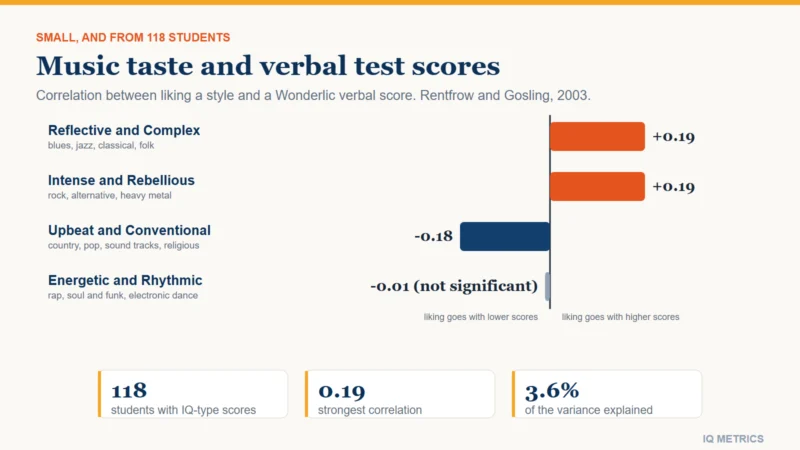
Music taste and IQ are linked, but only weakly. In the best-known study, Peter Rentfrow and Samuel Gosling found that liking reflective and complex music (blues, jazz, classical, folk) and intense and rebellious music (rock, alternative, heavy metal) went with somewhat higher verbal scores (r = 0.19), while liking upbeat and conventional music (country, pop, sound tracks, religious) went with slightly lower ones (r = −0.18). A correlation of 0.19 explains about 4% of the differences between people, and the IQ-type scores came from just 118 university students. A 2026 study that tracked five months of real listening in 185 people found the signal even fainter. Your playlist cannot tell anyone your IQ; this article explains what the research does show, and why.
- The classic result: verbal score correlated +0.19 with reflective and complex and with intense and rebellious music, −0.18 with upbeat and conventional, and about zero (−0.01) with energetic and rhythmic music such as rap, soul and dance.
- The size: r = 0.19 means about 3.6% of the variance; knowing someone’s favourite genre barely moves a guess about their score.
- The newest data: a 2026 study of 185 people’s smartphone listening found small but reliable links to cognitive ability with one machine-learning model only, driven more by lyrics than by sound.
- The confounds: personality, cognitive style, age, education and social identity all shape taste, and music training does not raise IQ once study quality is controlled.
What the best-known study found
Rentfrow and Gosling (2003) analysed the music preferences of over 3,500 people and found four underlying dimensions of taste across 14 genres. In a sixth study they tested how those dimensions related to personality, self-views and cognitive ability, giving a subsample of 118 University of Texas at Austin undergraduates the Wonderlic test — 50 items in 12 minutes — as a measure of verbal and analytic reasoning.
| Dimension | Typical genres | Correlation with verbal score |
|---|---|---|
| Reflective and Complex | Blues, jazz, classical, folk | +0.19 |
| Intense and Rebellious | Rock, alternative, heavy metal | +0.19 |
| Upbeat and Conventional | Country, pop, sound tracks, religious | −0.18 |
| Energetic and Rhythmic | Rap, soul and funk, electronic dance | −0.01 (not significant) |
Scores on analytic reasoning correlated even less — between −0.08 and +0.08, none significant — so the whole pattern is about verbal ability. The authors also report that people who like reflective and complex music rate themselves as more intelligent and score higher on Openness to New Experiences.
What a correlation of 0.19 means in practice
Squaring a correlation gives the share of variance it explains: 0.19 × 0.19 is about 0.036, or 3.6%. The other 96% of the differences in verbal score have nothing to do with which genre someone likes, so jazz fans and pop fans overlap almost completely. Put in IQ terms, each full standard deviation of extra liking for reflective music goes with about 0.19 of a standard deviation more verbal score — under 3 points on a scale where 15 points equal one standard deviation. Add the caveats: undergraduates at one university are a narrow slice of the population, a 12-minute test is a rough measure, and 118 people is a small sample that could easily produce a different number on a rerun. For how far any score from a short test can be trusted, see IQ test accuracy.
The instrumental-music theory
Satoshi Kanazawa and Kaja Perina (2012) proposed a different pattern. Their “Savanna–IQ interaction hypothesis” says more intelligent people are more likely to adopt evolutionarily novel preferences, and because music was originally vocal, purely instrumental music counts as novel. Using American General Social Survey data and the British Cohort Study, they reported that intelligence predicted a preference for instrumental music but not for vocal music, and that this was not simply because instrumental music is more cognitively complex. The hypothesis is one research team’s theory, it rests on survey answers rather than listening records, and the evolutionary argument behind it is contested. It does show how the same weak link can be read in very different ways.
Personality and thinking style do more of the work
Musical taste tracks temperament more reliably than it tracks IQ. A 2015 study in PLOS ONE led by David Greenberg tested a cognitive-style explanation across four samples (2,178, 891, 747 and 320 people) plus a replication of 353. People with an empathising style preferred mellow music (R&B, soul, adult contemporary, soft rock); people with a systemising style preferred intense music (punk, heavy metal, hard rock) and favoured tracks described as high in arousal and cerebral depth. Empathy predicted taste even within a single genre and beyond what personality traits accounted for. None of this is an IQ effect. It suggests that how a person thinks and feels shapes what they play far more than how they score, which fits the weak overlap of IQ and personality described in IQ versus personality.
What 2026 listening data adds
Most earlier studies asked people what they liked. A 2026 study in the Journal of Intelligence used smartphone music-listening records collected over five months from 185 participants. It measured listening habits, such as durations, and preferences based on audio traits (tempo, mode) and lyric traits (positive-emotion words, affiliation words), then tried to predict general cognitive ability. Out-of-sample testing showed modest performance: only the nonlinear random-forest model detected small but reliable associations, and the linear LASSO model did not. Lyrics-based preferences carried the most information, then listening habits, while audio characteristics added little. The authors describe this as initial evidence that cognitive ability may be reflected, subtly, in everyday behaviour. It is not evidence that a streaming app could read your IQ: the associations were modest, and the sample was small.
Where would your own score land?
Take the IIF-certified assessment and get your score with the scale it was measured on, the percentile it corresponds to and the confidence range around it — the three figures most online tests leave out.
Find your IQ score now! →Listening is not the same as playing
Taste is what you like; training is what you do, and the second has its own research history. In a widely cited 2004 experiment, Glenn Schellenberg randomly assigned 144 children to keyboard lessons, voice lessons, drama lessons or no lessons; the music groups gained slightly more IQ, an effect he called relatively small. A 2020 multilevel meta-analysis by Giovanni Sala and Fernand Gobet pooled 54 studies and 6,984 children and found that once study-design quality is controlled the average effect of music training on cognitive skills is essentially zero. Small effects (about 0.20) appeared only in studies without random allocation and with non-active control groups. So neither hearing music nor learning it has been shown to raise IQ, which fits the Mozart-effect reporting, talent versus practice and the debate in multiple intelligences theory over whether musical ability is a separate intelligence.
Why IQ-by-genre charts are unreliable
- Self-report. Taste is usually self-reported, and people may answer in ways that flatter them.
- Narrow samples. The classic study used undergraduates at one university; both taste and test scores vary with age and education.
- Confounding. Education, income, personality and the social scene around a genre can all move taste and scores together.
- Tiny effects. The largest correlation in the classic study is 0.19; fans of different genres overlap almost entirely.
- Unsourced charts. Social-media charts that give each genre an “average IQ” rarely say where the numbers came from; peer-reviewed work reports correlations, not genre IQs.
What to take from the research
If you enjoy complex, reflective music, the research does not say you are smarter; if you love pop or rap, it does not say you are not. What it does support is modest: taste correlates weakly with verbal ability and more strongly with personality, empathy and how you like to think. Openness to Experience is the trait that links taste, creativity and, weakly, intelligence; see IQ and creativity. To find out where a score really sits, take a standardised test and read the percentile, for instance on our IQ test or with the IQ percentile calculator. For profiles of famous musicians and what is documented about their intelligence, see celebrity IQ: musicians.
Quick answers
- Do smart people listen to classical music? On average slightly more than others: liking classical and other reflective, complex music correlates about +0.19 with verbal ability in one study, a small effect with wide overlap between fans and non-fans.
- Does listening to rap or pop lower IQ? No. Energetic and rhythmic music (rap, soul, dance) showed essentially no link (−0.01), and upbeat and conventional music, which includes pop, showed a small negative correlation (−0.18) that reflects who chooses it, not what it does to the brain.
- Can a music app guess my IQ? Not usefully. A 2026 study of 185 people found only small, model-dependent associations.
- Does playing an instrument raise IQ? A 2020 meta-analysis of 54 studies found essentially no effect once study quality is controlled.
The bottom line
Music taste and IQ overlap a little and explain each other very little. The classic correlation of 0.19 comes from 118 students, the newest listening data show only a faint, model-dependent signal, and personality and cognitive style explain more of what people choose to play. Enjoy what you enjoy; it is not a test result.
Sources
- Rentfrow, P.J. and Gosling, S.D. (2003), Journal of Personality and Social Psychology 84(6): the structure and personality correlates of music preferences, including the Wonderlic correlations.
- Kanazawa, S. and Perina, K. (2012), Journal of Behavioral Decision Making 25(3): why more intelligent individuals like classical music.
- Greenberg, D.M. et al. (2015), PLOS ONE 10(7): musical preferences are linked to cognitive styles.
- “Deep Beats, Deep Thoughts? Predicting General Cognitive Ability from Natural Music-Listening Behavior” (2026), Journal of Intelligence 14(2): N = 185, five months of smartphone listening.
- Schellenberg, E.G. (2004), Psychological Science: music lessons enhance IQ.
- Sala, G. and Gobet, F. (2020), Memory & Cognition: cognitive and academic benefits of music training with children, a multilevel meta-analysis.
Keep reading
All articles →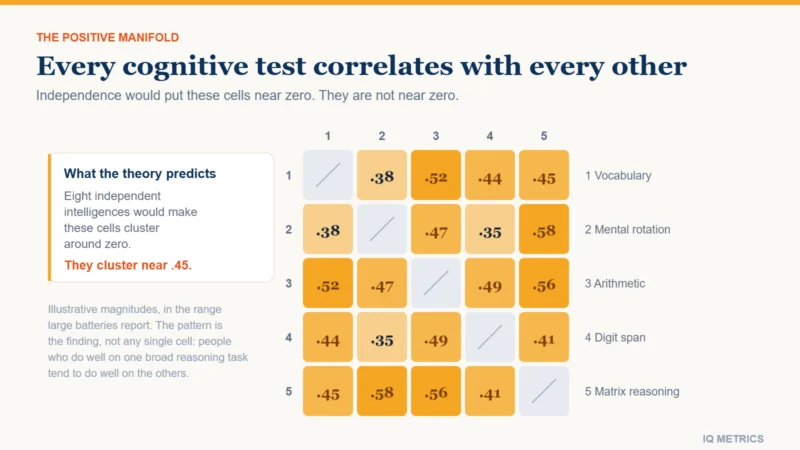 Research & Evidence
Gardner's Multiple Intelligences
Gardner's multiple intelligences theory is one of the most influential ideas in education and almost entirely absent from the tests psychologists use. That gap is not stubbornness. It comes down to one stubborn statistical finding, one missing instrument, and a real insight the theory carries.
 Research & Evidence
Talent vs Practice
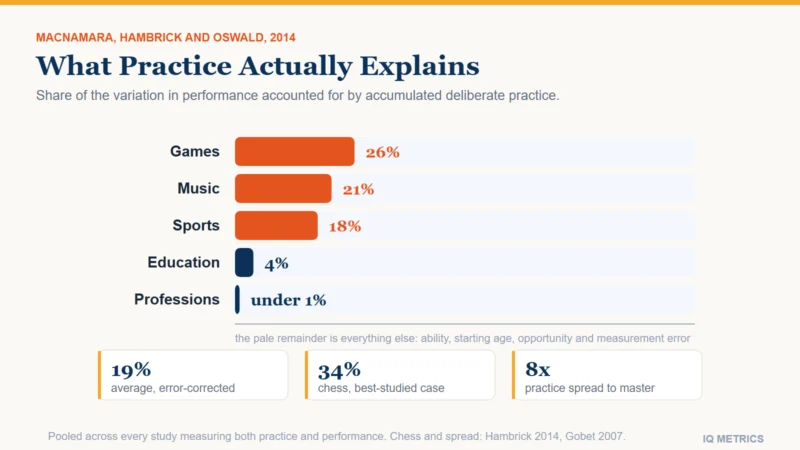
The 10,000-hour rule made a strong claim: expert performance is built by practice, not given by talent. When researchers pooled the studies that had actually measured it, practice explained about a quarter of the difference between people in games and almost none in professional work. Here is what fills the rest of the gap.
 Research & Evidence
IQ and Creativity
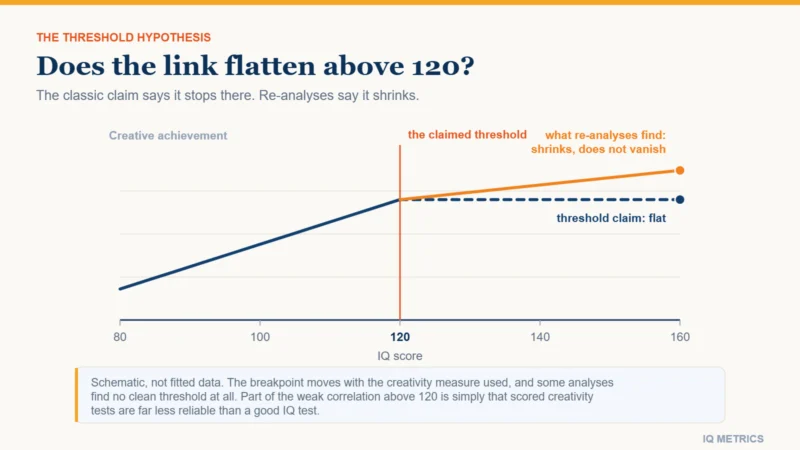
The threshold hypothesis says IQ and creativity move together up to about 120 and barely at all above it. It is a real claim with a real number, and modern re-analyses have weakened it. Here is what the segmented-regression work found, why the two kinds of task differ, and why measurement noise matters.