





What Does an IQ of 75 Mean? Is It Borderline, Low or a Disability?
An IQ of 75 is the 5th percentile: about 1 person in 21 scores it or lower. It sits at the top edge of the 65 to 75 zone around the intellectual-disability reference point and is labelled Borderline or Very Low. See what courts say, its mental age for a child and how accurate one 75 is.

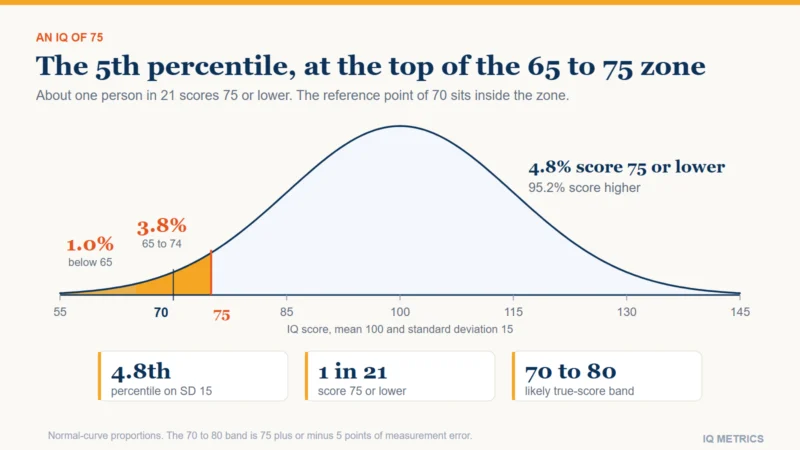
An IQ of 75 is the 5th percentile: about 1 person in 21 scores 75 or lower. It is not an intellectual disability on its own, but it sits at the top edge of the 65 to 75 zone that diagnostic manuals draw around the reference point of 70. Test charts call the 70 to 79 band Borderline (WAIS-IV and Stanford-Binet 5), Very Low (WISC-V) or Low (Woodcock-Johnson), and what happens next depends on everyday skills as much as on the number. This guide covers where 75 falls on the bell curve, whether it counts as a disability, what US courts and benefit rules do with scores from 71 to 75, the mental age a ratio score implies for a child, how accurate one 75 is, and what to do after getting one.
- Percentile: the 4.8th on a standard deviation (SD) 15 scale, 1 in 21. On SD 16 it is the 5.9th (1 in 17) and on Cattell’s SD 24 the 14.9th (1 in 6.7).
- Label: Borderline, Very Low or Low, depending on the test. The old DSM-IV-TR called 71 to 84 borderline intellectual functioning.
- Disability: not by itself. DSM-5-TR needs deficits in intellectual functioning (about 65 to 75), deficits in everyday adaptive functioning and onset in childhood or adolescence.
- Benefits and courts: the Social Security listing counts 71 to 75 only with a verbal or performance score of 70 or below, and the Supreme Court has said a score near 70 to 75 is a range, not a verdict.
Where does an IQ of 75 sit on the bell curve?
On a scale with a mean of 100 and a standard deviation of 15, a score of 75 is 25 points, or 1.67 standard deviations, below the mean. About 4.8% of people score 75 or lower and 95.2% score higher: roughly one or two pupils in a class of 30. The curve is symmetric, so 75 is exactly as far below 100 as 125 is above it and exactly as common (see what an IQ of 125 means). Check the scale before comparing: on the older Stanford-Binet SD 16 scale a 75 is the 5.9th percentile, and on a Cattell SD 24 scale it is the 14.9th. The IQ percentile calculator places any score on the same curve.
| Score band | Share of people | WISC-V label |
|---|---|---|
| Below 70 | 2.3% | Extremely Low |
| 70 to 74 | 2.5% | Very Low |
| 75 to 79 | 4.3% | Very Low |
| 80 to 84 | 6.7% | Low Average |
| 85 to 89 | 9.4% | Low Average |
| 90 to 109 | 49.5% | Average |
Together the 70 to 79 band holds 6.8% of people, and the 70 to 84 stretch holds 13.6%. Our guides to an IQ of 70 and an IQ of 80 cover the scores either side, and an IQ of 85 covers the top of the Low Average band.
Is an IQ of 75 an intellectual disability?
Not by itself. Under the DSM-5-TR a diagnosis of intellectual developmental disorder (intellectual disability) needs three things together: deficits in intellectual functions such as reasoning and learning, confirmed by clinical assessment and individually administered standardised testing; deficits in adaptive functioning, meaning everyday conceptual, social and practical skills; and onset during the developmental period. The intellectual criterion is scores about two standard deviations below the mean, which the manual puts at roughly 65 to 75 once measurement error is allowed for. So 75 is the upper edge of that zone, not the middle of it. Severity (mild, moderate, severe, profound) is graded by adaptive functioning, not by IQ bands, and according to the American Psychiatric Association intellectual disability affects about 1% of the population, about 85% of them in the mild range.
That makes 75 the edge case. Two people can both score 75 and get different conclusions: someone who struggles with communication, money and self-care may meet the criteria, while someone who manages work, bills and relationships independently may not. What an IQ of 70 means sets out the three-part test in full, and low IQ versus learning disability explains why a low score and a specific learning disability are different things.
What do benefit rules and courts do with scores near 75?
Because 70 appears in legal and administrative definitions in the United States, scores from 71 to 75 can carry real consequences, and the rules treat them as ranges rather than verdicts:
- Social Security: the adult listing for intellectual disorder (12.05) includes a full-scale IQ of 70 or below, or 71 to 75 with a verbal or performance score of 70 or below, alongside marked or extreme limits in mental functioning and evidence the disorder began before age 22. Our guide to low IQ and disability benefits goes through it.
- Hall v. Florida (2014): by 5 votes to 4 the Supreme Court struck down a rule that treated any score above 70 as final. The claimant had seven valid scores between 71 and 80, and the Court held that each score must be assessed using its standard error of measurement.
- Moore v. Texas (2017): a score of 74 with a range of 69 to 79 meant the state court had to move on to adaptive functioning.
- Hamm v. Smith: the case involved five valid scores of 75, 74, 72, 78 and 74, a mean of 74.6 and a median of 74. On 21 May 2026 the Court dismissed it without a holding, so how to combine several scores near 70 is still open. The Hamm v. Smith explainer walks through it.
These are legal questions about benefits and the death penalty, not clinical advice. The measurement point carries over: near the cut-off a score is a range, and other evidence decides.
Is an IQ of 75 borderline intellectual functioning?
Often, by the old definition. DSM-IV-TR defined borderline intellectual functioning as an IQ of 71 to 84. DSM-5 dropped the IQ boundaries and lists it only as a condition that may be a focus of clinical attention, not as a disorder, a change a 2016 paper in BJPsych Bulletin called one of the least highlighted in DSM-5 (Wieland and Zitman). On the normal curve about 13.2% of people score 71 to 84 (our arithmetic, counting each score from its lower edge up to the next whole number), roughly 1 person in 8. People in this band usually do not qualify for disability-based support, yet they can find school, complex jobs and paperwork genuinely hard, which is worth recognising even without a diagnosis. Different tests also print different words for the same band:
| Test | Band that contains 75 |
|---|---|
| WAIS-IV (Wechsler, adults) | 70 to 79: Borderline |
| WISC-V (Wechsler, children) | 70 to 79: Very Low |
| Stanford-Binet 5 | 70 to 79: Borderline impaired or delayed |
| Woodcock-Johnson (WJ IV chart) | 70 to 79: Low |
What is the mental age of someone with an IQ of 75?
The question comes from the original IQ formula: mental age divided by chronological age, multiplied by 100. On that ratio scale a 10-year-old who performed like an average child of 7 years 6 months scored 75, and for children it still gives a rough picture of where test performance sits (see IQ and mental age).
| Child's age | Mental age |
|---|---|
| 6 years | 4 years 6 months |
| 8 years | 6 years 0 months |
| 10 years | 7 years 6 months |
| 12 years | 9 years 0 months |
| 14 years | 10 years 6 months |
For adults the idea breaks down, because raw test performance stops climbing in the late teens and dividing by an adult’s age produces nonsense. The figure that circulates online, a mental age of 12 for an adult with an IQ of 75, comes from multiplying 0.75 by an assumed adult ceiling of 16. It describes test items, not a person: an adult who scores 75 still has adult experience, adult interests and often practical skills that no test item measures.
Where would your own score land?
Take the IIF-certified assessment and get your score with the scale it was measured on, the percentile it corresponds to and the confidence range around it — the three figures most online tests leave out.
Find your IQ score now! →How accurate is a single score of 75?
Every score carries measurement error. For full-scale IQ on the major Wechsler tests the standard error is about 3 points, so a 95% interval is roughly 6 points either side of the score, and a reported 75 is best read as a true score somewhere around 70 to 80. Kelley’s formula points the same way: on a test with a reliability of 0.95, an observed 75 has an expected true score of about 76 and a 95% range of roughly 70 to 83. That range crosses the 70 line and the 80 line, which is why the same person can be labelled differently on two sittings. An IQ score is a range, not a number works through the arithmetic, and how to read an IQ test report shows where the interval appears.
Three other things move a score near 75. Old norms tend to inflate results at roughly three points a decade (the Flynn effect, see why IQ norms expire), so an outdated test can put someone above a line that a current edition would put them below. Language, hearing, health and the day itself matter: hearing loss changes test scores before it changes cognition, and ADHD, autism and dyslexia can depress a score without lowering ability. And brief screening tests and group tests can produce invalid scores at this level; an online test cannot diagnose anything.
What does an IQ of 75 mean for school and work?
At school, the federal special-education definition of intellectual disability (IDEA) names no IQ number: it asks for significantly subaverage general intellectual functioning together with deficits in adaptive behaviour, appearing during the developmental period and affecting educational performance. A child with a 75 therefore has no automatic answer either way, and support turns on the school evaluation, not the score alone.
At work, no score closes a particular career by itself; what matters is how the demands of a role match a person’s skills and how much support comes with it. Across the whole population the link between IQ and later life is real but modest: Strenze’s 2007 meta-analysis found correlations of about .56 with education, .43 with occupational status and .20 with income, which describes groups far better than any one person. See average IQ by occupation and IQ tests for job interviews for what the data and the tests actually show.
If you or your child scored 75
- Ask which test, which edition and which scale. The same 75 means different things on SD 15, 16 and 24, and an old edition may be inflated.
- Ask for the confidence interval and the index scores. A full-scale 75 can average a verbal score in the 80s with a much lower processing-speed score; full-scale IQ versus index scores explains why the profile matters more than the total.
- Rule out other causes. Check hearing, vision, language background, sleep and health before treating the number as a finding.
- Ask about adaptive behaviour. It should be measured with a standardised tool and compared with others of the same age and background, not inferred from the IQ.
- Use the result to plan. For a child, skills in this range respond well to explicit teaching and early support; for an adult, the most useful result is a clear map of which tasks need support and which do not. Professional IQ tests describes the instruments psychologists use.
Quick answers
- Is an IQ of 75 low? Yes, it is below average: the 4.8th percentile, labelled Borderline, Very Low or Low depending on the test.
- Is an IQ of 75 a disability? Not by itself. A diagnosis also needs deficits in everyday adaptive skills that began in development, and 75 is the upper edge of the 65 to 75 zone.
- What is the mental age of an IQ of 75? For a child, 75% of their age: 7 years 6 months for a 10-year-old. For adults the idea does not apply.
- How many people have an IQ of 75? About 4.8% score 75 or lower, 1 person in 21; about 0.7% score 75 when scores are rounded to whole numbers.
- Is 75 the same as 70? No, but the two are inside each other’s margin of error, which is why diagnosis looks at daily functioning too.
- Can an IQ of 75 change? A retest moves by several points through error and practice. Real changes in everyday skills come mainly from teaching and support; see can you improve your IQ.
The bottom line
An IQ of 75 is the 5th percentile, about 1 person in 21, in the Borderline or Very Low band and at the top edge of the 65 to 75 zone around the intellectual-disability reference point. By itself it is neither a diagnosis nor a ceiling: what it means depends on the range, the test and the person’s everyday skills. Compare it with an IQ of 70, and for a genetic condition where scores sit far lower on average, see Down syndrome and IQ, or for one where they sit close to average, Klinefelter syndrome and IQ.
Sources
- Hall v. Florida, 572 U.S. 701 (2014), and Moore v. Texas, 581 U.S. 1 (2017): US Supreme Court opinions.
- Wieland, J. and Zitman, F.G. (2016): It is time to bring borderline intellectual functioning back into the main fold of classification systems, BJPsych Bulletin, 40(4), 204-206.
- Strenze, T. (2007): Intelligence and socioeconomic success: a meta-analytic review of longitudinal research, Intelligence, 35(5), 401-426.
- American Psychiatric Association: Diagnostic and Statistical Manual of Mental Disorders, fifth edition, text revision (DSM-5-TR), criteria for intellectual developmental disorder.
- Percentile, band and Kelley figures are computed from the normal distribution. The legal summaries, classification tables and DSM details follow our own guides to an IQ of 70, an IQ of 80 and the Hamm v. Smith decision.
Keep reading
All articles →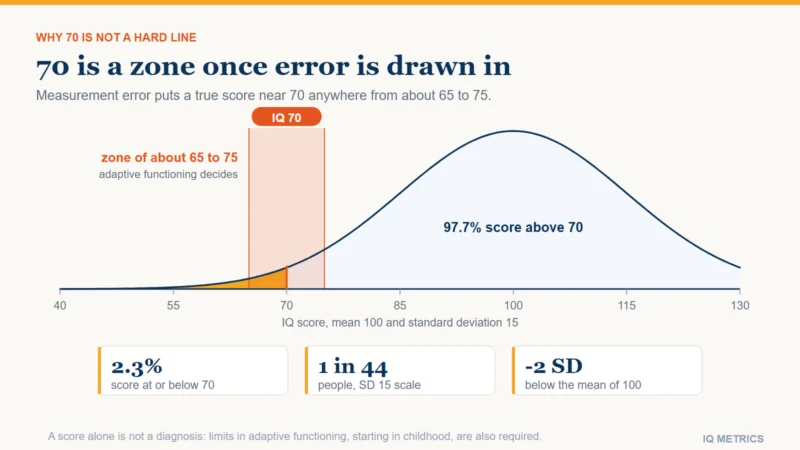 Scores & Scales
What an IQ of 70 Means
An IQ of 70 sits two standard deviations below the mean, at about the 2nd percentile. It is the score most often linked with intellectual disability, but a diagnosis never rests on the number alone: measurement error turns the line into a zone, and adaptive functioning decides who is inside it.
 Scores & Scales
What Does an IQ of 80 Mean?
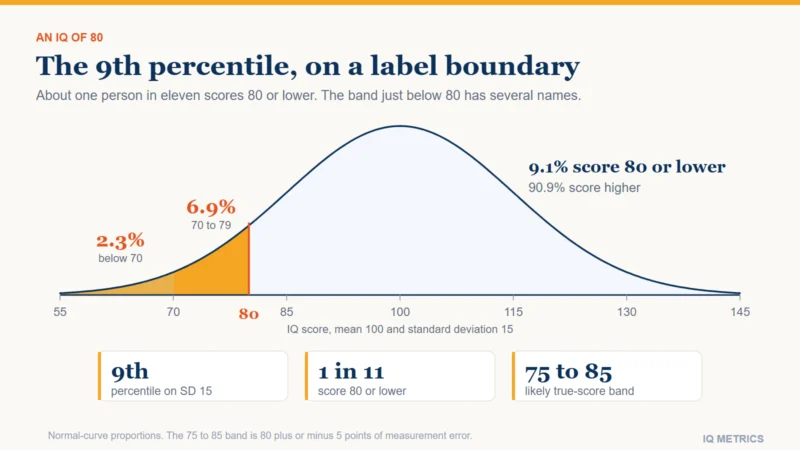
An IQ of 80 is the 9th percentile on the standard scale: about 1 person in 11 scores 80 or lower. Major test charts call it the bottom of the Low Average band, and the band just below it is called borderline on some. See what 80 means, how accurate it is and what it predicts.
 Understanding IQ
Low IQ vs Learning Disability
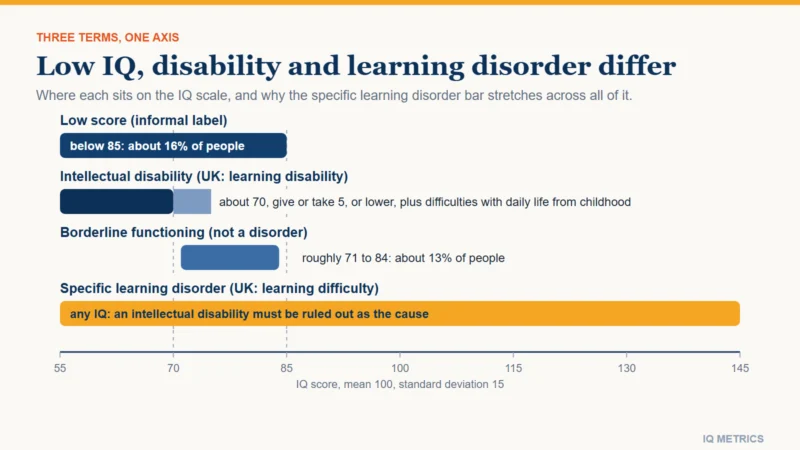
A low IQ, an intellectual disability and a specific learning disability are three different things, and the UK uses "learning disability" for the second. What each requires, how each is assessed, the US and UK terms, and what to do if you are worried.