





Angelman Syndrome and IQ: Developmental Scores, Subtypes and Strengths
Angelman syndrome and IQ: severe intellectual disability that standard IQ tests rarely measure, so researchers use developmental scales. Bayley-III scores average a developmental quotient near 40. See how genetic subtype, seizures and the Prader-Willi link shape development.

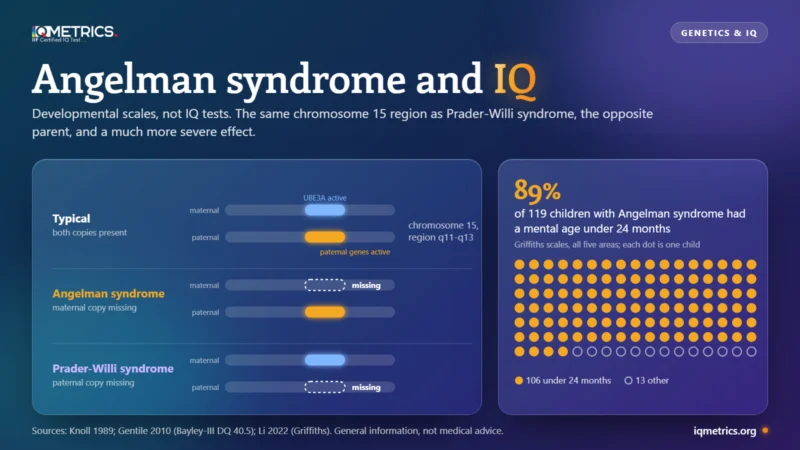
Angelman syndrome and IQ are hard to put together, because the syndrome causes severe intellectual disability and standard IQ tests usually cannot be used, so researchers describe cognition with developmental scales instead. On the Bayley-III, children aged 5 months to 5 years averaged a cognitive developmental quotient of about 40, with a range of roughly 25 to 56 for the middle two-thirds. In a Chinese cohort of 119 children, 89% had mental ages below 24 months. Skills keep growing, slowly, into the teenage years. This guide explains what those numbers mean, how Angelman syndrome compares with its sister disorder Prader-Willi syndrome and IQ, and why genetic subtype and seizures matter more than any single score.
What is Angelman syndrome?
Angelman syndrome is a rare neurogenetic disorder caused by the loss of function of the UBE3A gene on the long arm of chromosome 15 (15q11-q13). In neurons only the copy inherited from the mother is active; the father’s copy is silenced by genomic imprinting. So anything that removes or disables the maternal copy produces the syndrome: a deletion of the region on the maternal chromosome (the most common cause), two copies of chromosome 15 from the father (uniparental disomy), a fault in the imprinting control centre, or a variant within UBE3A itself. A recent consensus statement puts the frequency at about 1 in 12,000 and describes the core picture as developmental delay, cognitive impairment, movement problems, seizures and an abnormal EEG background. A British paediatrician, Harry Angelman, first described children with this pattern in 1965.
Diagnosis is genetic and clinical. A consensus update of the diagnostic criteria lists absent or minimal speech, a movement or balance disorder, a happy and easily excited demeanour and developmental delay as consistent features; an IQ score is not part of it. Anyone with concerns about a child should speak to a paediatrician or clinical geneticist; this page is general information, not medical advice.
How are Angelman syndrome and Prader-Willi syndrome related?
They are the textbook pair of imprinting disorders. In 1989 Knoll and colleagues showed that people with Angelman syndrome and people with Prader-Willi syndrome often carry the same deletion of 15q11-q13, yet look completely different, and that the difference lies in which parent the deleted chromosome came from: maternal in Angelman syndrome, paternal in Prader-Willi. It was an early demonstration that a gene’s effect can depend on its parent of origin.
| Feature | Angelman syndrome | Prader-Willi syndrome |
|---|---|---|
| Chromosome region | 15q11-q13 | 15q11-q13 |
| Which parent’s copy is lost or silent | Maternal copy | Paternal copy |
| Main gene involved | UBE3A (active only from the maternal copy in neurons) | Several paternally expressed genes in the region |
| Typical cognitive level | Severe; developmental scales, not IQ tests | Mild to moderate; IQ near 60 on average |
| Speech | Minimal or absent | Delayed, but usually present |
| Hallmark features | Seizures, ataxia, a happy demeanour, poor sleep | Hunger that cannot be satisfied, low muscle tone, short stature |
| Estimated frequency | About 1 in 12,000 | About 1 in 15,000 to 1 in 27,000 |
| Our IQ guide | This page | Prader-Willi syndrome and IQ |
The IQ contrast is stark. Prader-Willi syndrome is usually in the mild to moderate range of intellectual disability, with average scores near 60 on Wechsler-type tests, as set out in our Prader-Willi syndrome and IQ guide. Angelman syndrome sits well below, to the point where a Wechsler IQ is usually not obtainable.
Why are IQ tests rarely used for Angelman syndrome?
An IQ test needs a child to follow spoken instructions, answer or point on request, sit through a long session and attempt tasks built for typical development. The Wechsler scales print full-scale IQs from 40 upward, while the ICD-10 places severe intellectual disability at 20 to 34 and profound below 20 (our IQ of 65 guide sets out the bands). Children with Angelman syndrome typically have minimal or no speech, limited attention for formal tasks, and motor difficulties that make pointing and manipulating blocks hard, so standard IQ results are either impossible or floor-bound.
Researchers therefore use developmental tests designed for young children, mainly the Bayley Scales of Infant and Toddler Development and the Griffiths Mental Development Scales, together with caregiver-rated adaptive scales such as the Vineland. They report age equivalents (the age at which a typical child passes the same items) and a developmental quotient, roughly a child’s developmental age as a share of real age. These tools have limits of their own. In an international study of 142 children, expressive language scores on the Bayley-III were invalidated by the speech difficulties of Angelman syndrome, and scores were unstable between visits: more than half of the 52 children tested more than once got items wrong that they had passed before, which the authors link to motivation, attention and anxiety as well as true loss of skills.
What do the Bayley and Griffiths scores show?
The best-known profile is the 2010 natural history study by Gentile and colleagues, which assessed 92 children aged 5 months to 5 years. The mean Bayley-III cognitive developmental quotient was 40.5 with a standard deviation of 15.5. Cognitive scores were higher than motor and language scores, and receptive language (understanding) was higher than expressive language (speech). A 2022 study of 119 Chinese children (mean age 42 months) used the Griffiths scales and found a median general quotient of 29.6, with 106 of 119 (89%) functioning below the 24-month level in all five areas. The children had relatively good locomotor and personal-social skills but poor language.
To make a quotient concrete: a developmental quotient of 40 means a child is functioning at about 40% of their real age. The table below applies the 40.5 average, and the range for one standard deviation either side (25 to 56). It is illustrative arithmetic, not a claim about any individual child.
| Real age | Developmental age at DQ 40.5 | Range at one SD (DQ 25 to 56) |
|---|---|---|
| 2 years | 10 months | 6 to 13 months |
| 3 years | 15 months | 9 to 20 months |
| 4 years | 19 months | 12 to 27 months |
| 6 years | 29 months | 18 to 40 months |
| 8 years | 39 months | 24 to 54 months |
A quotient is not an IQ, and the two should not be mixed: a DQ is built from age equivalents and can fall as a child ages even when skills are still being learned, because the real-age denominator can grow faster than the developmental age. A longitudinal analysis of 236 children found that people with Angelman syndrome keep making slow gains at about 1 to 2 months of age equivalent per year through at least age 12. In other words, development does not stop; it is slow.
Does the genetic subtype change the picture?
Yes, more than any other single factor. Children with a deletion are more delayed than those with the other mechanisms in every Bayley domain except expressive language. A 2021 analysis of 250 individuals and 848 assessments ranked the groups: those with a deletion are most affected, then paternal uniparental disomy, then imprinting defects and UBE3A variants, and among the variants, truncating changes are more severe than missense ones. Interestingly, the researchers found little evidence that the size of the deletion (class I or class II) changes severity much, which points to genes other than UBE3A in the region contributing.
| Cause | Share of children | Severity relative to the rest |
|---|---|---|
| Deletion of 15q11-q13 (UBE3A and neighbouring genes) | 74% of children in the Gentile cohort | Most affected |
| Paternal uniparental disomy (UPD) | Part of the other 26% | Less affected than deletion, more than the next two |
| Imprinting defect | Part of the other 26% | Less affected than UPD |
| UBE3A variant, truncating | Part of the other 26% | Less affected than UPD; more than missense |
| UBE3A variant, missense | Part of the other 26% | Milder than truncating variants |
Where would your own score land?
Take the IIF-certified assessment and get your score with the scale it was measured on, the percentile it corresponds to and the confidence range around it — the three figures most online tests leave out.
Find your IQ score now! →What about seizures?
Epilepsy is a core feature: up to 90% of people with Angelman syndrome have seizures, usually in the early years. In the Chinese Griffiths study the group with epilepsy had lower quotients than the group without, on the locomotor, personal-social, speech, language and eye-hand scales. Whether seizures lower development, or whether the severe neurological changes cause both, cannot be decided from these studies; the practical point is that seizure control is a central part of care, and that scores differ by seizure history as well as by genetics.
What are the strengths?
The Gentile study found cognition to be the strongest developmental domain and understanding stronger than speech, which fits the clinical picture of children who take in far more than they can say. Communication through signs, pictures and devices therefore matters, and the developmental scales may understate what a child understands because they rely on a child showing it. The happy, sociable demeanour is a real feature of the syndrome, but an older nickname built on it is now widely regarded as outdated and is not used here.
Why does this matter for treatment trials?
Clinical trials in Angelman syndrome need ways to measure change. A 2025 study of clinicians who give them describes the Bayley-4 and the Vineland-3 as outcome measures often considered as primary endpoints, with barriers such as a child’s lack of interest in the tasks; a 2026 panel of 19 caregivers set out what size of change on those scales is meaningful in daily life. None of this involves an IQ.
How does this compare with other genetic conditions?
Angelman syndrome is at the severe end of the genetic syndromes we cover. For comparison, our guides to Down syndrome, Williams syndrome, fragile X syndrome, Turner syndrome and Klinefelter syndrome show mild to moderate effects on IQ, which can be measured with Wechsler tests, and at the opposite end of the scale see what an IQ of 155 means. If you want to see how an ordinary IQ result is built, take the IQ Metrics IQ test or browse the IQ tests hub, and read the IQ classification bands.
Sources
- Gentile, J.K. et al. (2010): A neurodevelopmental survey of Angelman syndrome with genotype-phenotype correlations, Journal of Developmental & Behavioral Pediatrics.
- Li, S. et al. (2022): Epilepsy and molecular phenotype affect the neurodevelopment of pediatric Angelman syndrome patients in China, Frontiers in Psychiatry.
- Sadhwani, A. et al.: Developmental skills of individuals with Angelman syndrome assessed using the Bayley-III, Journal of Autism and Developmental Disorders.
- Keute, M. et al. (2021): Angelman syndrome genotypes manifest varying degrees of clinical severity and developmental impairment, Molecular Psychiatry.
- Ten Hooven-Radstaake, M. et al. (2025): Criterion validity, scalability and stability of scoring on the Bayley-III in children with Angelman syndrome, Journal of Intellectual Disability Research.
- Duis, J. et al. (2022): A multidisciplinary approach and consensus statement to establish standards of care for Angelman syndrome, Molecular Genetics & Genomic Medicine; Williams, C.A. et al. (2006): Angelman syndrome 2005: updated consensus for diagnostic criteria, American Journal of Medical Genetics; Buiting, K., Williams, C. and Horsthemke, B. (2016): Angelman syndrome: insights into a rare neurogenetic disorder, Nature Reviews Neurology.
- Knoll, J.H. et al. (1989): Angelman and Prader-Willi syndromes share a common chromosome 15 deletion but differ in parental origin of the deletion, American Journal of Medical Genetics.
- Halpin, S.N. et al. (2025): Using the Bayley-4 and Vineland-3 in Angelman syndrome, Orphanet Journal of Rare Diseases; Powers, S. et al. (2026): Developing meaningful score differences for the Bayley-4 and Vineland-3 in Angelman syndrome using a Delphi panel, Value in Health; Ebrat-Mancilla, E. et al. (2024): Epilepsy in Angelman syndrome and the most common electroencephalographic findings, Revista de Neurologia.
Keep reading
All articles →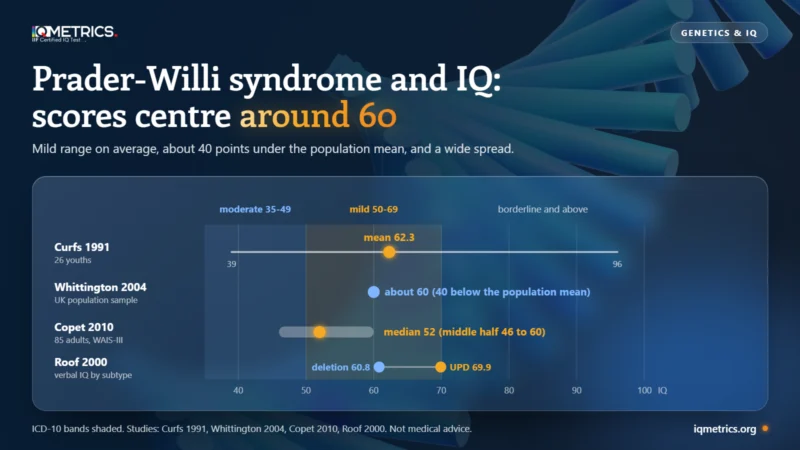 Understanding IQ
Prader-Willi Syndrome and IQ
Prader-Willi syndrome and IQ: average scores sit near 60, about 40 points below the general population, with a range from the 40s to the 90s. See how deletion and maternal UPD differ, the jigsaw-puzzle strength what a growth hormone trial found and how IQ fits into diagnosis.
 Understanding IQ
Down Syndrome and IQ
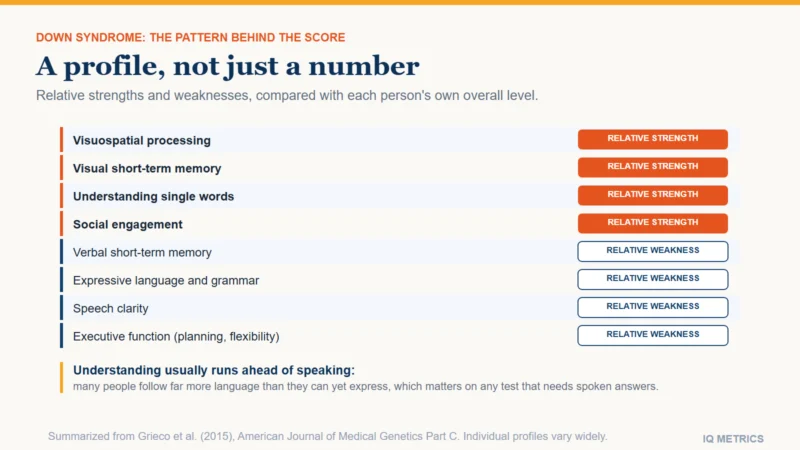
Most people with Down syndrome score in the mild to moderate range of intellectual disability, with an average IQ of around 50 and a typical range of about 30 to 70. The number hides a wide spread, a consistent profile of strengths, and test limits that matter more here than almost anywhere else.
 Understanding IQ
Williams Syndrome and IQ
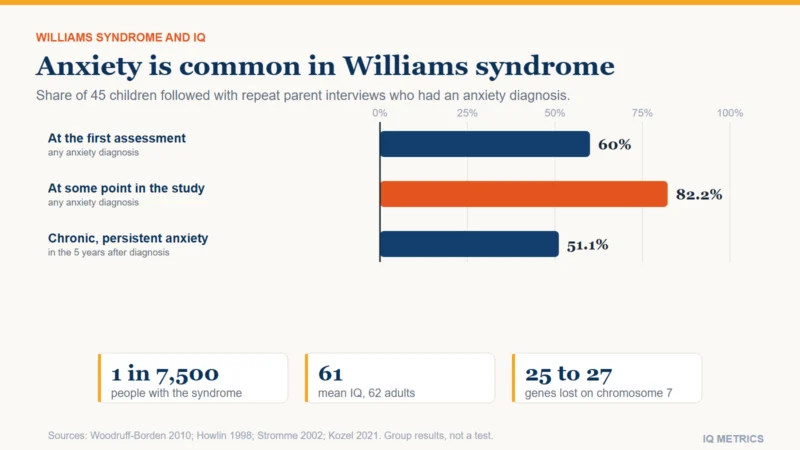
Williams syndrome and IQ: mean full-scale IQ was 61 in 62 adults, and 292 children averaged in the borderline range on the KBIT-2, stable from age 4 to 17. Language is a relative strength and visuospatial construction an extreme weakness. Here is what the studies show.