





Prader-Willi Syndrome and IQ: Average Scores, Subtypes and Strengths
Prader-Willi syndrome and IQ: average scores sit near 60, about 40 points below the general population, with a range from the 40s to the 90s. See how deletion and maternal UPD differ, the jigsaw-puzzle strength what a growth hormone trial found and how IQ fits into diagnosis.

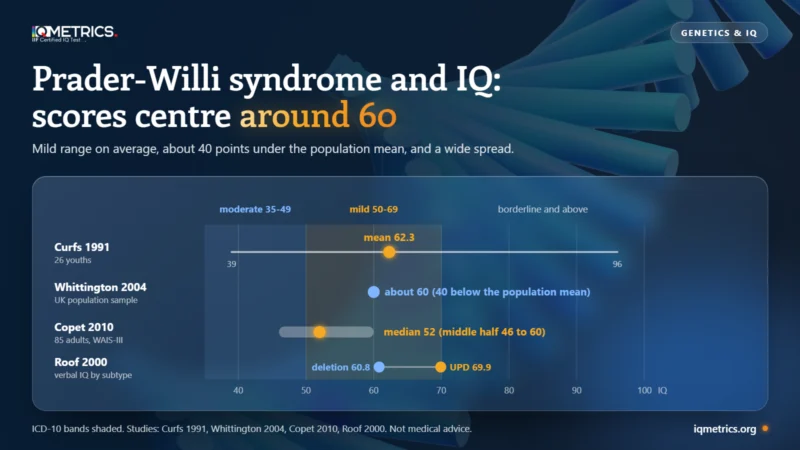
Prader-Willi syndrome and IQ: people with the syndrome typically have a mild intellectual disability, with average scores around 60, roughly 40 points below the general population and individual results ranging from the 40s to the average range. A UK population-based study found an approximately normal distribution shifted about 40 points down, a study of 26 young people found a mean of 62.3 (range 39 to 96), and adults in a French cohort had a median Full Scale IQ of 52 on the WAIS-III. The genetic subtype changes the profile more than the total: people with maternal uniparental disomy (UPD) tend to have higher verbal IQ, and those with a deletion higher performance IQ. This guide covers the genetics, the published IQ figures, the deletion-versus-UPD differences, the visual-spatial strengths (including jigsaw puzzles), what a growth hormone trial found and how IQ fits into diagnosis. It is general information, not medical advice: questions about a particular child or adult belong with their specialist team.
- Average: about 60 in two samples (62.3 in 26 youths; roughly 40 points under the population mean in a UK population sample) and a median of 52 in French adult inpatients.
- Genetics: loss of paternally expressed genes on chromosome 15q11.2-q13: a deletion in 65 to 75% of cases, maternal UPD in 20 to 30% and an imprinting defect in 1 to 3%.
- Subtypes: a meta-analysis of 744 cases found full-scale IQ 2.7 points lower with a deletion, verbal IQ 7.5 lower and performance IQ 4.0 higher than with UPD.
- Strength: visual-spatial tasks. Children with the syndrome placed more than twice as many jigsaw pieces as typically developing children in one study.
What is Prader-Willi syndrome?
Prader-Willi syndrome (PWS) is a rare genetic disorder caused by the lack of expression of genes on the paternally inherited copy of chromosome 15q11.2-q13. There are three molecular routes to it: a deletion of that region on the father’s chromosome (65 to 75% of cases), two copies of the mother’s chromosome 15 with none from the father, called maternal uniparental disomy (20 to 30%), and an imprinting defect (1 to 3%). Newborns are floppy and feed poorly. Later come short stature, an insatiable appetite (hyperphagia), delayed development, cognitive disability and behavioural difficulties, probably because of hypothalamic dysfunction. Population studies put the birth incidence between about 1 in 15,830 (Victoria, Australia, 2003 to 2012) and 1 in 26,676 (Flanders, 1993 to 2001), with 1 in 22,000 in a UK population-based study. The same region on the mother’s chromosome is the one that goes missing in Angelman syndrome, its sister disorder, which is usually too severe for a standard IQ test.
Cognitive disability is one feature among many, alongside hunger, weight and health. That context matters for how IQ is read: the score is one input into a picture that also includes adaptive skills, health and behaviour. Compare the patterns in Down syndrome and IQ, Williams syndrome and IQ, fragile X and IQ, Klinefelter syndrome and IQ and Turner syndrome and IQ.
What is the average IQ in Prader-Willi syndrome?
Four studies give the clearest picture. They used different samples and tests, so the figures are not interchangeable, but they agree on the centre of the distribution.
| Study | Sample | Finding |
|---|---|---|
| Curfs et al. (1991) | 26 youngsters | Mean IQ 62.3, range 39 to 96 |
| Whittington et al. (2004) | People over age 3 found through a UK health region, plus others | IQ roughly normally distributed, mean about 40 points below the general population |
| Copet et al. (2010) | 99 adult inpatients, 85 able to complete the WAIS-III | Median Full Scale IQ 52 (middle half 46 to 60), Verbal 53, Performance 52.5 |
| Roof et al. (2000) | 38 people (24 with a deletion, 14 with UPD) | Verbal IQ 60.8 with a deletion, 69.9 with UPD |
Against the ICD-10 bands, a score near 60 sits in the mild range and a score near 52 sits just inside it, at the border of moderate. A small share of people with PWS score in the borderline or average range: the top of the youth sample was 96. The UK study found the whole distribution shifted, not a separate low group, which is why individuals vary so much around the average.
| Band | IQ range | Adult mental age |
|---|---|---|
| ICD-10 F70 mild | 50 to 69 | Adult mental age 9 to under 12 years |
| ICD-10 F71 moderate | 35 to 49 | Adult mental age 6 to under 9 years |
Two cautions on the figures. The adult median of 52 is lower than the younger samples, and its authors noted that their scores were slightly lower than most other studies, in a cohort of inpatients on a specialist unit. And the published numbers describe people who could take the test: in the French adult cohort 14 of 99 could not cope with the test situation, so they are not in the 52. See what an IQ of 65 means and IQ and mental age for what scores in these bands imply day to day, and low IQ vs learning disability for how the terms differ. Scores at either extreme of the curve are also less precise than scores near 100, because a test has few items at the ends of its range; the ceiling problem at the top is set out in the guide to an IQ of 200.
Does the genetic subtype change IQ?
The two main subtypes, paternal deletion and maternal UPD, are the best-studied split. The totals are close; the profiles differ. A meta-analysis pooling 13 studies (423 people with a deletion and 318 with UPD) found that the deletion group had a full-scale IQ 2.69 points lower (95% interval 0.52 to 4.86), a verbal IQ 7.5 points lower, and a performance IQ 4.02 points higher. Individual studies agree on the direction.
| Source | Sample | Verbal IQ | Performance IQ | Full-scale IQ |
|---|---|---|---|---|
| Roof et al. (2000) | 24 deletion, 14 UPD | UPD higher by 9.1 points (69.9 vs 60.8); 50% of UPD and 17% of deletion cases at 70 or above | No difference | – |
| Copet et al. (2010) | 57 deletion, 27 non-deletion | No significant difference | Deletion higher | No significant difference |
| Yang et al. (2013), meta-analysis | 13 studies, 744 cases | Deletion lower by 7.5 | Deletion higher by 4.0 | Deletion lower by 2.7 |
| Whittington et al. (2004) | Population-based sample | UPD better verbal ability | Some deletion cases strong visuospatial; UPD weaker coding | – |
A gap of about three points in full-scale IQ is smaller than the margin of error of a single score (see the margin-of-error explainer), so the subtype tells you little about the total and more about the shape. A related split is the size of the deletion. In 96 people (49 with UPD and 47 with a deletion), Milner and colleagues found few cognitive differences between the larger type I and smaller type II deletions, though ability tended to be lower with type I. UPD cases showed more autistic-like social difficulty. For how an uneven profile shows up on a test, see verbal vs non-verbal IQ scores.
Strengths and weaknesses: the cognitive profile
The profile is uneven, and the strongest finding is visual-spatial. In the 26-youth study, the highest scores came on performance tasks, with Block Design the best subtest in nine children and Coding or Mazes in five, and the group did better on visual-motor discrimination than on auditory skills. Dykens (2002) tested the old clinical impression that people with PWS are unusually good at jigsaws. Children with PWS scored higher than age- and IQ-matched peers with mixed intellectual disability on standard visual-spatial tasks (Object Assembly, Triangles and a visual-motor integration test), though below typically developing children of average IQ. On jigsaw puzzles they placed more than twice as many pieces as the typically developing group, and scored on par with them on word searches. Puzzle skill was not predicted by IQ, age, gender, obesity or obsessive-compulsive symptoms, but by genetic subtype.
A later study of 26 people with PWS and 26 typically developing children matched for mental age found that the PWS group solved puzzles by piece shape while the comparison children used the picture. The pattern is the reverse of Williams syndrome, where jigsaws are a weakness. The practical point for IQ is that a single Full Scale score hides a spiky profile: a performance strength can sit beside a verbal weakness, and which pattern appears depends on the subtype.
Does growth hormone change IQ in Prader-Willi syndrome?
One randomised trial looked directly. Siemensma and colleagues followed 50 prepubertal children aged 3.5 to 14, first in a two-year randomised trial and then for four years of treatment, testing cognition every two years with short forms of the WPPSI-R or WISC-R. Over the two-year trial, the treated children’s estimated total IQ stayed level while that of untreated controls fell, significantly so on the Similarities and Vocabulary subtests. After four years of treatment, Similarities and Block Design scores were above baseline, total IQ was unchanged from baseline, and children with the larger baseline deficits gained most. The authors concluded that treatment prevented deterioration of some skills and improved abstract reasoning and visuospatial skills. That is a finding about change over time in a trial, not advice: treatment decisions belong to the child’s endocrinologist and family.
Where would your own score land?
Take the IIF-certified assessment and get your score with the scale it was measured on, the percentile it corresponds to and the confidence range around it — the three figures most online tests leave out.
Find your IQ score now! →Does IQ predict behaviour or health in Prader-Willi syndrome?
Less than people expect. In 25 children and 61 adults with PWS, Dykens and Cassidy (1995) found no difference in maladaptive behaviour between higher and lower IQ groups, so the score did not sort people by how they behaved. A diagnosis of intellectual disability needs weaknesses in everyday adaptive skills, not a score alone. That is why two people with the same score can need very different support, and why how to read an IQ test report recommends reading the subscores and not the headline.
How is IQ tested in Prader-Willi syndrome?
- Test choice. Research uses the Wechsler family: the WAIS-III in the French adult cohort and short forms of the WPPSI-R and WISC-R in the growth hormone trial. Clinical teams choose by age and ability (see the WPPSI-IV and the KBIT-2).
- Who can sit it. Some adults cannot complete a full Wechsler test, so published scores are weighted toward those who can.
- Reading the result. Look at the verbal and performance split and the subtests, and at the confidence interval, not only the Full Scale number.
- Re-testing. Scores shift with age, treatment and test version, so compare like with like.
Quick answers
- What is the average IQ of someone with Prader-Willi syndrome? About 60 in two studies (a mean of 62.3 in 26 youths and roughly 40 points under the general mean in a UK sample); a median of 52 in French adult inpatients.
- Can a person with Prader-Willi syndrome have a normal IQ? A few score in the borderline to average range (the top of one sample was 96), but the whole distribution is shifted down, so it is uncommon.
- Is Prader-Willi syndrome an intellectual disability? Most people with it have a mild intellectual disability. Diagnosis also requires deficits in adaptive functioning.
- Which subtype has the higher IQ? Maternal UPD is about three points higher on full-scale IQ and seven higher on verbal IQ in a meta-analysis; a deletion is about four points higher on performance IQ.
- Does growth hormone raise IQ? In a randomised trial it prevented a decline in untreated controls and improved some reasoning and visuospatial scores, with total IQ unchanged after four years.
The bottom line
Prader-Willi syndrome and IQ come down to a distribution shifted about 40 points below average, centred in the mild intellectual disability range, with enough spread that a few people score near average and some score in the moderate range. The subtype shapes the profile (verbal strengths with UPD, performance and visual-spatial strengths with a deletion) more than the total, and a growth hormone trial suggests scores can be protected. Read any single number alongside adaptive skills and the person’s own strengths, and to see how a score of your own is built, start with the IQ Metrics IQ test and the IQ tests hub.
Sources
- Curfs, L.M.G. et al. (1991): Strengths and weaknesses in the cognitive profile of youngsters with Prader-Willi syndrome, Clinical Genetics.
- Whittington, J. et al. (2004): Cognitive abilities and genotype in a population-based sample of people with Prader-Willi syndrome, Journal of Intellectual Disability Research.
- Copet, P. et al. (2010): Cognitive profile in a large French cohort of adults with Prader-Willi syndrome: differences between genotypes, Journal of Intellectual Disability Research.
- Roof, E. et al. (2000): Intellectual characteristics of Prader-Willi syndrome: comparison of genetic subtypes, Journal of Intellectual Disability Research.
- Yang, L. et al. (2013): Psychiatric illness and intellectual disability in the Prader-Willi syndrome with different molecular defects: a meta analysis, PLoS ONE.
- Milner, K.M. et al. (2005): Prader-Willi syndrome: intellectual abilities and behavioural features by genetic subtype, Journal of Child Psychology and Psychiatry.
- Dykens, E.M. (2002): Are jigsaw puzzle skills “spared” in persons with Prader-Willi syndrome? and Verdine, B.N. et al. (2008): Strategies and correlates of jigsaw puzzle and visuospatial performance by persons with Prader-Willi syndrome; Ly, T.M. and Hodapp, R.M. (2005): Children with Prader-Willi syndrome vs. Williams syndrome on a jigsaw puzzle task.
- Siemensma, E.P.C. et al. (2012): Beneficial effects of growth hormone treatment on cognition in children with Prader-Willi syndrome, Journal of Clinical Endocrinology & Metabolism.
- Dykens, E.M. and Cassidy, S.B. (1995): Correlates of maladaptive behavior in children and adults with Prader-Willi syndrome, American Journal of Medical Genetics; Angulo, M.A., Butler, M.G. and Cataletto, M.E. (2015): Prader-Willi syndrome: a review of clinical, genetic, and endocrine findings, Journal of Endocrinological Investigation.
- Birth incidence: Lionti, T. et al. (2015), a population-based profile of 160 Australians; Butler, J.V. et al. (2002), a population-based study; Vogels, A. et al. (2004), Flanders. ICD-10 bands as set out in our IQ of 65 guide.
Keep reading
All articles →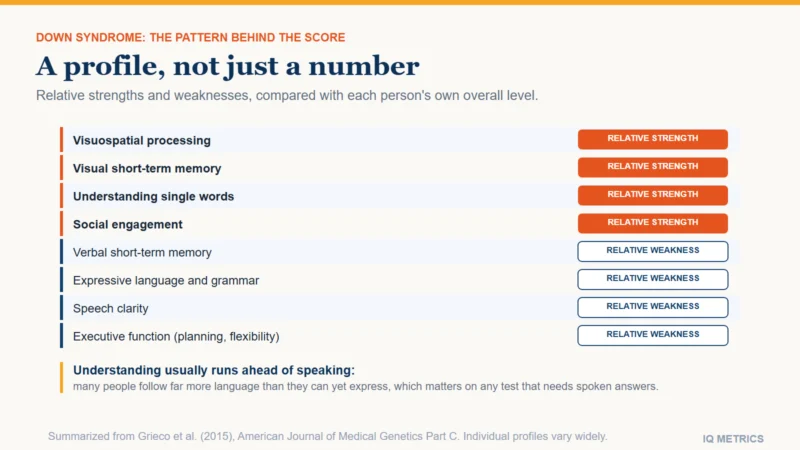 Understanding IQ
Down Syndrome and IQ
Most people with Down syndrome score in the mild to moderate range of intellectual disability, with an average IQ of around 50 and a typical range of about 30 to 70. The number hides a wide spread, a consistent profile of strengths, and test limits that matter more here than almost anywhere else.
 Understanding IQ
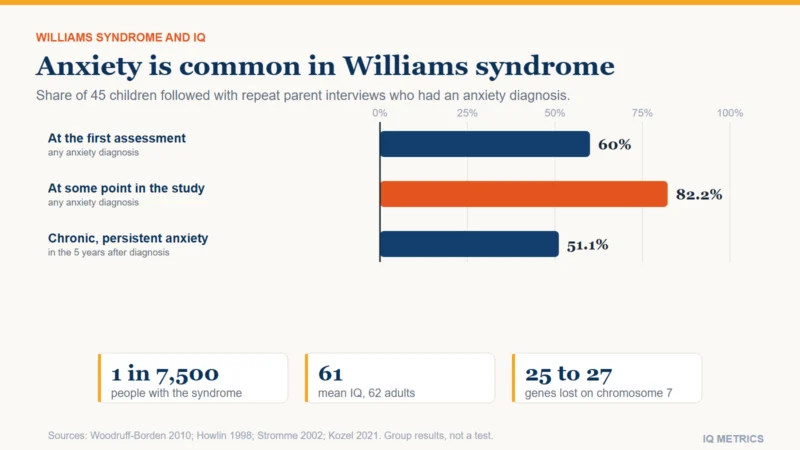
Williams Syndrome and IQ
Williams syndrome and IQ: mean full-scale IQ was 61 in 62 adults, and 292 children averaged in the borderline range on the KBIT-2, stable from age 4 to 17. Language is a relative strength and visuospatial construction an extreme weakness. Here is what the studies show.
 Scores & Scales
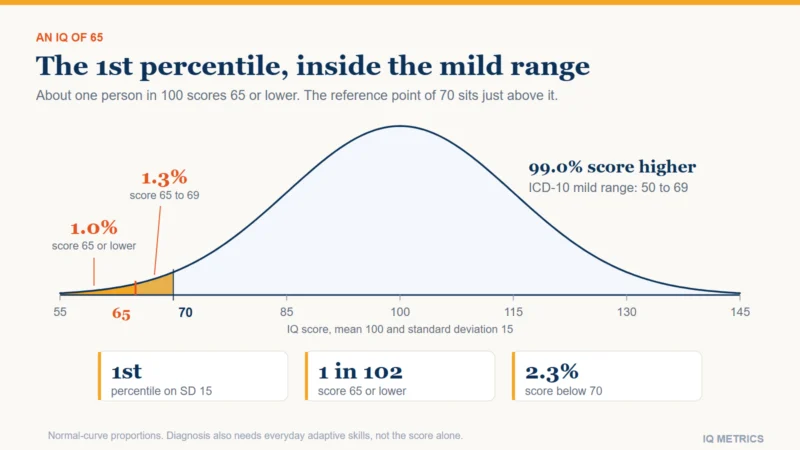
What Does an IQ of 65 Mean?
An IQ of 65 is the 1st percentile: about 1 person in 102 scores it or lower. It sits inside the ICD-10 mild range, is labelled Extremely Low on Wechsler tests and has a likely true score of about 60 to 73. See its mental age, what it means for daily life and how courts treat it.