





What Does an IQ of 155 Mean? Rarity, Percentile and Reliability
An IQ of 155 means a score 3.7 standard deviations above average: the 99.988th percentile, about 1 in 8,140 people or a million worldwide. See how it differs by scale, the odds a retest repeats it, what it means for a child as a mental age, and which historical figures Cox rated at 155.

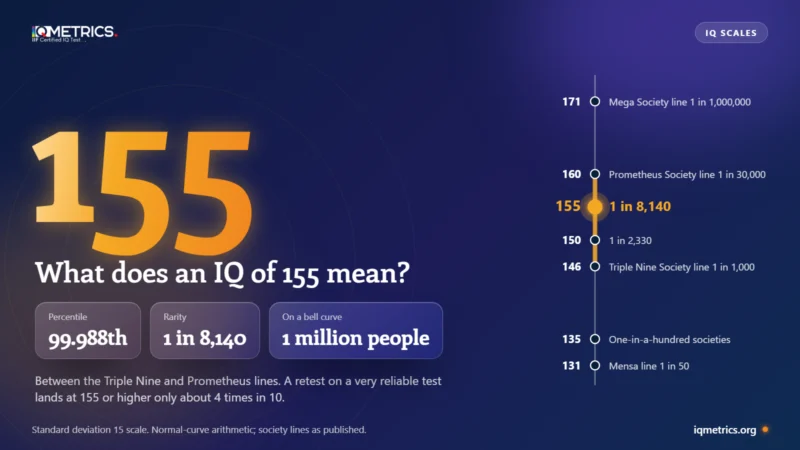
An IQ of 155 is about 3.7 standard deviations above the mean, the 99.988th percentile on the standard scale, roughly 1 in 8,140 people. That puts it between the Triple Nine Society line (146) and the Prometheus Society line (160), and means about a million people alive today would score this high on a bell curve. This guide gives the exact rarity on each scale, how many people that is in your country, why a reported 155 usually comes down on a retest, what it means for a child, and who history’s ratings put near it.
How rare is an IQ of 155?
On the scale used by the Wechsler tests and the current Stanford-Binet, which fix the mean at 100 and the standard deviation at 15, a score of 155 is 55 points above average, or 3.67 standard deviations. The bell curve leaves about 1 in 8,140 of the population above that point. The old Stanford-Binet Form L-M and Cattell’s scales used a wider spread, so the same number meant something very different on them.
| Scale | Standard deviation | Standard deviations above mean | Percentile | Rarity |
|---|---|---|---|---|
| Wechsler tests, Stanford-Binet 5 | 15 | 3.67 | 99.988% | 1 in 8,140 |
| Stanford-Binet Form L-M (older edition) | 16 | 3.44 | 99.971% | 1 in 3,410 |
| Cattell scales | 24 | 2.29 | 98.9% | 1 in 91 |
Always ask which scale a quoted 155 belongs to. A 155 on a standard-deviation-24 scale is only about the top 1%; on the standard scale it is 1 in 8,140. If you want to convert between them, the IQ score converter does it, and the IQ percentile calculator gives the percentile for any score.
| Population | People at 155 or above |
|---|---|
| The world (8.2 billion) | 1,000,000 |
| United States (336.8 million) | 41,000 |
| United Kingdom (68.5 million) | 8,400 |
| Canada (40.0 million) | 4,900 |
| Australia (26.7 million) | 3,300 |
| New Zealand (5.2 million) | 640 |
Set beside its neighbours, 155 is a long way from either. The last column shows what a single sitting on a very reliable test (reliability .98) would be expected to give on a second try, which previews a point we return to below.
| IQ | Rarity | People in the world | Expected retest, reliability .98 |
|---|---|---|---|
| 150 | 1 in 2,330 | 3,500,000 | 149 |
| 155 | 1 in 8,140 | 1,000,000 | 154 |
| 160 | 1 in 31,600 | 260,000 | 159 |
These are the numbers a perfect bell curve predicts, not a count of people who have taken a test. Real score distributions have thicker tails at the very top and bottom than the textbook curve, and few people ever sit a test that can reliably report a score this high, so the real number of documented 155s is a small fraction of these counts. Our guide to how rare a high IQ score is compares more scores.
Where does 155 sit between Mensa and the Mega Society?
Each high-IQ society draws a line at a percentile, and each step up is roughly a tenfold jump in rarity. A 155 clears the first three lines easily and stops short of the fourth. The scores below are for the standard-deviation-15 scale.
| IQ (SD 15) | Percentile | Rarity | Reference point |
|---|---|---|---|
| 131 | 98th | 1 in 50 | Mensa line (top 2%, usually quoted as 130) |
| 135 | 99th | 1 in 100 | One-in-a-hundred societies such as Intertel |
| 146 | 99.9th | 1 in 1,000 | Triple Nine Society line |
| 150 | 99.96th | 1 in 2,330 | Our IQ of 150 guide |
| 155 | 99.988th | 1 in 8,140 | This page |
| 160 | 99.997th | 1 in 30,000 | Prometheus Society line; our IQ of 160 guide |
| 171 | 99.9999th | 1 in 1,000,000 | Mega Society line; see IQ of 170 |
So 155 is roughly 3.5 times rarer than 150 and 3.9 times more common than 160. For the societies themselves, and which tests they accept, see high-IQ societies and Mensa score requirements.
Can a test even report an IQ of 155?
Fewer than you might think. The Wechsler Adult Intelligence Scale, fourth edition, reports a full-scale IQ from 40 to 160, so 155 sits only five points from the printed maximum and needs near-top scaled scores on almost every subtest. The WISC-V has extended norms for children that continue past 160, but ordinary scoring stops at the same ceiling. Short online quizzes and puzzle tests often cannot separate a 140 from a 155 at all, because they contain too few hard items; our guide to the IQ ceiling effect explains why, and the highest IQ score a test can report lists the cut-offs by test.
Older ratio-IQ tests had a ceiling of a different kind. On the Stanford-Binet Form L-M the highest mental age was about 22 years 10 months, so a ratio IQ of 155 was out of reach for anyone older than 14 years 9 months (our arithmetic: 274 months divided by 1.55). For the full story of ratio versus deviation IQ, see deviation IQ vs ratio IQ.
If you score 155, how likely is it to be real?
A single high score is less certain than it looks. Every test has measurement error, and an extreme score tends to be partly luck: on a retest the expected result moves back toward 100. The standard correction (Kelley’s formula) gives the expected true score as 100 plus the test’s reliability times 55. The table applies it, and also shows the chance that a second sitting lands at 155 or higher.
| Test reliability | Expected retest score | 95% range for the true score | Chance a retest is 155+ |
|---|---|---|---|
| 0.80 (A short unsupervised online test) | 144 | 132 to 156 | 12% |
| 0.90 (A good group-administered test) | 150 | 141 to 158 | 22% |
| 0.95 (A strong individual test) | 152 | 146 to 159 | 32% |
| 0.98 (A full individually administered battery) | 154 | 150 to 158 | 42% |
Even on the most reliable battery, only about four in ten people who score 155 will score 155 or higher again, and on a short online test it is about one in eight. That is not a flaw to fix; it is what a score near the extreme of any measured trait does. It is the reason serious assessments report a confidence band rather than a single number, and the reason a result like this should be checked on a second, independent test. To see how your own result is built, take the IQ Metrics IQ test.
Where would your own score land?
Take the IIF-certified assessment and get your score with the scale it was measured on, the percentile it corresponds to and the confidence range around it — the three figures most online tests leave out.
Find your IQ score now! →What does an IQ of 155 mean for a child?
For a child the number was once defined as mental age divided by real age, times 100. That means a ratio IQ of 155 is a child functioning like someone 55% older. Modern tests no longer divide this way, but the arithmetic still shows how far ahead a 155 implies:
| Real age | Mental age | Reachable on Stanford-Binet L-M? |
|---|---|---|
| 5 years | 7 years 9 months | Yes |
| 6 years | 9 years 4 months | Yes |
| 8 years | 12 years 5 months | Yes |
| 10 years | 15 years 6 months | Yes |
| 12 years | 18 years 7 months | Yes |
| 14 years | 21 years 8 months | Yes |
A child with this profile is usually described as highly gifted in school terms, a common label for 145 to 159, with 130 to 144 “moderately gifted” and 160 or more “exceptionally gifted”. These labels are conventions, not diagnoses, and a child’s profile is usually uneven: a high overall score can hide large gaps between verbal, visual and working-memory skills. Mental-age conversions are explained further in IQ and mental age.
Is an IQ of 155 genius level?
There is no official genius threshold, and 140 is the most common informal line. A 155 is well past it by any usage, but "genius" in the sense of an original contribution to a field is not something a test score shows; see what genius IQ level means and whether 130 is genius. The people who produce the work history remembers have generally had high scores, but the score is a floor for opportunity and effort to build on, not a prediction of eminence.
Who has been estimated at an IQ of 155?
No historical figure sat an IQ test, so every figure below is an estimate. In 1926 Catharine Cox rated 301 eminent people from biographies, and she concluded that the group’s true average was not lower than 155 to 165. The table lists some of those whose corrected rating was exactly 155. Her raters gave lower figures; the correction pushed each one up.
| Person | Field | Raters' young-adult estimate | Corrected |
|---|---|---|---|
| John Adams (1735-1826) | Statesman | 145 | 155 |
| Alexander Hamilton (1757-1804) | Statesman | 140 | 155 |
| Ralph Waldo Emerson (1803-1882) | Essayist | 145 | 155 |
| Thomas More (1478-1535) | Statesman, writer | 135 | 155 |
| Rembrandt van Rijn (1606-1669) | Artist | 135 | 155 |
| Albrecht Dürer (1471-1528) | Artist | 135 | 155 |
The key point is how common 155 is on Cox’s own scale: 253 of the 301 people carry a corrected rating of 155 or more, 36 of them exactly 155. Her scale was stretched and cannot be compared with a modern test, which is why quoting a historical genius as “IQ 155” tells you little. The comparison with a real test sample is Terman’s: the 1,070 children in his study averaged 151.0 on the Stanford-Binet of the time, with scores from 135 to 200, so a 155 would be a typical member of that group, on a ratio scale whose top end is stretched. Our pages on the IQs of 301 historical geniuses and the Terman study of the gifted give the full tables.
What an IQ of 155 does not tell you
- Your future. The correlation of IQ with later outcomes is moderate at best, and at the extreme top other traits matter as much.
- Your strengths. A composite hides the shape of a profile; two people with 155 can be very different.
- That the score is exact. Add or subtract several points for measurement error, as in the table above.
- That it will stay put. Norms age; see why IQ norms expire.
For neighbouring scores see an IQ of 145, 150, 160 and 170. To see how rare your country’s highest scorers are, see average IQ in Canada and average IQ in Australia.
Sources
- Cox, C.M. (1926): The Early Mental Traits of Three Hundred Geniuses (Genetic Studies of Genius, Vol. II), Stanford University Press, Tables 12A and 12B, as set out in our study of 301 historical geniuses.
- Terman, L.M. et al. (1925): Mental and Physical Traits of a Thousand Gifted Children, as summarised in our Terman study page.
- Kelley, T.L. (1923): Statistical Method, Macmillan (the regression-to-the-true-score formula). Normal-curve arithmetic is ours; the high-IQ society percentiles are those published by the societies, summarised in our guide.
- Pearson: WAIS-IV score ranges (full-scale IQ 40 to 160) and WISC-V extended norms technical report.
Keep reading
All articles →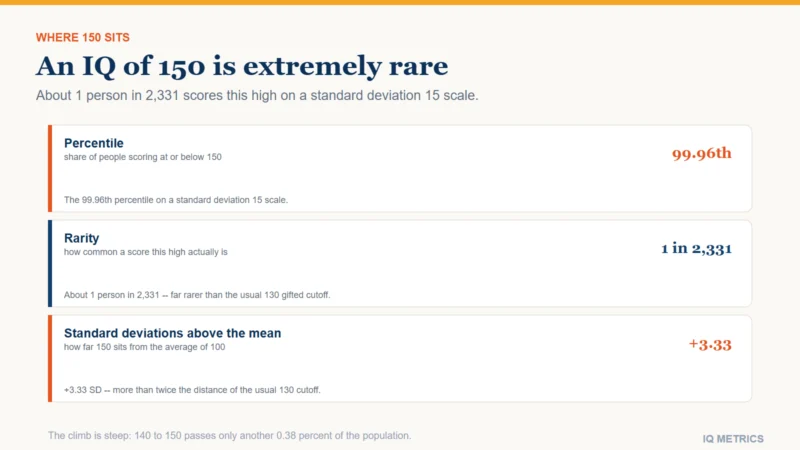 Scores & Scales
What an IQ of 150 Means
An IQ of 150 is about 1 person in 2,331 on a standard deviation 15 scale, the 99.96th percentile. See how rare it really is, what "genius" cutoffs actually mean, and why scores this high need a real test to trust.
 Scores & Scales
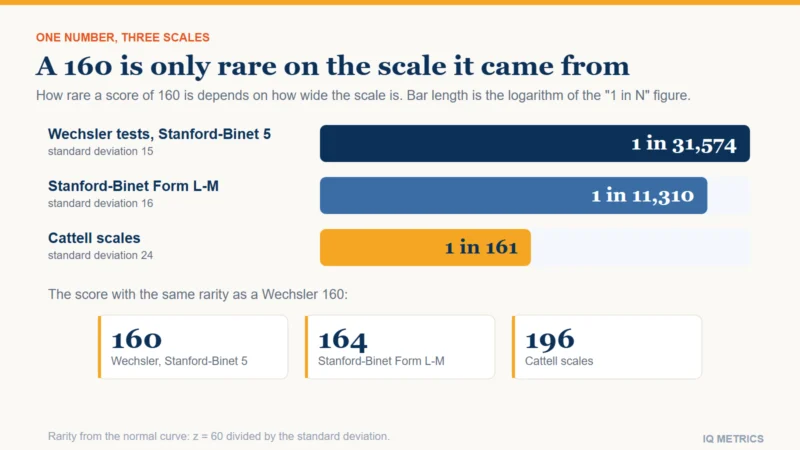
What an IQ of 160 Means
An IQ of 160 is about 1 person in 31,600 on a standard deviation 15 scale, but only 1 in 161 on the Cattell scale. What a 160 means on each scale, which tests can print one, how accurate it is, what it predicts and where the claims come from.
 Scores & Scales
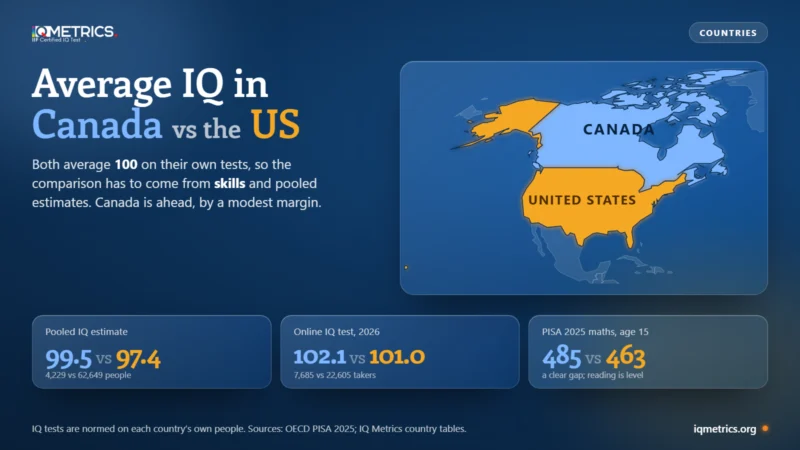
Average IQ in Canada (vs the US)
Average IQ in Canada vs the US: both are 100 on their own tests, so compare skills instead. Canada is ahead on PISA 2025 maths by 22 points and on adult skills by 16. See the provinces, why Canadian and US WAIS-IV norms give different scores, and how far Canada has fallen since 2012.