





Are Sharks Smart? What Studies Show About Shark Brains
Are sharks smart? Yes, at learning and remembering, though no shark IQ exists. Bamboo sharks remembered a task for up to 50 weeks, lemon sharks learned by watching, and catsharks kept a habit for under 3 weeks. See the studies and what shark brains show.

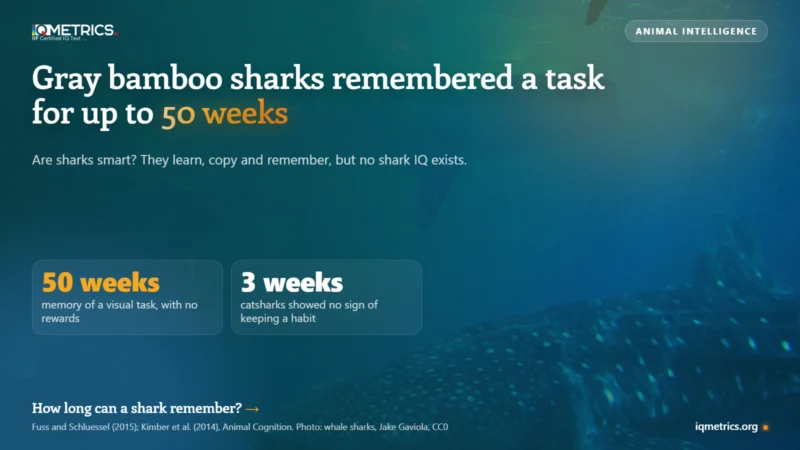
Are sharks smart? Yes, at learning and remembering, though no shark IQ exists. In lab tests, juvenile gray bamboo sharks remembered a visual task for up to 50 weeks, and juvenile lemon sharks learned a food task by watching trained sharks. Memory is not the same everywhere: catsharks showed no sign of keeping a learned habit after a 3-week break.
Below: each study with its journal and year, how big shark brains are, and why no test can say whether a shark beats a dolphin or an octopus. New here: a shark’s memory ran from 3 weeks to over 50 weeks, depending on the species and the task, so “how smart is a shark” has no single answer.
Key takeaways
- There is no shark IQ. IQ compares a person with a norm group of people, and no such test or group exists for sharks.
- Long memory: gray bamboo sharks remembered visual tasks for up to 50 weeks without rewards, when testing ended (Fuss and Schluessel, Animal Cognition, 2015).
- Copying: juvenile lemon sharks that watched trained sharks did more trials and touched the target more often (Guttridge et al., Animal Cognition, 2013).
- Short memory too: small-spotted catsharks did not keep a learned foraging habit across a 3-week break (Kimber et al., Animal Cognition, 2014).
- Brain size varies: the largest brains belong to reef and open-ocean species, the smallest to bottom dwellers (Yopak, Journal of Fish Biology, 2012).
How smart are sharks?
Sharks are better learners than their reputation suggests, but only a few species have been tested. The studies below used a bamboo shark, a lemon shark and a catshark in aquariums.
Researchers test sharks one skill at a time: pick the right shape, touch a target, find a hidden food signal. That is how scientists judge the question “how smart is a shark” without a single score.
Do sharks have an IQ?
No. IQ compares one person with a large sample of people of the same age, and no such norm group or test exists for sharks.
So any “shark IQ” number you see online is a joke or a guess. Scientists give sharks two-choice tests and measure what they learn and keep. For scale, a human brain holds about 86.1 billion neurons (see our human brain facts).
Can sharks learn, remember and copy each other?
Yes, on all three counts, in the species tested. Three studies in the journal Animal Cognition cover learning, memory and copying.
| Study | Shark | What the sharks did | What it shows |
|---|---|---|---|
| Fuss and Schluessel, 2015 | Juvenile gray bamboo sharks | Two-choice visual tasks, retested without rewards | Remembered for up to 50 weeks, when testing stopped |
| Guttridge et al., 2013 | Juvenile lemon sharks | Watched trained or untrained sharks, then ran a food task alone | Observers of trained sharks did more trials and touched the target more often |
| Kimber et al., 2014 | Small-spotted catsharks | Learned to find and bite electrodes that mimic prey for food | Learned during the test; no sign of keeping it after 3 weeks |
Memory first. Fuss and Schluessel (2015) retested bamboo sharks that had been trained to tell squares, triangles and lines apart, and optical illusions such as the Kanizsa figures and the Müller-Lyer illusion. Even without rewards, the sharks remembered what they had learned for up to 50 weeks, when the testing ended.
The authors note that memory windows vary with species and task. A long memory could help a shark with food retrieval, predator avoidance, mate choice or habitat selection.
Copying next. Guttridge and colleagues (2013) built a task where a lemon shark had to enter a start zone and touch a target for food. Sharks that spent time with a trained shark made more trips to the target than sharks paired with an untrained one. When tested alone, they finished more trials and touched the target more often. The authors say no such evidence existed before for cartilaginous fishes.
Finally, a shorter memory. Kimber and colleagues (2014) rewarded small-spotted catsharks for biting electrodes that mimic the electric field of prey. The catsharks improved at finding and biting them. After a 3-week break, though, the learned changes were not retained.
Are sharks smart, or just eating machines?
The lab results do not fit the “eating machine” picture. In these studies sharks learned from rewards, copied other sharks and kept some memories for most of a year.
None of this makes a shark a dolphin. It does show behaviour that depends on experience, not on instinct alone. That is why we call sharks smart for learning, with the limits listed below.
What do sharks sense that helps them learn?
Sharks learn through six senses, not one. Collin (Brain, Behavior and Evolution, 2012) reviewed the sense organs of cartilaginous fishes: vision, smell, taste, the lateral line, electroreception and hearing.
Electroreception is the odd one out for people. The catsharks in the Kimber study learned to bite electrodes that mimic the electric field of prey, so a sense we lack can still feed learning.
Collin also found large differences between species in the eye’s light receptors, the smell surface inside the nose and the electroreceptive pores over the head. What a shark can learn from its world therefore depends on the species.
How big is a shark brain for its body?
It depends on the species. Yopak (Journal of Fish Biology, 2012) reviewed brain size in 151 species of cartilaginous fishes, the group that holds sharks, rays and chimaeras.
The largest brains, with well-developed forebrains and cerebella, belonged to species living on complex reefs or in the open ocean. Bottom-dwelling species had the smallest brains.
Kimber and colleagues add that many sharks have relatively large brains “comparable to some mammals”. The catch is coverage: brain mass is known for only about 16% of species. Our smartest animals research table holds only mammals, birds and reptiles, so it has no shark and we give no shark neuron count.
Where would your own score land?
Take the IIF-certified assessment and get your score with the scale it was measured on, the percentile it corresponds to and the confidence range around it — the three figures most online tests leave out.
Find your IQ score now! →Are sharks smarter than dolphins or octopuses?
Nobody knows, because no study tests sharks, dolphins and octopuses on the same task. Each group has its own tests.
See what was measured for each in our dolphin IQ guide, octopus IQ guide and orca IQ guide. Our smartest animal in the ocean article explains why the answer depends on the yardstick.
Which shark is the smartest?
No study ranks sharks by smarts. Brain size points at reef and open-ocean sharks, but size is not a test result. The three species tested so far were a bamboo shark, a lemon shark and a catshark.
What do we still not know about shark intelligence?
- Only a few species were tested, in captivity and mostly as juveniles. Wild sharks and other species may differ.
- Memory ran from 3 weeks to over 50 weeks in different species and tasks, and no one yet knows why.
- Brain mass is known for only about 16% of cartilaginous fish species, and Yopak calls for functional studies on a greater range of species.
- No shark IQ or norm group exists.
- No test compares sharks with dolphins, octopuses or one another beyond these studies.
If you want a number for yourself, take the IQ test. It is built and normed for people.
Quick answers
- Are sharks smart? Yes, at learning and remembering. No shark IQ exists.
- How smart are sharks? Bamboo sharks remembered a task for up to 50 weeks and lemon sharks learned by watching.
- Do sharks have an IQ? No. There is no test or norm group for sharks.
- Can sharks learn? Yes. Rewarded catsharks got faster at finding food signals, and lemon sharks copied trained sharks.
- Are sharks smarter than dolphins? Untested. No study compares them on the same task.
The bottom line
Sharks are smart in ways a lab can measure: they learn, copy and remember, and how long they remember depends on the species and the task. No shark has an IQ, and nobody has ranked sharks against dolphins. More from the water and the cold-blooded animals: the smartest fish in the world and the smartest reptile. On land, see are mice smart.
Sources
- Collin SP (2012). The neuroecology of cartilaginous fishes: sensory strategies for survival. Brain, Behavior and Evolution 80, 80-96.
- Fuss T, Schluessel V (2015). Something worth remembering: visual discrimination in sharks. Animal Cognition 18, 463-471.
- Guttridge TL, van Dijk S, Stamhuis EJ, Krause J, Gruber SH, Brown C (2013). Social learning in juvenile lemon sharks, Negaprion brevirostris. Animal Cognition 16, 55-64.
- Kimber JA, Sims DW, Bellamy PH, Gill AB (2014). Elasmobranch cognitive ability: using electroreceptive foraging behaviour to demonstrate learning, habituation and memory in a benthic shark. Animal Cognition 17, 55-65.
- Yopak KE (2012). Neuroecology of cartilaginous fishes: the functional implications of brain scaling. Journal of Fish Biology 80, 1968-2023.
- IQ Metrics Research (2026). Smartest animals: neurons vs test scores.
Keep reading
All articles →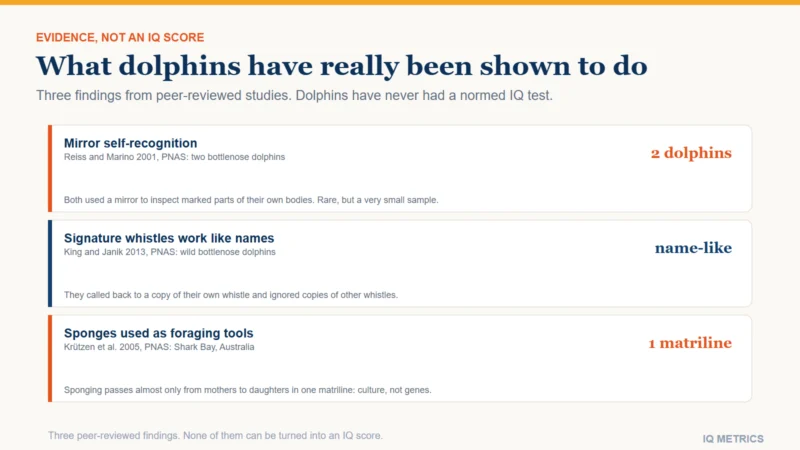 Research & Evidence
Dolphin IQ
Dolphins have no IQ, but they have passed a mirror test, use signature whistles like names and pass tool use down the female line. See the evidence, the brain data, and the peer-reviewed sceptics who question the hype.
 Understanding IQ
Octopus IQ
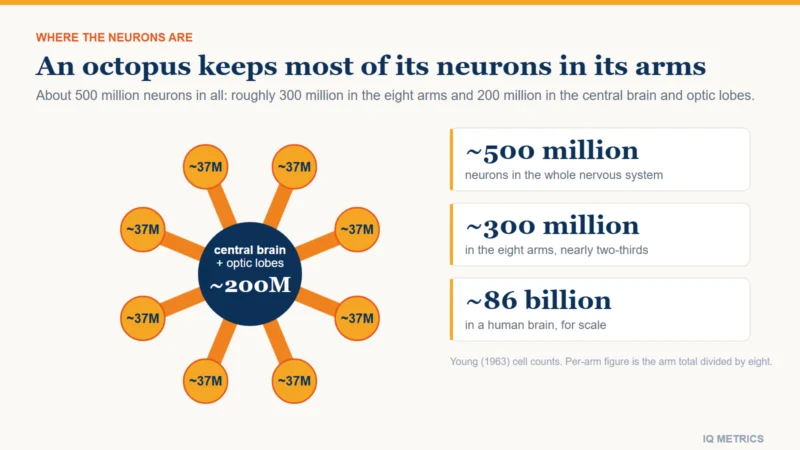
An octopus has no IQ, but it has about 500 million neurons, most of them in its arms. The neuron count, the tool-use and recognition studies, why short lives leave no room for teaching, and why UK law now treats octopuses as sentient.
 Research & Evidence
Orca IQ
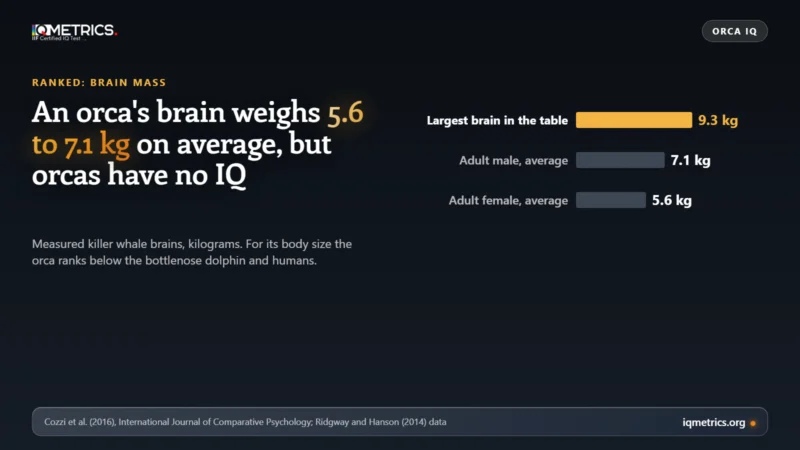
How smart are killer whales? An orca brain averages about 5.6 kg in females and 7.1 kg in males, yet ranks below the bottlenose dolphin and humans for its body size. What is known about neurons, leadership by older females and pod sounds, and why orcas have no IQ.