





Are Mice Smart? What Mouse Studies Show About Learning
Are mice smart? Yes, at learning, though no mouse IQ exists. In a 2003 study of 56 mice, one shared factor explained 38% of the differences across five learning tasks. See mouse neuron counts against a rat, rabbit and squirrel, and what mice remember.

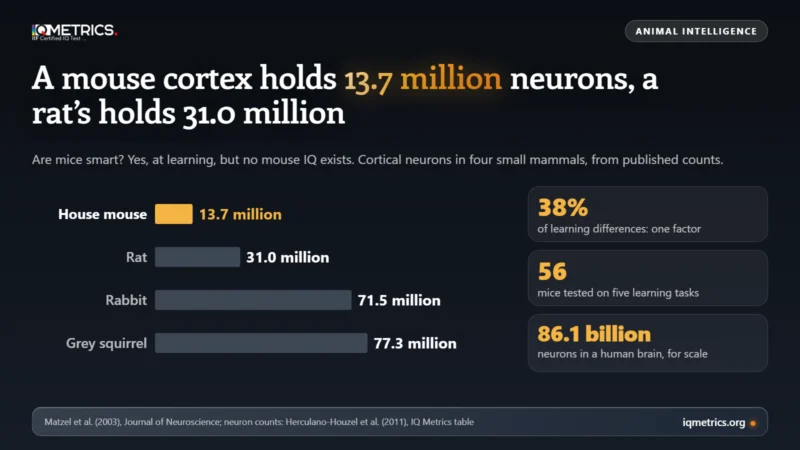
Are mice smart? Yes, at learning, though no one has measured a mouse IQ. In a 2003 Journal of Neuroscience study of 56 mice, scores on five different learning tasks moved together, and one shared factor explained 38% of the differences between animals. A house mouse brain holds about 67.9 million neurons, a human brain about 86.1 billion.
Below: what that shared factor means, how a mouse cortex compares with a rat, rabbit and squirrel, what mice remember, and why labs use them. New here: the mouse cortex has 13.7 million neurons, less than half a rat’s 31.0 million, yet its neurons sit about twice as densely. Size alone does not decide who learns well.
Key takeaways
- There is no mouse IQ. IQ compares a person with a norm group of people, and no such group or test exists for mice.
- General learning: in 56 outbred mice, one factor explained 38% of the differences across five learning tasks (Matzel et al., 2003).
- Working memory: a mouse’s working memory capacity went with its general learning score, but long-term retention did not (Kolata et al., 2005).
- Brain size: a house mouse has about 13.7 million cortical neurons, a rat 31.0 million, a rabbit 71.5 million and a grey squirrel 77.3 million.
- Smell: wild house mice recognise other mice partly through proteins in urine (Hurst et al., Nature, 2001).
How smart are mice?
Mice are strong learners with very small brains, and their learning skills hang together. Researchers test one skill at a time: linking a signal with a mild shock, finding a safe spot, telling two options apart. A mouse that does well on one test tends to do well on the others.
That pattern is what lets scientists say a mouse is smart in a measurable way. It means better at learning and remembering in a lab task. It does not mean human-style reasoning, and we found no study that gives mice a reasoning test like a human one.
Is there a mouse IQ?
No. IQ compares one person with a large sample of people of the same age, and no such norm group or test exists for mice.
So any “mouse IQ” number you see online is a joke or a guess. Matzel and colleagues came closest: they ranked each of 56 mice against its peers, which is the same logic IQ uses. But that rank holds only inside their sample. It is not a score on a scale with an average of 100. For the human side of the comparison, see our human brain facts.
Are mice smart enough to have a general intelligence factor?
Something like one, according to a 2003 study. Matzel and seven colleagues found a single factor behind five different learning tasks.
The team tested 56 genetically varied CD-1 mice on fear conditioning, operant avoidance, path integration, discrimination and spatial navigation. Each task made different demands on the animal’s senses, movement and motivation, so one skill could not explain the whole pattern.
Mice that learned fast on one task tended to learn fast on the others. Across several test batteries, each animal’s overall rank stayed stable, and the ranks followed a normal curve. A factor analysis showed that a single factor accounted for 38% of the total variance across animals.
In people, the same paper notes, a general factor accounts for up to 50% of the differences between individuals on intelligence tests. The mouse figure is lower but in the same range. Body weight and general activity explained little. Willingness to explore went with better learning.
A 2005 follow-up asked what drives the factor. Kolata and colleagues found that mice with a larger working memory capacity, the amount an animal can hold in mind at once, also scored higher on general learning. Long-term retention did not vary with it. Our memory and IQ guide covers the same link in people.
Both studies used one stock of outbred lab mice, so other strains and wild mice may differ.
How many neurons does a mouse have compared with a rat or squirrel?
A house mouse has about 67.9 million neurons in its whole brain and 13.7 million in its cortex. These counts come from our smartest animals research table, which uses published neuron counts from Herculano-Houzel and colleagues (Brain, Behavior and Evolution, 2011).
| Animal | Whole-brain neurons | Cortex neurons | Brain mass (g) |
|---|---|---|---|
| House mouse | 67.9 million | 13.7 million | 0.40 |
| Rat | 188.9 million | 31.0 million | 1.72 |
| Rabbit | 494.2 million | 71.5 million | 9.13 |
| Grey squirrel | 453.7 million | 77.3 million | 5.55 |
| Human | 86.1 billion | 16.3 billion | 1,508 |
The mouse cortex has 44% as many neurons as the rat’s. A human cortex holds about 1,190 times as many as a mouse cortex (16.3 billion against 13.7 million).
Mouse neurons are packed tightly. The mouse cortex holds about 79,000 neurons per milligram, almost twice the rat’s 40,300 and six times the human’s 13,200. So a small brain can still hold a dense network.
Do more neurons mean a smarter animal? Not on their own. In the 8 species in our research with every measure, cortical neuron counts tracked a self-control test (rank correlation 0.80), but the 95% confidence interval ran from 0.20 to 0.96, too wide to crown any measure. See how the squirrel and the rabbit fare in our other animal posts.
Can mice learn and remember mazes, faces and smells?
Yes for tasks and smells; we found no study of faces. In the 2003 battery, mice learned a spatial navigation task, a path integration task and a rule that linked a cue with a mild shock. A mouse’s rank across these tests was highly reliable, so the differences were not luck on the day.
Smell matters for mice. Hurst and colleagues (Nature, 2001) showed that proteins in the urine of wild house mice play an important role in how one mouse recognises another. We did not find a study of mice recognising faces, so we do not claim one.
Want to feel how a memory task works? Try our memory game. It is a person’s version of the lab’s “remember and repeat” idea.
Where would your own score land?
Take the IIF-certified assessment and get your score with the scale it was measured on, the percentile it corresponds to and the confidence range around it — the three figures most online tests leave out.
Find your IQ score now! →Why do labs use mice for intelligence research?
Mice carry nearly the same set of genes as people and can be studied in a lab. The US National Human Genome Research Institute said in 2002 that the mouse “carries virtually the same set of genes as the human but can be used in laboratory research”.
The Nature paper on the mouse genome (Waterston et al., 2002) called the sequence a key experimental tool for biomedical research. Matzel’s team gave a brain-science reason: the biology behind general ability is “essentially unknown” in part because animal research that allows brain analysis is scarce.
The catch is that similar genes do not make a similar mind. Mouse results suggest mechanisms. They do not prove that people work the same way.
Are mice smarter than rats?
No study we found ranks them, and no IQ exists for either animal. Rats have more neurons: 2.8 times as many in the whole brain (188.9 against 67.9 million) and 2.3 times as many in the cortex.
Mice pack their cortex more densely, and both species learn the same kinds of lab tasks. Neuron counts describe the brain, not the test result. So the honest answer is that rats have bigger brains, mice have denser ones, and no head-to-head intelligence test settles it.
What do we still not know about mouse intelligence?
- The general learning factor comes from one stock of lab mice (CD-1) and 56 animals. Wild mice and other strains are not covered here.
- No mouse IQ exists, and no norm group of mice sets an average of 100.
- No study here tests mice on reasoning like a human puzzle.
- No head-to-head test ranks mice against rats, rabbits or squirrels.
If you want a number for yourself, take the IQ test. It is built and normed for people.
Quick answers
- Are mice smart? Yes, at learning and remembering. No mouse IQ exists.
- How smart are mice? In one study, five learning tasks shared a common factor that explained 38% of the differences between 56 mice.
- Is there a mouse IQ? No. There is no norm group or scale of mice with an average of 100.
- How many neurons does a mouse have? About 67.9 million in the whole brain and 13.7 million in the cortex.
- Can mice learn and remember? Yes. Their overall learning rank stayed stable across test batteries, and working memory went with general learning.
- Are mice smarter than rats? Untested. Rats have more neurons; mice pack them more densely.
The bottom line
Mice are smart in the ways a lab can measure: they learn, remember and show one common learning factor. The factor comes from a single stock of 56 animals, so treat it as a strong sign and not the last word. More in our animal series: are sheep smart, are rabbits smart, are sharks smart and the smartest primate.
Sources
- Matzel LD, Han YR, Grossman H, Karnik MS, Patel D, Scott N, Specht SM, Gandhi CC (2003). Individual differences in the expression of a “general” learning ability in mice. Journal of Neuroscience 23(16), 6423-6433.
- Kolata S, Light K, Townsend DA, Hale G, Grossman HC, Matzel LD (2005). Variations in working memory capacity predict individual differences in general learning abilities among genetically diverse mice. Neurobiology of Learning and Memory 84, 241-246.
- Hurst JL, Payne CE, Nevison CM, Marie AD, Humphries RE, Robertson DH, Cavaggioni A, Beynon RJ (2001). Individual recognition in mice mediated by major urinary proteins. Nature 414, 631-634.
- Herculano-Houzel S, Ribeiro P, Campos L, Valotta da Silva A, Torres LB, Catania KC, Kaas JH (2011). Updated neuronal scaling rules for the brains of Glires (rodents/lagomorphs). Brain, Behavior and Evolution 78, 302-314.
- Mouse Genome Sequencing Consortium, Waterston RH et al. (2002). Initial sequencing and comparative analysis of the mouse genome. Nature 420, 520-562.
- National Human Genome Research Institute (2002). International team of researchers assembles draft sequence of mouse genome.
- IQ Metrics Research (2026). Smartest animals: neurons vs test scores.
Keep reading
All articles →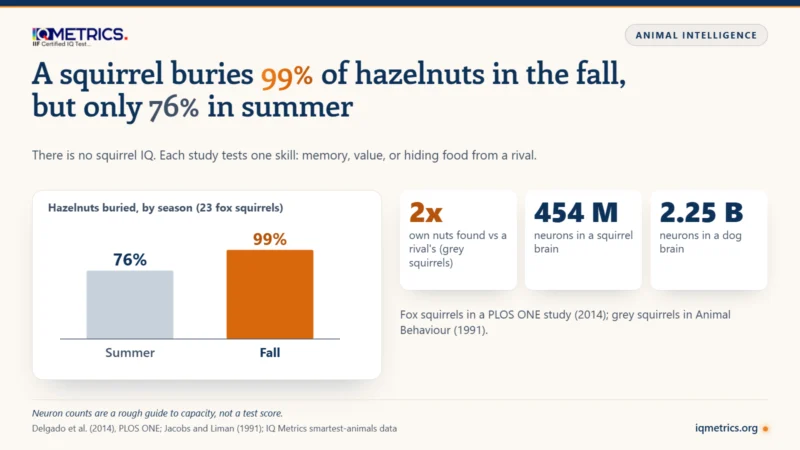 Mind & Everyday Life
Are Squirrels Smart?
Are squirrels smart? Yes, for rodents: grey squirrels recover their own buried nuts at about twice the rate of a rival's, and fox squirrels bury 99% of hazelnuts in the fall but 76% in summer. There is no squirrel IQ. Each study, with journal, year and number of animals.
 Mind & Everyday Life
Are Rabbits Smart?
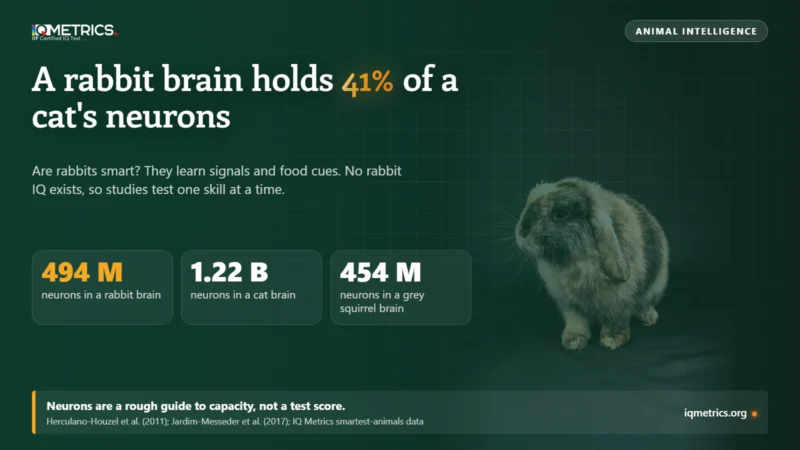
Are rabbits smart? Yes, at learning signals and food cues, but no rabbit IQ exists. A rabbit brain holds about 494 million neurons, 41% of a cat's and 9% more than a squirrel's. Each study, with journal and year, and how rabbit brains compare with squirrels, cats and dogs.
 Mind & Everyday Life
Are Sheep Smart?
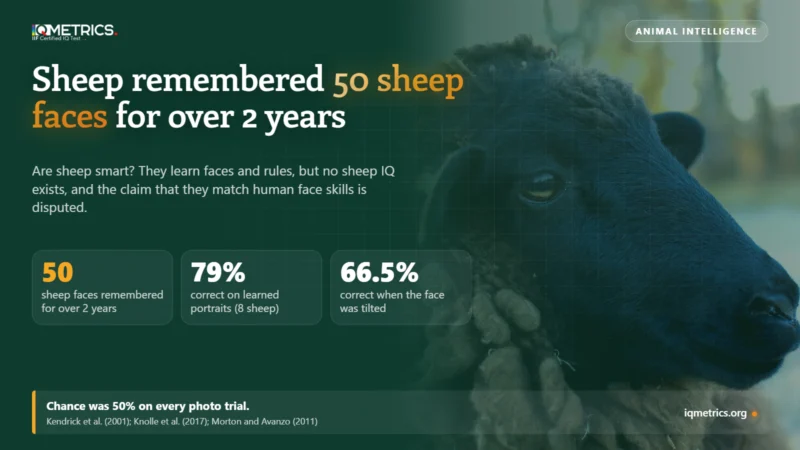
Are sheep smart? Yes, at learning faces and rules, though no sheep IQ exists. In a 2001 Nature study sheep remembered 50 sheep faces for over 2 years, and in 2019 scientists debated how close that skill is to ours. See each study with its journal, year and sample size.