





Octopus IQ: How Smart Is an Octopus, Really?
An octopus has no IQ, but it has about 500 million neurons, most of them in its arms. The neuron count, the tool-use and recognition studies, why short lives leave no room for teaching, and why UK law now treats octopuses as sentient.

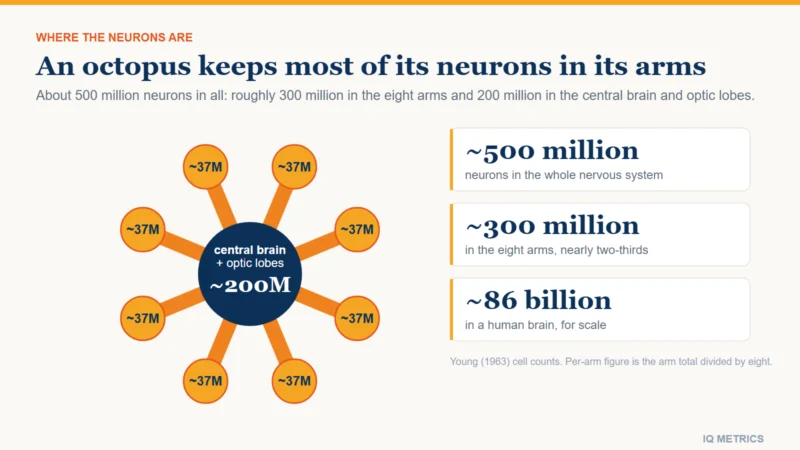
An octopus does not have an IQ. IQ is a rank within humans on a human-normed test, and no standard battery exists for cephalopods. What scientists have documented instead is a set of problem-solving abilities that are remarkable in an animal with a completely different nervous system: about 500 million neurons, roughly 300 million of them in the arms, recognition of individual people, coconut-shell shelters that are carried from place to place, and a sleep cycle with active and quiet phases. This article covers the neuron count and where the neurons sit, the best-documented experiments, why octopus lives are too short for teaching, what UK law now says about octopus sentience, and how the animal compares with crows, chimpanzees and dogs.
- Neurons: about 500 million in total, about 300 million of them in the arms (Young, 1963), against about 86 billion in a human brain.
- Tool use: veined octopuses carry coconut-shell halves to use as shelter (Finn, Tregenza and Norman, 2009).
- Lifespan: one to two years in the common octopus, so almost no octopus ever meets its parents.
- Law: the UK’s Animal Welfare (Sentience) Act 2022 was amended to cover cephalopods.
Does an octopus have an IQ?
No. An IQ score compares a person with a norm group of the same age, and there is no such group for an octopus or for the roughly 300 octopus species, most of which have never been studied in a laboratory. The experiments that exist involve a few species (the common octopus, the giant Pacific octopus and a handful of others), and each tests something specific: learning a maze, telling two shapes apart, opening a jar. As far as published work shows, nobody has tested whether octopus performance across tasks shares a general factor of the kind the g factor describes in people and, as chimpanzee IQ shows, in chimpanzees. The large multi-task batteries used for primates have not been run on them.
How many neurons does an octopus have, and where are they?
The common octopus has about 500 million neurons, a figure from the anatomist J. Z. Young’s cell counts. Roughly 300 million, nearly two-thirds, sit in the nerve cords and ganglia of the eight arms, and the remaining 200 million or so are in the central brain and the two large optic lobes. Each arm can taste, touch and move with a good deal of local control, and an arm cut from a living octopus keeps responding to touch for a while. The central brain sets goals; the arms do much of the execution, which is what people mean when they say an octopus has “nine brains”. It is a figure of speech, not an anatomical count.
| Animal | Neurons | What was counted |
|---|---|---|
| Human | about 86 billion | whole brain |
| Raven | about 2.2 billion | whole brain (Olkowicz et al., 2016) |
| Chimpanzee | about 6 to 8 billion | cerebral cortex only; estimates differ |
| Dog | 429 to 627 million | cerebral cortex of two dogs (Jardim-Messeder et al., 2017) |
| Common octopus | about 500 million | whole nervous system, about 300 million in the arms |
Read the table loosely: the counts cover different tissue and were made by different methods, and more neurons do not simply mean more intelligence. What makes octopuses useful to researchers is that their large, flexible nervous system evolved independently of ours, from a common ancestor that lived more than 500 million years ago. The octopus genome, published in 2015 by Albertin and colleagues, turned out to be large and complex, about 2.7 billion base pairs with roughly 33,000 protein-coding genes.
What has an octopus actually been shown to do?
- Use tools. Veined octopuses in Indonesia were filmed collecting coconut-shell halves, carrying them across the sea floor and assembling them into a shelter (Finn, Tregenza and Norman, 2009). Carrying the shells is slow and costly, which is what makes it look like planning for later use.
- Tell people apart. In a 2010 study, giant Pacific octopuses learned to distinguish two identically dressed caretakers, one who fed them and one who prodded them with a bristly stick. They approached the feeder and squirted water at the other (Anderson and colleagues).
- Change shape on demand. The mimic octopus of Indonesian waters appears to switch between shapes and movements that resemble a sea snake, a lionfish or a flatfish (Norman, Finn and Tregenza, 2001).
- Sleep in stages. Octopuses have a quiet sleep phase and an “active” phase in which skin patterns flicker and brain activity looks like waking (Pophale and colleagues, 2023, Nature).
- Escape. Keepers tell of octopuses lifting lids and slipping through tiny gaps. One named Inky vanished from the National Aquarium of New Zealand in 2016 and was presumed to have gone down a drainpipe to the sea, an anecdote rather than an experiment.
Why octopus intelligence is unusual: short lives and no teachers
Most octopuses live one to two years, and the giant Pacific octopus three to five. Females typically guard their eggs without feeding and die soon after hatching; males decline after mating. Hatchlings therefore never meet a parent, so skills cannot pass down by teaching or imitation, and the cumulative culture seen in chimpanzees (see chimpanzee IQ) has no obvious route in octopuses. Each animal learns alone. The extreme case is a deep-sea species, Graneledone boreopacifica: a female watched in Monterey Canyon guarded her eggs for about 4.5 years, 53 months, the longest brooding period recorded for any animal (Robison and colleagues, 2014).
Where would your own score land?
Take the IIF-certified assessment and get your score with the scale it was measured on, the percentile it corresponds to and the confidence range around it — the three figures most online tests leave out.
Find your IQ score now! →Do octopuses feel? Sentience and the law
Intelligence and sentience are different questions. Sentience is the capacity to feel pain and distress; it is what animal-welfare law cares about, and it does not depend on an IQ-style ranking. In 2021 a review from the London School of Economics judged the evidence strong for cephalopod molluscs and decapod crustaceans, and the UK government then amended the Animal Welfare (Sentience) Act 2022 to bring both groups into its definition of “animal”. European law had already protected live cephalopods in scientific research under Directive 2010/63/EU. In practice, when octopuses appear in policy debates, farming proposals or research rules, the argument is about what they can feel, not how they would score on a test.
Octopus, crow, chimpanzee and dog: who is smartest?
There is no honest ranking. Ravens match chimpanzees on some tasks (crow IQ), dogs read human gestures better than chimpanzees do (dog IQ), and octopuses solve problems with a body plan none of them share. What the comparisons do show is that intelligence has evolved in different lineages by different routes, which is a reason to distrust any single number. The same point runs through brain myths about intelligence.
Quick answers
- What is the IQ of an octopus? There is none. IQ is a rank within humans of the same age, and no octopus norm group exists.
- How many neurons does an octopus have? About 500 million, with about 300 million of them in the arms.
- Do octopuses have nine brains? No. They have one central brain plus arm nerve cords with local control; “nine brains” is a figure of speech.
- Can octopuses use tools? Yes. Veined octopuses carry coconut-shell halves and use them as shelter.
- How long do octopuses live? One to two years for the common octopus and three to five for the giant Pacific octopus.
- Is an octopus smarter than a dog? No shared test exists, so the honest answer is that they are good at different things.
- Are octopuses sentient? UK law has recognised cephalopods as sentient since the 2022 Act was amended to include them.
The bottom line
An octopus has no IQ, but it has about 500 million neurons, most of them in its arms, and it has been shown to use tools, recognise individual people and sleep in stages. It does all this on a short life with no parents to learn from, and the law in the UK now treats it as a feeling animal. The lesson for anyone comparing animals is the same as for chimpanzees and crows: describe what each species does, and be wary of a single score.
Sources
- Young (1963), Proceedings of the Zoological Society of London: the number and sizes of nerve cells in Octopus.
- UK Parliament: amendment 39 to the Animal Welfare (Sentience) Bill, adding cephalopod molluscs and decapod crustaceans to the definition of animal.
- Also cited: Albertin et al. (2015), Nature 524:220–224; Finn, Tregenza and Norman (2009), Current Biology 19:R1069–R1070; Anderson, Mather, Monette and Zimsen (2010), Journal of Applied Animal Welfare Science 13:261–272; Norman, Finn and Tregenza (2001), Proceedings of the Royal Society B 268:1755–1758; Pophale et al. (2023), Nature 619:129–134; Robison, Seibel and Drazen (2014), PLOS ONE 9(7):e103437; Olkowicz et al. (2016), PNAS; Jardim-Messeder et al. (2017), Frontiers in Neuroanatomy 11:118.
Keep reading
All articles →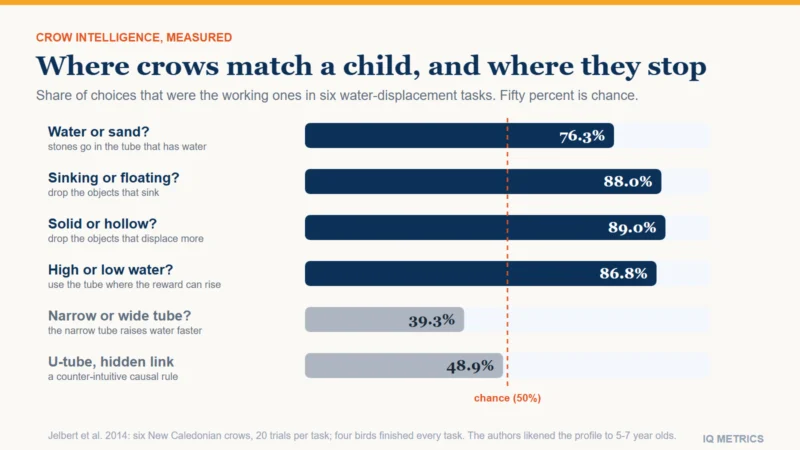 Understanding IQ
Crow and Raven IQ
A crow has no IQ, but tests show what corvids can do: bend wire, plan hours ahead, count their own calls. The 7-year-old comparison traces to one 2014 study of six crows, who were at chance on two of six puzzles.
 Understanding IQ
Brain Myths About Intelligence
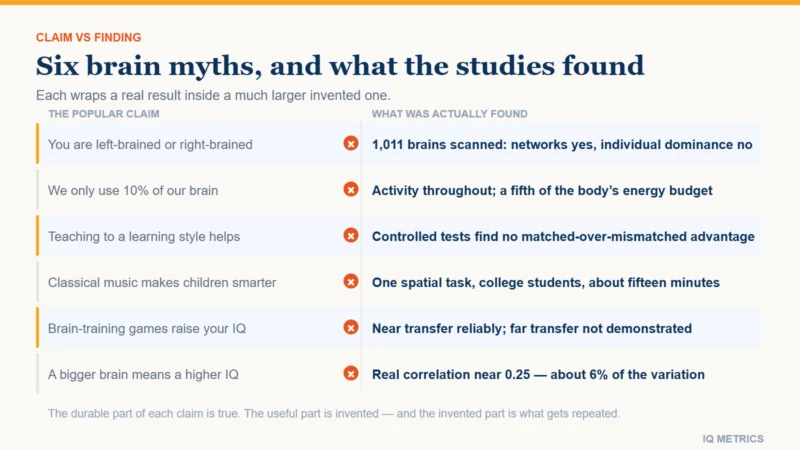
You are not left-brained or right-brained, you do not use ten per cent of your brain, and matching a lesson to your learning style does not help you learn. Six claims about intelligence that almost everyone repeats, what the studies that tested them found, and the smaller true fact hiding inside each one.
 Understanding IQ
Chimpanzee IQ
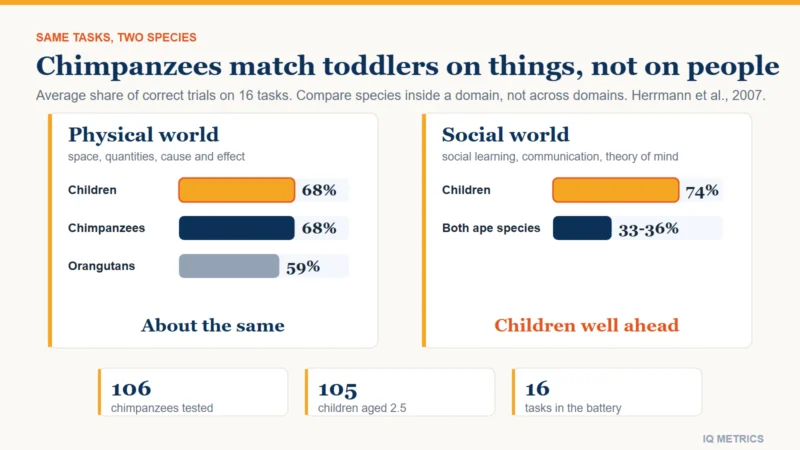
Chimpanzees have no IQ, but they have been tested. How chimps and 2.5-year-old children scored on the same 16 tasks, what a chimpanzee brain holds, the memory claim that did not survive practice, and whether chimps have a g factor.