





Average IQ in India: What Compiled Studies, PISA and ASER Show
The average IQ in India is 100 on an Indian-normed test. The circulating national figures are 76.24 from a compiled estimate and 98.44 from an online table, 22 points apart. See where each comes from, what PISA 2009+ and ASER 2024 show, and how India compares with China, the US and South Korea.

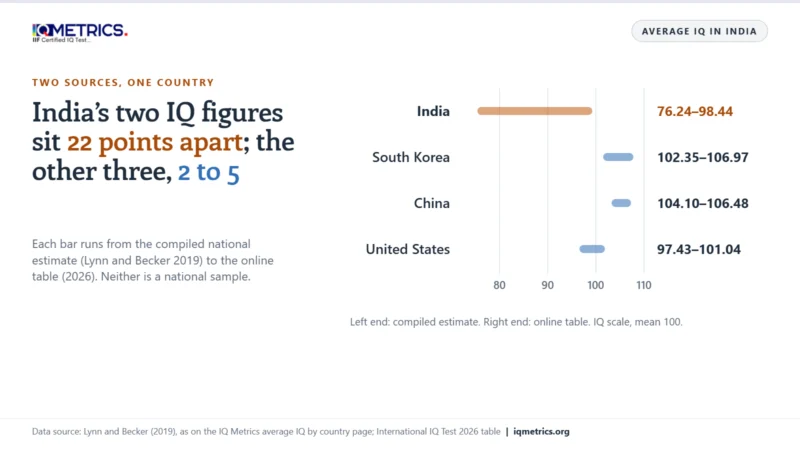
The average IQ in India is 100 on any test normed in India, because every IQ test sets its own average at 100. We found no national IQ sample for India. The figures that circulate are 76.24 from a compiled estimate (20,299 people in 20 studies) and 98.44 from an online table (8,340 takers), 22.2 points apart.
Below: where each figure comes from and why they differ. Then India’s one PISA result (2009+, two states), the 2024 ASER survey, and a comparison with China, the US and South Korea on the same two sources. New here: the two figures for India are 22 points apart, while the same two sources differ by only 2 to 5 points for those three countries. This page covers country-level data only. It says nothing about any group of people.
Key takeaways
- Any Indian-normed IQ test averages 100 by design. A national comparison needs a different kind of data.
- Two numbers circulate: 76.24 (compiled, 20 studies, mostly school samples) and 98.44 (online table, 8,340 volunteers). Neither is a national sample.
- India’s one PISA result, in 2009+, covers 15-year-olds in school in two states, Tamil Nadu and Himachal Pradesh. In maths they scored 351 and 338, and 85% to 88% of them were below PISA’s baseline level.
- ASER 2024 tested 649,491 rural children. By Std V, 30.7% could do a division problem, up from 25.6% in 2022.
What is the average IQ in India?
On a test normed in India, the average is 100 by construction. A norm group is a large sample of people who took the test. Its mean is set to 100, with a standard deviation (SD) of 15 points. An Indian who scores 100 is average among Indians. That says nothing about India against another country.
Four numbers get called the average IQ of Indians. They answer different questions, and none is an IQ test of all Indians. The India average IQ in most search results is one of them, printed with no sample. As far as we found, no nation’s IQ has been measured on one test given to a random sample of the whole country. The IQ of India is no exception.
| Source | India | Sample | What it measures |
|---|---|---|---|
| Compiled national estimate (Lynn and Becker 2019, on our average IQ by country page) | 76.24, 144th of 201 | 20,299 people in 20 studies | Published studies on different tests, averaged |
| Online test (International IQ Test 2026 table) | 98.44, 50th of 137 | 8,340 volunteers | People who chose to take one website’s test |
| PISA 2009+ (OECD), maths | Tamil Nadu 351, Himachal Pradesh 338 | 15-year-olds in school in two states | School maths skill, not IQ |
| ASER 2024 (Pratham), reading and arithmetic | Std V: 30.7% can divide | 649,491 rural children aged 5 to 16 | Basic skills, not IQ |
Why do the published figures for India differ so much?
They describe different people. The compiled 76.24 rests largely on school samples, and the online 98.44 rests on people who chose to take a web test. The gap is 22.2 points, about 1.5 SDs.
Our average IQ by country page reproduces the compiled figure from Lynn and Becker (2019). It gives India 20,299 people in 20 studies, rank 144 of 201. The page says the value rests largely on studies of rural schoolchildren, several of them decades old, tested on Western norms and often not in their first language. We did not open the 20 studies. We use only the 2019 edition because it is the one we could read.
The online figure comes from one website’s annual table, updated on 1 January 2026 from people who took its test in 2025. India is 50th of 137 with 98.44, from 8,340 takers. Our report on the 2026 online ranking shows that countries with more takers score higher, which is the opposite of what a fair national comparison needs. Our country page says self-selected Indian visitors typically score 15 to 20 points higher than the school samples.
The choice of studies can move a national figure a long way. For sub-Saharan Africa, one review found 67.4 or 80.4 depending on which studies were counted (Wicherts, Dolan and van der Maas, Intelligence, 2010, as summarised on our country page). Our report on why country IQ rankings are weaker than the charts suggest sets out the wider problem.
What does PISA show for India?
India has one PISA result: the 2009+ round, which tested 15-year-olds in school in two states, Tamil Nadu and Himachal Pradesh. PISA measures school skills, not IQ, as our guide to whether PISA is an IQ test explains.
| Subject | Tamil Nadu score | Himachal Pradesh score | At or above baseline (Tamil Nadu / Himachal Pradesh) | At or above baseline (OECD average) |
|---|---|---|---|---|
| Maths | 351 (72nd of 74) | 338 (73rd) | 15% / 12% | 75% |
| Reading | 337 (72nd) | 317 (73rd) | 17% / 11% | 81% |
| Science | 348 (72nd) | 325 (74th) | 16% / 11% | 82% |
The scores come from the 2009 PISA tables as reproduced on Wikipedia. The baseline shares come from ACER, the Australian Council for Educational Research (release of 16 December 2011). In maths and reading the two states ranked 72nd and 73rd of 74 systems, above only Kyrgyzstan.
Read the table with care. It covers two states, and only 15-year-olds still in school. It cannot stand for the whole of India. The baseline is the level at which students begin to use a skill in everyday life. Our estimate from the shares: 85% to 88% of the maths sample was below it, against 25% for the OECD.
Why did India stop taking part in PISA?
India pulled out of the 2012 round, and has not taken part since. The Indian government blamed a mismatch between the test questions and Indian students.
Wikipedia’s summary of the press reports says the education ministry cited a “socio-cultural disconnect” (The Indian Express, 3 September 2012). It says India did not take part in 2015 or 2018, and skipped 2022 citing COVID-19. India is also not among the systems in the OECD’s PISA 2025 results tables that we use for our country pages. Our report on PISA 2025 and what it does not show about IQ covers the latest round.
What do ASER's learning surveys say about India?
ASER 2024 found that basic skills rose after 2022 but remain low in rural schools. Fewer than half of Std V children in government schools can read a Std II text: 44.8% in 2024, up from 38.5% in 2022.
ASER is a household survey facilitated by Pratham. The 2024 round reached 649,491 children in 17,997 villages across 605 rural districts. Each child is tested one-on-one on reading and arithmetic at the highest level he or she reaches, and the method has not changed since 2006. It covers rural India only, and it measures skills, not IQ.
| Measure | 2018 | 2022 | 2024 |
|---|---|---|---|
| Std III reads a Std II text (government schools) | 20.9% | 16.3% | 23.4% |
| Std V reads a Std II text (government schools) | 44.2% | 38.5% | 44.8% |
| Std VIII reads a Std II text (government schools) | 69.0% | 66.2% | 67.5% |
| Std III can do a subtraction (all schools) | 28.2% | 25.9% | 33.7% |
| Std V can do a division (all schools) | 27.9% | 25.6% | 30.7% |
| Std VIII basic arithmetic (all schools) | 44.1% | 44.7% | 45.8% |
ASER says Std III reading in government schools is the highest since the survey began, and basic arithmetic the highest in over a decade. Enrolment of 6 to 14-year-olds is 98.1%. So most Indian children are in school. The surveys ask whether they have learned the basics there.
Where would your own score land?
Take the IIF-certified assessment and get your score with the scale it was measured on, the percentile it corresponds to and the confidence range around it — the three figures most online tests leave out.
Find your IQ score now! →Do IQ tests need Indian norms?
Yes. An IQ score means something only against the group the test was normed on, and India has 22 official languages, as our country page notes. A test normed in another country and given in a second language measures more than ability.
Schooling changes scores too. A meta-analysis of 142 effect sizes found about 1 to 5 IQ points per extra year of education (Ritchie and Tucker-Drob, Psychological Science, 2018). It drew on 42 data sets and over 600,000 participants. So an average built from rural school samples reflects schooling, language and test habits as well as ability.
Is the average IQ in India rising?
Nobody can say, because India has no national series of IQ scores. What is measured is skills, and ASER shows a rebound from 2022 to 2024.
Std III subtraction rose from 25.9% to 33.7% between 2022 and 2024, and Std V division from 25.6% to 30.7%. Against 2018 the gains are smaller: 28.2% to 33.7% and 27.9% to 30.7%. Those are school skills in rural India, not IQ.
How does India compare with China, the US and South Korea?
On the compiled estimate India is lowest of the four, and on the online table it is also lowest, but its two figures sit 22.2 points apart. For the other three the same two sources differ by 2.4 to 4.6 points.
| Country | Compiled estimate (2019) | People and studies | Online table (2026) | Gap between the two |
|---|---|---|---|---|
| India | 76.24 | 20,299 in 20 | 98.44 | 22.2 |
| China | 104.10 | 51,500 in 6 | 106.48 | 2.4 |
| United States | 97.43 | 62,649 in 58 | 101.04 | 3.6 |
| South Korea | 102.35 | 3,586 in 4 | 106.97 | 4.6 |
A small gap means two weak sources roughly agree. A 22-point gap means at least one of them is a poor guide, and for India both are. For the same kind of comparison on other countries, read our posts on the average IQ in South Korea and Israel, or the UK against the US. For the global picture, see our smartest countries study.
How can you check your own score?
- Treat 100 as the average Indian IQ on any Indian-normed test, and nothing more.
- Read the online table as web visitors, 76.24 as 20 studies, and PISA and ASER as school skills, not IQ.
- For a score of your own, take the IQ test, then place it with the IQ percentile calculator. Our guide to an IQ of 132 shows how the same number changes meaning from one scale to another.
Quick answers
- What is the average IQ in India? The average IQ in India is 100 on any Indian-normed test. Circulating national figures are 76.24 (compiled, 20 studies) and 98.44 (online, 8,340 takers).
- What is the IQ of India according to PISA? PISA is not an IQ test. In the 2009+ round Tamil Nadu scored 351 in maths and Himachal Pradesh 338; 15% and 12% of students reached the baseline, against 75% for the OECD.
- Why did India leave PISA? It pulled out of 2012, and the ministry cited a mismatch between the questions and Indian students, as The Indian Express reported.
- What does ASER show? Of 649,491 rural children surveyed in 2024, 33.7% of Std III children could do a subtraction, up from 25.9% in 2022.
- Is there a reliable Indian IQ? Not as one national figure. Both numbers come from self-chosen or school-based samples.
Sources
- Lynn R, Becker D (2019). The Intelligence of Nations. Ulster Institute for Social Research (NIQ-DATASET V1.3.2), as reproduced on our average IQ by country page.
- International IQ Test 2026 country table (updated 1 January 2026), as read and recomputed in our 2026 online ranking report.
- Australian Council for Educational Research (16 December 2011). ACER releases results of PISA 2009+ participant economies.
- PISA 2009 mean scores as tabulated in Programme for International Student Assessment (2009 and earlier), Wikipedia; India’s withdrawal as summarised in Programme for International Student Assessment, Wikipedia, which cites The Times of India (3 August 2012) and The Indian Express (3 September 2012).
- OECD (2026). PISA 2025 Results, Volume I: results for countries and economies, tables I.B1.2a.1 to I.B1.2a.3 (India is not listed).
- ASER Centre (2025). ASER 2024 national findings and ASER 2024 overview.
- Ritchie SJ, Tucker-Drob EM (2018). How much does education improve intelligence? A meta-analysis. Psychological Science.
- Wicherts JM, Dolan CV, van der Maas HLJ (2010). A systematic literature review of the average IQ of sub-Saharan Africans. Intelligence 38(1), 1-20.
Keep reading
All articles →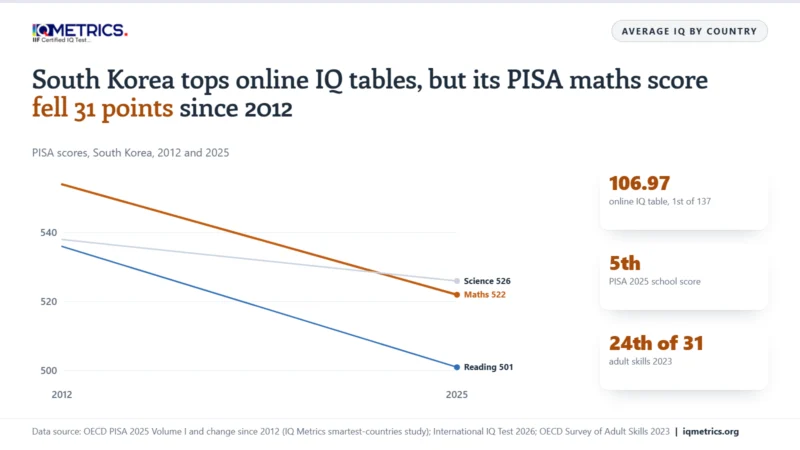 Scores & Scales
Average IQ in South Korea
Average IQ in South Korea is 100 on a Korean test. The 106.97 online is 26,996 volunteers. Korean teenagers rank 5th on PISA 2025, yet adults rank 24th of 31 in adult skills. See why, and what we know about North Korea.
 Scores & Scales
Average IQ in Israel
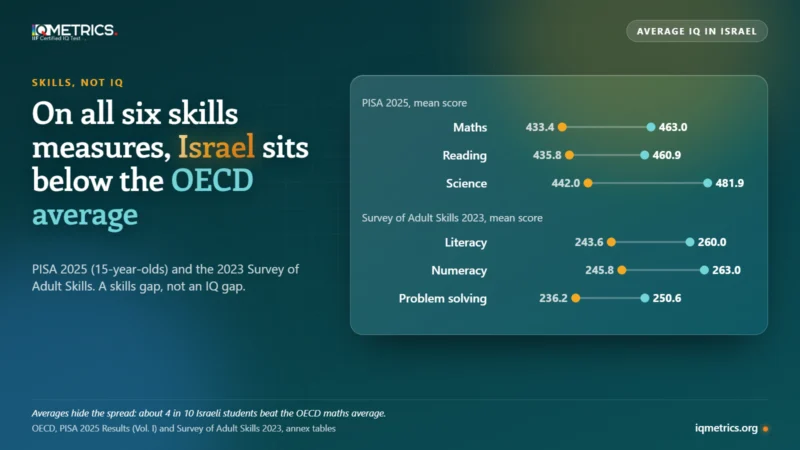
The average IQ in Israel is 100 on an Israeli-normed test. The circulating national figures are 98.57 from an online table and 92.43 from a compiled estimate. See PISA 2025 and adult skills against the OECD, how Israel compares with the US, Germany and South Korea, and what a country average cannot tell you.
 Understanding IQ
PISA Test vs IQ Test
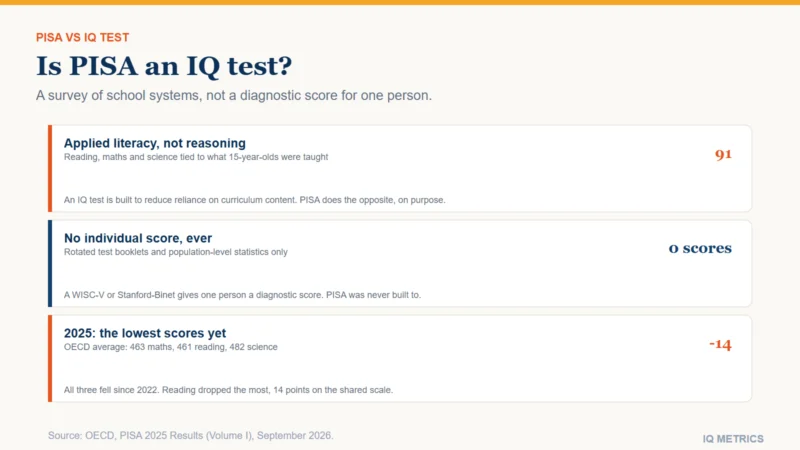
Is PISA an IQ test? No. PISA surveys applied school literacy across whole education systems and returns no individual score, while an IQ test diagnoses one person. See the new PISA 2025 results, published September 2026, and the real debate over using PISA as a national IQ proxy.