





Are Ravens Smart? What Studies Show About Planning, Tool Use and How They Differ From Crows
Ravens are smart on the tasks tested: they planned for tool use up to 17 hours ahead, guarded food from rivals they only heard, and matched chimpanzees on a self-control task. See the studies and how many birds each used, how ravens compare with crows and parrots, and why no raven has an IQ.

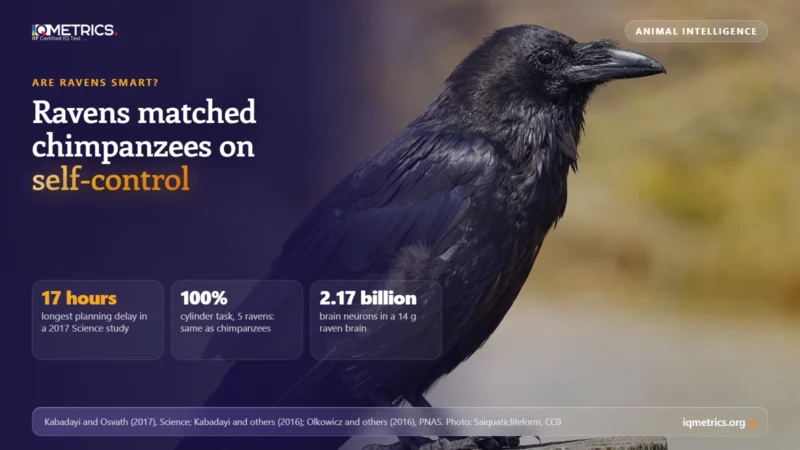
Are ravens smart? Yes. They are among the most studied birds in animal-intelligence research. Experiments show they plan for a need that arrives hours later, guard hidden food from rivals that can see or hear them, and resist grabbing visible food. No raven has an IQ, though: IQ needs human norms, so the evidence is a set of task results.
New here: the strongest raven evidence is social, not tool use. In a 2016 study, hand-raised ravens guarded their food stores when they heard another raven through an open peephole, but not through a closed one. And every raven result below rests on 3 to 10 birds. Below: the experiments, ravens against crows and parrots, and why there is no raven IQ.
Key takeaways
- Ravens planned for tool use and bartering with delays of up to 17 hours, in a 2017 Science study that reports performance parallel to great apes.
- In a 2016 study of ten hand-raised ravens, the birds treated a rival they could only hear as a rival that could see, when a peephole was open.
- On a self-control task, all 5 ravens succeeded on every trial (100%), the same score as chimpanzees. Jackdaws scored 97% and New Caledonian crows 92%.
- A raven brain holds about 2.17 billion neurons in 14 grams, 2.2 times a jackdaw’s, but the count rests on 3 birds.
- There is no raven IQ. The Raven’s matrices test is a different thing: a test for people.
Are ravens smart, and how smart is a raven?
Ravens are smart on specific tasks that scientists have tested: planning, hiding food from rivals and self-control. How smart is a raven overall? No test measures that, and no study ranks ravens on one scale.
How smart are ravens compared with apes? On two tasks the answer is: about the same. The table lists the main experiments, how many birds took part and where each was published. The sample sizes come from the papers’ methods sections, and the first row is abstract-only.
| Question | What the ravens did | Ravens tested | Paper |
|---|---|---|---|
| Can they plan for the future? | Chose and used a tool or a token for a task that came up to 17 hours later; waited and considered how far off it was | Not read (abstract only) | Kabadayi and Osvath 2017, Science |
| Do they know what a rival saw? | Changed how they guarded caches when a rival had or had not watched the caching | 7 (experiment 1) | Bugnyar and Heinrich 2005, Proc R Soc B |
| Do they infer being seen? | Guarded caches when they heard a rival through an open peephole, not a closed one | 10 (9 in the main tests) | Bugnyar, Reber and Buckner 2016, Nature Communications |
| Can they resist temptation? | Succeeded on every trial of the cylinder task (100%) | 5 | Kabadayi and others 2016, Royal Society Open Science |
| How many brain neurons? | Counted: about 2.17 billion in a 14.1 g brain | 3 | Olkowicz and others 2016, PNAS |
Do ravens plan for the future?
Yes, in the lab. A 2017 study in Science found that ravens planned for events with no link to food hiding, in tool use and bartering, with delays of up to 17 hours.
The authors also report that the ravens exerted self-control and considered how far off the future event was. They write that the performance parallels that seen in apes and suggests planning evolved independently in corvids. That is a claim about two kinds of planning task, not about an ape-level mind. We read the abstract only, so we give no sample size here; our crow IQ guide lists the experiments for crows and ravens side by side.
Ravens also hide food and must remember where it is. You can test your own recall in our memory game.
Can ravens tell what another bird knows or sees?
Some evidence says yes. Ravens change how they guard hidden food depending on what a rival could have seen, and a 2016 study found they respond even to a rival they cannot see.
In 2005, Thomas Bugnyar and Bernd Heinrich ran experiments with hand-raised ravens, seven in the first one. Birds that stored food, and birds that tried to steal it, behaved differently when a rival had watched the caching than when it had not. The authors conclude that the birds recall whom they saw during caching and know that obstacles can block the view of others.
The 2016 study, by Bugnyar, Stephan Reber and Cameron Buckner, tried to rule out a simpler idea: that ravens only follow a rival’s line of gaze. Ten subadult ravens (6 males, 4 females) were tested, nine in the main comparisons.
The birds had learned to use a peephole into the next room. Then they cached food while they could only hear another raven. With the peephole open, they finished their caches sooner and went back to improve them less often than in the non-observed condition (both differences significant). With it closed, they did not guard in the same way. The authors read this as ravens generalising from their own experience of looking through a peephole.
There is a limit. As a group, the ravens did not choose caching spots away from the open peephole, and the authors say more work is needed to find the limits of ravens and other animals on such tasks. Ten captive, hand-raised birds from one research station also cannot stand for every raven.
Where would your own score land?
Take the IIF-certified assessment and get your score with the scale it was measured on, the percentile it corresponds to and the confidence range around it — the three figures most online tests leave out.
Find your IQ score now! →Raven intelligence vs crow and parrot: which is smarter?
No study ranks them on one test battery. On the one task given to ravens and crows alike, ravens scored 100%, jackdaws 97% and New Caledonian crows 92%, on small groups of birds.
That task is the cylinder task. Birds first learn to take food from an opaque tube open at both ends. Then a clear tube replaces it: a direct grab at the visible food counts as a failure, and going round to an opening counts as a success.
The raven and crow results come from one 2016 paper, which also set them beside ape scores from an earlier study. We add a second source, the 2016 neuron count by Olkowicz and colleagues, to put brain size and neuron numbers in the same table. The neuron table has no crow species and no cylinder scores for the parrots, so some cells are empty.
| Species | Cylinder task, success | Birds in cylinder task | Endocranial volume (cm3) | Total brain neurons (millions) | Birds in neuron count |
|---|---|---|---|---|---|
| Raven | 100% | 5 | 14.5 | 2,171 | 3 |
| Jackdaw | 97% | 10 | 5.2 | 968 | 3 |
| New Caledonian crow | 92% | 10 | 7.3 | ||
| Rook | 1,509 | 3 | |||
| Gray parrot | 1,566 | 2 | |||
| Kea | 2,149 | 1 | |||
| Blue-and-yellow macaw | 3,136 | 1 | |||
| Chimpanzee (ape data from an earlier study) | 100% | 368.4 |
Read across the rows. A raven matches a chimpanzee on the cylinder task with a brain about 25 times smaller by volume. By total neurons the raven (2.17 billion) is level with the kea (2.15 billion) and the sulfur-crested cockatoo (2.12 billion), 1 bird each, and behind the macaw (3.14 billion, 1 bird). The raven also has 2.2 times a jackdaw’s neurons.
The paper’s text adds that the raven and the kea have about 1.2 billion neurons in the pallium, more than a capuchin monkey has in its pallium.
So raven intelligence vs crow intelligence depends on the task. The raven’s lead over the crow on the cylinder task is 8 points on groups of 5 and 10 birds, which is too little to rank them. Our report the smartest bird in the world ranks birds by neuron counts and behaviour tests, and our guides to parrot IQ, owls and pigeons cover other birds.
Do ravens have an IQ?
No. There is no raven IQ, because an IQ score compares a person with the norm group of people the same age, and no norm group exists for any bird.
Any raven IQ you see in a list or a meme has no source, and checking the source matters for national IQ figures too: our page on the average IQ in Mexico shows what one such figure rests on. Scientists test ravens with tasks built for the species and report what the birds did, as the table above does. The same reason applies to apes: our page on chimpanzee IQ explains it.
One more thing: a search for raven IQ also finds Raven’s Progressive Matrices, a pattern test for people named after the psychologist John Raven. It has nothing to do with the bird, and our guide to Raven’s Progressive Matrices scores covers it. To see where your own score falls, take the IQ test.
Quick answers
- Are ravens smart? Yes, on the tasks tested: planning up to 17 hours ahead, guarding food from rivals and self-control.
- How smart is a raven? No test gives one overall figure. On the cylinder task, 5 ravens scored 100%, the same as chimpanzees.
- Do ravens plan for the future? In the lab, yes: a 2017 Science study found planning for tool use and bartering with delays of up to 17 hours.
- Are ravens smarter than crows? Not shown. On the one shared task the ravens scored 100% and New Caledonian crows 92%, on 5 and 10 birds.
- Do ravens have an IQ? No. IQ needs human norms, so no bird has one.
Sources
- Kabadayi, C. and Osvath, M. (2017). Ravens parallel great apes in flexible planning for tool-use and bartering. Science 357:202-204 (abstract read on 19 November 2026).
- Bugnyar, T. and Heinrich, B. (2005). Ravens, Corvus corax, differentiate between knowledgeable and ignorant competitors. Proceedings of the Royal Society B 272:1641-1646.
- Bugnyar, T., Reber, S. A. and Buckner, C. (2016). Ravens attribute visual access to unseen competitors. Nature Communications 7:10506.
- Kabadayi, C., Taylor, L. A., von Bayern, A. M. and Osvath, M. (2016). Ravens, New Caledonian crows and jackdaws parallel great apes in motor self-regulation despite smaller brains. Royal Society Open Science 3:160104.
- Olkowicz, S. and others (2016). Birds have primate-like numbers of neurons in the forebrain. PNAS 113:7255-7260, supplementary Table S1 (all read on 19 November 2026).
Keep reading
All articles →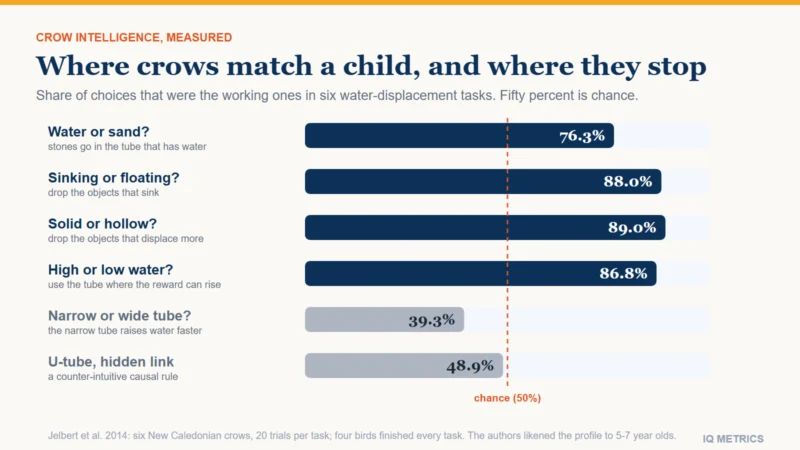 Understanding IQ
Crow and Raven IQ
A crow has no IQ, but tests show what corvids can do: bend wire, plan hours ahead, count their own calls. The 7-year-old comparison traces to one 2014 study of six crows, who were at chance on two of six puzzles.
 Understanding IQ
Chimpanzee IQ
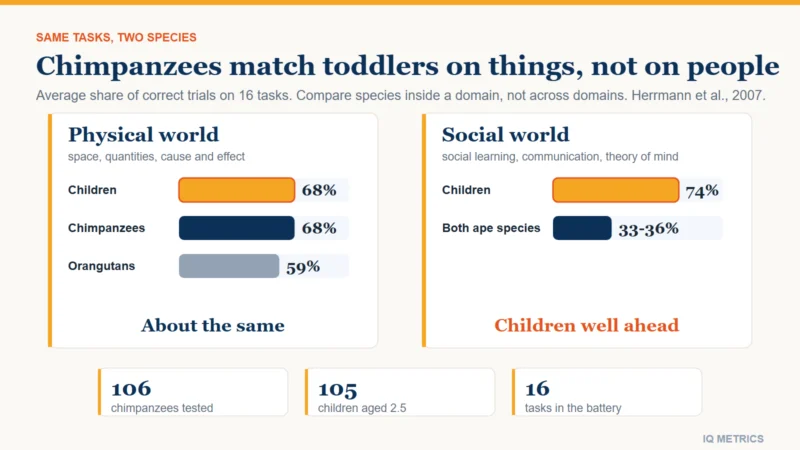
Chimpanzees have no IQ, but they have been tested. How chimps and 2.5-year-old children scored on the same 16 tasks, what a chimpanzee brain holds, the memory claim that did not survive practice, and whether chimps have a g factor.
 Understanding IQ
Parrot IQ
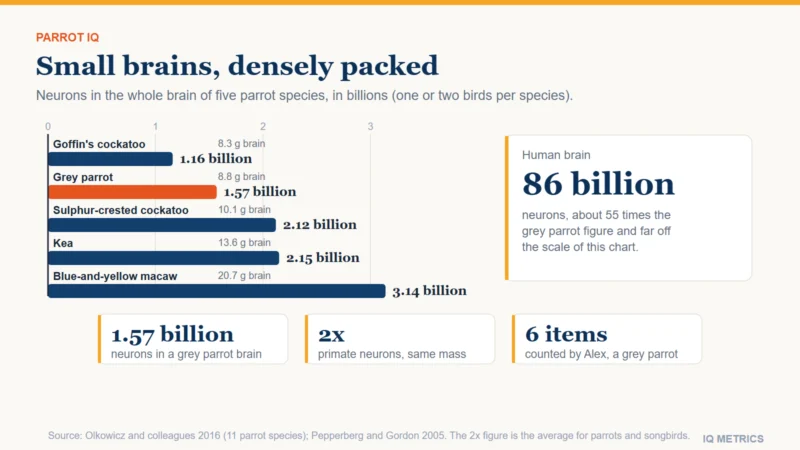
Parrots have no IQ score: no validated test gives one. Studies measure single skills instead. Alex, a grey parrot, named the number in sets of up to six items and used none for zero, kea predicted draws from odds, and parrot brains hold about twice as many neurons as primate brains of the same mass.