





Are Pigeons Smart? What the Counting, Art and Cancer-Slide Experiments Show
Pigeons learned to tell Monet from Picasso, sorted benign from malignant breast slides at about 85% correct and came closer to the best Monty Hall play than people, but they failed on mammogram masses. A pigeon brain holds about 310 million neurons, against 2.17 billion in a raven. See what pigeons passed and what they did not.

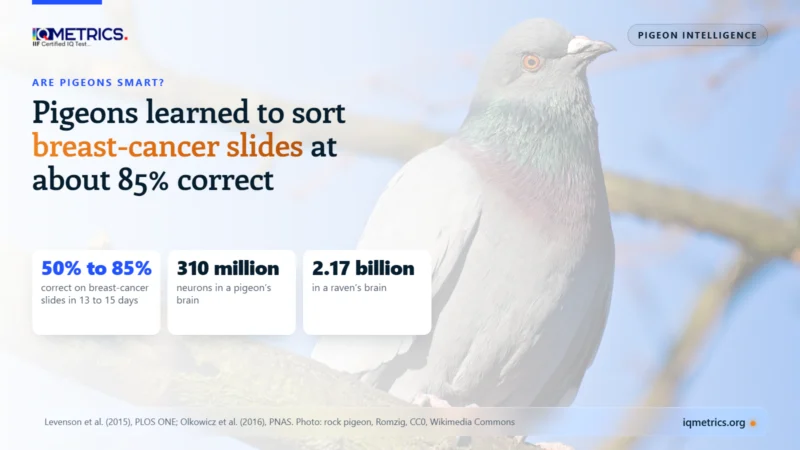
Are pigeons smart? In lab tests, yes. Pigeons learned to tell Monet from Picasso, to sort benign from malignant breast slides at about 85% correct, and to get closer to the best Monty Hall strategy than people did. They also failed one task, classifying mammogram masses. A pigeon’s brain holds about 310 million neurons, against 2.17 billion in a raven. No pigeon has an IQ.
New here: one table of what pigeons passed and what they did not, each row tied to its paper. And only about 27% of a pigeon’s brain neurons sit in the forebrain, against 56% in a jackdaw or a magpie and 62% in a raven. Below: the experiments one by one, the brain numbers, and why no pigeon IQ exists.
Key takeaways
- Passed: the Monty Hall puzzle (Herbranson and Schroeder, 2010), an abstract numerical rule (Scarf and others, Science, 2011), Monet versus Picasso (Watanabe and others, 1995) and benign versus malignant breast slides (Levenson and others, 2015).
- Not passed: classifying mammogram masses. The birds memorised the pictures and could not handle new ones (Levenson and others, 2015).
- Slides: accuracy rose from chance, 50%, on day 1 to near 85% by days 13 to 15. On new images the birds scored 85%, against 87% on familiar ones.
- Brain: a rock pigeon has a 2.1 g brain with about 310 million neurons, 27% of them in the forebrain. A raven has 7.0 times as many neurons in a brain 6.7 times as heavy.
- Self-control: given the same two tasks, dogs scored higher than pigeons (cylinder 79% against 33%, A-not-B 89% against 55%). That is one skill, not general intelligence. Not shown: a pigeon IQ.
Are pigeons smart? What they passed and what they did not
Pigeons are smart at some lab tasks and weak at others. Pigeon intelligence has been tested one task at a time, usually in a chamber where a bird pecks a key for grain.
The table lists each result with its paper. We read every abstract, and the open-access breast-cancer paper in full.
| Experiment (paper) | What the pigeons did | Result |
|---|---|---|
| Monty Hall puzzle (Herbranson and Schroeder, 2010) | Adjusted how often they switched and stayed, and approached the optimal strategy | Passed |
| Abstract numerical rule (Scarf, Hayne and Colombo, 2011) | Used a numerical rule with performance indistinguishable from monkeys’ | Passed |
| Monet versus Picasso (Watanabe, Sakamoto and Wakita, 1995) | Sorted new paintings by both artists; carried over to Cezanne, Renoir, Braque and Matisse | Passed; upside-down Monet disrupted it |
| Benign versus malignant breast slides (Levenson and others, 2015) | From 50% to near 85% correct in 13 to 15 days; 85% on new images | Passed |
| Microcalcifications on mammograms (same paper) | Detected cancer-relevant calcifications | Passed |
| Mammogram masses (same paper) | Memorised the images; could not generalise to new examples | Not passed |
Can pigeons count, and can they learn rules?
Pigeons can use an abstract numerical rule, at least in one lab test. Scarf, Hayne and Colombo (Science, 2011) reported that this ability is present in pigeons, and that their performance was indistinguishable from monkeys’.
The paper starts from a contrast. Many animals can tell a larger set from a smaller one, but only primates were thought to share our ability to use abstract numerical rules. The pigeons joined the primates.
So can pigeons count? They can treat number as a rule, not just tell two sets apart. That is not counting aloud, as people do. We could read only the paper’s two-sentence abstract, so we give no trial numbers from it.
Can pigeons tell paintings apart?
Yes, at least Monet from Picasso. Watanabe, Sakamoto and Wakita (Journal of the Experimental Analysis of Behavior, 1995) trained pigeons to tell colour slides of paintings by the two artists. The birds then sorted new paintings they had never seen.
The pigeons also carried the rule across artists. They generalised from Monet to Cezanne and Renoir, and from Picasso to Braque and Matisse. The authors say this suggests categorising.
Turning the slides upside down disrupted the Monet discrimination but not the Picasso one. The authors write that this may indicate the pigeons were reading objects in the Impressionist paintings but not in the Cubist ones.
Can pigeons spot cancer on slides?
Pigeons can sort benign from malignant breast tissue slides at about 85% correct, but not every cancer task. Levenson, Krupinski, Navarro and Wasserman (PLOS ONE, 2015) trained pigeons with food rewards on images of human breast histopathology.
Accuracy rose from 50%, which is chance, on day 1 to near 85% by days 13 to 15. On new images the birds scored 85%, against 87% on familiar ones, so they were not only remembering pictures. When four birds’ answers were pooled, group accuracy reached 99% on the full set of uncompressed images. Experiment 1 used 8 pigeons, and Experiments 2 and 3 used 4 each.
The birds could also detect cancer-relevant microcalcifications on mammograms. But they failed at classifying suspicious masses, a task the authors call quite difficult for humans too. There they only memorised the images and could not generalise to new ones. The authors see pigeons as models for studying how people read medical images, not as stand-ins for doctors.
Did pigeons beat humans at the Monty Hall problem?
In one set of experiments, the pigeons came closer to the best strategy than people did. Herbranson and Schroeder (Journal of Comparative Psychology, 2010) gave pigeons a version of the puzzle. Three response keys served as the three doors, and mixed grain was the prize.
The birds adjusted how often they switched and stayed, and approached the optimal strategy. People who repeated the procedure failed to adopt optimal strategies, even with extensive training. The paper’s title, “Are birds smarter than mathematicians?”, is a question, not a finding. The birds had many trials with food feedback.
Our report on the Monty Hall problem and what the pigeons did explains why switching wins two times in three.
Where would your own score land?
Take the IIF-certified assessment and get your score with the scale it was measured on, the percentile it corresponds to and the confidence range around it — the three figures most online tests leave out.
Find your IQ score now! →How does a pigeon brain compare with a crow's?
A rock pigeon’s brain weighs about 2.1 g and holds about 310 million neurons. The corvids in the same study hold 3 to 7 times as many.
Olkowicz and colleagues (PNAS, 2016) counted neurons in 28 bird species with the isotropic fractionator, which counts the nuclei of neurons after the tissue is homogenised. The table uses a jackdaw, a magpie and a raven, which are all members of the crow family, beside a rock pigeon. The forebrain here is the telencephalon of the paper’s tables.
| Bird | Brain weight (g) | Neurons in the whole brain (millions) | Neurons in the forebrain (millions) | Share of neurons in the forebrain |
|---|---|---|---|---|
| Raven | 14.1 | 2,170.7 | 1,355.3 | 62% |
| Jackdaw | 6.0 | 968.0 | 541.4 | 56% |
| Magpie | 5.4 | 897.3 | 497.9 | 55% |
| Rock pigeon | 2.1 | 310.0 | 83.3 | 27% |
A raven holds 7.0 times the pigeon’s neurons, a jackdaw 3.1 times and a magpie 2.9 times. In the forebrain the gap is wider: 16.3, 6.5 and 6.0 times. Only 27% of a pigeon’s neurons sit in the forebrain, against 56% in a jackdaw, 55% in a magpie and 62% in a raven.
Behaviour gives a mixed picture. MacLean and colleagues (PNAS, 2014) gave two self-control tasks to many species, and their raw data hold two jays. On the cylinder task, Eurasian jays scored 58% and Western scrub jays 77%, against the pigeons’ 33%. On the A-not-B task the jays scored 17% each, below the pigeons’ 55%.
The paper’s abstract says corvids and parrots have a much higher share of brain neurons in the forebrain than other birds. It suggests that large numbers of densely packed neurons help explain avian intelligence. A count is a clue, not a test result. Our crow IQ and parrot IQ pages set out what those birds have been tested on, and are owls smart does the same for a bird of prey.
Are pigeons smarter than dogs?
On two self-control tasks, dogs scored higher. That is not the same as being smarter. MacLean and colleagues (PNAS, 2014) gave the same two tasks to 567 animals of 36 species, and both pigeons and dogs were among them.
In the cylinder task, an animal must detour round a clear cylinder to reach food instead of bumping into it. Dogs chose the detour on 79% of test trials, pigeons on 33%. In the A-not-B task, each animal had one test trial, and 89% of dogs and 55% of pigeons searched in the right place. We computed these means from the paper’s raw data: 66 dogs and 12 White Carneau pigeons in the first task, 66 dogs and 11 pigeons in the second.
Self-control is one skill, and the paper does not rank species on general intelligence. It found that absolute brain volume best predicted scores across species. Its raw data also cover great apes: see are orangutans smart. Our dog IQ page sets out what dog studies measured. For another bird, see are chickens smart, and for the whole field, our smartest animals study and the report on the smartest bird in the world.
Is there a pigeon IQ?
No. An IQ ranks a person against others of the same age on one test, and there is no such test or norm group for pigeons. Any “pigeon IQ” number is invented.
What exists are task results, as above. To try short tests of your own memory, speed and logic, play our Brain Games, such as the memory game, which works visual memory. To see where your own score falls, take the IQ test.
Quick answers
- Are pigeons smart? In lab tests, yes. They learned to sort Monet from Picasso and benign from malignant slides, and they approached the best Monty Hall strategy.
- How smart are pigeons? Smart at some tasks, weak at others. They failed to generalise on mammogram masses.
- Can pigeons count? They can use an abstract numerical rule, with performance indistinguishable from monkeys’ in one study (Science, 2011).
- What is pigeon intelligence like? Measured one task at a time, with food as the reward. A pigeon brain holds about 310 million neurons, a raven’s 2.17 billion.
- Is there a pigeon IQ? No. There is no test or norm group for pigeons.
- Are pigeons smarter than dogs? Dogs scored higher on two self-control tasks in one 36-species study (PNAS, 2014). That is one skill, not general intelligence.
Sources
- Herbranson WT, Schroeder J (2010). Are birds smarter than mathematicians? Pigeons (Columba livia) perform optimally on a version of the Monty Hall Dilemma. Journal of Comparative Psychology 124(1), 1-13 (abstract read).
- Scarf D, Hayne H, Colombo M (2011). Pigeons on par with primates in numerical competence. Science 334, 1664 (abstract read).
- Watanabe S, Sakamoto J, Wakita M (1995). Pigeons’ discrimination of paintings by Monet and Picasso. Journal of the Experimental Analysis of Behavior 63(2), 165-174 (abstract read).
- Levenson RM, Krupinski EA, Navarro VM, Wasserman EA (2015). Pigeons (Columba livia) as trainable observers of pathology and radiology breast cancer images. PLOS ONE 10(11), e0141357 (open access; read).
- Olkowicz S and others (2016). Birds have primate-like numbers of neurons in the forebrain. PNAS 113(26), 7255-7260 (abstract and supplementary Tables S1 and S4 read on 16 November 2026).
- MacLean EL and others (2014). The evolution of self-control. PNAS 111(20), E2140-E2146 (abstract and methods read; species means computed from the paper’s raw data).
- Photo: a rock pigeon (Columba livia), Romzig, 13 March 2026, CC0, via Wikimedia Commons.
Keep reading
All articles →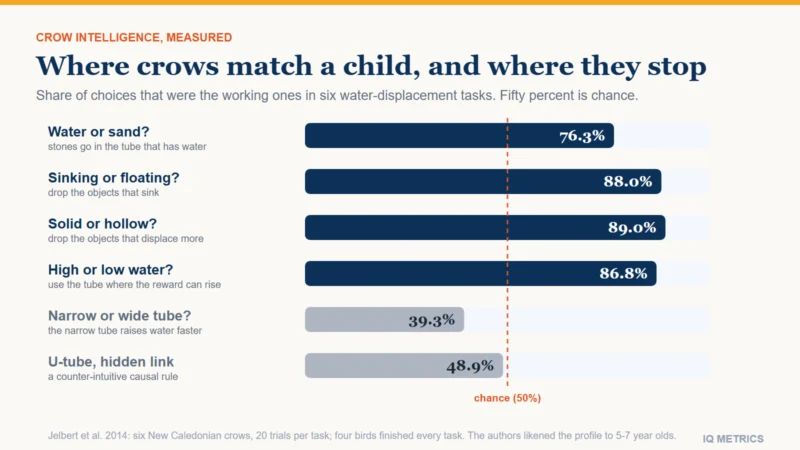 Understanding IQ
Crow and Raven IQ
A crow has no IQ, but tests show what corvids can do: bend wire, plan hours ahead, count their own calls. The 7-year-old comparison traces to one 2014 study of six crows, who were at chance on two of six puzzles.
 Understanding IQ
Parrot IQ
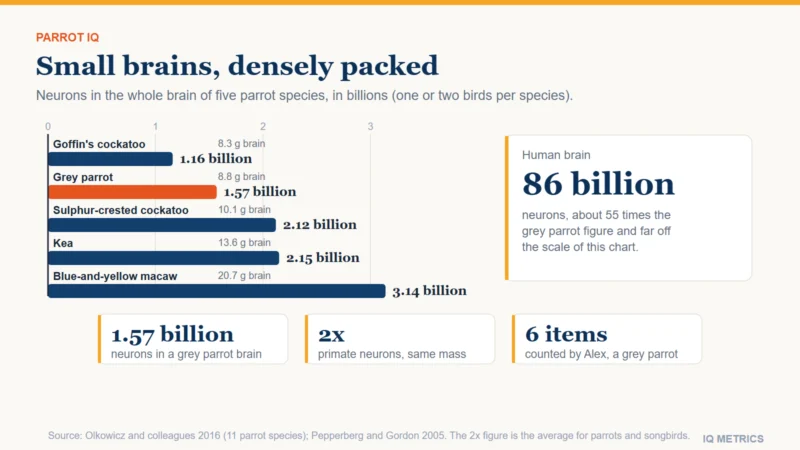
Parrots have no IQ score: no validated test gives one. Studies measure single skills instead. Alex, a grey parrot, named the number in sets of up to six items and used none for zero, kea predicted draws from odds, and parrot brains hold about twice as many neurons as primate brains of the same mass.
 Mind & Everyday Life
Are Owls Smart?
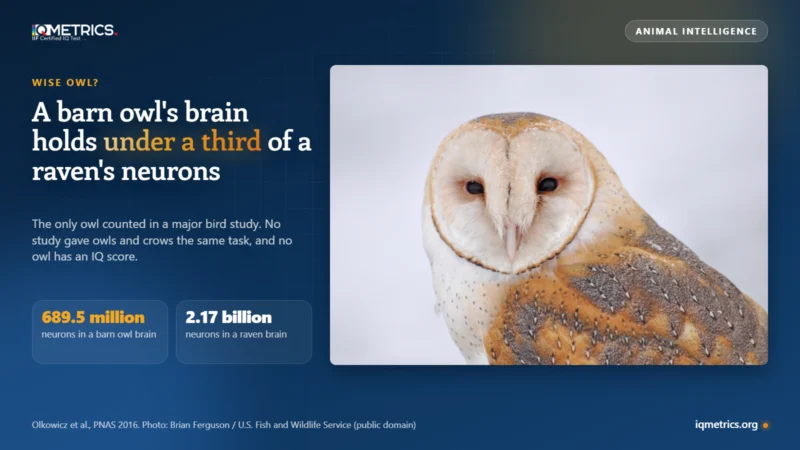
Owls are smart in the tests that exist: burrowing owls bait dung beetles with dung and captive owls know their keepers' voices. A barn owl's brain holds 689.5 million neurons, under a third of a raven's 2.17 billion, and no study gave owls and crows the same task. See what the studies show.