



Smartest Bird in the World: Ranked by What Studies Measured
Counting neurons in 28 bird species puts the blue-and-yellow macaw first, with 2.46 billion in the forebrain, and the raven fourth. On behaviour tests, ravens, crows, rooks, jays and grey parrots all have standout results. No study ranks them on one test.


What you need to know
- No bird has an IQ, so "smartest" depends on the measure. In a 2016 count of 73 birds from 28 species (Olkowicz and colleagues, PNAS), the forebrain of a blue-and-yellow macaw holds 2.46 billion neurons, a kea 1.63 billion, a sulphur-crested cockatoo 1.49 billion and a raven 1.36 billion.
- A pigeon's forebrain holds 83 million neurons and a red junglefowl's 74 million. A raven's has about 16 times the pigeon's, and a macaw's about 30 times, from birds with brains of 14 and 21 grams.
- The count has gaps. The macaw, kea and sulphur-crested cockatoo are one bird each, the pallium split rests on one bird per species, and no crow is in the sample, not even the tool-using New Caledonian crow.
- Behaviour tests point to the same two groups, corvids and parrots, but each result is from a different bird, task and small sample, such as 8 crows, 4 rooks or one grey parrot. We found no study that tests them on one battery.
Which is the smartest bird in the world? No bird has an IQ, so the answer depends on the measure. By forebrain neurons in a 2016 count of 28 bird species, the blue-and-yellow macaw leads with 2.46 billion, then the kea, the sulphur-crested cockatoo and the raven at 1.36 billion. On behaviour tests, ravens, crows, rooks, scrub-jays and grey parrots all have standout results. No study we found ranks them on one test.
The new finding is a caveat that rarely makes the headline. The famous neuron count has no crow in it. The New Caledonian crow, star of the tool-use studies, was not among the 28 species, and the top parrots are one bird each. Below: the ranking by neurons, the ranking by tests, and why they do not add up to one winner.
Which is the smartest bird in the world?
No one can say who the smartest bird in the world is. Intelligence has no single scale across species, and no study compares all the contenders. Two kinds of evidence exist. One is how many neurons a bird's forebrain holds. The other is how birds do on tests built for them. Both point to two groups of smartest bird species, corvids (crows, ravens, jays) and parrots, but not to one winner.
For single birds and single skills, our guides to crow and raven IQ and parrot IQ go into detail. This article is the side-by-side view they do not give.
Which birds have the most neurons? The smartest birds ranked by the count
Olkowicz and colleagues (Proceedings of the National Academy of Sciences, 2016) counted neurons in 73 birds from 28 species. The forebrain, or telencephalon, is the part that does the work of the mammalian cortex. Here are the smartest birds ranked by that count, the top ten species and two comparison birds, with the number of birds counted in brackets. Brain mass is in grams and neurons are in millions.
- 1. Blue-and-yellow macaw (1 bird): forebrain 2,459, whole brain 3,136, brain mass 20.7 g
- 2. Kea (1 bird): forebrain 1,630, whole brain 2,149, brain mass 13.6 g
- 3. Sulphur-crested cockatoo (1 bird): forebrain 1,491, whole brain 2,122, brain mass 10.1 g
- 4. Common raven (3 birds): forebrain 1,355, whole brain 2,171, brain mass 14.1 g
- 5. Grey parrot (2 birds): forebrain 1,148, whole brain 1,566, brain mass 8.8 g
- 6. Rook (3 birds): forebrain 918, whole brain 1,509, brain mass 8.4 g
- 7. Goffin's cockatoo (2 birds): forebrain 715, whole brain 1,161, brain mass 8.3 g
- 8. Eurasian jay (3 birds): forebrain 600, whole brain 1,085, brain mass 4.6 g
- 9. Jackdaw (3 birds): forebrain 541, whole brain 968, brain mass 6.0 g
- 10. Magpie (3 birds): forebrain 498, whole brain 897, brain mass 5.4 g
- For comparison, rock pigeon (3 birds): forebrain 83, whole brain 310, brain mass 2.1 g. Red junglefowl (3 birds), the wild ancestor of the chicken: forebrain 74, whole brain 221, brain mass 2.8 g
Three things stand out. The top four species hold 1.4 to 2.5 billion forebrain neurons, against 83 million in a pigeon. A raven's forebrain has about 16 times the pigeon's, and a macaw's about 30 times. Second, the top ten splits five and five between parrots and corvids, and parrots hold four of the top five places. Third, brain mass is a poor guide: the kea, at 13.6 g, has more forebrain neurons than the raven at 14.1 g.
For scale, the paper puts the pallium, the cortex-like layer of the forebrain, at about 1.2 billion neurons in the raven and kea and about 1.9 billion in the macaw. A human cerebral cortex holds about 16 billion, by our arithmetic from the 86.1 billion neurons and 19% cortical share counted by Azevedo and colleagues (2009). The macaw's pallium is about one-eighth of that.
How reliable is the bird neuron count?
Less than the headlines suggest. The macaw, kea and sulphur-crested cockatoo are single birds. The grey parrot and Goffin's cockatoo are two each. The paper's own methods say the split between pallium and subpallium was made in one individual per species. A count from one bird cannot say how much birds of that species vary.
The sample also leaves out the famous names. The 13 songbird species include a raven, a rook, a jackdaw, a magpie, an azure-winged magpie and a Eurasian jay, but no crow. The New Caledonian crow has no neuron count in this paper. Any claim that the crow's tool use "matches its neuron count" is therefore an inference from its cousins.
Which birds do best on cognition tests?
Several, and no bird wins them all. Each result below comes from a different task and a small sample.
- New Caledonian crows: 8 crows treated a moving stick differently when a hidden human might have moved it, which suggests reasoning about an unseen cause (Taylor, Miller and Gray, PNAS, 2012). Earlier work reported crows shaping hooks (Weir, Chappell and Kacelnik, Science, 2002)
- Rooks: all 4 captive rooks solved an Aesop's-fable problem by dropping stones to raise water until a floating worm came within reach (Bird and Emery, Current Biology, 2009)
- Western scrub-jays: the jays stored food where they would be hungry the next morning, which the authors read as planning for a future need (Raby and colleagues, Nature, 2007)
- Magpies: some birds showed mark-directed behaviour in a mirror test, the first such evidence in a non-mammal (Prior, Schwarz and Gunturkun, PLoS Biology, 2008)
- Crows: they produced one to four calls on cue, and the first call predicted the total, which the authors read as planning (Liao, Brecht, Veit and Nieder, Science, 2024)
- Grey parrot: one bird, Alex, named quantities up to six with accuracy above 80% and used "none" for zero (Pepperberg and Gordon, Journal of Comparative Psychology, 2005)
- Kea: given a string-pulling problem, the birds found an immediate solution that nine more trials did not improve, which the review reads as insight (Huber and Gajdon, Animal Cognition, 2006)
- Goffin's cockatoo: one bird spontaneously made and used tools (Auersperg and colleagues, Current Biology, 2012)
Notice the sample sizes: 8 crows, 4 rooks, one grey parrot, one cockatoo. These are strong findings about those birds on those tasks. They are not a league table. For a comparison with dogs, where a ranking does exist for one measure, see our article on smartest dog breeds and what Coren's order measures.
Are crows smarter than parrots?
The evidence does not decide it. Parrots lead on raw forebrain neurons, with the macaw at 2.46 billion against the raven's 1.36 billion. Corvids show strong results on tool use, planning and reasoning about hidden causes. We found no study that tested ravens, grey parrots and keas on the same battery, so a head-to-head claim goes beyond the data.
What the count does show is that both groups sit far above ordinary birds. The paper's abstract says corvids and parrots have much higher proportions of brain neurons in the pallium than primates, other mammals or other birds, and that large-brained parrots and corvids have forebrain counts equal to or greater than primates with much larger brains. That makes them the sensible short list, not the proven winners.
Why can't birds be ranked by IQ?
An IQ is a position on a bell curve built from thousands of people, with an average of 100 and a standard deviation of 15 on most modern tests. No such norm group exists for any bird. The IQ bell curve shows what the number means for people, and why a bird cannot have one.
Researchers compare animals task by task. Our smartest animals study sets out how we handled that across species, and our guide to brain size and IQ explains why brain mass alone is a weak guide even in people. Pigeons, the low end of the neuron table, still do surprising things; see the Monty Hall problem and the pigeons.
Ask which bird is smartest and the data give two groups, corvids and large parrots, not one winner.
What is the smartest bird ever?
No one can name the smartest bird ever. The best-documented individual in the studies above is Alex, the grey parrot, whose number skills were tested in the studies above. But he is one bird tested on one family of tasks, and no study sets him beside the best crow or kea. The smartest bird on earth, as a title, rests on a scale nobody has built.
Where would your own score land?
Birds have no IQ, but you can have yours measured. The IQ Metrics test reports a score on the standard scale with its percentile.
Find your IQ score now! →If you want a number for yourself, take the IQ test and read it against the bell curve. Birds have to be compared task by task. People can be placed on one scale.
Common questions
What is the smartest bird in the world?
No one can say. By forebrain neurons in a 2016 count (73 birds, 28 species), the blue-and-yellow macaw leads with 2.46 billion, ahead of the kea, sulphur-crested cockatoo and raven. On behaviour tests, ravens, crows, rooks, scrub-jays and grey parrots all stand out. No study ranks them on one test.
Are crows or parrots smarter?
The evidence does not decide it. Parrots lead on raw forebrain neurons (macaw 2.46 billion, raven 1.36 billion). Crows and ravens show strong tool use, planning and causal reasoning. We found no study that tested both on the same battery, so a head-to-head answer would go beyond the data.
What is the smartest bird ever?
No one can name it. Alex the grey parrot is among the best-documented individuals: he named quantities up to six with accuracy above 80% and used "none" for zero. But he is one bird tested on one family of tasks, and no study compares him with the best crow or kea.
Do birds have an IQ?
No. An IQ score compares a person with a norm group of other people, with an average of 100 and a standard deviation of 15 on most modern tests. No norm group exists for any bird. Researchers compare birds task by task, such as tool use, planning and counting.
Sources for this story
- Olkowicz and colleagues (2016), Birds have primate-like numbers of neurons in the forebrain, PNAS 113(26):7255-7260, with Tables S1 and S4 — Proceedings of the National Academy of Sciences
- Azevedo and colleagues (2009), Equal numbers of neuronal and nonneuronal cells make the human brain an isometrically scaled-up primate brain, Journal of Comparative Neurology 513(5):532-541 — Wiley
- Taylor, Miller and Gray (2012), New Caledonian crows reason about hidden causal agents, PNAS 109(40):16389-16391 — Proceedings of the National Academy of Sciences
- Bird and Emery (2009), Rooks use stones to raise the water level to reach a floating worm, Current Biology 19(16):1410-1414 — Cell Press
- Raby, Alexis, Dickinson and Clayton (2007), Planning for the future by western scrub-jays, Nature 445:919-921 — Nature Portfolio
- Pepperberg and Gordon (2005), Number comprehension by a grey parrot, including a zero-like concept, Journal of Comparative Psychology 119(2):197-209 — American Psychological Association
Corrections: spotted an error? Email corrections@iqmetrics.org and we will update this story and note the change here.
Related stories
All news →
Monty Hall Problem: Why Switching Wins and What Pigeons Did
Switching doors wins 2 times in 3, and Marilyn vos Savant was right to say so. In a 2010 experiment six pigeons learned to switch 96% of the time within 30 days, while 13 students did not reach the best strategy.

Smartest Dog Breeds Ranked: Coren's Order and What It Measures
The famous list of the smartest dog breeds is a vote by 199 obedience judges, not an IQ test. The Border Collie, Poodle and German Shepherd lead it, and a 2022 Science study found that breed explains just 9% of behavioural variation between dogs.
Einstein's Brain: Taken, Weighed, Sliced and What It Did Not Show
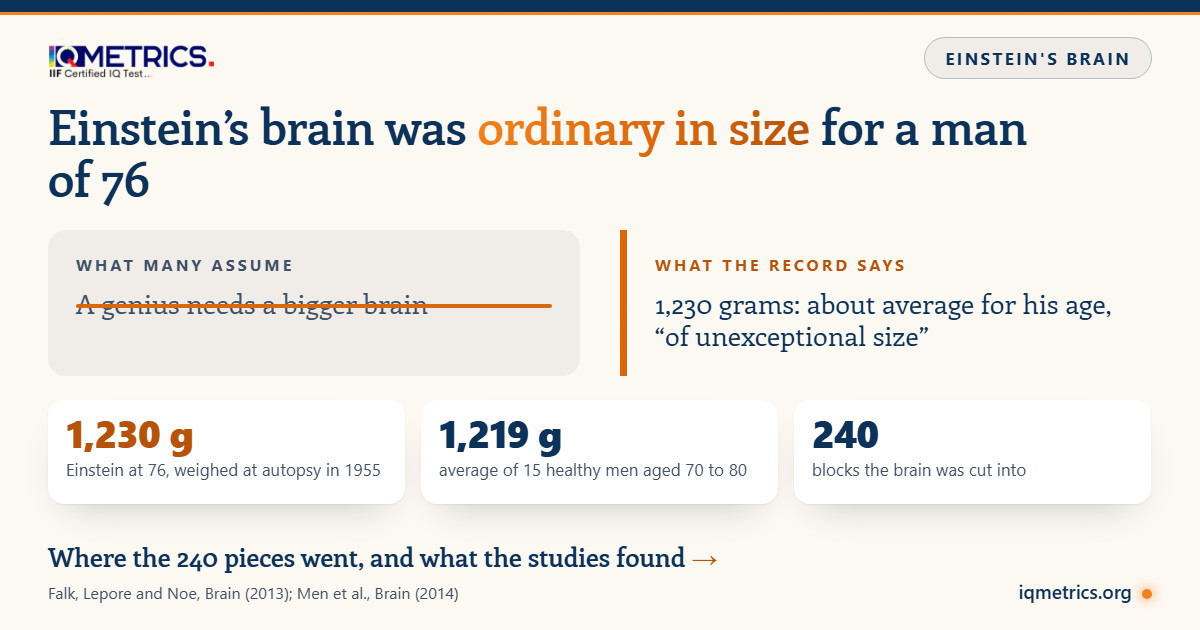
Einstein's brain weighed 1,230 grams, about average for a man of 76. It was cut into 240 blocks that are now spread across three institutions, and the studies of it are more modest, and more disputed, than the headlines.
Read the research.
Then find your own number.
Our IIF-certified assessment reports your score with its scale, percentile and confidence range — and a breakdown of the cognitive domains behind it.
Start IQ Test →