





The Bilingual Advantage: What the Executive-Function Research Actually Shows
For about a decade, a well-known finding held that bilingual children and adults show sharper executive function than monolinguals. Then researchers tried to replicate it across 15 separate measures and found almost nothing. A study of conference abstracts explained part of why the early evidence looked so much stronger than what came next.

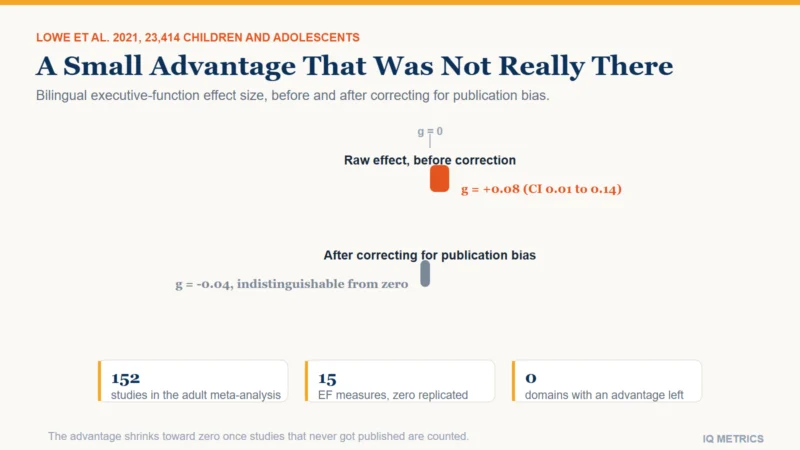
Probably not in the way a decade of headlines suggested, and the story of how researchers found that out is a clean, well-documented case of a plausible finding failing to survive closer scrutiny. The original claim, built on real studies by a respected research group, was that juggling two languages exercises a general-purpose control system in the brain, producing an advantage on tasks that require ignoring irrelevant information. A direct replication attempt across 15 separate measures of that exact skill found essentially nothing, and a large 2021 study of more than 23,000 children — the population the original claim was actually about — reduced the effect to zero once a specific statistical bias was corrected for.
None of that means the underlying research was done badly. It means this is one of the cleaner examples in psychology of how a real, appealing early finding can look much stronger in the published literature than it turns out to be once other labs go looking for it directly.
The original finding, and why it was plausible
The foundational work came from Ellen Bialystok and colleagues, first in preschoolers using card-sorting tasks that require switching rules, then extended to middle-aged and older adults using the Simon task, a reaction-time test where a stimulus's position conflicts with the response it requires. Bilingual participants in these studies showed a smaller performance cost from that conflict than monolinguals, and the proposed explanation was straightforward: managing two active languages and suppressing the one not currently in use functions as a kind of constant low-level exercise for a domain-general executive-control system, one that should show up on any task drawing on the same underlying skill.
The replication that did not confirm it
In 2013, researchers set out to test that prediction directly and broadly, gathering roughly 15 separate indicators of executive control across four different task types — antisaccade, Simon, flanker and task-switching paradigms — in young adults. If the domain-general theory were right, a bilingual advantage should have turned up on most of them. It did not turn up as a significant effect on any of the 15 measures, and the single interaction that did reach significance pointed toward a disadvantage for bilinguals, not an advantage. The paper's own title stated the conclusion plainly: there was no coherent evidence for a bilingual advantage in executive processing.
A second problem: which studies got published
A 2015 study in Psychological Science offered a specific explanation for why the published record looked so much more convincing than a direct replication did. The researchers tracked every conference abstract on bilingualism and executive control presented between 1999 and 2012, then checked which of those studies eventually appeared as full journal articles. Studies whose results fully supported a bilingual advantage were published far more often than studies with mixed or contrary results, even though the groups did not differ in sample size or statistical power — a textbook publication-bias pattern, where positive findings are simply more likely to make it into print than null ones.
What happens when you pool everything, published or not
A 2018 meta-analysis in Psychological Bulletin, deliberately built to include unpublished data alongside published studies, pooled 891 effect sizes from 152 studies of adults across six components of executive function. Before adjusting for publication bias, a very small advantage appeared in a few of those domains. After adjusting for it, the advantage disappeared in every domain tested, and a small disadvantage showed up for verbal fluency specifically, plausibly because bilinguals split their exposure to any one language across two rather than concentrating it in one.
Where would your own score land?
Take the IIF-certified assessment and get your score with the scale it was measured on, the percentile it corresponds to and the confidence range around it — the three figures most online tests leave out.
Find your IQ score now! →The same null result shows up in children now too
The strongest recent evidence extends the null finding to exactly the population the original claim was about. A 2021 study in Psychological Science analyzed 1,194 effect sizes from more than 23,000 children and adolescents: the raw advantage across that entire literature was 0.08 standard deviations, small but technically real. Once corrected for the same publication bias described above, that number fell to negative 0.04 — statistically indistinguishable from zero, including inside the specific "executive attention" subdomain the original theory predicted should show the clearest effect. A separate study of more than 4,500 9- and 10-year-olds in a large, nationally representative U.S. cohort reached the same conclusion using an entirely different dataset.
Where a real effect might still survive
None of this fully rules out an effect under narrower conditions than the original claim proposed. One line of newer research argues that the binary bilingual-versus-monolingual comparison used in essentially every study above may itself be part of the problem: a 2019 paper argues bilingual experience is better treated as a continuous spectrum — proficiency, age of acquisition, how immersive the environment is — than a single either-or label, so a null result on a binary comparison could still be masking a smaller, dosage-dependent effect concentrated at the far end of that spectrum. A related theory, the adaptive control hypothesis, proposes that what actually matters is not bilingual status at all but how someone uses their languages day to day — dense, moment-to-moment code-switching between two languages in the same conversation is a much heavier load on executive control than keeping two languages largely separated by context or setting, and most of the studies above did not distinguish between the two usage patterns. Neither idea has yet produced the kind of large, preregistered, bias-corrected confirmation that settled the null result above; both are the live, serious version of "there might still be something here," not a reflexive defense of the original claim.
Even the original researcher has revised the theory
In 2024, Bialystok herself published a theoretical revision in Trends in Cognitive Sciences, moving away from the original "skill transfer" account — the claim that bilingual experience directly boosts general executive function as a flat, always-on advantage — toward a narrower "adaptation" framework that predicts a benefit only under specific, high-demand conditions rather than as a general boost. That is not a minor footnote: it is the field's founding researcher publicly updating the theory in response to exactly the pattern of evidence described above, which is roughly the scientific process working the way it is supposed to.
A different, more contested claim worth keeping separate
This site's news desk has separately covered a different bilingualism claim, about delayed dementia symptoms in older adults, and it is worth being precise that these are not the same finding restated. Two retrospective clinic studies found Alzheimer's symptoms appearing roughly four to five years later in bilingual patients already diagnosed with dementia. That is a different measure, symptom timing in people who already have the disease, from a healthy person's risk of developing it at all — and when researchers restricted the analysis to the stronger prospective study designs rather than the retrospective ones, the pooled result showed no reduced risk of actually developing dementia. Retrospective clinic samples like the original two studies are also particularly prone to referral-pattern bias: which patients get diagnosed, and when, can differ systematically between bilingual and monolingual communities for reasons that have nothing to do with brain biology. If it holds up at all, this is a narrower and later-life claim than the childhood executive-function story above, not confirmation of it. A third, unrelated finding covers something else again: taking an IQ test in your second language lowers verbal-subtest scores for reasons that have nothing to do with underlying ability.
The pattern this fits
A skill developed through intensive practice failing to transfer into a broad cognitive advantage is not unique to bilingualism on this site — world-class memory athletes show the same disconnect between a trained skill and general reasoning ability, and the research on commercial brain-training programs, covered on this site's news desk, turns up a strikingly similar gap between narrow, trained improvement and any broader intelligence gain. Skepticism toward "doing X trains your brain generally" claims is, again and again, the position the evidence keeps rewarding. It is a far gentler version of a pattern that shows up with much higher stakes in this site's piece on IQ testing's eugenics era: a confident, published claim about what a cognitive measure proves, later substantially walked back once other researchers looked more carefully.
Keep reading
All articles →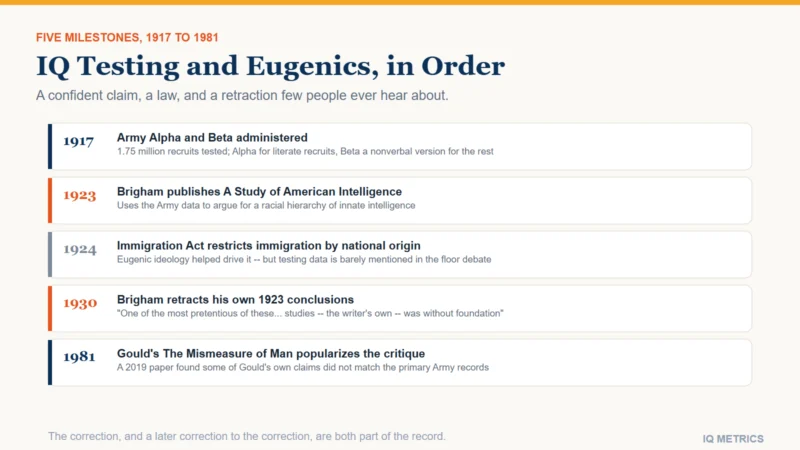 Understanding IQ
IQ Testing and Eugenics
Between 1917 and 1919, the United States Army tested roughly 1.75 million recruits in the largest intelligence-testing program the world had yet seen. Within a decade, one psychologist had turned that data into a case for restricting immigration by race. Thirteen years after that, the same psychologist published a retraction few people have ever heard of.
 Understanding IQ
Memory and IQ
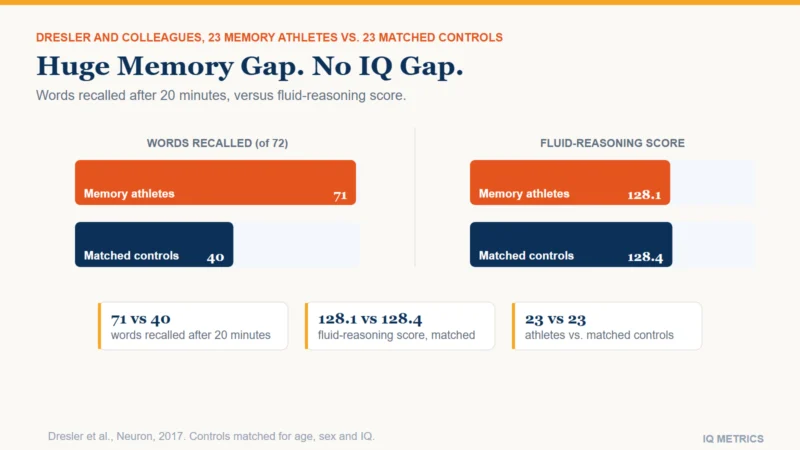
The world's best memory athletes can memorize 71 shuffled words in twenty minutes. Their IQ scores are not measurably different from a matched control group who could only manage 40. If a spectacular memory is not the same thing as a high IQ, what actually is the difference?
 Research & Evidence
Talent vs Practice
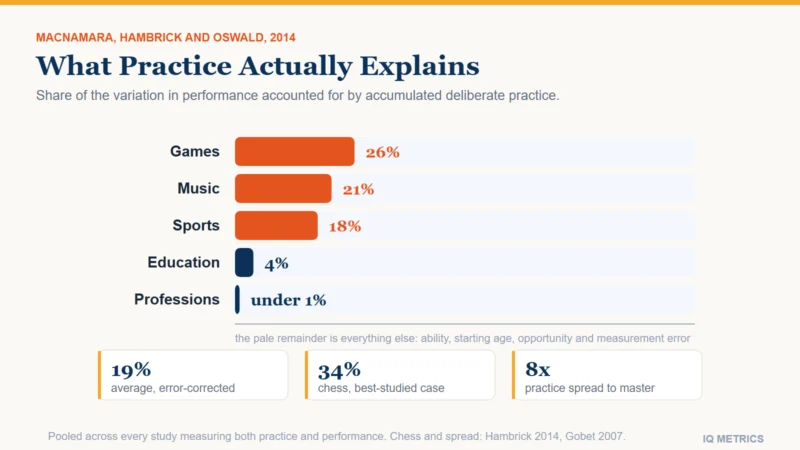
The 10,000-hour rule made a strong claim: expert performance is built by practice, not given by talent. When researchers pooled the studies that had actually measured it, practice explained about a quarter of the difference between people in games and almost none in professional work. Here is what fills the rest of the gap.