



What was Voltaire’s IQ?
Sixty years of evidence.
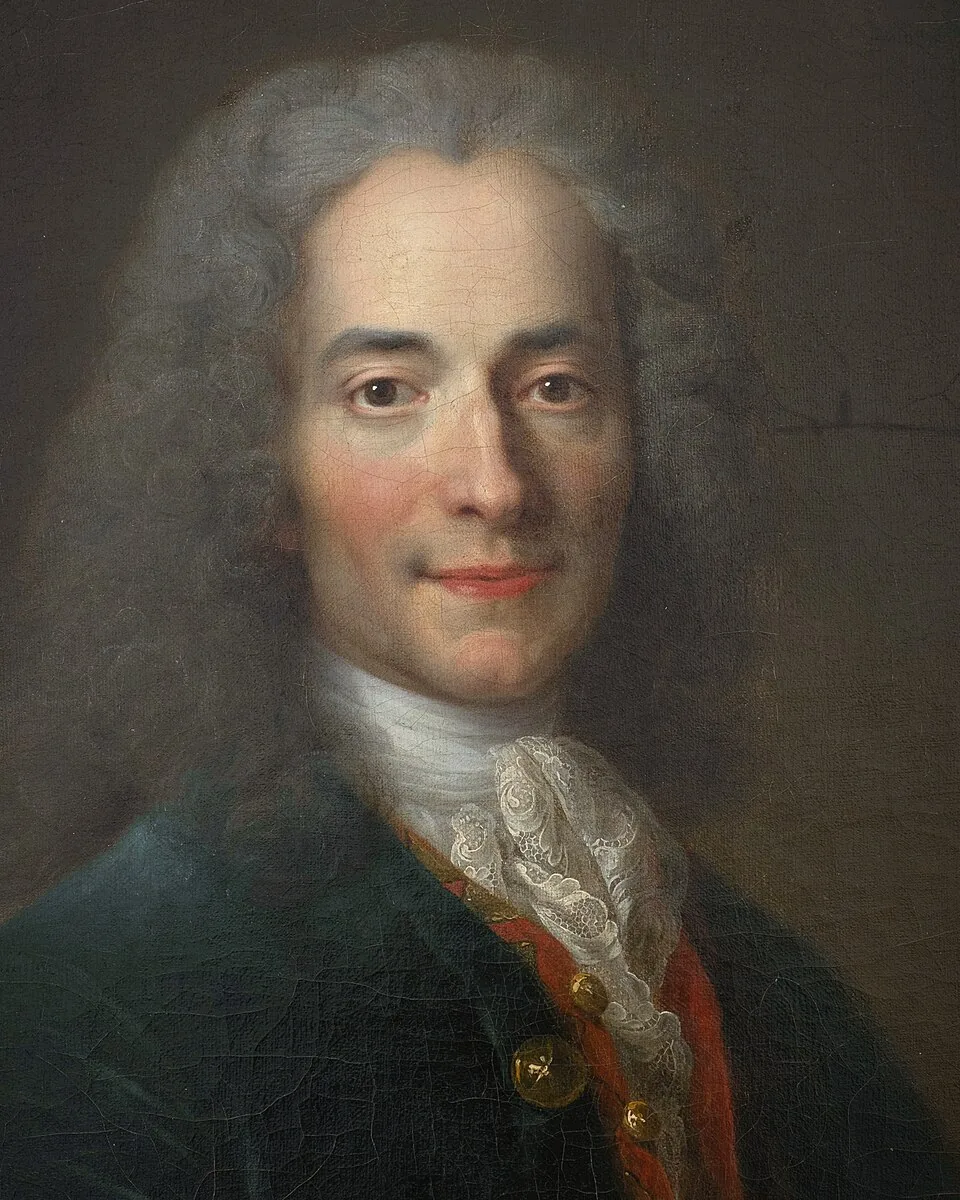
Writers rarely get IQ numbers unless they were also famously quick — Voltaire got both a reputation and a retrospective estimate.
Voltaire’s estimated IQ
- Wrote across philosophy, drama, history, poetry and pamphleteering, in enormous volume, for six decades.
- Correspondence runs to many thousands of surviving letters.
- Precocity is central to the historiometric method, and his early literary output is well documented.
Volume and precocity are what historiometry can see. They are a real signal and a narrow one — the method cannot distinguish reasoning ability from opportunity, patronage and a very long working life.
- Born
- 21 November 1694, Paris
- Died
- 30 May 1778, Paris
- Field
- Philosophy, drama, history, satire
- Known for
- Candide; Letters on the English
- Nationality
- French
What an IQ of 170–190 actually means
Set the claim aside for a moment. If someone genuinely scored in this range, here is what that would represent.
Average is 100 by construction, and about two-thirds of people fall between 85 and 115. Take the test to place your own score on this scale.
| Score range | Classification | Share of people | What it indicates |
|---|---|---|---|
| 85 – 114 | Average | ~68% | The range most people fall into. |
| 115 – 129 | Above average | ~13.6% | Roughly one person in seven. |
| 130 – 144 | Gifted | ~2% | The threshold most high-IQ societies use. |
| Above 144 | Highly gifted | ~0.1% | Figures above this range are extrapolated from the curve rather than measured. |
Percentages are approximate and describe a normal distribution. The same number means different things on tests with different standard deviations.
Thirty questions gives you a measured position on this exact scale — your score, your percentile and the ability breakdown behind it.
Find out in 30 minutes →Who Voltaire was
François-Marie Arouet took the name Voltaire in his early twenties, shortly after a spell in the Bastille for satirising the regent. He spent much of his life in exile or near it — in England, in Prussia, and finally at Ferney on the Swiss border, from where he conducted an enormous correspondence.
He wrote in nearly every form available: tragedy, epic, history, philosophy, and the pamphlets that made him dangerous. His campaign to clear Jean Calas — a Protestant executed on a false charge in 1762 — is the case usually cited as the beginning of the modern public intellectual.
That volume and range are precisely what historiometric estimates respond to. They are also why his figure should be read as a statement about a documented career rather than about a mind.
 By Elora Mercer, Celebrity Research WriterFigures checked by Leon Falkner, Data & Research Analyst
Reviewed by Aarav Vardhan, Editor-in-Chief · Last reviewed August 2026
_-002.jpg)
Voltaire: the documented record
The estimate above rests on this record. Every entry here is a matter of public fact, which is more than can be said for the number itself.
- 1704Enters the Collège Louis-le-Grand in Paris at ten.
- 1717Imprisoned in the Bastille for verses satirising the regent.
- 1718Œdipe succeeds; adopts the pen name Voltaire.
- 1726Exiled to England after a quarrel with a nobleman.
- 1734Publishes the Lettres philosophiques; the book is condemned and burned.
- 1759Publishes Candide.
- 1762Begins the campaign to clear Jean Calas, executed on a false charge.
- 1764Dictionnaire philosophique.
- 1778Returns to Paris after decades away and dies there.
Where the 190 figure came from
Following a claim back to its first appearance is the part almost nobody does — and it is what most people are actually asking.
Voltaire sits among the highest estimates in the historiometric literature, and the reason is structural rather than flattering. The method rewards documented early output, and few people in history left more of it.
He was writing publicly in his early twenties, was imprisoned for it, and produced plays, histories, pamphlets and philosophy continuously for six decades. His surviving correspondence runs to many thousands of letters. A method that counts documented achievement will rank that extraordinarily highly.
Which is worth stating plainly: the estimate partly measures how much paper survived, and how long he lived to produce it. That is a real limitation of historiometry, not a criticism of Voltaire.
How we read a number →Level with Newton at the very top of Cox’s table — which says as much about how much of his early output survived as about Voltaire.
The collected works and many thousands of surviving letters — the documentary base historiometry draws on, and the reason his estimate sits where it does.
The published output the estimate reasons from.
The sources behind our estimate
The figures that circulate for Voltaire, what we were able to confirm, and where the two diverge.
The figure most often published, drawn from the historiometric literature and stripped of its caveats.
Voltaire predates intelligence testing by roughly two centuries. The estimates come from historiometric work that reads early achievement from the biographical record — a method that ranks prolific, well-documented writers very highly by construction.
The figures cluster at the top of the historiometric scale, which reflects how much of his output survived as much as anything about him.
Want a number that does hold up? Every figure on this page is somebody’s claim. Take the 30-question test and get a percentile you can check rather than a figure you have to trust.
Voltaire — frequently asked
What was Voltaire’s IQ?
Unknowable. He predates intelligence testing by roughly two centuries; the figures quoted are historiometric estimates.
Why do historical writers score so highly in these estimates?
Because the method rewards documented early output, and writers leave more early documentation than almost anyone else. That is a bias in the method, not a finding about writers.
What is Voltaire best known for?
Candide, his campaigns against religious persecution and judicial abuse, and a vast body of letters, plays, histories and pamphlets.
Was Voltaire his real name?
No. He was born François-Marie Arouet and adopted the pen name Voltaire in his early twenties.
Why does Cox’s 1926 study matter here?
Because it is the origin of most historical IQ estimates still circulating. Knowing where a number came from is more useful than the number.
How reliable are estimates for writers?
Less than they look. The method rewards documented early output, and writers leave more of it than almost anyone — that is a bias in the method, not a finding about writers.
How does my IQ compare with Voltaire?
You can find out in about fifteen minutes. The IQ Metrics assessment is 30 questions, scored on the same 100-mean scale used throughout this page, so your result and the estimate above are at least expressed in the same units — one measured, one inferred. Once you have a number, the leaderboard shows where it would sit, and how we score and norm it explains the benchmarking.
Where does this estimate come from?
From the documented record rather than a test — the method is named above and set out in full under how we read a number. Compare it against the other writers profiles, starting with Johann Wolfgang von Goethe.
- Take the 30-question IQ test — get a measured score and percentile of your own
- Average IQ by country — how the scale behaves across populations
- How IQ Metrics scores its assessment — the method behind our own number
- More on how IQ testing works — reliability, error and what a score can and cannot say
- More writers profiles — same field, same method
More writers


Photograph by Martin Kraft (Frankfurt Book Fair, October 2024), CC BY-SA 4.0. Background removed for the portrait above. · Portrait by Vasily Perov (1872), Tretyakov Gallery, via Wikimedia Commons, public domain. · Photograph by Joe Loong (Tech@State: Moneyball Diplomacy, June 2013), CC BY-SA 2.0. Background removed for the portrait above.
.jpg)


An estimate is an inference.
Yours can be measured.
Thirty questions, scored against general-population benchmarks. Your score, your percentile, your ability breakdown and a printable IIF certificate.
Find your IQ score now! →