



What was Johann Wolfgang von Goethe’s IQ?
The highest number in the study.
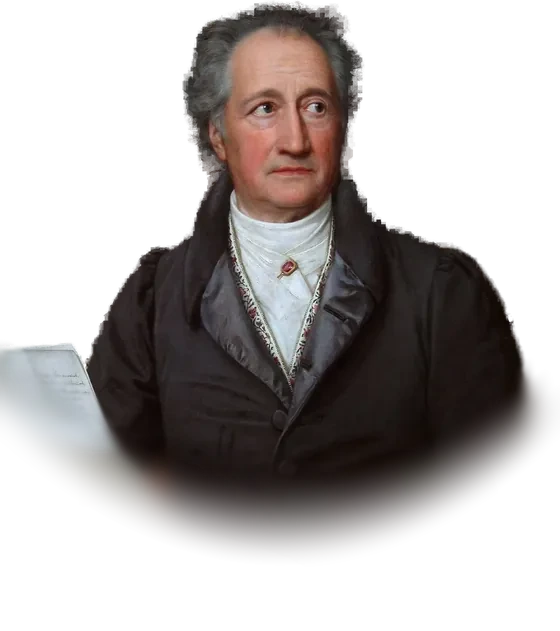
210 is the highest estimated IQ in the best-known study of its kind — and Goethe is also the subject whose childhood that study had the most paper to read.
Johann Wolfgang von Goethe’s estimated IQ
- Wrote publishable verse as a child and had a licence to practise law from Strasbourg by twenty-one.
- Die Leiden des jungen Werthers (1774) made him famous across Europe at twenty-four; Faust occupied him for close to sixty years.
- Worked seriously outside literature: he identified the human intermaxillary bone in 1784, and published Zur Farbenlehre, a theory of colour, in 1810.
Our range is deliberately well below the 210. Cox’s method converts documented childhood achievement into a score, and Goethe left more documented childhood than any other subject in the study — which inflates the result by construction.
- Born
- 28 August 1749, Frankfurt am Main
- Died
- 22 March 1832, Weimar
- Field
- Literature, drama, natural science, public administration
- Education
- Leipzig; law licence, Strasbourg, 1771
- Known for
- Faust, Werther, Zur Farbenlehre
What an IQ of 165–185 actually means
Set the claim aside for a moment. If someone genuinely scored in this range, here is what that would represent.
Average is 100 by construction, and about two-thirds of people fall between 85 and 115. Take the test to place your own score on this scale.
| Score range | Classification | Share of people | What it indicates |
|---|---|---|---|
| 85 – 114 | Average | ~68% | The range most people fall into. |
| 115 – 129 | Above average | ~13.6% | Roughly one person in seven. |
| 130 – 144 | Gifted | ~2% | The threshold most high-IQ societies use. |
| Above 144 | Highly gifted | ~0.1% | Figures above this range are extrapolated from the curve rather than measured. |
Percentages are approximate and describe a normal distribution. The same number means different things on tests with different standard deviations.
Thirty questions gives you a measured position on this exact scale — your score, your percentile and the ability breakdown behind it.
Find out in 30 minutes →Who Johann Wolfgang von Goethe was
Goethe was born in Frankfurt in 1749 into a wealthy household with a large library and private tutors. He was sent to Leipzig to study law, finished at Strasbourg in 1771, and published Werther three years later, which made him a European celebrity before he was twenty-five.
In 1775 he moved to Weimar at the invitation of the young duke and stayed for the rest of his life, serving as a privy councillor with responsibility for mines, roads and the treasury. He treated his scientific work as seriously as his literary work and considered Zur Farbenlehre among his more important achievements, though physics did not agree.
He finished the second part of Faust in 1831, sealed it, and died the following March. It was published after his death, sixty years after he had begun it.
 By Elora Mercer, Celebrity Research WriterFigures checked by Leon Falkner, Data & Research Analyst
Reviewed by Aarav Vardhan, Editor-in-Chief · Last reviewed August 2026
.jpg)
Johann Wolfgang von Goethe: the documented record
The estimate above rests on this record. Every entry here is a matter of public fact, which is more than can be said for the number itself.
- 1749Born in Frankfurt am Main.
- 1765Sent to Leipzig to study law.
- 1771Receives a licence to practise law at Strasbourg, aged twenty-one.
- 1774Die Leiden des jungen Werthers makes him famous across Europe.
- 1775Moves to Weimar; later serves as a privy councillor.
- 1784Identifies the intermaxillary bone in humans.
- 1786Begins the Italian journey that reshapes his work.
- 1808Faust, Part One, is published.
- 1810Publishes Zur Farbenlehre, his theory of colour.
- 1832Dies in Weimar; Faust, Part Two, is published posthumously.
Where the 210 figure came from
Following a claim back to its first appearance is the part almost nobody does — and it is what most people are actually asking.
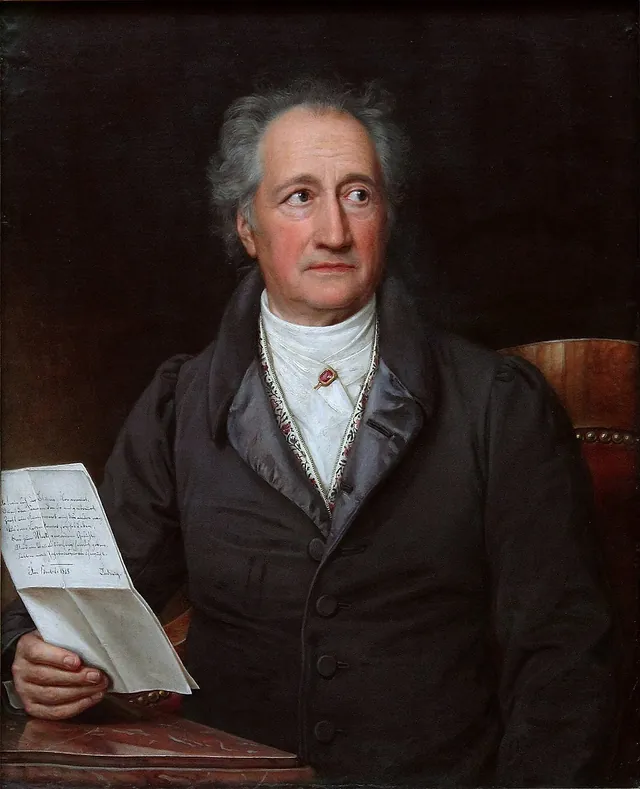
This is the single most important entry on the site for understanding where historical IQ numbers come from, because almost all of them come from here. Cox’s 1926 volume is the origin of the estimated scores attached to Voltaire, Mozart and dozens of other pre-modern figures, and Goethe sits at the top of her table.
The method was to gather everything recorded about a subject’s childhood, compare each documented achievement with the age at which an ordinary child reached it, and derive a ratio. It is a serious attempt at a hard problem. It also has an unavoidable flaw: a child about whom nothing was written scores low, whatever they could do.
Goethe wrote an autobiography of his own early years. His family preserved his juvenilia. His correspondence runs to thousands of letters. No other subject in the study offered a fraction of that material, and the score reflects it. The 210 is best read as a measurement of the archive.
How we read a number →The source of the 210. Volume II of Terman’s Genetic Studies of Genius. Cox states the estimates are inferences from biographical record, and discusses the record-quantity bias directly.
His autobiography of his first twenty-six years, and a large part of why the childhood record is so full.
A genuine comparative-anatomy result, and evidence for the breadth the estimate rests on.
Dated institutional record from his twenty-second year.
Goethe died in 1832. The first practical intelligence scale was published by Binet and Simon in 1905.
The sources behind our estimate
The figures that circulate for Johann Wolfgang von Goethe, what we were able to confirm, and where the two diverge.
210 is quoted everywhere, usually as “the highest IQ ever recorded”. It is neither the highest nor recorded.
The 210 is real, in the sense that Catharine Cox published it — as an estimate, in a Stanford monograph, with the method stated openly. What is false is the way it travels: as a measurement, without the study attached, and without the caveat Cox herself put on it. She noted that her estimates rose with the quantity of surviving biographical record. Goethe has the fullest such record of anyone she examined.
Cox gives two figures for each subject, and the lower of hers is 185. Popular sources quote only the higher one, which is the usual direction of drift.
Want a number that does hold up? Every figure on this page is somebody’s claim. Take the 30-question test and get a percentile you can check rather than a figure you have to trust.
Johann Wolfgang von Goethe — frequently asked
What was Goethe’s IQ?
He was never tested; he died in 1832, more than seventy years before the first practical intelligence scale. The 210 comes from Catharine Cox’s 1926 historiometric study, which estimated scores from biographical records.
Is 210 the highest IQ ever recorded?
No. It is the highest estimate in one 1926 study of three hundred historical figures, and it was never a recorded test result.
Why does this page estimate lower than Cox?
Because Cox’s scores rise with the amount of surviving childhood documentation, and Goethe’s is the fullest in the study. Correcting for that bias pulls the figure down.
Who else is in the Cox study?
Around three hundred figures born between 1450 and 1850. Voltaire and Mozart are both profiled on this site from the same source, and most historical IQ numbers online trace back to it.
Was Goethe a scientist as well as a writer?
Yes. He identified the human intermaxillary bone in 1784 and published a theory of colour in 1810. The colour theory was wrong as physics but influential in the study of perception.
How long did Goethe work on Faust?
Close to sixty years. He began it in his twenties and completed the second part in 1831, the year before his death.
How does my IQ compare with Johann Wolfgang von Goethe?
You can find out in about fifteen minutes. The IQ Metrics assessment is 30 questions, scored on the same 100-mean scale used throughout this page, so your result and the estimate above are at least expressed in the same units — one measured, one inferred. Once you have a number, the leaderboard shows where it would sit, and how we score and norm it explains the benchmarking.
Where does this estimate come from?
From the documented record rather than a test — the method is named above and set out in full under how we read a number. Compare it against the other writers profiles, starting with Voltaire.
- Take the 30-question IQ test — get a measured score and percentile of your own
- Average IQ by country — how the scale behaves across populations
- How IQ Metrics scores its assessment — the method behind our own number
- More on how IQ testing works — reliability, error and what a score can and cannot say
- More writers profiles — same field, same method
More writers


Photograph by Gtl12345, CC BY-SA 4.0. Cropped and with background removed for the portrait above. · Photograph by Friedrich Hermann Hartmann (c. 1875), public domain. Background removed for the portrait above. · Photograph by Martin Kraft (Frankfurt Book Fair, October 2024), CC BY-SA 4.0. Background removed for the portrait above.


.jpg)
An estimate is an inference.
Yours can be measured.
Thirty questions, scored against general-population benchmarks. Your score, your percentile, your ability breakdown and a printable IIF certificate.
Find your IQ score now! →