





IQ for Mental Retardation: What IQ Counts as Intellectual Disability, and Why the Old Line Moved
The IQ for mental retardation, now called intellectual disability, is a full-scale IQ of around 70 to 75 plus limits in everyday skills, says AAIDD. The old line was about 85 in 1959 and about 70 from 1973. See why it moved, the old IQ levels and how diagnosis works today.

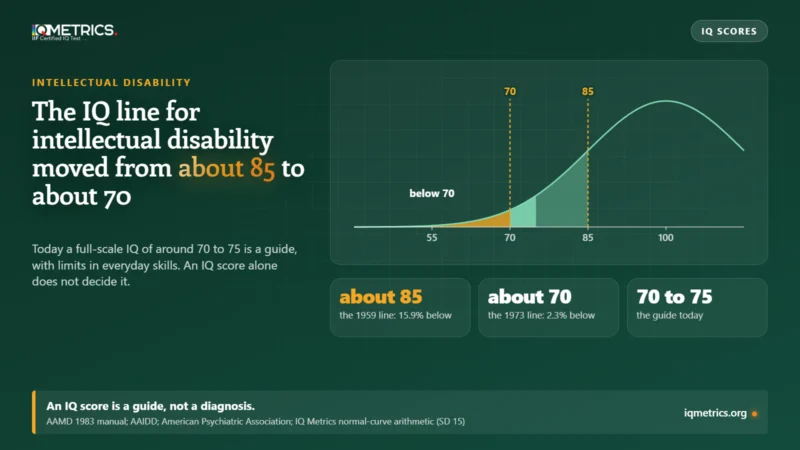
“Mental retardation” is the former term for what is now called intellectual disability. The IQ for mental retardation, and for intellectual disability today, is a full-scale IQ of about 70, or as high as 75, together with limits in everyday skills that began before adulthood. An IQ score alone does not decide it, and no online quiz can.
New here: the line moved on paper. A 1959 manual put it at about 85, one standard deviation (SD) below average, which the 1983 manual says took in almost 15 percent of Americans. In 1973 it went back to about 70, two SDs below. Below: each version, how a diagnosis works today, and why 70 is a guide, not a cut-off.
Key takeaways
- Today: AAIDD and the American Psychiatric Association (APA) both say a full-scale IQ of around 70 to 75 shows a significant limit in intellectual functioning. A second limit, in everyday skills, is also needed.
- Then: the old manuals set the line at about 85 in 1959, then about 70 from 1973, with 70 to 75 allowed in 1983.
- Why it moved: the 1959 line labelled almost 15 percent of Americans, and users of the manual objected, so the 1973 committee returned to about two SDs below the mean.
- Not a cut-off: the 1983 manual calls 70 a guideline and warns against treating low IQ alone as enough. The APA says a specific IQ score is no longer required.
- The term: Rosa’s Law replaced “mental retardation” in US federal law on 5 October 2010.
What is the IQ for mental retardation, now called intellectual disability?
A full-scale IQ of about 70, or as high as 75, plus limits in everyday skills that start in childhood or adolescence. That is the guide used by AAIDD, the American Association on Intellectual and Developmental Disabilities.
AAIDD defines intellectual disability as significant limits in both intellectual functioning and adaptive behaviour that begin before age 22. On its definition page it says an IQ score of around 70, or as high as 75, generally indicates a significant limit in intellectual functioning. The APA’s patient page gives the same range, a full-scale IQ of around 70 to 75.
| Part | What it means | Source |
|---|---|---|
| Intellectual functioning | A full-scale IQ about 2 SDs or more below the mean on an individually given, standardised test: around 70, or as high as 75 | AAIDD; APA |
| Adaptive behaviour | A standard score about 2 SDs or more below the mean on a standardised measure of conceptual, social or practical skills | AAIDD; APA |
| Onset | Both limits show up in the developmental period: before age 22 (AAIDD), typically before 18 (APA) | AAIDD; APA |
Two SDs below the mean is an IQ of 70 on SD 15. That is the 2.3rd percentile, or 1 person in 44, and 70 is as far below the mean as 130 is above it. Our page on what an IQ of 133 means covers the high end. Our page on what an IQ of 70 means covers the current criteria in more detail, and the IQ bell curve shows where 70 sits.
The APA adds two cautions. A specific full-scale IQ score is no longer required for a diagnosis, although standardised testing is still used. And subtest scores can vary a lot, so the full-scale IQ may not show overall functioning. Clinical judgment is needed.
What were the old IQ levels, from mild to profound?
If you searched for “iq level mental retardation” or “what IQ is mental retardation”, you want the old manual bands. In the 1983 manual of the American Association on Mental Deficiency, the mild level covered IQs of 50 to 55 up to about 70.
| Level | IQ range for the level | Same bands on SD 15 in the 1977 manual (approximate) |
|---|---|---|
| Mild | 50-55 to about 70 | 55 to 69 |
| Moderate | 35-40 to 50-55 | 40 to 54 |
| Severe | 20-25 to 35-40 | 25 to 39 |
| Profound | Below 20 or 25 | Under 25 |
The ranges overlap on purpose. The manual says a person with a Wechsler full-scale IQ of 53 might be placed in the mild or the moderate level, depending on other evidence. It also says its ranges are generally consistent with those in the American Psychiatric Association’s DSM-III.
One more point from the same manual: more people have IQs below 50 than the normal curve predicts, because of biological causes. So the percentile arithmetic on this site is best at the top of the range and not reliable far below 50.
Why was the IQ line lowered from about 85 to about 70?
Because the 1959 line of about 85 took in far too many people, and the field’s own committee reversed it in 1973. The 1983 manual tells the story in its history chapter.
Before 1959 the traditional line was about 70. The 1959 manual moved it to one SD below the mean, about 85 on the most common tests. The 1983 manual says that change made it possible to include almost 15 percent of the US population. It adds that the 1959 authors knew many people who scored between 70 and 85 did not function as retarded, but a person also had to show limits in adaptive behaviour.
Users of the 1959 manual were not reassured. The 1983 manual records much concern and numerous debates about labelling so large a share of the population. After long debate, the 1973 committee abolished the one-SD cut-off, which had a Borderline band, and returned to a line about two SDs below the mean. It also moved the end of the developmental period from the 16th birthday to the 18th.
| Version | IQ line | Share of people below it | What the source says |
|---|---|---|---|
| Before 1959 | About 70 | 2.3% (1 in 44) | The traditional line, in the 1983 manual’s words |
| 1959 manual | About 85 (1 SD below) | 15.9% (about 1 in 6) | Almost 15 percent of the US population, said the 1983 manual |
| 1973 manual | About 70 (2 SDs below) | 2.3% (1 in 44) | Borderline cut-off dropped; developmental period to age 18 |
| 1983 manual | 70 or below, a guideline up to 75 or more | 4.8% at 75 (1 in 21) | Depends on the reliability of the test |
| AAIDD 12th edition (2021) and APA now | About 2 SDs below, around 70 to 75 | 2.3% to 4.8% | An IQ score is no longer required (APA); onset before 22 (AAIDD) |
Why is an IQ of 70 a guide and not a cut-off?
Because every IQ score carries a margin of error, and the manuals say so. The 1983 manual calls the 70 limit a commonly accepted guideline, not an exact value, and says it could be extended to 75 or more depending on the test’s reliability.
Take a measured 70. If the standard error of measurement is about 3 points, the figure on our page on an IQ of 70 for the Wechsler scales, the 95% range for a true score is about 64 to 76. AAIDD likewise tells clinicians to weigh any sources of assessment or measurement error. Our page on IQ test accuracy explains how that error works.
The same manual warns against assuming that low IQ alone is enough for a diagnosis. Scores near the line are read with the rest of the evidence. See an IQ of 65, an IQ of 75 and borderline IQ for the scores on either side.
Where would your own score land?
Take the IIF-certified assessment and get your score with the scale it was measured on, the percentile it corresponds to and the confidence range around it — the three figures most online tests leave out.
Find your IQ score now! →How does diagnosis work for a child and for an adult?
A qualified clinician gathers an individually given IQ test, a standardised measure of everyday skills and the views of people who know the person. Most diagnoses are made in early childhood, and an adult can still be diagnosed if the limits began before age 22.
The APA says adaptive functioning is assessed with standardised measures and with interviews of family members, teachers and caregivers. AAIDD says the vast majority of diagnoses are made in early childhood, and its age-22 rule allows for the few people identified later. AAIDD gives brain development that continues into the 20s as the reason for age 22.
AAIDD says the reason to classify is to tailor a personal set of supports, delivered over a sustained period. Its current approach stresses community inclusion and self-direction. The APA calls intellectual disability life-long and says early intervention may improve functioning. It names mild, moderate, and severe or profound levels, and says most people are in the mild group.
An online score cannot diagnose anything, including a score from our kids IQ test. If you are worried about a child’s development, ask a doctor or a school psychologist. For the different question of learning disability, read low IQ vs learning disability.
When was the term dropped, and what is Rosa's Law?
In US federal law the term changed on 5 October 2010, when Rosa’s Law became Public Law 111-256. It swaps “mental retardation” for “intellectual disability” in a list of federal laws.
The Act amends the Higher Education Act, the Individuals with Disabilities Education Act, the Elementary and Secondary Education Act, the Rehabilitation Act and the Public Health Service Act, among others. Section 4 says the change is not meant to alter coverage, eligibility, rights, responsibilities or definitions, and it does not force States to change their own wording.
AAIDD says it is proud to have been a leader in adopting the term intellectual disability, and that the condition was most recently known as mental retardation. For the history of the older labels, see our page on the old moron, imbecile and idiot labels, the IQ classifications guide and IQ and mental age. On benefits, see what the score rules say.
Quick answers
- What is IQ for mental retardation? The old term’s line was about IQ 70, with 50-55 to about 70 as the mild level in the 1983 AAMD manual. Today the term is intellectual disability, and the guide is a full-scale IQ of around 70 to 75 with limits in everyday skills.
- What IQ is mental retardation? Under the old manuals, about 70 or below, with levels down to below 20 or 25. No single score decided it alone.
- Why did they lower the IQ for mental retardation? The 1959 line of about 85 took in almost 15 percent of Americans. The 1973 committee returned to about two SDs below the mean, about 70.
- Is 70 a hard cut-off? No. The 1983 manual calls it a guideline that could extend to 75, and the APA says a specific score is no longer required.
- Can an online IQ test diagnose intellectual disability? No. A clinician uses individual tests and measures of everyday skills.
Sources
- AAIDD. Defining criteria for intellectual disability, FAQs on intellectual disability and historical context (pages read on 15 November 2026).
- American Psychiatric Association. What is intellectual disability? (page read on 15 November 2026).
- American Association on Mental Deficiency (1983). Classification in Mental Retardation, edited by H. J. Grossman, chapters 2 and 3, Table 1 and pages 30-32 (read).
- Rosa’s Law, Public Law 111-256, approved 5 October 2010, US Government Publishing Office (full text read).
- Percentages and the 64 to 76 range: normal-curve arithmetic by IQ Metrics. The 3-point standard error is the figure on our IQ 70 page, not from a test manual.
Keep reading
All articles →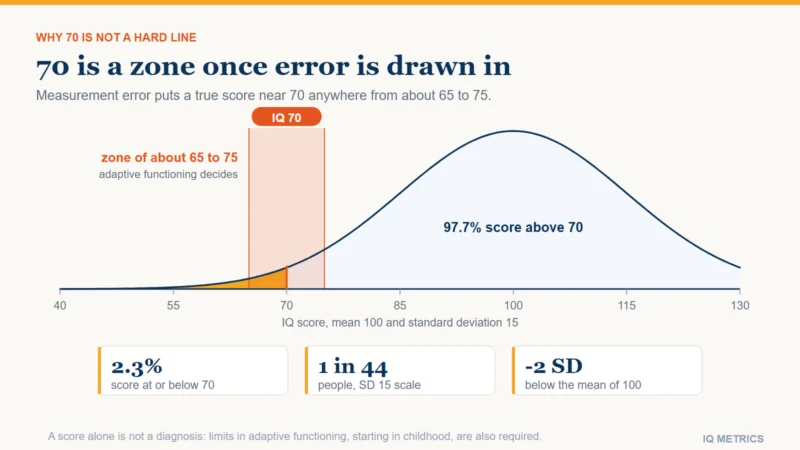 Scores & Scales
What an IQ of 70 Means
An IQ of 70 sits two standard deviations below the mean, at about the 2nd percentile. It is the score most often linked with intellectual disability, but a diagnosis never rests on the number alone: measurement error turns the line into a zone, and adaptive functioning decides who is inside it.
 Understanding IQ
Low IQ vs Learning Disability
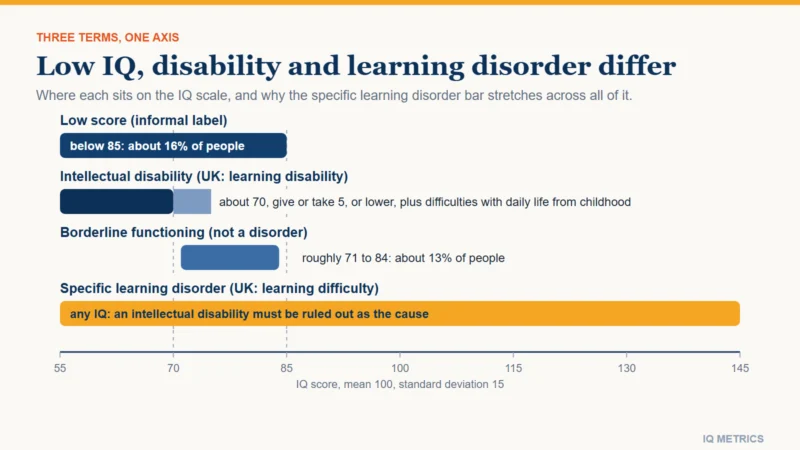
A low IQ, an intellectual disability and a specific learning disability are three different things, and the UK uses "learning disability" for the second. What each requires, how each is assessed, the US and UK terms, and what to do if you are worried.
 Scores & Scales
What IQ Is a Moron?
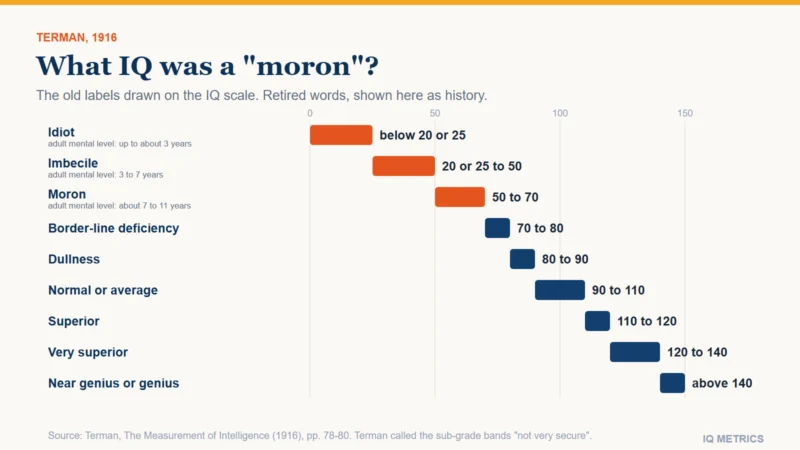
In the old clinical scheme a moron had an IQ of roughly 50 to 70, an imbecile about 20 or 25 to 50 and an idiot below that, according to Lewis Terman in 1916. See who coined the words, how the cut-offs moved, what the 1913 UK Act said and why the labels were dropped.