





Are Ants Smart? What One Ant Brain and a Whole Colony Can Do
Ants are smart as colonies: they pick shorter paths, move nests and farm fungus, with a desert ant brain of only about 70,200 to 90,000 cells against 613,000 in a honeybee. No ant has an IQ score, and the mirror-test claim has not been independently verified. See what each study shows.

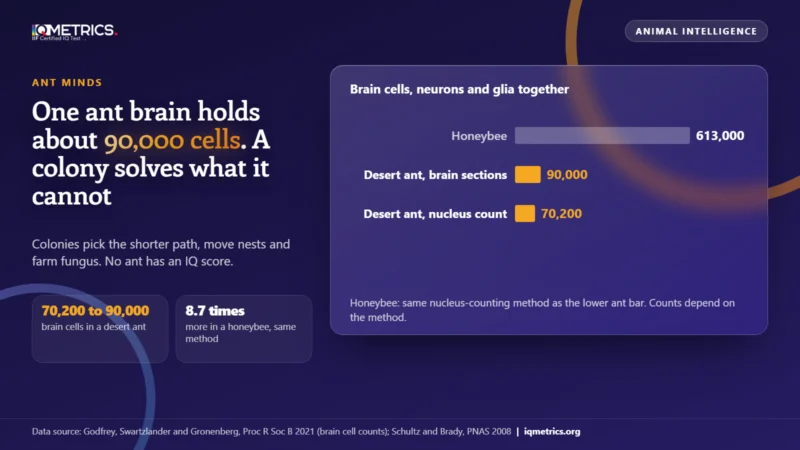
Are ants smart? As a colony, yes. One ant follows simple rules with a brain of about 90,000 cells, yet colonies pick the shorter of two paths, move a whole nest and grow fungus for food. No ant has an IQ score, and the two famous claims about single ants, a mirror test and number sums, come from one research group and need independent checks.
New here: the best-supported ant results belong to the colony, not to one ant. A desert ant’s brain holds about 90,000 cells by one count and 70,200 by another, against about 613,000 in a honeybee. Below: how big an ant brain is, what colonies solve, and what the mirror-test study does and does not show.
Key takeaways
- Brain: a desert ant brain holds about 70,200 to 90,000 cells, neurons and glia together, depending on how they are counted. A honeybee holds about 613,000 by the same method as the first figure.
- Colonies: Argentine ants chose the shorter of two paths in shortest-path experiments, and colonies of a tandem-running ant species chose the shorter path when moving nest.
- Farming: ants began growing fungus about 50 million years ago, and leaf-cutter ants about 8 to 12 million years ago (PNAS, 2008).
- Single-ant claims: ants that anticipate the next number and a mirror test both come from Cammaerts and Cammaerts, and a 2022 review says the mirror result lacks independent verification.
- Not shown: an ant IQ. No such score exists.
Are ants smart or just following rules?
Both. Each ant reacts to simple cues, such as a scent trail, and the pattern that results across the colony can look smart. Ants also learn.
A 2019 paper in the Journal of Experimental Biology states the established view in its abstract. Ants can optimise a foraging path through an emergent process, involving the strength of the trail pheromone, without any ant having to measure and compare distances. The cleverness is in the colony’s rule, not in a plan inside one head.
Individual learning is documented too. Cammaerts and Cammaerts (Behavioral Sciences, 2021) trained Myrmica sabuleti workers on the numbers of items near their food. The ants then chose the next quantity in an increasing or decreasing sequence. The authors say this may be explained by associative learning and by the ants’ ability to remember events and estimate elapsing time. That is a plain and modest reading.
So how smart are ants? Smart at learning cues and, as groups, at solving problems. Whether one ant understands what it does is a different question, and no study here answers it.
How big is an ant brain, and how many cells does it hold?
Very small. A desert ant’s brain holds about 90,000 cells by counts in sections of the brain and about 70,200 by a second method. Those counts include neurons and glia together, so they are not neuron counts.
Ant brain size is measured by Godfrey, Swartzlander and Gronenberg (Proceedings of the Royal Society B, 2021), who counted brain cell nuclei in 32 species of the insect group that includes ants, bees and wasps. They write that ants stand out from bees and wasps as having particularly small brains by mass and cell number. Their honeybee estimate, by the same nucleus-counting method, was about 613,000 cells, 8.7 times the desert ant’s 70,200.
You may see “250,000 neurons” quoted for an ant online. We found no primary source for that figure, so we do not use it. Our report on the smartest insect sets the same counts beside a fruit fly’s and shows why the method moves the total.
What can ant colonies solve?
Colonies solve routing and food problems that no single ant plans. Two well-studied cases are the shortest path and farming.
Shortest path: in classic experiments, Argentine ants (Linepithema humile) selected the shorter of two alternative paths from nest to food. A 2015 modelling paper calls these experiments an important example of self-organisation and notes that they inspired ant colony optimisation, a family of computer algorithms.
In 2019, Mukhopadhyay, Pathak and Annagiri followed 4,100 transports by 450 ants of the species Diacamma indicum as colonies moved nest. Leaders and colonies chose the shorter path significantly more often than the longer one. These ants recruit nestmates only by tandem running, not by scent trails.
Farming: Schultz and Brady (PNAS, 2008) report that agriculture is known in only four animal groups: humans, bark beetles, termites and ants. Ant farming of fungus began about 50 million years ago, they estimate, and leaf-cutter ants evolved about 8 to 12 million years ago to become the dominant plant-eaters of the New World tropics.
None of this needs an ant to understand the goal. It shows that simple rules in thousands of ants can produce results that look like planning.
Do ants recognise themselves in a mirror?
One study says some did, and it has not been independently checked. Cammaerts and Cammaerts (2015) tested three Myrmica species, and a 2022 review of self-awareness in animals says more studies are needed to verify it.
The review describes the setup. Ants marked with a blue dot tried to clean the mark when a mirror was present, and ants marked with a brown dot, the colour of their bodies, did not. If that holds, it would indicate self-recognition. We could not open the 2015 paper, so we rely on that description. The review lists ants as uncertain, and adds that studies of several species lack independent verification.
A single study from one group is a clue, not a result. A pass would need another lab to repeat it. The same group published the number-sequence study above.
Where would your own score land?
Take the IIF-certified assessment and get your score with the scale it was measured on, the percentile it corresponds to and the confidence range around it — the three figures most online tests leave out.
Find your IQ score now! →Is there an ants IQ?
No. An IQ ranks a person against others of the same age on one test, and no norm group or test like that exists for ants. Searches for ants IQ find no number because none can exist.
What exists are brain-cell counts and lab and field results, as above. To see what a score means for a person, take the IQ test or read our human brain facts.
How do ants compare with other animals?
Ants are strong on group problem solving and weak on brain size. For other animals, our smartest animals study shows how the winner changes with the yardstick.
See the jumping spider and octopus pages for animals with other kinds of small-brain skill, and our study on whether plants and slime moulds can learn for learning without a brain. From the same batch, read are owls smart.
Quick answers
- Are ants smart? As colonies, yes: they pick shorter paths, move nests and farm fungus. One ant is a small-brained rule follower that can learn cues.
- How smart are ants? Smart by the lab and field results, which are about colonies and learning. There is no score.
- What is the ants IQ? None. No IQ test or norm group exists for ants.
- What is the ant brain size? A desert ant has about 70,200 to 90,000 brain cells, neurons and glia together.
- Can ants pass the mirror test? One 2015 study says so. A 2022 review says it needs independent verification.
- Do ants farm? Fungus-growing ants began about 50 million years ago (PNAS, 2008).
Sources
- Godfrey RK, Swartzlander M, Gronenberg W (2021). Allometric analysis of brain cell number in Hymenoptera suggests ant brains diverge from general trends. Proceedings of the Royal Society B 288(1947) (read).
- Mukhopadhyay S, Pathak MK, Annagiri S (2019). Path minimization in a tandem running Indian ant in the context of colony relocation. Journal of Experimental Biology (abstract read).
- von Thienen W, Metzler D, Witte V (2015). Modeling shortest path selection of the ant Linepithema humile using psychophysical theory and realistic parameter values. Journal of Theoretical Biology 372, 168-178 (abstract read).
- Schultz TR, Brady SG (2008). Major evolutionary transitions in ant agriculture. PNAS 105(14), 5435-5440 (abstract read).
- Cammaerts MC, Cammaerts R (2021). Ants can anticipate the following quantity in an arithmetic sequence. Behavioral Sciences 11(2), 18 (abstract read).
- Lei Y (2022). Sociality and self-awareness in animals. Frontiers in Psychology 13, 1065638 (read; source for the description of the 2015 mirror study, which we could not open).
- Ratios of cell counts: arithmetic by IQ Metrics.
Keep reading
All articles →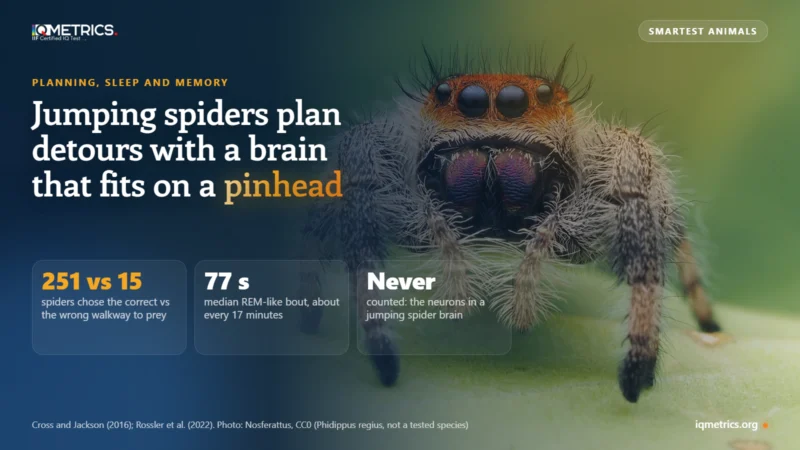 Research & Evidence
How Smart Are Jumping Spiders?
How smart are jumping spiders? Some planned a detour to prey they could no longer see: 251 spiders chose the correct walkway and 15 the wrong one. See what they remember, how REM-like sleep shows in 77-second bouts, why no one has counted their neurons and how they compare with bees, crows and octopuses.
 Understanding IQ
Octopus IQ
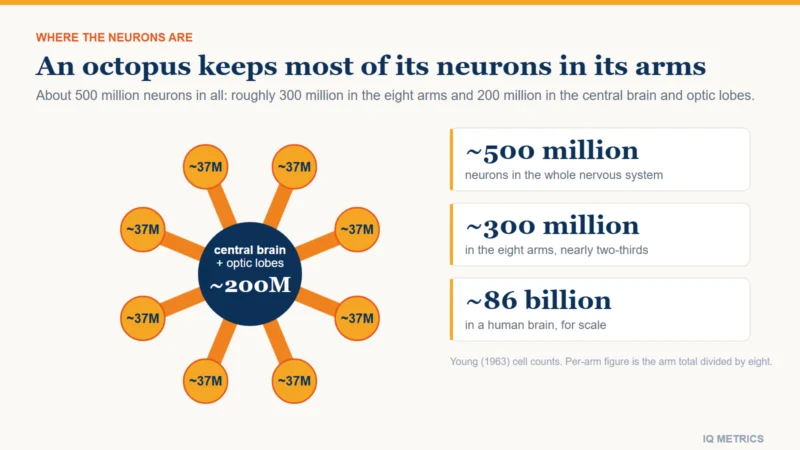
An octopus has no IQ, but it has about 500 million neurons, most of them in its arms. The neuron count, the tool-use and recognition studies, why short lives leave no room for teaching, and why UK law now treats octopuses as sentient.
 Mind & Everyday Life
Are Owls Smart?
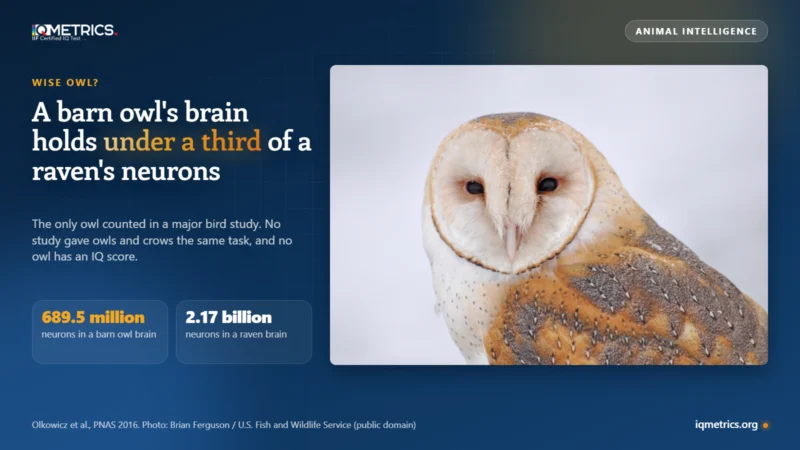
Owls are smart in the tests that exist: burrowing owls bait dung beetles with dung and captive owls know their keepers' voices. A barn owl's brain holds 689.5 million neurons, under a third of a raven's 2.17 billion, and no study gave owls and crows the same task. See what the studies show.