



Can a Robot Be Self-Aware? The Self-Awareness Robot Claims, Checked
No robot has been shown to be self-aware. The papers behind the best-known robot headlines tested narrower skills, such as finding an arm in a mirror or modelling a body, and a 2026 chatbot study stresses its own limits.


What you need to know
- No robot has been shown to be self-aware. Every self-awareness robot headline we traced rests on one narrow skill: locating an arm through a mirror (Yale, 2012) or modelling a body (Cornell, 2006; Columbia, 2019 and 2022). None of the four robot papers claims awareness.
- Nico's 2012 mirror work was scored on accuracy: positions worked out through the mirror matched its own arm model within a mean of 31.55 mm, and within 5.12 mm seen directly. Gizmodo's 2012 rebuttal says headlines overstated it as a mirror test pass.
- Some animals do pass the mirror mark test: chimpanzees (Gallup, 1970), two dolphins, an Asian elephant and magpies. We found no accepted test that shows a machine is self-aware.
- A January 2026 paper by an Anthropic author found Claude Opus 4.1 noticed injected concepts on about 20% of trials at best, with no false alarms in 100 control trials. The author says this does not address human-like self-awareness.
Can robots be self-aware? No robot has been shown to be. Each self-awareness robot headline we checked traces back to a machine that did one narrow job. Yale's Nico used a mirror to locate its own arm in 2012. Robots at Cornell and Columbia learned models of their own bodies. None of the four robot papers we read claims awareness, and we found no accepted test that proves a machine is self-aware.
Below: what self-aware means for an animal, what Nico's mirror work tested, what self-modelling robots do, and what a 2026 study found when chatbots were asked about their own internal states. A short list sets each famous demo beside its headline.
What does self-aware mean for a robot?
For animals, self-awareness is tested with the mirror mark test, and we found no matching test for robots that researchers accept. Gordon Gallup reported the first version in Science in 1970. Chimpanzees marked with red dye showed evidence of recognising their own reflections, while monkeys did not appear to.
The question in a mark test is simple. Does the animal use the mirror to touch an otherwise invisible mark on its own body? Plotnik and colleagues (PNAS, 2006) call it the litmus test for mirror self-recognition. It reads behaviour, not experience.
Researchers also use the words self-model for a robot's internal picture of its own body. That is an engineering term for a model used to plan movements, not a claim about experience. Arend Hintze listed self-aware AI as the last of four types of AI in 2016 and treated it as a future goal, as our types of artificial intelligence guide explains.
Has a robot passed the mirror test?
No study we read says so. The robot most often named is Nico, a humanoid at Yale, and its 2012 paper tested a different skill: using a mirror to locate its own arm. Justin Hart and Brian Scassellati called it mirror perspective-taking, and presented it at the AAAI conference.
The group's earlier work had taught the robot the spatial link between its body and its cameras. In this paper the robot watched its arm in a mirror in several poses and worked out the mirror's viewpoint, so it could use the mirror as a virtual camera. The robot mirror test in this story is a spatial reasoning test, not a self-recognition test.
It was scored on accuracy. Positions worked out through the mirror matched the robot's own arm model within a mean of 31.55 mm. Seen directly, the match was within 5.12 mm. The abstract mentions no mark, no reflection recognised as the robot itself, and no awareness.
Gizmodo's George Dvorsky made the same point on 28 August 2012. He wrote that Nico did not pass a true mirror test, and that outlets he named, including New Scientist, the BBC and KurzweilAI, had overstated the result. We read his article, not theirs, so we cannot say how each outlet worded it.
Nico was scored on how accurately it located its arm through a mirror, not on whether it recognised the reflection as itself.
Which animals pass the mirror test?
A few animals pass it, and each study was small. The list below gives what each paper reports, and nothing more.
- Chimpanzees (Gallup, Science, 1970): marked with red dye, they showed evidence of recognising their own reflections. Monkeys did not appear to
- Two bottlenose dolphins (Reiss and Marino, PNAS, 2001): both responded in ways consistent with using the mirror to inspect marked parts of the body
- Asian elephant (Plotnik, de Waal and Reiss, PNAS, 2006): three elephants were exposed to a large mirror, and the paper reports a successful mark test
- Magpies (Prior, Schwarz and Gunturkun, PLoS Biology, 2008): some birds showed mark-directed behaviour, the first evidence of mirror self-recognition outside mammals
For the animals' wider cognitive record, see our elephant IQ and dolphin IQ pages, our review of the smartest birds and our smartest animals research. None of those species has an IQ score either.
What are self-modelling robots?
Self-modelling robots learn a model of their own body from their own movements. Josh Bongard, Victor Zykov and Hod Lipson (Science, 2006) described a four-legged machine that used actuation-sensation relationships to infer its own structure. It used that model to walk, and when a leg part was removed it adapted the model and found new gaits.
Robert Kwiatkowski and Lipson (Science Robotics, 2019) reported a robot that modelled itself without prior knowledge of physics or its shape. It used the model to perform tasks and to detect damage to itself. Boyuan Chen and colleagues (Science Robotics, 2022) built a visual self-model that was accurate to about 1% of the robot's workspace, and the robot could detect, locate and recover from damage.
These are real advances in machine resilience. They are also engineering results about a body model. The Cornell abstract says the idea may help build more robust machines and shed light on self-modelling in animals. Not one of the abstracts we read claims the robot is aware.
Are AI chatbots self-aware?
There is no accepted test, and a chatbot saying that it is self-aware proves nothing. In a January 2026 paper, Jack Lindsey of Anthropic wrote that genuine introspection cannot be separated from made-up answers through conversation alone. The same self-awareness AI question needs a different kind of test.
His team injected representations of known concepts into a model's internal activations and asked whether the model noticed. Claude Opus 4.1 did so on about 20% of trials at the best layer and strength, and the production models gave no false alarms in 100 control trials. Anthropic makes the Claude models tested, so treat this as one lab's own report.
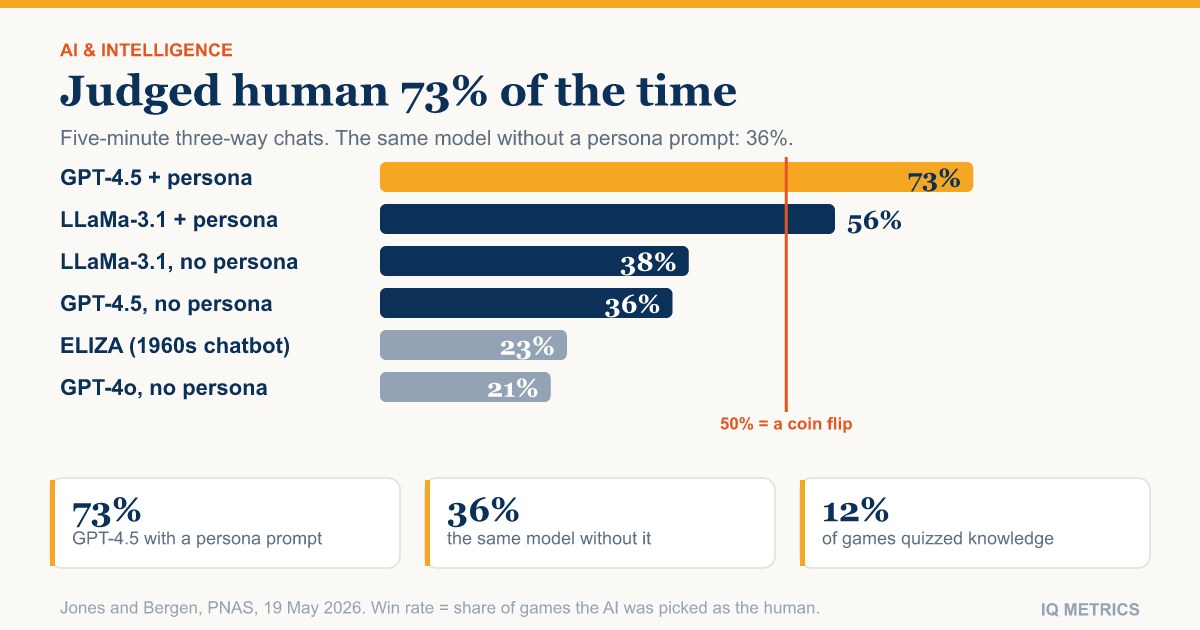
The author calls the result functional introspective awareness and says it is highly unreliable and context-dependent. He also states that the paper does not address whether AI systems have human-like self-awareness or subjective experience. For a different test of chatbots, see what the 2026 PNAS Turing test study found.
How do self-awareness robot headlines compare with what was tested?
On robot self awareness, every test we read was narrower than its headline. The list sets each famous self-awareness robot demo beside what it measured and left out.
- Nico, Yale, 2012: measured how accurately it located its arm through a mirror (31.55 mm through the mirror, 5.12 mm direct). Left out: any mark test or recognising itself
- Four-legged robot, Cornell, 2006: measured whether it could infer its own structure and keep walking after a leg part was removed. Left out: awareness
- Robot, Columbia, 2019: measured whether it could model itself with no prior knowledge of physics or its shape. Left out: awareness
- Robot, Columbia, 2022: measured a visual self-model accurate to about 1% of the workspace, used for planning and damage recovery. Left out: awareness
- Chatbots, Anthropic, 2026: measured whether models notice concepts injected into their activations (about 20% of trials at best). Left out: human-like self-awareness or experience, in the author's own words
Would a self-aware robot have an IQ?
No. An IQ is a position on a human bell curve, with an average of 100 and a standard deviation of 15, so it describes people tested against other people. A robot that finds its arm in a mirror has no IQ, and a chatbot that reports on its activations has none either. Our IQ bell curve shows what the scale means.
Where would your own score land?
Self-awareness has no score, but reasoning does. To see how your own reasoning compares with other adults, take the IQ Metrics test.
Find your IQ score now! →You can also test your own memory and attention in our Brain Games, or take the IQ Metrics test for a score with a percentile.
Common questions
Can robots be self-aware?
No robot has been shown to be self-aware. The four robot papers we read each tested one narrow skill, such as locating an arm through a mirror or modelling the robot's own body, and none claims awareness. We found no accepted test that proves a machine is self-aware.
Has a robot passed the mirror test?
Not in the sense used for animals. Yale's Nico (2012) used a mirror to locate its own arm, with a mean error of 31.55 mm through the mirror and 5.12 mm direct. The paper reports no mark test, and Gizmodo's George Dvorsky wrote that Nico did not pass a true mirror test.
What is a self-modelling robot?
It is a robot that learns an internal model of its own body from its own movements and uses it to plan, walk or detect damage. Cornell (2006) and Columbia (2019, 2022) built such robots. A self-model is an engineering tool, not evidence of awareness.
Are AI chatbots self-aware?
There is no accepted test. A January 2026 Anthropic paper found Claude Opus 4.1 noticed concepts injected into its activations on about 20% of trials at best, and calls this ability highly unreliable. The author says the paper does not address human-like self-awareness or subjective experience.
Sources for this story
- Hart J, Scassellati B. Mirror Perspective-Taking with a Humanoid Robot. Proceedings of the 26th AAAI Conference on Artificial Intelligence (2012), pp. 1990-1996, doi 10.1609/aaai.v26i1.8389; abstract read — AAAI
- Bongard J, Zykov V, Lipson H. Resilient machines through continuous self-modeling. Science 314:1118-1121 (2006), doi 10.1126/science.1133687; abstract read — AAAS
- Kwiatkowski R, Lipson H. Task-agnostic self-modeling machines. Science Robotics 4(26) (2019), doi 10.1126/scirobotics.aau9354; one-sentence abstract read — AAAS
- Chen B, Kwiatkowski R, Vondrick C, Lipson H. Fully body visual self-modeling of robot morphologies. Science Robotics 7(68):eabn1944 (2022), doi 10.1126/scirobotics.abn1944; abstract read — AAAS
- Gallup GG Jr. Chimpanzees: self-recognition. Science 167(3914):86-87 (1970), doi 10.1126/science.167.3914.86; abstract read — AAAS
- Lindsey J. Emergent Introspective Awareness in Large Language Models. arXiv:2601.01828 (5 January 2026); full text read. The author is affiliated with Anthropic — arXiv
Corrections: spotted an error? Email corrections@iqmetrics.org and we will update this story and note the change here.
Related stories
All news →
Types of Artificial Intelligence: Three Ways to Sort AI, and Five Levels
AI can be sorted by breadth (narrow, general, super), by function (four types) or by performance (five DeepMind levels). Those levels are percentiles of skilled adults, not IQ scores.
Has AI Passed the Turing Test? What the 2026 PNAS Study Found
A peer-reviewed PNAS paper says GPT-4.5, given a humanlike persona, was picked as the human in 73% of five-minute chats. Without the persona it managed 36%, and the authors say the test measures humanlikeness, not intelligence.

What Is an Artificial Intelligence Test? Three Meanings, Compared
An artificial intelligence test can be a Turing test, an AI benchmark or a skills test for people. Here is who is tested, what comes out and what, if anything, links each one to IQ.
Read the research.
Then find your own number.
Our IIF-certified assessment reports your score with its scale, percentile and confidence range — and a breakdown of the cognitive domains behind it.
Start IQ Test →