





Elephant IQ: How Smart Are Elephants Compared With Humans?
Elephants have no IQ score: no validated test gives one. Studies measure single skills instead. One of three Asian elephants passed the mirror mark test, six waited for a partner before pulling a rope, and wild herds use name-like calls, yet one elephant's cortex held 5.6 billion neurons, a third of the human count.

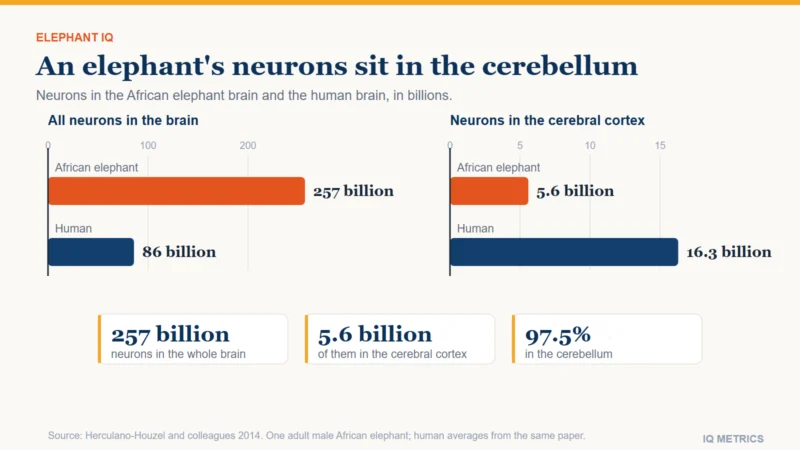
Elephants do not have an IQ score. No validated intelligence test produces one for elephants, so any number quoted as an elephant IQ is not a test result. What researchers can measure is a set of separate abilities, and the set is impressive: an Asian elephant passed the mirror mark test, elephants waited for a late partner before pulling a rope together, a young male stood on a cube to reach food, and wild African elephants appear to address one another with name-like calls. The brain behind this is the largest on land, yet a count of one African elephant found 5.6 billion neurons in its cerebral cortex, about a third of the human figure. This guide sets out what the studies found, how elephants compare with dogs, dolphins and chimpanzees, and why no test can reduce it to one number.
- Elephant IQ: none. There is no norm sample and no standard test, so researchers test one skill at a time, usually on a handful of animals.
- Brain: 257 billion neurons in all, 97.5% of them in the cerebellum, but only 5.6 billion in the cerebral cortex against about 16.3 billion in the human cortex (Herculano-Houzel and colleagues, 2014; one adult male African elephant).
- Mirror: one of three Asian elephants passed the mark test (Plotnik, de Waal and Reiss, 2006).
- Cooperation: six elephants waited for a late partner before pulling a rope, on average 93% of the time (Plotnik and colleagues, 2011).
- Calls: in wild African elephants a call's sound could be matched to the individual it was addressed to, and elephants answered calls addressed to them differently (Pardo and colleagues, 2024).
Is there an elephant IQ test?
No. An IQ score is a position on a bell curve: a test is given to thousands of people, the results are ranked, and each person's rank is printed on a scale whose average is 100 (an IQ of 90, for example, is simply the 25th percentile; see what an IQ of 90 means). Nothing like that exists for elephants. There is no standard test, no norm sample and no agreed way to make an elephant try. Researchers run single experiments, each measuring one narrow skill with a few animals, and report whether they beat chance. Our explainer on how IQ tests work shows what a real score needs that an elephant experiment lacks.
Elephants are also difficult subjects. The authors of a 2011 cooperation study put the shortage of systematic evidence down mainly to the danger and difficulty of testing the largest land animal. The trunk adds a second problem: the team behind a 2011 problem-solving study argued that earlier tool tests may have failed because they asked elephants to hold a stick in the trunk, which interferes with its use as a sensory organ for locating the food. A test designed around a human hand does not suit an animal that explores with its nose. Any figure that circulates as an elephant IQ comes without a test, a sample or a scale, so it cannot be read as a score.
How big is an elephant's brain, and what does it hold?
Very big, and unevenly organised. A 2014 count in Frontiers in Neuroanatomy measured the brain of one adult male African elephant. It weighed 4,619 grams, about three times the human brain, and held 257 billion neurons, three times the human average of 86 billion. But 97.5% of those neurons, 251 billion, sit in the cerebellum, which the authors suggest might be related to the elephant's sensorimotor specialisations, such as the trunk.
| Measure | African elephant (one adult male) | Human (average) |
|---|---|---|
| Brain mass | 4,619 g | about a third as heavy |
| Neurons in the whole brain | 257 billion | 86 billion |
| Neurons in the cerebral cortex | 5.6 billion | 16.3 billion |
The cortex is where the authors look for the difference. The elephant cortex weighs more than twice as much as the human cortex, yet it holds only 5.6 billion neurons, about a third of the human count. They argue that the larger number of cortical neurons in humans, not the size of the whole brain, is what goes with the cognitive edge humans have over elephants and other large-brained mammals. A 2008 review by Hart and colleagues adds that elephant cortical neurons are much less densely packed than in large-brained primates, which the reviewers link to slower, less compartmentalised processing.
Against the other animals in our guides the elephant cortex is large. Its 5.6 billion neurons are about 9 times the 627 million counted in a golden retriever and about 22 times the roughly 250 million in a domestic cat (the 2017 counts quoted in dog IQ and cat IQ). One caution: the elephant figure comes from a single animal, so read it as an estimate for one adult male rather than an average for the species.
Can an elephant recognise itself in a mirror?
One Asian elephant did. In a 2006 study in PNAS, three Asian elephants named Happy, Maxine and Patty were given a large mirror. All three spent far more time near it when it was open than when it was covered (Happy 19.4% of the time against 0.2%, Maxine 37.9% against 1.3%, Patty 49.7% against 3.3%), which shows that the reflection, not the novelty of the equipment, held their interest.
Then came the mark test: a visible mark on one side of the head and an invisible sham mark on the other, so that only sight could tell them apart. Only Happy passed. She repeatedly touched the visible mark and not the sham mark, and did so again while standing directly in front of the mirror. The authors compare the way the elephants' responses progressed with those of apes and dolphins and suggest convergent cognitive evolution linked to complex sociality and cooperation. Passing is usually read as a sign of self-awareness, but this is one test on one animal out of three, and failing it, as two elephants did, is hard to interpret.
Do elephants cooperate, use tools and solve problems?
Cooperation is the strongest result. In a 2011 study in Thailand, twelve elephants first learned to pull a rope attached to a sliding table that carried food. Six were then tested in pairs on a version where two elephants had to pull the two ends of one rope at the same time to bring the food within reach. When one elephant was released later than its partner, the six waited before pulling between 88% and 97% of the time, a mean of 93%, for delays of up to 45 seconds. They also stopped pulling when the partner had no access to a rope. The authors suggest that elephants may have reached a cooperative skill level on a par with chimpanzees.
Insight has been harder to show. A 2011 paper in PLOS ONE offered three Asian elephants food out of reach overhead. Without prior trial and error, a 7-year-old male moved a large plastic cube and stood on it to get the food, then fetched the cube from different places and, when given smaller objects, tried stacking them. One animal out of three is a thin base. The 2008 review by Hart and colleagues rates elephant performance on tool use, visual discrimination learning and insight tests as unimpressive next to chimpanzees, so the honest picture is mixed, and the stick problem described above may explain part of the gap.
Do elephants have names, and do they understand pointing?
Possibly names, yes. Dolphins and parrots address one another by imitating the addressee's calls. In a 2024 study in Nature Ecology & Evolution on wild African elephants, researchers used machine learning to show that the receiver of a call could be predicted from the call's acoustic structure, however similar it was to the receiver's own voice, and elephants responded differently to playbacks of calls that had been addressed to them than to calls addressed to someone else. The authors read this as individual addressing without imitation, which is why the calls are described as name-like rather than as names.
Pointing is a skill dogs are famous for, and elephants have never been domesticated. A 2013 study found that a group of 11 captive African elephants, seven of them significantly as individuals, could use a human pointing gesture to find hidden food, including when the experimenter's distance from the hiding place varied and when the gesture was visually subtle (Smet and Byrne). Wild elephants also sort people: family groups in Amboseli National Park, Kenya, became more defensive after playbacks of Maasai voices than after voices of a less threatening group, and responded less to Maasai women and boys (McComb and colleagues, 2014). An earlier study found that elephants tell the two groups apart by scent and by the colour of clothing (Bates and colleagues, 2007).
Where would your own score land?
Take the IIF-certified assessment and get your score with the scale it was measured on, the percentile it corresponds to and the confidence range around it — the three figures most online tests leave out.
Find your IQ score now! →The main elephant studies at a glance
| Study | Elephants | What was tested | What happened |
|---|---|---|---|
| Mirror mark test, 2006 | 3 Asian | Touch a mark visible only in a mirror | One of three passed |
| Rope cooperation, 2011 | 6 Asian, tested in pairs | Pull two ends of one rope together | Waited for a late partner 88% to 97% of the time |
| Cube stacking, 2011 | 3 Asian | Reach food hung overhead | A 7-year-old male stood on a cube without trial and error |
| Pointing, 2013 | 11 captive African | Find hidden food from a pointing gesture | Seven were significant as individuals |
| Human voices, 2014 | Family groups in Amboseli | Playbacks of Maasai and other voices | More defensive after Maasai voices, less after women and boys |
| Name-like calls, 2024 | Wild African | Is the receiver predictable from the call | Yes, and playbacks addressed to them drew a different response |
Do elephants never forget?
The saying is an exaggeration, because nobody has measured “never”, but there is a real finding behind it. The 2008 review by Hart and colleagues concludes that elephants seem to excel in long-term spatial and temporal memory and in social memory, while performing less impressively on tool use, discrimination learning and insight tasks than chimpanzees. It also notes reactions to disabled and dead companions that are mindful of what researchers call theory of mind. Memory is the ability reviewers single out, and it is the one an IQ-style test would measure least well in a wild animal.
How does elephant intelligence compare with dogs, dolphins and chimpanzees?
There is no common test, so the comparison has to go ability by ability. On mirror self-recognition, one elephant joined the apes and dolphins in a 2006 comparison. On cooperation, the 2011 authors place elephants possibly on a par with chimpanzees. On tool use and insight, the 2008 review ranks them below chimpanzees. On cortical neurons, elephants sit between the animals counted in our guides and humans. For the other species, see dog IQ, cat IQ, dolphin IQ, chimpanzee IQ, gorilla IQ, crow IQ and octopus IQ.
Quick answers about elephant IQ
- What is the IQ of an elephant? There is none. No validated test produces an elephant IQ.
- Are elephants smarter than dogs? No study measures that directly. An elephant cortex holds about 9 times the neurons counted in a golden retriever, but dogs have been tested on far more tasks.
- Are elephants as smart as humans? No test compares them. The human cortex holds about 16.3 billion neurons against 5.6 billion in the elephant counted.
- Can elephants recognise themselves in a mirror? One of three Asian elephants passed the mark test in 2006.
- Do elephants have names for each other? Wild African elephants appear to use calls addressed to individuals, which researchers call name-like.
- Do elephants never forget? Reviewers single out long-term spatial and social memory; “never” has not been measured.
Sources
- Herculano-Houzel, S., Avelino-de-Souza, K., Neves, K., Porfirio, J., Messeder, D., Mattos Feijo, L. et al. (2014): The elephant brain in numbers, Frontiers in Neuroanatomy, 8, 46.
- Plotnik, J.M., de Waal, F.B.M. and Reiss, D. (2006): Self-recognition in an Asian elephant, PNAS, 103(45), 17053-17057.
- Plotnik, J.M., Lair, R., Suphachoksahakun, W. and de Waal, F.B.M. (2011): Elephants know when they need a helping trunk in a cooperative task, PNAS, 108(12), 5116-5121.
- Foerder, P., Galloway, M., Barthel, T., Moore, D.E. and Reiss, D. (2011): Insightful problem solving in an Asian elephant, PLOS ONE, 6(8), e23251.
- Smet, A.F. and Byrne, R.W. (2013): African elephants can use human pointing cues to find hidden food, Current Biology, 23(20), 2033-2037.
- McComb, K., Shannon, G., Sayialel, K.N. and Moss, C. (2014): Elephants can determine ethnicity, gender, and age from acoustic cues in human voices, PNAS, 111(14), 5433-5438.
- Bates, L.A., Sayialel, K.N., Njiraini, N.W., Moss, C.J., Poole, J.H. and Byrne, R.W. (2007): Elephants classify human ethnic groups by odor and garment color, Current Biology, 17(22), 1938-1942.
- Pardo, M.A., Fristrup, K., Lolchuragi, D.S., Poole, J.H., Granli, P., Moss, C. et al. (2024): African elephants address one another with individually specific name-like calls, Nature Ecology & Evolution, 8(7), 1353-1364.
- Hart, B.L., Hart, L.A. and Pinter-Wollman, N. (2008): Large brains and cognition: where do elephants fit in?, Neuroscience & Biobehavioral Reviews, 32(1), 86-98.
- Jardim-Messeder, D. et al. (2017): Dogs have the most neurons, though not the largest brain, Frontiers in Neuroanatomy, 11, 118.
Keep reading
All articles →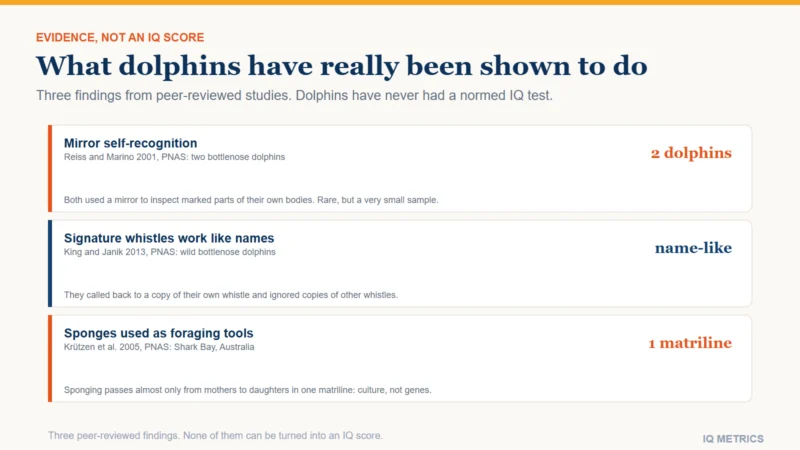 Research & Evidence
Dolphin IQ
Dolphins have no IQ, but they have passed a mirror test, use signature whistles like names and pass tool use down the female line. See the evidence, the brain data, and the peer-reviewed sceptics who question the hype.
 Understanding IQ
Chimpanzee IQ
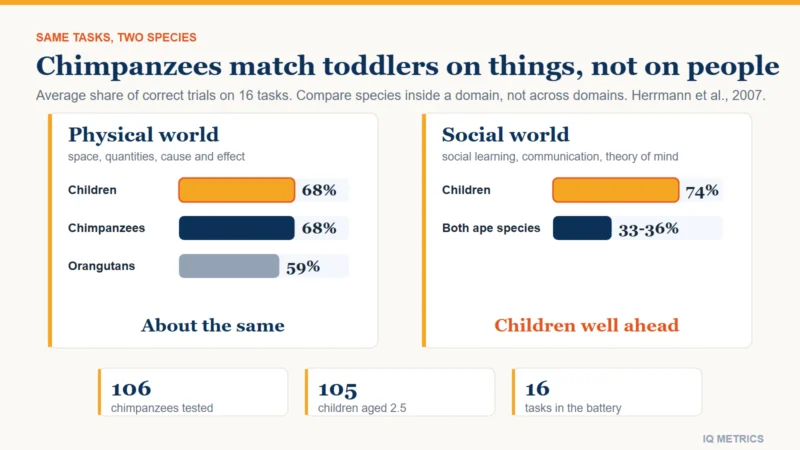
Chimpanzees have no IQ, but they have been tested. How chimps and 2.5-year-old children scored on the same 16 tasks, what a chimpanzee brain holds, the memory claim that did not survive practice, and whether chimps have a g factor.
 Understanding IQ
Cat IQ
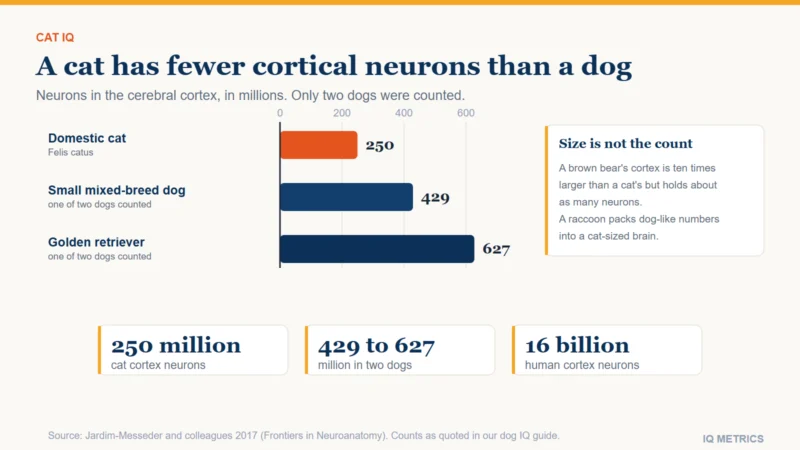
Cats have no IQ: no validated test gives one. Studies measure narrower skills. Cats tell their own names from other words and follow a pointing finger as well as dogs do, but struggle with hidden-object puzzles, and a cat's cortex holds about 250 million neurons against 429 to 627 million in the dogs counted.