At what age is a person an adult? Four legal ages in 51 US jurisdictions, 30 countries and the brain studies
IQ Metrics read four age rules in the statutes of 50 states and DC and in the laws of 30 countries, and lined them up with the age windows brain papers print: 48 of 51 set the age of majority at 18, 46 end juvenile court at 18, and the papers give windows from 6 to 29, not one age.

By Leon Falkner, Data & Research Analyst · Reviewed by Aarav Vardhan, Editor-in-Chief · Published 14 November 2026 · 15 min read
About this study
- Report type
- Data study: our three linked tables of legal ages and brain-science age windows
- Data
- 4 age rules in 50 states and DC (204 statute cells); 4 rules in 30 countries; 12 brain-science age markers; 4 Supreme Court rulings
- Sources
- State codes, national laws, OJJDP, Census Bureau, UN Committee on the Rights of the Child, Supreme Court opinions, 7 peer-reviewed papers
- Dates
- Statutes and laws as of 14 November 2026; Census population on 1 July 2025
- Licence
- CC BY 4.0 (our dataset and charts)
- Version
- 2026.11
- Sources
- 23
In US law a person is usually an adult at 18: 48 of 51 jurisdictions set the age of majority there, and 46 end juvenile court at 18. Four states use 17 for criminal court. Brain papers print windows, not one age: task performance near 16, self-regulation 23 to 26, white-matter volume peaking near 29 (IQ Metrics, 14 November 2026).
01 Key findings
- 18 is the common legal age, but never the only one. 48 of 51 jurisdictions set the age of majority at 18, 46 end juvenile court at 18, and the lowest marriage age with an exception runs from 15 to 18; 24 of 51 name no lowest age of delinquency.State statutes; IQ Metrics count
- The adult-court line moved up in 11 states since 2007. 14 states had 16 or 17 as the adult-court age in 2007; four do in 2026 (Georgia, Louisiana, Texas, Wisconsin), and Louisiana moved back in April 2024.State statutes and acts; IQ Metrics reading
- 18 jurisdictions allow no marriage under 18; 24 still allow it at 16 or younger with consent or a court order. The rule changed in many states in 2018-2026.State statutes
- The median age of criminal responsibility is 13 in 26 countries; 14 are below the UN committee’s 14. Voting is 18 in 26 of 29.National laws; UN CRC GC 24
- Brain science gives windows. Cognitive capacity reached adult levels near 16 and psychosocial maturity beyond 18 (5,227 people); self-regulation plateaued at 23 to 26; white matter volume peaks at 28.7 (101,457 people).Icenogle 2019; Steinberg 2018; Bethlehem 2022
- 16.9% of US 17-year-olds (761,404) live in the four states where 17 is the adult-court age.Census Vintage 2025; IQ Metrics calculation
02 At what age is a person legally an adult? The numbers to quote
In the law of the United States a person is usually an adult at 18: 48 of 51 jurisdictions (50 states and DC) set the age of majority there, 46 end juvenile-court jurisdiction at the 18th birthday, and 18 allow no marriage under 18 [1]. Brain science does not give one age. Studies print windows, from a grey matter peak at 5.9 years to a white matter peak at 28.7 years, and the researchers say so [15] [17].
US jurisdictions set the age of majority at 18; Alabama and Nebraska at 19, Mississippi at 21.
State statutes; IQ Metrics countjurisdictions end juvenile-court jurisdiction at 18; Georgia, Louisiana, Texas and Wisconsin at 17, Vermont at 19.
State statutes; IQ Metrics countstates with an adult-court age below 18: 14 in 2007, 4 in 2026 (11 states moved the line; Louisiana moved it back in 2024).
State statutes; IQ Metrics readingof the 4.50 million 17-year-olds in the US live in the four states with an adult-court age of 17 (761,404 people).
Census Vintage 2025; IQ Metrics calculationjurisdictions name no lowest age of juvenile-court delinquency in their statute; the 26 that do range from 7 to 13.
State statutes; IQ Metrics countjurisdictions allow no marriage under 18 in any circumstance; 24 still allow it at 16 or younger with consent or a court order.
State statutes; IQ Metrics countmedian minimum age of criminal responsibility in 26 countries; 14 are below the UN committee’s benchmark of 14.
National laws; IQ Metrics calculationcountries set the national voting age at 18; Argentina and Brazil at 16, Indonesia at 17.
National laws; IQ Metrics countcognitive capacity reached adult levels near 16, psychosocial maturity beyond 18 (5,227 people, 11 countries; Icenogle 2019).
Icenogle et al. 2019plateau of self-regulation; sensation seeking peaked at 19 (more than 5,000 people, 11 countries; Steinberg 2018).
Steinberg et al. 2018age at which white matter volume peaks (95% interval 28.1 to 29.2) in 101,457 people; grey matter volume peaks at 5.9 (Bethlehem 2022).
Bethlehem et al. 2022turning points in the brain’s wiring pattern across the lifespan in 4,216 people aged 0 to 90 (Mousley 2025).
Mousley et al. 2025statute cells read (51 jurisdictions x 4 rules): 97 on an official page, 61 on an archive copy of one, 46 on a mirror; 110 re-found by script.
IQ MetricsIQ Metrics Research built three linked tables. The first holds four legal ages for each of the 50 states and DC, with the statute, its URL and a short quote for every cell (204 cells). The second holds four ages for 30 countries. The third lists every age marker the brain papers print, with what was measured and in how many people. We then lined them up: no score, no index, only the ages side by side. Laws change, so every number carries a date: all are as of 14 November 2026, and a state that changes a rule is a reason to update this page.
We found no earlier table that holds these ages for every state next to the brain papers’ own age windows. The nearest work is a 2024 Bellwether report on age restrictions across the states (no brain science), the 2021 National Governors Association brief on juvenile-justice age boundaries, the US Department of Justice’s statistical tables on juvenile-court ages [3], and essays on “raise the age” and neuroscience such as [21]. What is new here is the one table, the statute behind each cell, and the brain papers’ windows with their sample sizes.
What this study does not say
This page describes laws and published studies. It is not legal advice, it takes no position on what any age should be, and it does not say that any person is or is not mature. A study of brain tissue or test scores is not a measure of IQ or of any individual. For a specific situation, ask a lawyer or read the statute linked in the table.
03 What is the age of majority in each US state?
The age of majority is 18 in 48 of 51 US jurisdictions, 19 in Alabama and Nebraska, and 21 in Mississippi [1]. We read the section that defines “age of majority”, “minor” or “adult” in each state; a single-purpose age, such as the end of child support, is not used. Mississippi’s statute keeps 21 for general purposes and sets 18 for some, such as contracts, so its figure is the one printed for minors.
The age of majority is one of four rules in the stack and the heatmap below. Federal law sets other ages that a state cannot change with its own age of majority: alcohol, through the highway-funding rule at 23 U.S.C. 158, which withholds money from a state where a person under 21 can lawfully buy or possess it [6]; tobacco, at 21 for any retailer sale [7]; voting at 18 under the 26th Amendment [9]; and Selective Service registration for men between the ages of 18 and 26 [8]. We list them once rather than 51 times. A person can be an adult in civil law at 18 and still be too young to buy alcohol in every state at once. The IQ Metrics pages on IQ and alcohol and cannabis and IQ cover the research behind the age-21 debate.
Where the states sit on four rules: the age of majority and the adult-court age pile up at 18; marriage spreads from 15 to 18
Number of US jurisdictions (50 states and DC) at each age for four rules, each column adds to 51. "19 or older" = Alabama and Nebraska 19, Mississippi 21 (majority; Nebraska 19 and Mississippi 21 for the marriage age with no exception), Vermont 19 (adult-court age). "No floor" = California, Mississippi and New Mexico name no lowest marriage age. As of 14 November 2026.
Source: State statutes (statutes.csv) [1]; IQ Metrics reading
Data table
| rule | Age 15 | Age 16 | Age 17 | Age 18 | 19 or older | No floor in statute | total |
|---|---|---|---|---|---|---|---|
| Age of majority | 0 | 0 | 0 | 48 | 3 | 0 | 51 |
| Adult-court age | 0 | 0 | 4 | 46 | 1 | 0 | 51 |
| Marriage, no exception | 0 | 0 | 0 | 49 | 2 | 0 | 51 |
| Marriage, lowest with an exception | 2 | 19 | 9 | 18 | 0 | 3 | 51 |
Embed this chart
Paste this HTML into your page: it carries the numbers and the credit link to this figure.
Four legal ages in every state: only the lowest juvenile-court age and the lowest marriage age vary much
Age in years for each of 51 jurisdictions: age of majority; adult-court age; lowest age of juvenile-court delinquency jurisdiction (blank = none in statute, or Utah not read); marriage age with no exception; lowest marriage age with an exception (blank = no floor named). As of 14 November 2026.
Source: State statutes (statutes.csv) [1]; IQ Metrics reading
Data table
| state | Age of majority | Adult-court age | Lowest juvenile-court age | Marriage, no exception | Marriage, lowest with exception |
|---|---|---|---|---|---|
| Alabama | 19 | 18 | 18 | 16 | |
| Alaska | 18 | 18 | 18 | 16 | |
| Arizona | 18 | 18 | 8 | 18 | 16 |
| Arkansas | 18 | 18 | 10 | 18 | 17 |
| California | 18 | 18 | 12 | 18 | |
| Colorado | 18 | 18 | 10 | 18 | 16 |
| Connecticut | 18 | 18 | 10 | 18 | 18 |
| Delaware | 18 | 18 | 18 | 18 | |
| District of Columbia | 18 | 18 | 18 | 18 | |
| Florida | 18 | 18 | 18 | 17 | |
| Georgia | 18 | 17 | 13 | 18 | 17 |
| Hawaii | 18 | 18 | 12 | 18 | 15 |
| Idaho | 18 | 18 | 18 | 16 | |
| Illinois | 18 | 18 | 18 | 16 | |
| Indiana | 18 | 18 | 18 | 16 | |
| Iowa | 18 | 18 | 18 | 16 | |
| Kansas | 18 | 18 | 10 | 18 | 15 |
| Kentucky | 18 | 18 | 18 | 17 | |
| Louisiana | 18 | 17 | 10 | 18 | 16 |
| Maine | 18 | 18 | 11 | 18 | 18 |
| Maryland | 18 | 18 | 13 | 18 | 17 |
| Massachusetts | 18 | 18 | 12 | 18 | 18 |
| Michigan | 18 | 18 | 18 | 18 | |
| Minnesota | 18 | 18 | 13 | 18 | 18 |
| Mississippi | 21 | 18 | 10 | 21 | |
| Missouri | 18 | 18 | 18 | 18 | |
| Montana | 18 | 18 | 18 | 16 | |
| Nebraska | 19 | 18 | 19 | 17 | |
| Nevada | 18 | 18 | 10 | 18 | 17 |
| New Hampshire | 18 | 18 | 13 | 18 | 18 |
| New Jersey | 18 | 18 | 18 | 18 | |
| New Mexico | 18 | 18 | 18 | ||
| New York | 18 | 18 | 12 | 18 | 18 |
| North Carolina | 18 | 18 | 10 | 18 | 16 |
| North Dakota | 18 | 18 | 18 | 16 | |
| Ohio | 18 | 18 | 18 | 17 | |
| Oklahoma | 18 | 18 | 7 | 18 | 18 |
| Oregon | 18 | 18 | 18 | 18 | |
| Pennsylvania | 18 | 18 | 10 | 18 | 18 |
| Rhode Island | 18 | 18 | 18 | 18 | |
| South Carolina | 18 | 18 | 18 | 16 | |
| South Dakota | 18 | 18 | 10 | 18 | 16 |
| Tennessee | 18 | 18 | 18 | 17 | |
| Texas | 18 | 17 | 10 | 18 | 16 |
| Utah | 18 | 18 | 18 | 16 | |
| Vermont | 18 | 19 | 12 | 18 | 18 |
| Virginia | 18 | 18 | 11 | 18 | 18 |
| Washington | 18 | 18 | 8 | 18 | 18 |
| West Virginia | 18 | 18 | 18 | 16 | |
| Wisconsin | 18 | 17 | 10 | 18 | 16 |
| Wyoming | 18 | 18 | 18 | 16 |
Embed this chart
Paste this HTML into your page: it carries the numbers and the credit link to this figure.
04 At what age is a juvenile treated as an adult in each state?
In 46 of 51 jurisdictions a person is treated as an adult in criminal court by default from the 18th birthday; Georgia, Louisiana, Texas and Wisconsin do so from 17, and Vermont from 19 (its limit rises again in 2027) [1] [3]. This is the “upper age of juvenile-court jurisdiction”: the oldest age at which the juvenile court has original jurisdiction over a person charged with an ordinary offence.
Every state has exceptions. Many exclude named offences or let a prosecutor choose the court, so some people under the line are tried as adults, and the juvenile court can often keep jurisdiction past it. The US Department of Justice notes that within most states there are statutory exceptions to the age rule [3]. This page records the default age and lists the exclusions per state in the CSV; it does not count how many young people are tried as adults.
In 46 of 51 jurisdictions the juvenile court ends at 18; Georgia, Louisiana, Texas and Wisconsin end it at 17
Age at which a person is treated as an adult in criminal court by default, from the statute that defines a juvenile or child for delinquency (offence-based exceptions and transfer not shown). 4 states at 17, 46 at 18 (45 states and DC), Vermont 19 (limit rising again in 2027). As of 14 November 2026.
Source: State statutes defining “child” or “juvenile” for delinquency (statutes.csv) [1]; OJJDP Statistical Briefing Book [3]; IQ Metrics reading
Data table
| state | abbr | value |
|---|---|---|
| Alabama | AL | 18 |
| Alaska | AK | 18 |
| Arizona | AZ | 18 |
| Arkansas | AR | 18 |
| California | CA | 18 |
| Colorado | CO | 18 |
| Connecticut | CT | 18 |
| Delaware | DE | 18 |
| District of Columbia | DC | 18 |
| Florida | FL | 18 |
| Georgia | GA | 17 |
| Hawaii | HI | 18 |
| Idaho | ID | 18 |
| Illinois | IL | 18 |
| Indiana | IN | 18 |
| Iowa | IA | 18 |
| Kansas | KS | 18 |
| Kentucky | KY | 18 |
| Louisiana | LA | 17 |
| Maine | ME | 18 |
| Maryland | MD | 18 |
| Massachusetts | MA | 18 |
| Michigan | MI | 18 |
| Minnesota | MN | 18 |
| Mississippi | MS | 18 |
| Missouri | MO | 18 |
| Montana | MT | 18 |
| Nebraska | NE | 18 |
| Nevada | NV | 18 |
| New Hampshire | NH | 18 |
| New Jersey | NJ | 18 |
| New Mexico | NM | 18 |
| New York | NY | 18 |
| North Carolina | NC | 18 |
| North Dakota | ND | 18 |
| Ohio | OH | 18 |
| Oklahoma | OK | 18 |
| Oregon | OR | 18 |
| Pennsylvania | PA | 18 |
| Rhode Island | RI | 18 |
| South Carolina | SC | 18 |
| South Dakota | SD | 18 |
| Tennessee | TN | 18 |
| Texas | TX | 17 |
| Utah | UT | 18 |
| Vermont | VT | 19 |
| Virginia | VA | 18 |
| Washington | WA | 18 |
| West Virginia | WV | 18 |
| Wisconsin | WI | 17 |
| Wyoming | WY | 18 |
Embed this chart
Paste this HTML into your page: it carries the numbers and the credit link to this figure.
The line moved a lot. In 2007, four states set the adult-court age at 16 (Connecticut, New York, North Carolina and Vermont, by the statutes’ own history) and ten at 17; in 2026, four set it at 17 and none at 16 [1]. Eleven states moved it up: Connecticut and Illinois first (2010), then Massachusetts (2013), New Hampshire (2015), Vermont (staged from 2017), New York (2018-19), South Carolina and North Carolina (2019), Louisiana (2019-20), Missouri and Michigan (2021). Louisiana moved back in April 2024. Our dates come from the statutes and the acts their history notes cite; for several we did not read the act text, and the timeline says which.
Since 2007, 10 of 11 states that moved the adult-court age raised it; Louisiana moved up and back, and three never moved
Age at which a person is an adult in criminal court by default, 2007 (before the change the statute history cites) and 2026, for the 11 states whose line moved and the 3 states still at 17 that we found no change for. The other 37 states are counted at their current age because we found no change. Louisiana rose to 18 in 2019-20 and fell back to 17 in 2024. As of 14 November 2026.
Source: State statutes and the acts cited in their history notes (raise_the_age.csv) [1]; IQ Metrics reading
Data table
| state | 2007 | 2026 |
|---|---|---|
| Connecticut | 16 | 18 |
| Illinois | 17 | 18 |
| Louisiana | 17 | 17 |
| Massachusetts | 17 | 18 |
| Michigan | 17 | 18 |
| Missouri | 17 | 18 |
| New Hampshire | 17 | 18 |
| New York | 16 | 18 |
| North Carolina | 16 | 18 |
| South Carolina | 17 | 18 |
| Vermont | 16 | 19 |
| Georgia | 17 | 17 |
| Texas | 17 | 17 |
| Wisconsin | 17 | 17 |
Embed this chart
Paste this HTML into your page: it carries the numbers and the credit link to this figure.
Four Supreme Court rulings, 11 raise-the-age laws and 10 marriage bans: the dated changes since 2005
Dates from the statutes, the acts their history notes cite and the Supreme Court opinions (U.S. Reports). Raise-the-age rows = the year a law first brought 17-year-olds under juvenile jurisdiction (staged laws show the first step); one row falls back (Louisiana, 2024). Marriage rows = the year the current statute ends exceptions under 18, where the page prints the date. As of 14 November 2026.
Source: State statutes and session laws (raise_the_age.csv, statutes.csv) [1]; U.S. Supreme Court opinions [11] [12] [13] [14]
Data table
| lane | type | from | to | label | detail |
|---|---|---|---|---|---|
| Supreme Court | event | 2005-03 | Roper | Roper v. Simmons, 543 U.S. 551, decided 2005-03-01: "The Eighth and Fourteenth Amendments forbid imposition of the death penalty on offenders who were under the age of 18 when their crimes were committed." | |
| Supreme Court | event | 2010-05 | Graham | Graham v. Florida, 560 U.S. 48, decided 2010-05-17: "The Constitution prohibits the imposition of a life without parole sentence on a juvenile offender who did not commit homicide." | |
| Supreme Court | event | 2012-06 | Miller | Miller v. Alabama, 567 U.S. 460, decided 2012-06-25: "mandatory life without parole for those under the age of 18 at the time of their crimes violates the Eighth Amendment" | |
| Supreme Court | event | 2016-01 | Montgomery | Montgomery v. Louisiana, 577 U.S. 190, decided 2016-01-25: "Miller announced a substantive rule of constitutional law." | |
| Adult-court age | event | 2010 | CT IL | Connecticut 2010: 16-year-olds into juvenile court from 1 Jan 2010 (17-year-olds in a second step, 2012) (June Sp. Sess. P.A. 07-4 and Sept. Sp. Sess. P.A. 09-7 (history note of Conn. Gen. Stat. 46b-120); acts cited on the statute page; step dates from the acts not read) | Illinois 2010: 17-year-olds charged with misdemeanours (felonies: 1 Jan 2014) (P.A. 95-1031 (2010) and P.A. 98-61 (1 Jan 2014, stated in 705 ILCS 405/5-120); 2014 date read in the statute; 2010 date not confirmed in the act text) | |
| Adult-court age | event | 2013 | MA | Massachusetts 2013: Age 17 into juvenile court (age range now 12 to 18) (St. 2013, c. 84, approved 18 Sept 2013; session law cited by the page; act text not read) | |
| Adult-court age | event | 2015 | NH | New Hampshire 2015: 17-year-olds into juvenile court, 1 July 2015 (Laws of 2014, ch. 215:3-4 (source note of RSA 169-B:2); source note on the statute page (snapshot 2023)) | |
| Adult-court age | event | 2017 | VT | Vermont 2017: Staged: 16-year-olds from 2017 (Act 153); court age 18 from 2018 to 2020, 19 in 2024 (Acts 201, 23, 125) (2015 Acts No. 153; 2017 Acts No. 201; 2023 No. 23; 2023 No. 125; 2025 No. 4 (history lines of 33 V.S.A. 5103 and 5201); history lines read; act texts not read; 2027 step scheduled) | |
| Adult-court age | event | 2018 | NY | New York 2018: 16-year-olds from 1 Oct 2018, 17-year-olds from 1 Oct 2019 (Chapter 59 of the Laws of 2017, Part WWW; Family Court Act 301.2; 1 Oct 2019 read in the statute text; act citation from summaries) | |
| Adult-court age | event | 2019 | SC LA NC | South Carolina 2019: 17-year-olds into family court, 1 July 2019 (Class A-D felonies stay with adult court) (2016 Act No. 268 (S.916) section 2 (history line of S.C. Code 63-19-20); section history read) | Louisiana 2019: 17-year-olds for non-violent acts from 1 Mar 2019, all acts from 1 July 2020 (Acts 2016 No. 501 as amended by Acts 2018 No. 654 (La. Children's Code art. 804); dated windows are printed in art. 804) | North Carolina 2019: 16- and 17-year-olds for most crimes (Class A-E felonies and motor vehicle offences stay in adult court) (S.L. 2017-57 s. 16D.4(a), as amended by S.L. 2019-186; section history cited; effective date not printed on the page read) | |
| Adult-court age | event | 2021 | MO MI | Missouri 2021: 17-year-olds into juvenile court, 1 Jan 2021 (S.B. 793 (2018), effective 1-01-21 (history line of RSMo 211.021); history line read) | Michigan 2021: 17-year-olds into family court, 1 Oct 2021 (2019 PA 113 and PA 109; 2021 PA 118 (MCL 712A.1, 712A.2); act numbers from summaries and history lines; official site not readable) | |
| Adult-court age | event | 2024 | LA | Louisiana 2024: 17-year-olds again adults for ordinary offences, 19 Apr 2024 (Acts 2024, 2nd Ex. Sess., No. 13 (art. 804(1)(a)); dated in art. 804(1)(a)) | |
| Marriage | event | 2018-06 | NJ | New Jersey, 22 June 2018: P.L. 2018, c.42 removes the 16-17 consent route; no exception remains | |
| Marriage | event | 2020-07 | PA | Pennsylvania, 7 July 2020: 23 Pa.C.S. 1304, no exception under 18 (history note P.L.121, No.18) | |
| Marriage | event | 2021-06 | RI | Rhode Island, 7 June 2021: P.L. 2021 ch. 39 and 40 repeal the parental-consent and judge exceptions | |
| Marriage | event | 2023-07 | CT VT MI | Connecticut P.A. 23-44 and Vermont 2023 No. 8 take effect on 1 July 2023; Michigan 19 September 2023 (mirror copy of the code): no exception under 18 | |
| Marriage | event | 2024-06 | WA | Washington, 6 June 2024: 2024 c 10, marriage of anyone under 18 is void | |
| Marriage | event | 2025-04 | DC MO | District of Columbia, 21 March 2025 (D.C. Law 25-311); Missouri, 28 August 2025 (RSMo 451.090) | |
| Marriage | event | 2026-11 | OK | Oklahoma, 1 November 2026: SB 504 (enrolled bill) removes the consent and judge route |
Embed this chart
Paste this HTML into your page: it carries the numbers and the credit link to this figure.
The four Supreme Court rulings on young offenders came while states were moving. Roper v. Simmons (1 March 2005) forbids the death penalty for those under 18 at the time of the crime; Graham v. Florida (17 May 2010) bars life without parole for a young offender who did not commit homicide; Miller v. Alabama (25 June 2012) bars mandatory life without parole for those under 18; Montgomery v. Louisiana (25 January 2016) made Miller retroactive [11] [12] [13] [14]. The Court cited developmental science in all three of the first rulings [21]. These are age numbers in the law, not a statement about any state’s policy.
The four Supreme Court rulings: date and holding in the Court's own words
| Case | Citation | Decided | Holding (quoted from the opinion) |
|---|---|---|---|
| Roper v. Simmons | 543 U.S. 551 | 2005-03-01 | The Eighth and Fourteenth Amendments forbid imposition of the death penalty on offenders who were under the age of 18 when their crimes were committed. |
| Graham v. Florida | 560 U.S. 48 | 2010-05-17 | The Constitution prohibits the imposition of a life without parole sentence on a juvenile offender who did not commit homicide. |
| Miller v. Alabama | 567 U.S. 460 | 2012-06-25 | mandatory life without parole for those under the age of 18 at the time of their crimes violates the Eighth Amendment |
| Montgomery v. Louisiana | 577 U.S. 190 | 2016-01-25 | Miller announced a substantive rule of constitutional law. |
Source:
05 At what age can a child be held criminally responsible in the US?
Most US states do not say: 24 of 51 jurisdictions name no lowest age of juvenile-court delinquency jurisdiction in the statute we read, and the 26 that do range from 7 to 13, with 12 states at 10 [1]. The lowest numbers are 7 (Oklahoma), then 8 and 10. Where there is no number, case law or the common-law presumption of the age of seven may apply; we did not count those, so “none in statute” is what we found, not a claim that no limit exists.
There is no single US figure, and the federal government sets no national minimum. The Department of Justice’s transfer table (as of the 2023 legislative session) notes that most states (15) that specify a minimum age for adult-court transfer set it at 14 [4]. We did not recode the transfer rules: the offence categories differ too much to put in one column, so that table is a cited source here, not our data.
24 of 51 jurisdictions name no lowest age of delinquency in the statute; the 26 that do range from 7 to 13
Number of jurisdictions by the lowest age at which a child can be adjudicated delinquent or is within juvenile-court delinquency jurisdiction, as the statute prints it. "None" = the cited definition contains no minimum age (case law and common-law rules not counted). One state (Utah) not read. As of 14 November 2026.
Source: State juvenile codes (statutes.csv) [1]; IQ Metrics reading
Data table
| label | value |
|---|---|
| 7 | 1 |
| 8 | 2 |
| 9 | 0 |
| 10 | 12 |
| 11 | 2 |
| 12 | 5 |
| 13 | 4 |
| None | 24 |
| Not read | 1 |
Embed this chart
Paste this HTML into your page: it carries the numbers and the credit link to this figure.
06 What is the minimum marriage age in each US state?
18 US jurisdictions allow no marriage under 18, and 24 of the other 33 allow it at 16 or younger with parental consent, a judge or both [1]. The lowest floors are 15 (Hawaii and Kansas, by court order); California, Mississippi and New Mexico name no floor at all in the sections we read. Without any exception, the marriage age is 18 in 49 jurisdictions, 19 in Nebraska and 21 in Mississippi.
The law moved fast. Among the changes with a date printed on the statute page, New Jersey ended exceptions in 2018, Pennsylvania in 2020, Rhode Island in 2021, Connecticut and Vermont in 2023, Michigan in 2023, Washington in 2024, the District of Columbia and Missouri in 2025, and Oklahoma on 1 November 2026. Because it changes so often, this is the rule most likely to be out of date on any given day.
18 jurisdictions allow no marriage under 18; 24 still allow it at 16 or younger with consent or a court order
Lowest age at which the statute allows a marriage in any circumstance. Dark = no exception under 18; lighter = parental consent, a judge or both. California, Mississippi and New Mexico name no floor (shown as under 15). Oklahoma's ban takes effect 1 November 2026. Laws changed often in 2018-2026. As of 14 November 2026.
Source: State marriage statutes (statutes.csv) [1]; IQ Metrics reading
Data table
| state | abbr | value |
|---|---|---|
| Alabama | AL | 16 |
| Alaska | AK | 16 |
| Arizona | AZ | 16 |
| Arkansas | AR | 17 |
| California | CA | 14 |
| Colorado | CO | 16 |
| Connecticut | CT | 18 |
| Delaware | DE | 18 |
| District of Columbia | DC | 18 |
| Florida | FL | 17 |
| Georgia | GA | 17 |
| Hawaii | HI | 15 |
| Idaho | ID | 16 |
| Illinois | IL | 16 |
| Indiana | IN | 16 |
| Iowa | IA | 16 |
| Kansas | KS | 15 |
| Kentucky | KY | 17 |
| Louisiana | LA | 16 |
| Maine | ME | 18 |
| Maryland | MD | 17 |
| Massachusetts | MA | 18 |
| Michigan | MI | 18 |
| Minnesota | MN | 18 |
| Mississippi | MS | 14 |
| Missouri | MO | 18 |
| Montana | MT | 16 |
| Nebraska | NE | 17 |
| Nevada | NV | 17 |
| New Hampshire | NH | 18 |
| New Jersey | NJ | 18 |
| New Mexico | NM | 14 |
| New York | NY | 18 |
| North Carolina | NC | 16 |
| North Dakota | ND | 16 |
| Ohio | OH | 17 |
| Oklahoma | OK | 18 |
| Oregon | OR | 18 |
| Pennsylvania | PA | 18 |
| Rhode Island | RI | 18 |
| South Carolina | SC | 16 |
| South Dakota | SD | 16 |
| Tennessee | TN | 17 |
| Texas | TX | 16 |
| Utah | UT | 16 |
| Vermont | VT | 18 |
| Virginia | VA | 18 |
| Washington | WA | 18 |
| West Virginia | WV | 16 |
| Wisconsin | WI | 16 |
| Wyoming | WY | 16 |
Embed this chart
Paste this HTML into your page: it carries the numbers and the credit link to this figure.
One square per jurisdiction: 18 with no marriage exception, 9 with a floor of 17, 19 at 16
Each square is one US jurisdiction (50 states and DC), coloured by the lowest age at which its statute allows marriage in any circumstance. Floors of 15: Hawaii and Kansas (a judge for 15-year-olds); no floor named: California, Mississippi and New Mexico. As of 14 November 2026.
51 jurisdictionsone square = one jurisdiction
Source: State marriage statutes (statutes.csv) [1]; IQ Metrics reading
Data table
| jurisdiction | group | label | detail |
|---|---|---|---|
| CT | No exception: 18 | Connecticut | Connecticut: lowest marriage age 18 |
| DE | No exception: 18 | Delaware | Delaware: lowest marriage age 18 |
| DC | No exception: 18 | District of Columbia | District of Columbia: lowest marriage age 18 |
| ME | No exception: 18 | Maine | Maine: lowest marriage age 18 |
| MA | No exception: 18 | Massachusetts | Massachusetts: lowest marriage age 18 |
| MI | No exception: 18 | Michigan | Michigan: lowest marriage age 18 |
| MN | No exception: 18 | Minnesota | Minnesota: lowest marriage age 18 |
| MO | No exception: 18 | Missouri | Missouri: lowest marriage age 18 |
| NH | No exception: 18 | New Hampshire | New Hampshire: lowest marriage age 18 |
| NJ | No exception: 18 | New Jersey | New Jersey: lowest marriage age 18 |
| NY | No exception: 18 | New York | New York: lowest marriage age 18 |
| OK | No exception: 18 | Oklahoma | Oklahoma: lowest marriage age 18 |
| OR | No exception: 18 | Oregon | Oregon: lowest marriage age 18 |
| PA | No exception: 18 | Pennsylvania | Pennsylvania: lowest marriage age 18 |
| RI | No exception: 18 | Rhode Island | Rhode Island: lowest marriage age 18 |
| VT | No exception: 18 | Vermont | Vermont: lowest marriage age 18 |
| VA | No exception: 18 | Virginia | Virginia: lowest marriage age 18 |
| WA | No exception: 18 | Washington | Washington: lowest marriage age 18 |
| AR | Lowest age 17 | Arkansas | Arkansas: lowest marriage age 17 |
| FL | Lowest age 17 | Florida | Florida: lowest marriage age 17 |
| GA | Lowest age 17 | Georgia | Georgia: lowest marriage age 17 |
| KY | Lowest age 17 | Kentucky | Kentucky: lowest marriage age 17 |
| MD | Lowest age 17 | Maryland | Maryland: lowest marriage age 17 |
| NE | Lowest age 17 | Nebraska | Nebraska: lowest marriage age 17 |
| NV | Lowest age 17 | Nevada | Nevada: lowest marriage age 17 |
| OH | Lowest age 17 | Ohio | Ohio: lowest marriage age 17 |
| TN | Lowest age 17 | Tennessee | Tennessee: lowest marriage age 17 |
| AL | Lowest age 16 | Alabama | Alabama: lowest marriage age 16 |
| AK | Lowest age 16 | Alaska | Alaska: lowest marriage age 16 |
| AZ | Lowest age 16 | Arizona | Arizona: lowest marriage age 16 |
| CO | Lowest age 16 | Colorado | Colorado: lowest marriage age 16 |
| ID | Lowest age 16 | Idaho | Idaho: lowest marriage age 16 |
| IL | Lowest age 16 | Illinois | Illinois: lowest marriage age 16 |
| IN | Lowest age 16 | Indiana | Indiana: lowest marriage age 16 |
| IA | Lowest age 16 | Iowa | Iowa: lowest marriage age 16 |
| LA | Lowest age 16 | Louisiana | Louisiana: lowest marriage age 16 |
| MT | Lowest age 16 | Montana | Montana: lowest marriage age 16 |
| NC | Lowest age 16 | North Carolina | North Carolina: lowest marriage age 16 |
| ND | Lowest age 16 | North Dakota | North Dakota: lowest marriage age 16 |
| SC | Lowest age 16 | South Carolina | South Carolina: lowest marriage age 16 |
| SD | Lowest age 16 | South Dakota | South Dakota: lowest marriage age 16 |
| TX | Lowest age 16 | Texas | Texas: lowest marriage age 16 |
| UT | Lowest age 16 | Utah | Utah: lowest marriage age 16 |
| WV | Lowest age 16 | West Virginia | West Virginia: lowest marriage age 16 |
| WI | Lowest age 16 | Wisconsin | Wisconsin: lowest marriage age 16 |
| WY | Lowest age 16 | Wyoming | Wyoming: lowest marriage age 16 |
| HI | Lowest age 15 | Hawaii | Hawaii: lowest marriage age 15 |
| KS | Lowest age 15 | Kansas | Kansas: lowest marriage age 15 |
| CA | No floor named | California | California: lowest marriage age no floor in statute |
| MS | No floor named | Mississippi | Mississippi: lowest marriage age no floor in statute |
| NM | No floor named | New Mexico | New Mexico: lowest marriage age no floor in statute |
Embed this chart
Paste this HTML into your page: it carries the numbers and the credit link to this figure.
07 What is the age of criminal responsibility around the world?
In 26 of 30 countries read, the median minimum age of criminal responsibility is 13: 14 are below 14, 9 are at 14 or 15 and 3 are at 16 or older [2]. The UN Committee on the Rights of the Child encourages States to raise the minimum to at least 14 [10]. Australia and England and Wales sit at 10, Germany and Spain at 14, and China at 16 for general criminal responsibility, with lower ages for the gravest crimes.
Voting is more uniform: 26 of 29 countries set 18, Argentina and Brazil 16 and Indonesia 17. The age of civil majority is 18 in 26 of 28 countries read; the marriage age with no exception is 18 in 25 of 28. Countries are not ranked: a lower age of criminal responsibility can sit beside a separate juvenile system, and a higher one beside none. Several cells were not read (India, Indonesia, Nigeria and Saudi Arabia for criminal responsibility), and a few use a flagged compilation rather than the law itself.
14 of 26 countries set the age of criminal responsibility below the UN committee's 14
Minimum age of criminal responsibility, general rule, in 26 of 30 countries (median 13). Below 14: 14; 14 or 15: 9; 16 or older: 3 (Brazil 18 for criminal law, with separate measures from 12). Hatched = not read. England and Wales shown for the United Kingdom. The Committee on the Rights of the Child encourages at least 14. As of 14 November 2026.
Source: National criminal and juvenile laws, official reports (countries_cells.csv) [2]; UN CRC General Comment 24 [10]; IQ Metrics reading
Data table
| country | iso2 | value |
|---|---|---|
| Argentina | AR | 14 |
| Australia | AU | 10 |
| Brazil | BR | 18 |
| Canada | CA | 12 |
| China | CN | 16 |
| Egypt | EG | 12 |
| France | FR | 13 |
| Germany | DE | 14 |
| Ireland | IE | 12 |
| Israel | IL | 12 |
| Italy | IT | 14 |
| Japan | JP | 14 |
| Mexico | MX | 12 |
| Netherlands | NL | 12 |
| New Zealand | NZ | 10 |
| Norway | NO | 15 |
| Philippines | PH | 15 |
| Poland | PL | 13 |
| Russia | RU | 16 |
| South Africa | ZA | 12 |
| South Korea | KR | 14 |
| Spain | ES | 14 |
| Sweden | SE | 15 |
| Switzerland | CH | 10 |
| Turkey | TR | 12 |
| England and Wales | GB | 10 |
Embed this chart
Paste this HTML into your page: it carries the numbers and the credit link to this figure.
Against the UN's 14: Australia and England and Wales at 10, Poland at 13, Germany and Spain at 14
Each country's minimum age of criminal responsibility (general rule) against the age of 14 that the UN Committee on the Rights of the Child encourages (General Comment 24). 26 countries; lower value printed left. A benchmark is a recommendation, not a legal limit. As of 14 November 2026.
age in years
Source: National laws (countries_cells.csv) [2]; UN CRC General Comment 24 [10]
Data table
| country | Country's legal age | UN benchmark: 14 |
|---|---|---|
| Australia | 10 | 14 |
| England and Wales | 10 | 14 |
| New Zealand | 10 | 14 |
| Switzerland | 10 | 14 |
| Canada | 12 | 14 |
| Egypt | 12 | 14 |
| Ireland | 12 | 14 |
| Israel | 12 | 14 |
| Mexico | 12 | 14 |
| Netherlands | 12 | 14 |
| South Africa | 12 | 14 |
| Turkey | 12 | 14 |
| France | 13 | 14 |
| Poland | 13 | 14 |
| Argentina | 14 | 14 |
| Germany | 14 | 14 |
| Italy | 14 | 14 |
| Japan | 14 | 14 |
| South Korea | 14 | 14 |
| Spain | 14 | 14 |
| Norway | 15 | 14 |
| Philippines | 15 | 14 |
| Sweden | 15 | 14 |
| China | 16 | 14 |
| Russia | 16 | 14 |
| Brazil | 18 | 14 |
Embed this chart
Paste this HTML into your page: it carries the numbers and the credit link to this figure.
Four legal ages across countries: voting and majority bunch at 18, criminal responsibility spreads from 10 to 18
Spread of four rules across the countries where we read them (every country is one dot; whiskers = lowest and highest, box = middle half, line = median). Criminal responsibility 26 countries, voting 29, majority 28, marriage with no exception 28. As of 14 November 2026.
age in years. Dotted line: UN benchmark 14.
Source: National laws (countries_cells.csv) [2]; IQ Metrics reading
Data table
| rule | n | low | q1 | median | q3 | high |
|---|---|---|---|---|---|---|
| Criminal responsibility | 26 | 10 | 12 | 13 | 14 | 18 |
| Voting age | 29 | 16 | 18 | 18 | 18 | 18 |
| Age of majority | 28 | 18 | 18 | 18 | 18 | 20 |
| Marriage, no exception | 28 | 18 | 18 | 18 | 18 | 21 |
Embed this chart
Paste this HTML into your page: it carries the numbers and the credit link to this figure.
Countries cluster at 12 to 14 for criminal responsibility: 8 at 12, 6 at 14, 4 at 10
Number of countries by minimum age of criminal responsibility (general rule), 26 of 30 countries; each column is one year of age (the column "12" = age 12). Median 13. India, Indonesia, Nigeria and Saudi Arabia not read. As of 14 November 2026.
Minimum age of criminal responsibility (years)
Source: National laws (countries_cells.csv) [2]; UN CRC General Comment 24 [10]; IQ Metrics count
Data table
| from | to | countries |
|---|---|---|
| 10 | 11 | 4 |
| 11 | 12 | 0 |
| 12 | 13 | 8 |
| 13 | 14 | 2 |
| 14 | 15 | 6 |
| 15 | 16 | 3 |
| 16 | 17 | 2 |
| 17 | 18 | 0 |
| 18 | 19 | 1 |
Embed this chart
Paste this HTML into your page: it carries the numbers and the credit link to this figure.
08 When is the brain mature? What the papers measured
Brain studies measure many things and print many ages. None prints a single age at which the brain is “done”, and several say so: one author team writes that research on the adolescent brain does not give definitive answers about the exact age for different legal purposes [17] [21]. The table below lists what each paper measured, in whom, and the window it prints.
The largest sample is Bethlehem et al. (2022): 123,984 MRI scans of 101,457 people from 115 days after conception to 100 years. Total grey matter volume peaks at 5.9 years, cortical surface area near 11, cerebrum volume at 12.5, subcortical grey matter at 14.4 and white matter volume at 28.7 [15]. A volume peak is when a tissue stops growing, which is not the same as when a person is ready for adult responsibilities. Mousley et al. (2025) scanned 4,216 people aged 0 to 90 and found turning points in how the brain’s network is wired at about 9, 32, 66 and 83 [16]; the paper does not call 32 the age of maturity.
Two papers from the same cross-national sample, 11 countries and more than 5,000 people aged 10 to 30, matter most to the legal debate because they test behaviour, not tissue [17] [18]. Cognitive capacity, the basis of logical thinking, reached adult levels around age 16. Psychosocial maturity, the ability to restrain oneself in the face of emotional or risky stimuli, reached adult levels “beyond age 18”. Sensation seeking peaked at 19 and self-regulation reached a plateau between 23 and 26. The authors argue it is reasonable to have different age boundaries for different legal purposes. A 2018 Lancet paper proposes defining adolescence as 10 to 24 rather than 10 to 19 [19]. An earlier study scanned 13 children every 2 years and found that association cortex matures after sensory cortex between ages 4 and 21 [20].
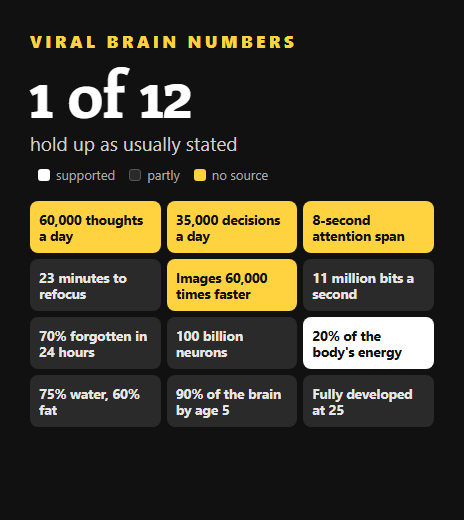
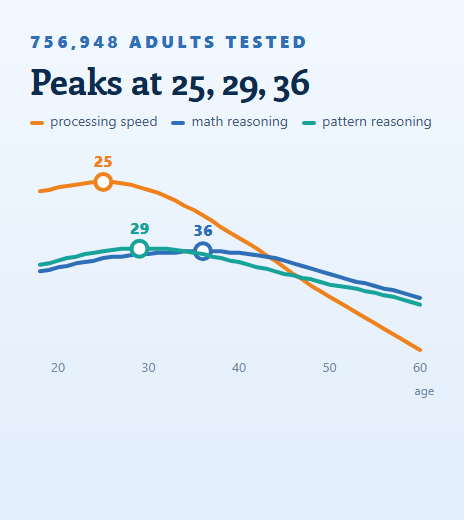
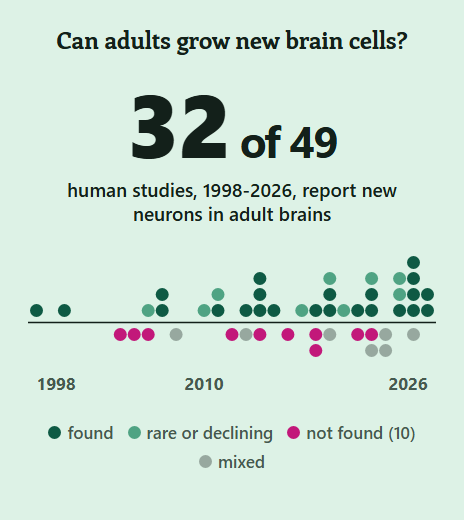
IQ Metrics has covered the popular claim already. The widely quoted “the brain is fully developed at 25” traces to a 2004 magazine quote, as our brain statistics fact check shows, and when scores peak depends on the skill: overall test performance peaked at 25 in 756,948 adults, with individual skills between 18 and 36 [22] (peak brain age). See also our news explainer on when the human brain is fully developed, and our pages on the average IQ of teenagers, IQ and age and whether IQ changes over time. Brain tissue measures and online test scores are not IQ. Other IQ Metrics studies on this hub cover whether adults grow new brain cells, brain myths by country, how fast humans think and what raises or lowers IQ.
The brain has many ages: grey matter volume peaks near 6, subcortical grey matter near 14, white matter near 29
Age at which each measure peaks, with the 95% bootstrap interval, in 101,457 people scanned between 115 days after conception and 100 years (Bethlehem et al. 2022, Nature, 123,984 MRI scans). A volume peak is when a tissue stops growing, not when a person is mature. As of 14 November 2026.
Source: Bethlehem et al. 2022 [15]
Data table
| label | low | estimate | high |
|---|---|---|---|
| Cortical grey matter volume peaks | 5.8 | 5.9 | 6.1 |
| Cortical surface area peaks | 10.4 | 11 | 11.5 |
| Total cerebrum volume peaks | 12.1 | 12.5 | 12.9 |
| Subcortical grey matter volume peaks | 14 | 14.4 | 14.7 |
| White matter volume peaks | 28.1 | 28.7 | 29.2 |
Embed this chart
Paste this HTML into your page: it carries the numbers and the credit link to this figure.
Every age marker in the brain table: what was measured, in whom, and the window the paper prints
| Gogtay et al., PNAS (2004) | Order in which cortex matures | healthy children scanned every 2 years for 8 to 10 years | 13 | ages 4 to 21 (an observed span, not a single age) | Association cortex matured after sensory cortex within the age span watched |
| Bethlehem et al., Nature (2022) | Cortical grey matter volume peaks | MRI scans pooled from more than 100 studies | 101,457 | peak at 5.9 years (95% interval 5.8 to 6.1) | Volume of grey matter, not ability |
| Bethlehem et al., Nature (2022) | Cortical surface area peaks | same pooled scans | 101,457 | peak at 10.97 years (10.42 to 11.51) | Surface area of the cortex |
| Bethlehem et al., Nature (2022) | Total cerebrum volume peaks | same pooled scans | 101,457 | peak at 12.5 years (12.14 to 12.89) | Whole-cerebrum volume |
| Bethlehem et al., Nature (2022) | Subcortical grey matter volume peaks | same pooled scans | 101,457 | peak at 14.4 years (14.0 to 14.7), “in adolescence” | Volume of deep grey-matter structures |
| Bethlehem et al., Nature (2022) | White matter volume peaks | same pooled scans | 101,457 | peak at 28.7 years (28.1 to 29.2) | Volume of white matter |
| Mousley et al., Nature Communications (2025) | Turning points in the wiring pattern of the brain | diffusion MRI, ages 0 to 90 | 4,216 | turning points at about 9, 32, 66 and 83; the second epoch runs from 9 to 32 | Network topology; the paper does not call 32 “mature” |
| Icenogle et al., Law and Human Behavior (2019) | Cognitive capacity reaches adult levels | tests of reasoning in 11 countries, ages 10 to 30 | 5,227 | around age 16; psychosocial maturity reached adult levels “beyond age 18” | A cross-sectional test battery, not an MRI |
| Steinberg et al., Developmental Science (2018) | Sensation seeking peaks | same kind of sample, 11 countries, ages 10 to 30 | 5,000 | peaked at age 19, then declined | Self-report and task measures; “more than 5000” is the paper’s count |
| Steinberg et al., Developmental Science (2018) | Self-regulation reaches a plateau | same sample | 5,000 | a plateau between ages 23 and 26 | Self-report and task measures |
| Sawyer et al., Lancet Child and Adolescent Health (2018) | Proposed span of adolescence | a review and proposal, no sample | no sample | adolescence defined as 10 to 24 rather than 10 to 19 | A definition, not a measurement |
| IQ Metrics Research, Peak Brain Age (2026) | Overall test performance peaks | adults on one online test battery | 756,948 | overall peak at 25; individual skills peak between 18 and 36 | Test scores of a self-selected online sample |
Source:
09 How do legal ages line up with brain science?
The legal ages sit between 10 and 21, while the brain and test ages in the table run from 6 to 36; they overlap, and no rule matches one measure [1] [15] [17]. The adult-court age and the age of majority, 18, fall after the age at which cognitive capacity reached adult levels (about 16) and before the self-regulation plateau (23 to 26) and the white matter peak (28.7). The lowest marriage and juvenile-court ages fall earlier, in the range where grey matter and cerebrum volumes peak (5.9 to 12.5) and before subcortical grey matter peaks (14.4).
A plain subtraction makes the line-up concrete, and it is only that. The adult-court age of 18 is 2 years above the cognitive-capacity age of 16 from Icenogle 2019, and 5 years below the start of the self-regulation plateau (23) from Steinberg 2018. These differences describe where numbers sit; they do not say which is correct, and a paper’s age is a group average from a sample, not a limit for any person. The authors of the cross-national paper argue for several boundaries rather than one [17]; that is a conclusion of theirs, and this page does not adopt it.
Legal ages and brain-science windows on one axis: the laws sit between 10 and 21, the measured ages between 6 and 36
Mark = median or mode (laws) or the paper's age (brain); bar = lowest to highest. Laws: US states (marriage, juvenile court, majority, adult court) and countries (criminal responsibility, voting). Brain and test rows: the papers' own ages and windows (table below). The overlap is descriptive: a law is not tied to any one measure. As of 14 November 2026.
Source: Statutes and laws (statutes.csv, countries_cells.csv) [1] [2]; papers [15] [16] [17] [18]; IQ Metrics Peak Brain Age [22]; IQ Metrics calculation
Data table
| label | low | estimate | high |
|---|---|---|---|
| LAW criminal responsibility, 26 countries | 10 | 13 | 18 |
| LAW lowest juvenile-court age, 26 states | 7 | 10 | 13 |
| LAW lowest marriage age with an exception, 48 states | 15 | 16 | 18 |
| LAW voting age, 29 countries | 16 | 18 | 18 |
| LAW adult-court age, 51 states | 17 | 18 | 19 |
| LAW age of majority, 51 states | 18 | 18 | 21 |
| LAW marriage with no exception, 51 states | 18 | 18 | 21 |
| BRAIN grey matter volume peak | 5.8 | 5.9 | 6.1 |
| BRAIN total cerebrum volume peak | 12.1 | 12.5 | 12.9 |
| BRAIN subcortical grey matter peak | 14 | 14.4 | 14.7 |
| BRAIN white matter volume peak | 28.1 | 28.7 | 29.2 |
| BRAIN network turning point 9 to 32 | 9 | 32 | 32 |
| TEST cognitive capacity at adult level | 16 | 16 | 16 |
| TEST sensation seeking peak | 19 | 19 | 19 |
| TEST self-regulation plateau 23 to 26 | 23 | 23 | 26 |
| TEST overall score peak (our study) | 18 | 25 | 36 |
Embed this chart
Paste this HTML into your page: it carries the numbers and the credit link to this figure.
Risk-taking is part of why the debate exists, and why smart people make bad decisions shows that a high score on a reasoning test does not remove it; the papers above measure psychosocial maturity separately from cognitive capacity for that reason.
Curious how your own reasoning measures up?
This study compares ages written into law with ages measured in studies. An IQ test is how reasoning is measured.
Take the IQ test10 How many young people live under each rule?
On 1 July 2025 the United States had 4,499,146 17-year-olds and 13,338,618 people aged 18 to 20 [5]. 761,404 of the 17-year-olds, 16.9%, lived in the four states where 17 is the adult-court age (Georgia, Louisiana, Texas and Wisconsin). These are counts of people of that age living in those states, not people affected by any particular law: most 17-year-olds are never charged with anything.
In the three states with a general age of majority above 18 (Alabama, Nebraska, Mississippi) the numbers for 18- to 20-year-olds are not separated here, because the rule does not apply to every purpose. The Census file counts civilians only, so the numbers leave out people in the military overseas.
About 761 thousand 17-year-olds live in the four states where 17 is the adult-court age: 16.9% of 4.50 million
US civilian population by single year of age, 12 to 25, in thousands, on 1 July 2025 (Census Bureau Vintage 2025 estimate). People of that age living in the four states with an adult-court age of 17 (Georgia, Louisiana, Texas and Wisconsin): 761,404 17-year-olds; they are people living in those states, not people affected by any particular law. 18- to 20-year-olds: 13,338,618. As of 14 November 2026.
Source: Census Bureau Vintage 2025 civilian population by single year of age [5]; IQ Metrics calculation
Data table
| label | value |
|---|---|
| 12 | 4107 |
| 13 | 4116 |
| 14 | 4175 |
| 15 | 4270 |
| 16 | 4352 |
| 17 | 4499 |
| 18 | 4487 |
| 19 | 4428 |
| 20 | 4423 |
| 21 | 4452 |
| 22 | 4431 |
| 23 | 4517 |
| 24 | 4807 |
| 25 | 4849 |
Embed this chart
Paste this HTML into your page: it carries the numbers and the credit link to this figure.
11 How we built the dataset
Each cell holds a value, the statute section, the URL read, an access date and a verbatim quote of one sentence. A script re-fetched every cited page and looked for the quote: 110 of 204 state cells were found again, and 93 could not be re-confirmed because many state sites block scripts, so those were read in a browser or in an Internet Archive copy of the official page, and the CSV says which. 46 cells (listed in the CSV) were read on a mirror of the code when the official site could not be read; those are flagged. A value we could not read is empty, not filled in.
- 01
Definitions first
We wrote each rule as the statute words it (data/DEFINITIONS.md) before collecting: age of majority, upper and lower juvenile-court age, marriage minimum with and without exceptions.
- 02
States
For each of the 50 states and DC we found the section in the official code, read the current text, and recorded value, section, URL and quote. Compilations by advocacy groups were used only to find the right section.
- 03
Countries
For 30 countries we read the criminal, civil, electoral and marriage laws on official sites where possible, a government or UN report where not, and flagged the last-resort compilations.
- 04
Brain table
We read the abstract (and, for the two open-access papers, the full text) of each paper and copied its own ages, n and wording; windows are the paper’s, not ours.
- 05
Checks
analyse.py runs 16 checks (states add to 51, Census states add to the US row, each court holding is inside the cached opinion) and writes every number the page prints.
- Age of majority
- The age at which a person stops being a minor for general civil purposes, as the state’s statute defines it.
- Adult-court age
- The age at which a person is treated as an adult in criminal court by default: the upper age of juvenile-court jurisdiction plus one.
- Upper age of juvenile-court jurisdiction
- The oldest age at which a juvenile court has original jurisdiction over a person charged with an ordinary offence (OJJDP).
- Minimum age of criminal responsibility
- The age below which a child cannot be held criminally responsible; in US states, the lowest age of delinquency jurisdiction where a statute states one.
- Marriage age with no exception
- The age at which a person may marry without a court order, parental consent or other exception.
- Raise the age
- A law that moves the age at which a person is treated as an adult in criminal court upward.
- Cognitive capacity and psychosocial maturity
- In the cross-national study, the ability to reason logically, and the ability to restrain oneself in emotional or risky situations (Icenogle 2019).
- Turning point
- An age at which the pattern of the brain’s wiring changes direction in the lifespan model of Mousley 2025; not an age of maturity.
Read every number with these in mind
- Four state rules were coded for all 51 jurisdictions; firearm, driving-licence, cannabis and transfer-age rules were dropped for time. Our count is of statute cells read, not of every legal age that exists.
- Of 204 state cells, 97 were read on an official page, 61 on an Internet Archive copy of the official page and 46 on a mirror of the code; 93 could not be re-confirmed by script. Statutes change, and a cell can be out of date.
- The adult-court age is the default only: exclusions, prosecutor choice, transfer and extended juvenile jurisdiction change what happens to an individual. Vermont’s limit rises again in 2027.
- The 2007 values are the ages in the statutes’ history notes for the 11 states that moved; the other 37 states are counted at their current age because we found no change.
- Brain papers measure samples, usually of volunteers, and print group averages and intervals. A peak of a volume or a plateau of a task is not an age of maturity or a limit for any person.
- Countries not read for a rule are left blank; several country cells use a government report or a flagged compilation. Countries are not ranked.
- This page is descriptive. It is not legal advice and takes no position on any age.
12 Which age applies in my state? Every state and country in one table
Every US state and DC, sorted by name; click a header to sort. The last column links the official statute page that each cell was read from; cells read on a mirror have no link. The full CSV (legal-age-of-adulthood-vs-brain-science-2026-iqmetrics.csv) has every column, and statutes.csv has the quote for every cell.
Every US state and DC: four legal ages and where each was read (as of 14 November 2026)
| Alabama | 19 | 18 | none in statute | 18 | 16 | majority · adult court · juvenile low · marriage | |
| Alaska | 18 | 18 | none in statute | 18 | 16 | majority (mirror) · adult court (mirror) · juvenile low (mirror) · marriage (mirror) | |
| Arizona | 18 | 18 | 8 | 18 | 16 | majority · adult court · juvenile low · marriage | |
| Arkansas | 18 | 18 | 10 | 18 | 17 | majority (mirror) · adult court (mirror) · juvenile low (mirror) · marriage (mirror) | |
| California | 18 | 18 | 12 | 18 | no floor in statute | majority · adult court · juvenile low · marriage | |
| Colorado | 18 | 18 | 10 | 18 | 16 | majority (mirror) · adult court (mirror) · juvenile low (mirror) · marriage (mirror) | |
| Connecticut | 18 | 18 | 10 | 18 | 18 | 2010: 15 to 17 | majority (archive copy) · adult court (archive copy) · juvenile low (archive copy) · marriage (archive copy) |
| Delaware | 18 | 18 | none in statute | 18 | 18 | majority · adult court · juvenile low · marriage | |
| District of Columbia | 18 | 18 | none in statute | 18 | 18 | majority · adult court · juvenile low · marriage | |
| Florida | 18 | 18 | none in statute | 18 | 17 | majority · adult court · juvenile low · marriage | |
| Georgia | 18 | 17 | 13 | 18 | 17 | majority (mirror) · adult court (mirror) · juvenile low (mirror) · marriage (mirror) | |
| Hawaii | 18 | 18 | 12 | 18 | 15 | majority · adult court · juvenile low · marriage | |
| Idaho | 18 | 18 | none in statute | 18 | 16 | majority (archive copy) · adult court (archive copy) · juvenile low (archive copy) · marriage (archive copy) | |
| Illinois | 18 | 18 | none in statute | 18 | 16 | 2010: 16 to 17 | majority (archive copy) · adult court (archive copy) · juvenile low (archive copy) · marriage (archive copy) |
| Indiana | 18 | 18 | none in statute | 18 | 16 | majority (mirror) · adult court (mirror) · juvenile low (mirror) · marriage (mirror) | |
| Iowa | 18 | 18 | none in statute | 18 | 16 | majority · adult court · juvenile low · marriage | |
| Kansas | 18 | 18 | 10 | 18 | 15 | majority · adult court · juvenile low · marriage | |
| Kentucky | 18 | 18 | none in statute | 18 | 17 | majority · adult court · juvenile low · marriage | |
| Louisiana | 18 | 17 | 10 | 18 | 16 | 2019: 16 to 17; 2024: 17 to 16 | majority (archive copy) · adult court (archive copy) · juvenile low (archive copy) · marriage (archive copy) |
| Maine | 18 | 18 | 11 | 18 | 18 | majority · adult court · juvenile low · marriage | |
| Maryland | 18 | 18 | 13 | 18 | 17 | majority · adult court · juvenile low · marriage | |
| Massachusetts | 18 | 18 | 12 | 18 | 18 | 2013: 16 to 17 | majority (mirror) · adult court (archive copy) · juvenile low (archive copy) · marriage (archive copy) |
| Michigan | 18 | 18 | none in statute | 18 | 18 | 2021: 16 to 17 | majority (mirror) · adult court (mirror) · juvenile low (mirror) · marriage (mirror) |
| Minnesota | 18 | 18 | 13 | 18 | 18 | majority · adult court · juvenile low · marriage | |
| Mississippi | 21 | 18 | 10 | 21 | no floor in statute | majority (mirror) · adult court (mirror) · juvenile low (mirror) · marriage (mirror) | |
| Missouri | 18 | 18 | none in statute | 18 | 18 | 2021: 16 to 17 | majority (archive copy) · adult court (archive copy) · juvenile low (archive copy) · marriage (archive copy) |
| Montana | 18 | 18 | none in statute | 18 | 16 | majority · adult court · juvenile low · marriage | |
| Nebraska | 19 | 18 | none in statute | 19 | 17 | majority (archive copy) · adult court (archive copy) · juvenile low (archive copy) · marriage (archive copy) | |
| Nevada | 18 | 18 | 10 | 18 | 17 | majority (archive copy) · adult court (mirror) · juvenile low (mirror) · marriage (archive copy) | |
| New Hampshire | 18 | 18 | 13 | 18 | 18 | 2015: 16 to 17 | majority (archive copy) · adult court (archive copy) · juvenile low (archive copy) · marriage (archive copy) |
| New Jersey | 18 | 18 | none in statute | 18 | 18 | majority (mirror) · adult court (mirror) · juvenile low (mirror) · marriage (archive copy) | |
| New Mexico | 18 | 18 | none in statute | 18 | no floor in statute | majority (mirror) · adult court (mirror) · juvenile low (mirror) · marriage (mirror) | |
| New York | 18 | 18 | 12 | 18 | 18 | 2018: 15 to 17 | majority · adult court · juvenile low · marriage |
| North Carolina | 18 | 18 | 10 | 18 | 16 | 2019: 15 to 17 | majority (archive copy) · adult court (archive copy) · juvenile low (archive copy) · marriage (archive copy) |
| North Dakota | 18 | 18 | none in statute | 18 | 16 | majority · adult court · juvenile low · marriage | |
| Ohio | 18 | 18 | none in statute | 18 | 17 | majority (archive copy) · adult court (archive copy) · juvenile low (archive copy) · marriage (archive copy) | |
| Oklahoma | 18 | 18 | 7 | 18 | 18 | majority (archive copy) · adult court · juvenile low · marriage | |
| Oregon | 18 | 18 | none in statute | 18 | 18 | majority (archive copy) · adult court (mirror) · juvenile low (mirror) · marriage (archive copy) | |
| Pennsylvania | 18 | 18 | 10 | 18 | 18 | majority · adult court · juvenile low · marriage | |
| Rhode Island | 18 | 18 | none in statute | 18 | 18 | majority (archive copy) · adult court (archive copy) · juvenile low (archive copy) · marriage (archive copy) | |
| South Carolina | 18 | 18 | none in statute | 18 | 16 | 2019: 16 to 17 | majority · adult court · juvenile low · marriage |
| South Dakota | 18 | 18 | 10 | 18 | 16 | majority · adult court · juvenile low · marriage | |
| Tennessee | 18 | 18 | none in statute | 18 | 17 | majority (mirror) · adult court (mirror) · juvenile low (mirror) · marriage (mirror) | |
| Texas | 18 | 17 | 10 | 18 | 16 | majority · adult court · juvenile low · marriage | |
| Utah | 18 | 18 | not read | 18 | 16 | majority (mirror) · adult court (archive copy) · juvenile low (not read) · marriage (mirror) | |
| Vermont | 18 | 19 | 12 | 18 | 18 | 2017: 15 to 18 | majority (archive copy) · adult court (archive copy) · juvenile low (archive copy) · marriage (archive copy) |
| Virginia | 18 | 18 | 11 | 18 | 18 | majority · adult court · juvenile low · marriage | |
| Washington | 18 | 18 | 8 | 18 | 18 | majority · adult court · juvenile low · marriage | |
| West Virginia | 18 | 18 | none in statute | 18 | 16 | majority (archive copy) · adult court (archive copy) · juvenile low (archive copy) · marriage (archive copy) | |
| Wisconsin | 18 | 17 | 10 | 18 | 16 | majority (archive copy) · adult court (archive copy) · juvenile low · marriage (archive copy) | |
| Wyoming | 18 | 18 | none in statute | 18 | 16 | majority · adult court · juvenile low · marriage |
Source:
The 30 countries: criminal responsibility, majority, voting and marriage ages (as of 14 November 2026)
| Argentina | 14 | 18 | 16 | 18 | not read | primary-law |
| Australia | 10 | 18 | 18 | 18 | 16 | primary-law |
| Brazil | 18 | 18 | 16 | 18 | 16 | primary-law |
| Canada | 12 | 18 | 18 | not read | 16 | primary-law |
| China | 16 | 18 | 18 | 20 | 20 | primary-law |
| Egypt | 12 | not read | 18 | 18 | 18 | primary-law |
| France | 13 | 18 | 18 | 18 | not read | primary-law |
| Germany | 14 | 18 | 18 | 18 | 18 | primary-law |
| India | not read | 18 | 18 | 18 | 18 | |
| Indonesia | not read | not read | 17 | 21 | not read | |
| Ireland | 12 | 18 | 18 | 18 | 18 | primary-law |
| Israel | 12 | 18 | 18 | not read | not read | compilation |
| Italy | 14 | 18 | 18 | 18 | 16 | primary-law |
| Japan | 14 | 18 | 18 | 18 | 18 | primary-law |
| Mexico | 12 | 18 | 18 | 18 | 18 | primary-law |
| Netherlands | 12 | 18 | 18 | 18 | 18 | primary-law |
| New Zealand | 10 | 20 | 18 | 18 | 16 | government-report |
| Nigeria | not read | 18 | 18 | 18 | not read | |
| Norway | 15 | 18 | 18 | 18 | 18 | primary-law |
| Philippines | 15 | 18 | 18 | 18 | 18 | primary-law |
| Poland | 13 | 18 | 18 | 18 | 16 | primary-law |
| Russia | 16 | 18 | 18 | 18 | 16 | primary-law |
| Saudi Arabia | not read | 18 | not read | 18 | not read | |
| South Africa | 12 | 18 | 18 | 18 | not read | primary-law |
| South Korea | 14 | 19 | 18 | 19 | 18 | primary-law |
| Spain | 14 | 18 | 18 | 18 | 16 | primary-law |
| Sweden | 15 | 18 | 18 | 18 | 18 | primary-law |
| Switzerland | 10 | 18 | 18 | 18 | 18 | primary-law |
| Turkey | 12 | 18 | 18 | 18 | 16 | primary-law |
| England and Wales | 10 | 18 | 18 | 18 | 18 | government-report |
Source:
Sources
- State legislatures and official code sites. State codes and session laws of the 50 states and DC (one statute per cell: section, URL, quote and how it was read in statutes.csv). 2026. iqmetrics.org/research/legal-age-of-adulthood-vs-brain-sciencePublic law (government edicts); cited by section and short quote. 97 of 204 cells read on an official page, 61 on an Internet Archive copy of the official page, 46 on a mirror of the code (flagged)
- National legislatures, governments and the UN. National laws and official reports of 30 countries (one cell per rule: law or report, article, URL, quote and source class in countries_cells.csv). 2026. iqmetrics.org/research/legal-age-of-adulthood-vs-brain-sciencePublic law; cited by article and short quote. 101 of 120 cells from the law itself on an official site; the rest from government reports or flagged compilations (CIA World Factbook, public domain; World Bank Women, Business and the Law, CC BY 4.0)
- Office of Juvenile Justice and Delinquency Prevention, Statistical Briefing Book. Upper age of juvenile court delinquency jurisdiction (table and notes, as of the end of the 2023 legislative session, released 6 October 2025). 2025. ojjdp.ojp.gov/statistical-briefing-book/structure_process/faqs/qa04101US government work (public domain)
- Office of Juvenile Justice and Delinquency Prevention, Statistical Briefing Book. Minimum transfer age specified in statute (notes, as of the end of the 2023 legislative session, released 11 May 2026). 2026. ojjdp.ojp.gov/statistical-briefing-book/structure_process/faqs/qa04105US government work (public domain)
- U.S. Census Bureau, Population Division. Annual Estimates of the Civilian Population by Single Year of Age and Sex for States, Vintage 2025 (SC-EST2025-AGESEX-CIV). 2026. www2.census.gov/programs-surveys/popest/datasets/2020-2025/state/asrh/sc-est2025-agesex-civ.csvUS government work, public domain (17 U.S.C. 105)
- U.S. Code, 2023 edition (U.S. Government Publishing Office). 23 U.S.C. 158: National minimum drinking age. 2023. www.govinfo.gov/content/pkg/USCODE-2023-title23/html/USCODE-2023-title23-chap1-sec158.htmUS government work (public domain)
- U.S. Code, 2023 edition (U.S. Government Publishing Office). 21 U.S.C. 387f(d)(5): Minimum age of sale (tobacco). 2023. www.govinfo.gov/content/pkg/USCODE-2023-title21/html/USCODE-2023-title21-chap9-subchapIX-sec387f.htmUS government work (public domain)
- U.S. Code, 2023 edition (U.S. Government Publishing Office). 50 U.S.C. 3802: Registration (Military Selective Service Act). 2023. www.govinfo.gov/content/pkg/USCODE-2023-title50/html/USCODE-2023-title50-chap49-sec3802.htmUS government work (public domain)
- National Archives (Constitution amendments 11-27). Amendment XXVI to the Constitution of the United States (passed 23 March 1971, ratified 1 July 1971). 1971. www.archives.gov/founding-docs/amendments-11-27US government work (public domain)
- UN Committee on the Rights of the Child. General Comment No. 24 (2019), Children's rights in juvenile justice, CRC/C/GC/24 (advance unedited text). 2019. www.ohchr.org/sites/default/files/Documents/HRBodies/CRC/GC24/GeneralComment24.pdfUN document, cited by paragraph and short quote
- Supreme Court of the United States. Roper v. Simmons, 543 U.S. 551 (2005). 2005. www.supremecourt.gov/opinions/boundvolumes/543BV.pdfUS government work (public domain)
- Supreme Court of the United States. Graham v. Florida, 560 U.S. 48 (2010). 2010. www.supremecourt.gov/opinions/boundvolumes/560BV.pdfUS government work (public domain)
- Supreme Court of the United States. Miller v. Alabama, 567 U.S. 460 (2012). 2012. www.supremecourt.gov/opinions/boundvolumes/567BV.pdfUS government work (public domain)
- Supreme Court of the United States. Montgomery v. Louisiana, 577 U.S. 190 (2016). 2016. www.supremecourt.gov/opinions/boundvolumes/577BV.pdfUS government work (public domain)
- Nature 604, 525-533 (CC BY 4.0). Bethlehem RAI et al.: Brain charts for the human lifespan. 2022. doi.org/10.1038/s41586-022-04554-yCC BY 4.0
- Nature Communications 16, 10055 (CC BY 4.0). Mousley A, Bethlehem RAI, Yeh FC, Astle DE: Topological turning points across the human lifespan. 2025. doi.org/10.1038/s41467-025-65974-8CC BY 4.0
- Law and Human Behavior 43(1), 69-85. Icenogle G et al.: Adolescents' cognitive capacity reaches adult levels prior to their psychosocial maturity: evidence for a "maturity gap" in a multinational, cross-sectional sample. 2019. doi.org/10.1037/lhb0000315Paywalled journal; facts (n, ages, findings) cited from the abstract
- Developmental Science 21(2). Steinberg L et al.: Around the world, adolescence is a time of heightened sensation seeking and immature self-regulation. 2018. doi.org/10.1111/desc.12532Paywalled journal; facts cited from the abstract
- The Lancet Child and Adolescent Health 2(3), 223-228. Sawyer SM et al.: The age of adolescence. 2018. doi.org/10.1016/S2352-4642(18)30022-1Paywalled journal; facts cited from the abstract
- PNAS 101(21), 8174-8179. Gogtay N et al.: Dynamic mapping of human cortical development during childhood through early adulthood. 2004. doi.org/10.1073/pnas.0402680101Facts cited from the abstract
- Trends in Cognitive Sciences 18(2), 63-65. Cohen AO, Casey BJ: Rewiring juvenile justice: the intersection of developmental neuroscience and legal policy. 2014. doi.org/10.1016/j.tics.2013.11.002Facts cited from the abstract
- IQ Metrics Research. IQ Metrics Research: At what age is your brain sharpest? (peak brain age). 2026. iqmetrics.org/research/peak-brain-ageCC BY 4.0
- IQ Metrics Research. IQ Metrics Research: The brain numbers everyone quotes, checked. 2026. iqmetrics.org/research/brain-statistics-fact-checkCC BY 4.0
Version history
- 2026.1114 November 2026First release: four state rules, four country rules and 12 brain markers. Next update due when a state changes one of the rules (marriage, juvenile age), when OJJDP updates its 2023 tables, and to add firearm, driving and cannabis ages and the cells that could not be read.
Leon Falkner, Data & Research Analyst. Leon owns the arithmetic on IQ Metrics: the percentile tables, the score converter and the figures in everyone else's drafts. On the research desk Leon pulls the data, builds each index and writes the method. More about Leon.
Questions
At what age is a person legally an adult in the US?
18 in 48 of 51 US jurisdictions (Alabama and Nebraska 19, Mississippi 21), and criminal courts treat a person as an adult from 18 in 46 of 51 (Georgia, Louisiana, Texas and Wisconsin from 17). Federal law sets alcohol and tobacco at 21 (IQ Metrics, as of 14 November 2026).
What is the age of majority by state?
It is 18 in 48 of 51 jurisdictions, 19 in Alabama and Nebraska and 21 in Mississippi, from each state's definition of "minor" or "age of majority". The table on this page lists every state with the statute it was read from.
What age is a juvenile an adult in each state?
In 46 of 51 jurisdictions the juvenile court ends at the 18th birthday; in Georgia, Louisiana, Texas and Wisconsin it ends at 17, and in Vermont at 19. Many states have exceptions that send some younger people to adult court.
Which states treat 17-year-olds as adults?
Four: Georgia, Louisiana, Texas and Wisconsin (761,404 of the 4,499,146 US 17-year-olds live there, 16.9%). Louisiana moved 17-year-olds into juvenile court in 2019-2020 and back in April 2024; 11 states raised the line since 2007.
What is the minimum marriage age by state?
18 jurisdictions allow no marriage under 18; the others allow it at 17, 16 or 15 with parental consent or a court order, and California, Mississippi and New Mexico name no floor. Laws changed often in 2018-2026, with Oklahoma's ban starting 1 November 2026.
What is the age of criminal responsibility by country?
The median is 13 in the 26 countries we read, from 10 (Australia, England and Wales) to 16 (China) and 18 in Brazil's criminal law. 14 are below 14, the age the UN Committee on the Rights of the Child encourages.
When is the brain fully developed?
There is no single age: studies print different ages for different measures, such as 5.9 years for grey matter volume and 28.7 for white matter volume in 101,457 people (Bethlehem 2022). "Fully developed at 25" traces to a 2004 magazine quote; see our fact check.
Is the brain fully developed at 25?
No study we found says so. Self-regulation reached a plateau between 23 and 26 in more than 5,000 people (Steinberg 2018), white matter volume peaks near 29 (Bethlehem 2022) and brain wiring has a turning point near 32 (Mousley 2025), each measuring something different.
What did the Supreme Court say about under-18 offenders?
Roper v. Simmons (2005) forbids the death penalty for those under 18 at the time of the crime; Graham v. Florida (2010) bars life without parole for non-homicide; Miller v. Alabama (2012) bars mandatory life without parole; Montgomery (2016) made Miller retroactive.
Does brain science match the legal age of 18?
It overlaps but does not match: cognitive capacity reached adult levels near 16 and psychosocial maturity beyond 18 (Icenogle 2019, 5,227 people, 11 countries), while self-regulation plateaued at 23 to 26. No law is tied to one measure, and this page takes no position.
Share it, cite it, download it
You may reuse everything on this page under CC BY 4.0: in articles, reports, lessons and posts. The one condition is credit to IQ Metrics with a link to this page.
Cite this study
Version 2026.11. Citing the version lets readers find the exact numbers.
Archived copy with a DOI: 10.5281/zenodo.24217229 (report PDF and data on Zenodo).
Falkner, L. (2026). At what age is a person an adult? Four legal ages in 51 US jurisdictions, 30 countries and the brain studies (Version 2026.11) [Data set]. IQ Metrics Research. https://iqmetrics.org/research/legal-age-of-adulthood-vs-brain-science/ (DOI: 10.5281/zenodo.24217229)
Falkner, Leon. "At what age is a person an adult? Four legal ages in 51 US jurisdictions, 30 countries and the brain studies." IQ Metrics Research, 14 Nov. 2026, iqmetrics.org/research/legal-age-of-adulthood-vs-brain-science/. DOI: 10.5281/zenodo.24217229.
Falkner, Leon. "At what age is a person an adult? Four legal ages in 51 US jurisdictions, 30 countries and the brain studies." IQ Metrics Research. November 14, 2026. https://iqmetrics.org/research/legal-age-of-adulthood-vs-brain-science/. DOI: 10.5281/zenodo.24217229.
@misc{iqmetrics2026legalageofadulthoodvsbrainscience, author = {Falkner, Leon}, title = {At what age is a person an adult? Four legal ages in 51 US jurisdictions, 30 countries and the brain studies}, institution = {IQ Metrics}, year = {2026}, version = {2026.11}, doi = {10.5281/zenodo.24217229}, url = {https://iqmetrics.org/research/legal-age-of-adulthood-vs-brain-science/} }
Source: Leon Falkner, "At what age is a person an adult? Four legal ages in 51 US jurisdictions, 30 countries and the brain studies." IQ Metrics Research, version 2026.11, https://iqmetrics.org/research/legal-age-of-adulthood-vs-brain-science/ (DOI 10.5281/zenodo.24217229)
Get the data
One row per US state or DC (51) and per country (30). State rows: age of majority, adult-court age (also for 2007), lowest juvenile-court age, marriage ages, Census population aged 17 and 18-20 (1 July 2025). Country rows: criminal-responsibility, majority, voting and marriage ages. The statute, URL, quote and how it was read for every cell are in statutes.csv and countries_cells.csv; brain.csv lists the brain-science markers. Empty cells: not read. Rules: legal-ages/data/DEFINITIONS.md.
| Column | What it holds |
|---|---|
level, code, name | US state or country, its code and name |
age_majority | Age of majority (civil), from the statute or code |
adult_court_age | Age at which a person is treated as an adult in criminal court by default (upper age of juvenile jurisdiction + 1) |
adult_court_age_2007 | Same age in 2007 (statute history for the 11 states that moved; others carried back, no change found) |
juvenile_lowest_age, juvenile_lowest_age_text | Lowest age of juvenile-court delinquency jurisdiction in the statute; text "none in statute" where the definition names none |
criminal_responsibility_age | Minimum age of criminal responsibility (countries, general rule) |
voting_age | Minimum voting age for national elections (countries) |
marriage_min_age_no_exception | Age at which marriage needs no court order or consent |
marriage_min_age_any_exception | Lowest age at which marriage is allowed in any circumstance |
marriage_exceptions | Short text of what the exception is |
people_aged_17_2025, people_aged_18_20_2025 | Census Vintage 2025 civilian population, 1 July 2025 |
source_note, as_of | How each cell was read and the date |
For journalists, researchers and teachers
Everything on this page may be quoted, charted and republished with credit. No embargo, no permission needed, no sign-up. If you need a number that is not here, ask.
Summary you can paste
Plain news style. Edit freely; keep the credit.
IQ Metrics Research read four age rules in the statutes of 50 states and DC, four in the laws of 30 countries, and listed the age windows of 12 brain-science markers. 48 of 51 US jurisdictions set the age of majority at 18; 46 end juvenile court at 18, four (Georgia, Louisiana, Texas, Wisconsin) at 17; 18 allow no marriage under 18. Median criminal-responsibility age in 26 countries: 13. Brain papers print windows from 6 to 29, not one age. Source: IQ Metrics Research, https://iqmetrics.org/research/legal-age-of-adulthood-vs-brain-science/
Angles for a story
- Four states still treat 17-year-olds as adults. Georgia, Louisiana, Texas and Wisconsin; 16.9% of US 17-year-olds live there. In 2007 it was 14 states.
- Louisiana moved up, then back. It raised the line for 17-year-olds in 2019-20 and moved it back in April 2024, the only state to reverse.
- Child marriage law changed state by state. 18 jurisdictions now allow none under 18, with Oklahoma’s ban starting 1 November 2026; 24 still allow 16 or younger with consent or a court order.
- Most states do not say how young is too young. 24 of 51 name no lowest age of delinquency in the statute; the others name 7 to 13.
- There is no brain age of adulthood. Task performance near 16, self-regulation at 23 to 26, white-matter volume peaking near 29: the papers print different ages for different things, and a volume peak is not a maturity age.
Quotes you can use
Attributable as written, with the name and title. For a different angle or a quote on a specific figure, ask through the contact page.
The law has a favourite age, 18, but when you read the statutes the line moves with the question: majority, criminal court, marriage and the youngest child a state names are four different answers.
Leon Falkner, Data & Research Analyst, IQ Metrics ResearchThe brain papers do not give one age of adulthood; they print windows, and the researchers say the law can reasonably have more than one boundary. Our job here was to put the numbers side by side.
Leon Falkner, Data & Research Analyst, IQ Metrics ResearchStatutes change, which is why every cell carries a date and a source. If a state changes a rule, this page will change with it.
Leon Falkner, Data & Research Analyst, IQ Metrics Research
Files
- CSV of every US jurisdiction and country in our dataset: the four state rules, the 2007 adult-court age, the country rules, people aged 17 and 18 to 20, and a source note (CC BY 4.0)
- Every figure as a print-ready PNG: use the Image button under each figure
- Embed code and data table under every figure
- Share images for social media in three sizes, with the credit line built in
- Citations in APA, MLA, Chicago, BibTeX and plain text
- Also in the data pack: statutes.csv and countries_cells.csv, one row per rule with its section, address and quote, shared on request through the contact page
Terms, contact and corrections
Licence and credit: CC BY 4.0. Credit “IQ Metrics Research, At what age is a person an adult? (2026)” with a link to this page. On air or in print, “IQ Metrics” and the page address are enough.
What it covers: Statutes, laws and Supreme Court opinions are public law; papers are cited by their findings. Descriptive only: no policy position and no legal advice.
Contact: the research team, through the contact page. Corrections are made on this page with a dated note in the version history.