
Does Chess Raise Your IQ? What the Research Actually Shows
Chess is one of the oldest test cases for a big question: does practicing a demanding mental skill make you generally smarter, or just better at that skill? The honest summary from decades of research: real for chess itself, modest for a couple of related skills, and close to zero for general IQ.
No, not in the way most people hope. Chess reliably makes you better at chess, and with enough structured instruction it appears to help a little with school subjects that lean on planning and working memory, particularly math. The evidence that it raises general intelligence — the kind an IQ test measures — is much weaker, and it gets weaker still in the studies built to rule out the obvious alternative explanations. That gap between the two claims is worth understanding rather than just accepting, because the same pattern — a confident headline about “raising IQ” resting on evidence that only ever supported a narrower, less exciting claim — shows up across most of the games, apps and hobbies marketed the same way.
That pattern — a real effect on the skill itself, a smaller and shakier one on anything further away — shows up again almost exactly with video games, which this article treats as a companion piece. Both are examples of the same question asked about a different activity: does deliberately practicing a demanding mental skill make you smarter overall, or just better at that skill?
What the raw numbers show
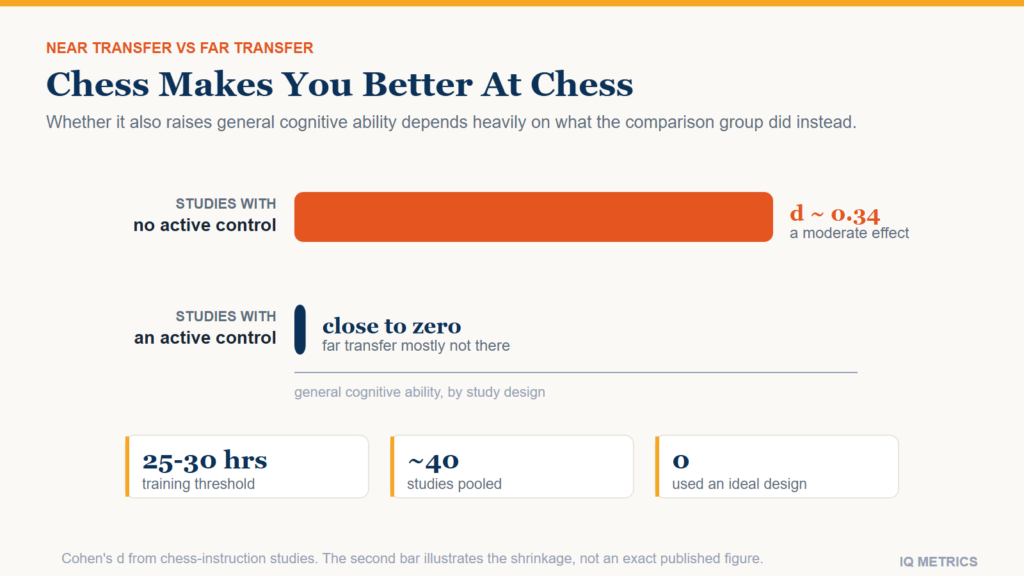
Pooling roughly forty studies of children given structured chess instruction, one widely cited analysis reported a moderate association with general cognitive-ability scores, and a similar or slightly larger one with math achievement specifically. Reading and literacy scores moved less. On the numbers alone, chess looks like a genuinely useful classroom activity.
Two details in the same body of research matter before taking that at face value. The size of the effect tracked how much chess the children actually did: benefits showed up reliably only once a class had logged somewhere around 25 to 30 hours of instruction, roughly a school year of one lesson a week. And the authors of the underlying review were explicit that no single study in it used what they considered an ideal design, so a placebo-like effect from novelty and extra adult attention could not be ruled out. That is not a small caveat in a literature this size: it means the best-supported number available is also, by the reviewers’ own account, an upper bound rather than a settled estimate.
Why the number shrinks when you look closer
That second caveat turned out to matter a great deal. Most of the early chess-and-cognition studies compared a chess class against doing nothing different at all, which leaves the comparison unable to separate three things that all point the same direction: chess itself, structured attention from an instructor, and simply doing something new and engaging instead of a normal lesson.
The same research group later re-ran the comparison using only studies where the control group did a different structured activity of their own, rather than nothing. Their own paper described the result in its title: negative evidence for far transfer. Once novelty and extra attention are matched on both sides, the boost to general cognitive ability mostly is not there. What survives is much closer to zero than the raw 0.34 figure above suggests.
Are strong players just smart people who chose chess
There is a second, separate question hiding inside the first one: are the best chess players in the world unusually high in IQ to begin with? Loosely, yes — competitive players as a group score above the general population average on cognitive tests, the way people who stick with any demanding hobby tend to skew toward whatever trait makes that hobby rewarding. But among players who already compete seriously, differences in tournament rating track hours of deliberate, structured study far more closely than they track differences in general intelligence scores. Two players with similar ratings can differ substantially in IQ, and two players with similar IQs can differ by hundreds of rating points depending on how they trained.
That is worth remembering the next time a very strong player’s IQ gets quoted as though it explained their rating. Magnus Carlsen and Garry Kasparov are both, by any measure, exceptionally strong players; neither’s rating is well explained by IQ alone, and both logged the kind of practice hours this research keeps landing on as the real driver.
Where would your own score land?
Take the IIF-certified assessment and get your score with the scale it was measured on, the percentile it corresponds to and the confidence range around it — the three figures most online tests leave out.
Chess, bridge and dementia risk in later life
A related and often-repeated claim is that chess and similar games protect older adults against cognitive decline and dementia. The observational evidence pointing that way is real: large studies following older adults over years have found that people who regularly play chess, cards or similar strategy games show a lower rate of later dementia diagnosis than people who do not.
The catch is a familiar one in this kind of research. Dementia has a long preclinical phase, often many years, during which subtle cognitive changes can make demanding hobbies less appealing well before any diagnosis is made. People already, invisibly, on the path to decline may simply stop playing chess first, which would produce exactly this pattern even if chess itself did nothing protective at all. Randomized trials, which could rule that out, are far smaller and shorter than the observational studies, and the question has not been settled either way.
What chess is actually good evidence for
Set the far-transfer question aside and the chess research is genuinely informative about something else: what deliberate practice does to the skill it targets, and how narrowly that tends to stay put. One of the more careful studies in this literature found chess instruction improved children’s meta-cognitive habits inside math problem-solving specifically — noticing when a plan is not working, checking an answer against the question — without a matching jump in general test scores. That is near transfer: chess did not make the children smarter in general, it made them better at monitoring their own thinking while doing something chess-like, and that skill did not travel very far past the domain it was trained in.
That study used an active control group of its own — children who received extra math instruction instead of chess — and still found the chess group ahead on the meta-cognitive measure, which is a more convincing design than most of the literature behind it. It is also a good example of what a believable transfer claim looks like: specific, modest, and tied to a plausible shared mechanism, rather than a blanket “chess makes children smarter.”
- Real, and well supported. Chess makes you better at chess, and rating gains track practice hours closely.
- Plausible, and modest. A year or more of regular instruction may help planning-heavy schoolwork a little, mainly math.
- Not well supported once studies control for novelty. A durable boost to general intelligence.
So should you play chess for a smarter brain
If the goal is a higher IQ score, the honest answer is that chess is not a reliable way to get one, and probably no single hobby is; see how much of IQ is fixed versus changeable for the wider picture and what the evidence says actually moves the number. If the goal is a genuinely absorbing game that rewards planning, pattern recognition and calm decision-making under pressure, none of the transfer research changes that case at all — it only argues against expecting it to do something else on the side.
The more general lesson travels well beyond chess. Any claim that a specific game, app or hobby raises IQ deserves the same two questions asked here: what did the comparison group do, and how much of the reported effect survives once that comparison is fair? Retesting itself raises scores for reasons that have nothing to do with getting smarter, which is one more way an easy-looking result can mislead.
None of that is a reason to skip chess. It is a reason to want it for what it reliably gives you — a demanding, endlessly replayable game, not a training program with a guaranteed side effect on a test score you will take somewhere else entirely.
Keep reading
 Mind & Everyday Life
Do Video Games Raise Your IQ?
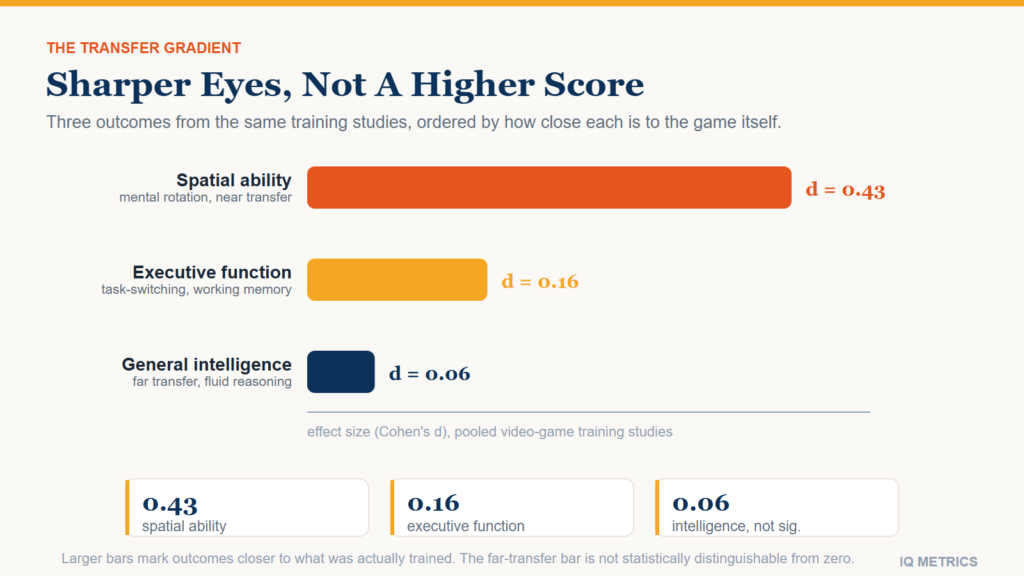
Action video games produce real, replicated gains in spatial ability and attention, some of the best near-transfer evidence in this batch. Push the test further away, toward the general reasoning an IQ test measures, and the effect all but disappears once the research is pooled properly.
 Mind & Everyday Life
Does Exercise Raise Your IQ?
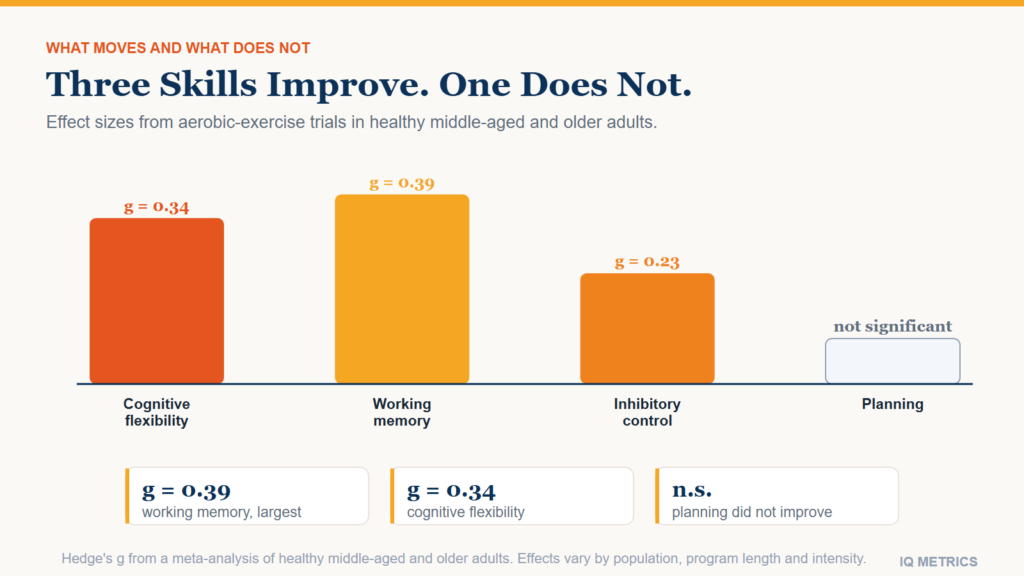
Aerobic exercise has some of the best-replicated cognitive evidence of any lifestyle factor, but not for a full IQ score. What reliably improves is executive function: working memory, inhibitory control, cognitive flexibility. One related skill, planning, barely moves at all.
 Research & Evidence
Is IQ Genetic?
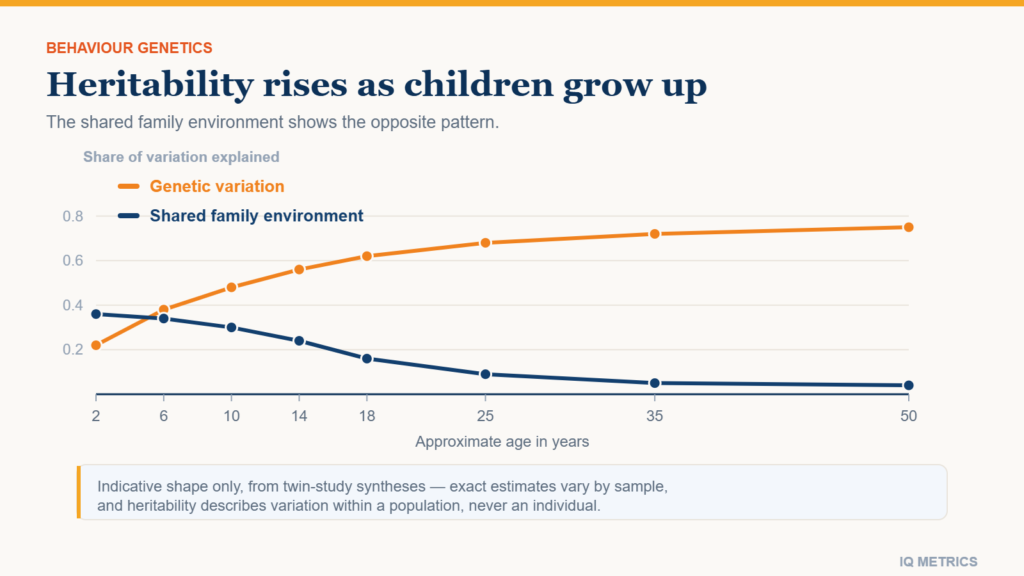
Heritability estimates for IQ rise from roughly 0.4 in childhood to 0.7 or higher in adulthood, which sounds decisive until you know what heritability measures. Here is what twin and adoption studies actually show, and the four conclusions people draw from them that the statistic does not support.