





What Does an IQ of 126 Mean? IQ 126 Percentile, Rarity and Why the Scale Matters
IQ 126 is the 95.8th percentile on SD 15, about 1 in 24 people, and 4 points under the 130 line. On SD 16 it is the 94.8th and on SD 24 the 86.1st, so it is inside the top 5% on one scale and just short on another. See the Mensa gap and what a retest of 126 can read.

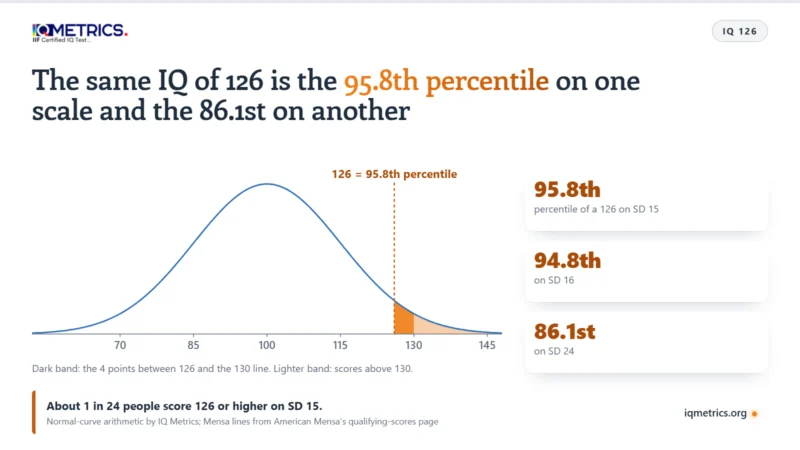
IQ 126 is the 95.8th percentile on a scale with a mean of 100 and a standard deviation (SD) of 15: about 1 in 24 people score 126 or higher. It is a high score, and it sits 4 points under the 130 line that Mensa and many gifted programmes use. On other scales the same 126 ranks lower: the 94.8th percentile on SD 16 and the 86.1st on SD 24.
New here: a 126 is inside the top 5% on an SD 15 test (the line is 124.7) but 0.3 points short of it on an SD 16 test (126.3). And a person whose true level is 126 would read 130 or higher in about 1 sitting in 7. Below: the percentile, the three scales, gifted and Mensa lines, and retests.
Key takeaways
- An IQ of 126 is the 95.8th percentile on SD 15 (1 in 24), the 94.8th on SD 16 (1 in 19) and the 86.1st on SD 24 (1 in 7).
- The top-5% line is 124.7 on SD 15, 126.3 on SD 16 and 139.5 on SD 24. A 126 clears it on the first only.
- Mensa: every IQ line American Mensa lists starts at 130, so a 126 is 4 points short on a Wechsler test and 6 short on a CogAT.
- About 55 of every 100 people who score 126 or higher also reach 130. The other 45 sit between 126 and 129.
- A true 126 would read 130 or higher about 5%, 15% or 23% of the time, depending on the test (our arithmetic).
What percentile is IQ 126, and what does it mean?
An IQ of 126 is the 95.8th percentile on SD 15. That means 95.8% of people in the test’s norm group score below 126, and 4.2% score at or above it.
Here is the sum. The z-score is (126 minus 100) divided by 15, which is 1.73: the score sits 1.73 SDs above the average. On a normal curve, 95.85% of people fall below that point and 4.15% above. One divided by 0.0415 is about 24, so 1 person in 24 scores 126 or higher.
That is the 126 IQ percentile on the scale most modern tests use. Our IQ percentile calculator gives the same figure for any score, and the IQ bell curve shows where 126 sits.
| IQ score | Percentile | About 1 in |
|---|---|---|
| 124 | 94.5th | 1 in 18 |
| 125 | 95.2nd | 1 in 21 |
| 126 | 95.8th | 1 in 24 |
| 127 | 96.4th | 1 in 28 |
| 128 | 96.9th | 1 in 32 |
| 129 | 97.3rd | 1 in 38 |
| 130 | 97.7th | 1 in 44 |
One point near 126 is worth about half a percentile point (0.56). So a 126 and a 127 are close neighbours. For the scores either side, read what an IQ of 125 means and what an IQ of 127 means.
Is 126 IQ good?
Yes. An IQ of 126 is higher than about 96 of every 100 people in the norm group, and it is 26 points above the average of 100.
It is a high score, not a rare one. In a class of 30 drawn from the norm group, about 1 child scores 126 or higher, and the chance of at least one is 72%. In a school of 1,000 it is about 42 children, and in a town of 10,000 about 415. A selective school or a gifted class will hold more. Our IQ score converter shows what the same standing looks like on other tests.
Is 126 IQ gifted?
Not on the usual line. Gifted programmes most often start at 130, which is two SDs above the mean, and a 126 is 4 points under it. Some districts set their own lines, so ask which test and which scale yours uses.
Our guide to gifted cut-off scores explains that 130 is a convention, not a discovery. Where a school uses a percentile instead, the result depends on the scale. The table lists the score each common line needs on three scales, and where a 126 stands against it. The lines are arithmetic, not any one programme’s rule.
| Line | SD 15 (Wechsler) | SD 16 (older Stanford-Binet) | SD 24 (Cattell) |
|---|---|---|---|
| Top 10% (90th percentile) | 119.2 (126 is 6.8 above) | 120.5 (126 is 5.5 above) | 130.8 (126 is 4.8 short) |
| Top 5% (95th percentile) | 124.7 (126 is 1.3 above) | 126.3 (126 is 0.3 short) | 139.5 (126 is 13.5 short) |
| Top 2% (98th percentile) | 130.8 (126 is 4.8 short) | 132.9 (126 is 6.9 short) | 149.3 (126 is 23.3 short) |
| Top 1% (99th percentile) | 134.9 (126 is 8.9 short) | 137.2 (126 is 11.2 short) | 155.8 (126 is 29.8 short) |
So a 126 is inside the top 10% on SD 15 and SD 16, and inside the top 5% on SD 15 only. On SD 16 it falls 0.3 points short of the 95th percentile. On SD 24 it is below the 90th percentile line by 4.8 points. Nobody sits a test to land on a line, but the scale can decide which side of it you fall.
Does 126 mean the same on every IQ test?
No. The 126 IQ meaning depends on the scale, because each test spreads its scores differently. Most modern tests use SD 15, older Stanford-Binet forms use SD 16, and the Cattell scales use SD 24.
The table gives the same 126 on each scale, with the SD 15 score of equal standing in the last column. Our report on IQ scales with SD 15 and SD 16 shows how the conversion works.
| Scale (SD) | Used by | Percentile of a 126 | About 1 in | Same standing on SD 15 |
|---|---|---|---|---|
| SD 15 | Wechsler scales, Stanford-Binet 5 | 95.8th | 1 in 24 | 126.0 |
| SD 16 | Older Stanford-Binet forms | 94.8th | 1 in 19 | 124.4 |
| SD 24 | Cattell scales | 86.1st | 1 in 7 | 116.2 |
A 126 on a Cattell test is only the 86th percentile, the same standing as a 116 on SD 15. A 126 on an older Stanford-Binet is close to a 124 on SD 15. On a Wechsler test, the number is what it looks like. Always ask which scale or source a score came from before you compare two of them. A country’s “average IQ” shows the same problem: the average IQ in Nigeria is 67.80 in one table and 92.76 in another.
Where would your own score land?
Take the IIF-certified assessment and get your score with the scale it was measured on, the percentile it corresponds to and the confidence range around it — the three figures most online tests leave out.
Find your IQ score now! →How does an IQ of 126 compare to Mensa?
An IQ of 126 is 4 points under the lowest Mensa line, which is 130 on the Wechsler scales. Mensa asks for the top 2%, and that starts at 130.8 on SD 15.
American Mensa’s qualifying-scores page, which we read on 16 November 2026, lists IQ lines of 130 (Wechsler, Stanford-Binet 5, DAS-II, RIAS), 131 (Otis-Gamma, Woodcock-Johnson IV), 132 (CogAT, OLSAT, the older Stanford-Binet) and 148 (Cattell). There is no line below 130. A 126 is 4 points short on a Wechsler test, 6 short on a CogAT, and 22 short on a Cattell.
On SD 16 the exact top-2% mark is 132.9, so a 126 is 6.9 short there. Here is the part the percentile hides. About 55 of every 100 people who score 126 or higher also reach 130. Only 45 of them sit in the 126 to 129 band, and the gap between a 126 and a 130 is just 1.9 percentile points. The test-by-test list is in our Mensa IQ requirements guide.
Could a retest of a 126 come out at 130 or higher?
Yes, sometimes. Every score carries a margin of error, and a gap of 4 points is not always larger than it. How often a 126 would read 130 or higher depends on how reliable the test is.
The standard error of measurement (SEM) is the SD times the square root of one minus the test’s reliability. Our IQ test accuracy page sets out the formula. The reliabilities below are assumptions, not figures from any one manual. They assume errors that follow a normal curve and no practice effect.
| Reliability | SEM (points) | 95% range of one sitting | Chance one sitting reads 130 or higher |
|---|---|---|---|
| 0.98 | 2.1 | 122 to 130 | 5% (1 in 20) |
| 0.95 | 3.4 | 119 to 133 | 15% (1 in 7) |
| 0.90 | 4.7 | 117 to 135 | 23% (1 in 4) |
With a reliability of 0.95, a true 126 reads anywhere from about 119 to 133, and 130 or higher about 1 sitting in 7. The error runs both ways, so a 126 could also be a true 129. So one 126 is good evidence of a high score, but it is not proof of one under 130. Our post on an IQ of 129 works through what that error does to a score one point from the line.
What jobs and college fit an IQ of 126?
No job or college sets a 126 as its requirement, so none “fits” it. Scores like this relate to outcomes only as group averages, and effort, field and opportunity carry most of the rest.
Our page on an IQ of 125 applies a 2007 meta-analysis (Strenze, Intelligence) to a score one point lower. It finds that the average person near this level lands above average on education, occupation and income, with income the weakest link. We did not re-read that paper for this article, so we give no new figures from it. For the measured link between scores and grades, see whether IQ predicts school success. To see where your own result falls, take the IQ test.
Quick answers
- What does IQ 126 mean? The 95.8th percentile on SD 15: about 1 in 24 people score 126 or higher.
- Is 126 IQ good? Yes. It is higher than about 96 of every 100 people, and 26 points above average.
- Is 126 IQ gifted? Not on the usual 130 line. It is inside the top 5% on SD 15, but not on SD 16 or SD 24.
- What is an IQ of 126 compared to Mensa? Four points short of the lowest line, 130 on Wechsler tests.
- What is a 126 IQ percentile on SD 16? The 94.8th, about 1 in 19, the same standing as 124 on SD 15.
Sources
- American Mensa. Qualifying test scores (page read on 16 November 2026).
- Percentiles, 1-in-N figures, percentile lines, group counts and retest chances: normal-curve arithmetic by IQ Metrics, computed in code, not copied. The reliabilities in the retest table are assumptions.
- Our own pages: IQ test accuracy, IQ scales: SD 15 vs 16, gifted cut-off scores and the Mensa IQ requirements guide.
Keep reading
All articles →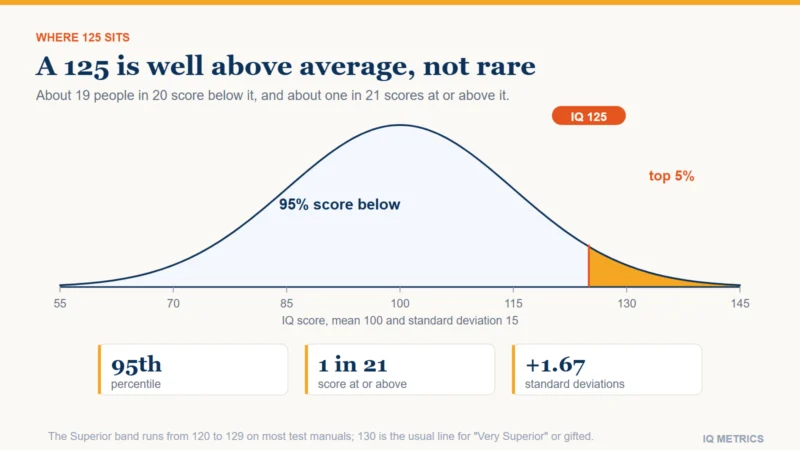 Scores & Scales
What an IQ of 125 Means
An IQ of 125 is the 95th percentile on the standard scale: about 1 person in 21, in the Superior band and one band below most gifted cutoffs. See how many people that is, what an IQ between 115 and 125 means, how accurate a single score is and what a 125 predicts.
 Scores & Scales
What Does an IQ of 127 Mean?
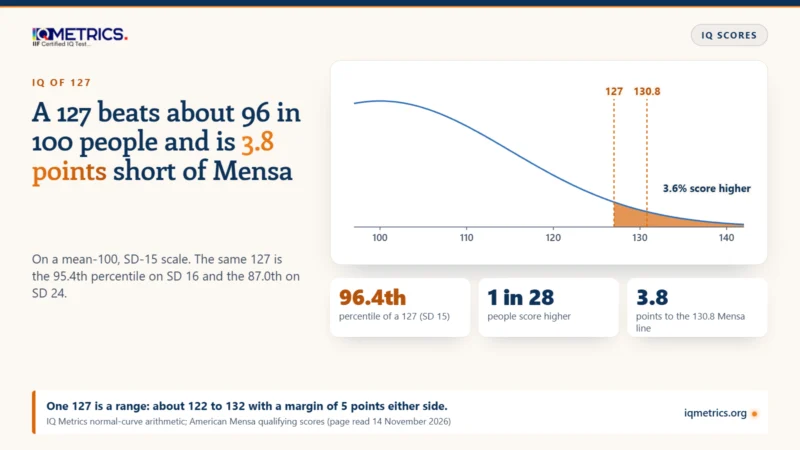
An IQ of 127 is the 96.4th percentile on SD 15, about 1 in 28 people, and 3 points short of the 130 Mensa line. See 127 on each scale, how many people in a class reach it, which gifted-programme rule it misses, and how far one score can move.
 Scores & Scales
Mensa IQ Score Requirements
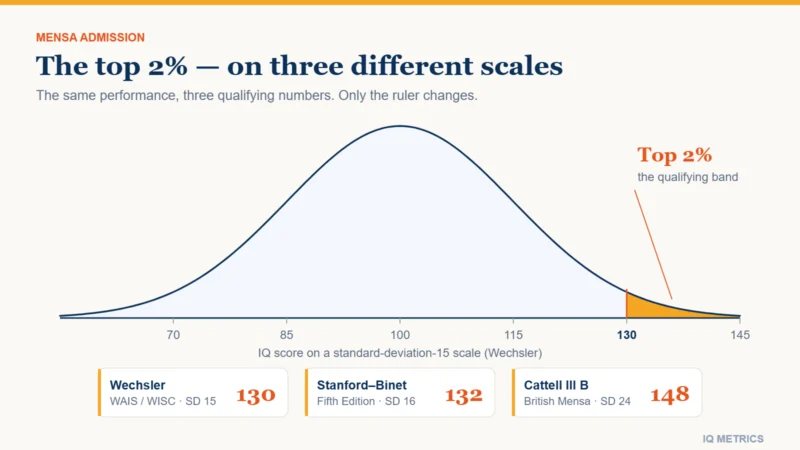
Mensa admits the top 2% of scorers, but "the top 2%" is a rank, not a number, and the number it maps to changes with the test you sat. Here is what qualifies on the Wechsler, Stanford-Binet and Cattell scales, the two routes to membership, and what the supervised admission test is actually like.