





What Does an IQ of 136 Mean? Percentile, Mensa and Scale Differences
An IQ of 136 is the 99.2nd percentile on SD 15 (about 1 in 122) but the 98.8th on SD 16 (about 1 in 82) and the 93.3rd on the Cattell scale. How 136 stands against Mensa's own table, including the old Army tests that share the number, and how precise one score is.

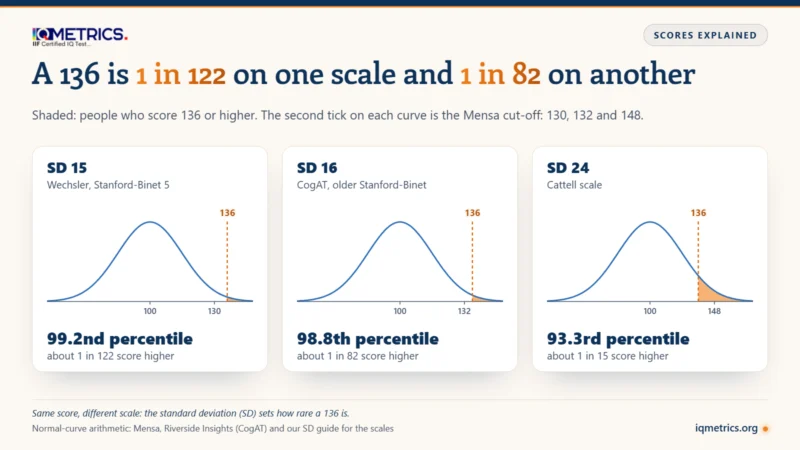
An IQ of 136 is the 99.2nd percentile on a scale with an average of 100 and a standard deviation (SD) of 15. About 1 in 122 people score that high or higher. On an SD 16 scale the same number is the 98.8th percentile, about 1 in 82. A 136 clears Mensa’s cut-off on every Wechsler test, but not the Cattell’s 148.
Below: the percentile arithmetic, what 136 becomes on other scales, and how it stands against Mensa’s own table. That table holds one surprise. 136 is the exact score American Mensa lists for two old US Army tests, the GCT and the GT, taken before October 1980.
What percentile is an IQ of 136?
The 99.2nd percentile, on the scale most clinical tests use. That scale sets the average at 100 and one SD at 15 points, so 136 sits 36 points, or 2.4 SDs, above average.
Here is the sum. The z-score is (136 minus 100) divided by 15, which is 2.4. On a normal curve 99.18% of people fall below z = 2.4 and 0.82% fall above it. One divided by 0.0082 is about 122, so roughly 1 person in 122 scores 136 or higher. Our IQ percentile calculator does the same sum for any score.
A class of 30 has about a 22% chance of containing at least one pupil at 136 or higher on SD 15, so a teacher may meet one every few years.
Scaled to larger groups, that is about 12 people in a school of 1,500, about 8,200 in a city of one million and about 820,000 in a country of 100 million. A 136 is a little rarer than a 135 (1 in 102) and far more common than a 140 (1 in 261). It is also about 2.8 times rarer than a 130, which is 1 in 44.
Is an IQ of 136 the same on every scale?
No. The scale decides what 136 means. Most modern tests use an SD of 15, but some use 16 or 24, and the same number sits at a different distance from average on each.
| Scale | Used by | z-score | Percentile | Rarity | Same rarity on SD 15 |
|---|---|---|---|---|---|
| SD 15 | Wechsler tests, Stanford-Binet 5 | 2.40 | 99.18th | 1 in 122 | 136 |
| SD 16 | CogAT standard age score, older Stanford-Binet forms | 2.25 | 98.78th | 1 in 82 | 133.8 |
| SD 24 | Cattell scale | 1.50 | 93.32nd | 1 in 15 | 122.5 |
Read the table both ways. A 136 on an SD 16 test is worth about 134 on an SD 15 test. A 136 on the Cattell scale is only about 122.5 on SD 15. Going the other way, someone whose SD 15 score is 136 would report about 138 on an SD 16 test and about 158 on the Cattell scale.
Riverside Insights, which publishes the CogAT, defines its standard age score as having a mean of 100 and an SD of 16. The IQ score converter moves a score between scales, and our guide to SD 15 versus SD 16 explains why both exist.
Does an IQ of 136 qualify for Mensa?
Yes, on every test Mensa lists except the Cattell. Mensa International asks for a score “in the top 2% of the population” on a professionally supervised test that Mensa recognises.
The top 2% starts 2.05 SDs above average, so the qualifying score depends on the scale: 130.8 on SD 15, 132.9 on SD 16 and 149.3 on SD 24. American Mensa rounds these to the numbers in its own table, and 136 meets every line but one.
| Test | Mensa minimum | Does 136 qualify? |
|---|---|---|
| Wechsler adult, children and preschool scales (Full Scale IQ) | 130 | Yes, 6 points above |
| Stanford-Binet 5 | 130 | Yes, 6 points above |
| Stanford-Binet (older form) | 132 | Yes, 4 points above |
| CogAT composite (standard age score) | 132 | Yes, 4 points above |
| Cattell | 148 | No, 12 points short |
| US Army GCT or GT, taken before October 1980 | 136 | Yes, exactly on the line |
The table follows American Mensa’s qualifying-scores page, read on 3 November 2026. Mensa says it may change the scores as tests are renormed, and that it appraises each application individually. The Army rows apply only to tests taken before October 1980. Mensa does not accept those tests after that date.
That last row is the one nobody mentions. The Army General Classification Test and the GT line score carry a Mensa line of 136, and no other test on the page uses that number. Today the line most people meet is 130 on a Wechsler test. Our guide to the score you need for Mensa covers the application routes.
A 136 sits well inside Mensa’s range, not at its edge. The top 2% starts near 131 and the top 0.82% starts at 136, so about 41% of all people who clear the Mensa line score 136 or higher. That is our arithmetic, not a Mensa figure.
Is an IQ of 136 good, and is it gifted?
Yes, it is well above average on every current test. Pearson labels scores of 130 and above Very Superior on the WAIS-IV and Extremely High on the WISC-V. Our IQ classification chart sets out the labels each test uses.
“Gifted” has no single cut-off. Schools and programmes set their own, and many use percentiles on group tests rather than IQ. Our guide to gifted cutoff scores shows the lines in use. Whether a 136 meets one depends on the programme.
How precise is a score of 136?
Within about 5 points either way. No IQ score is exact. A full-scale Wechsler score has a reliability near .97, which means the observed score is a close but imperfect guide to the true one.
With a reliability of .97, our estimate of the true score behind an observed 136 is about 135, with a 95% range of roughly 130 to 140. We used the estimated-true-score method: the score is pulled toward 100 by the reliability, then widened by 1.96 standard errors. Your test’s manual gives the exact figure. The lower end of that range reaches the Mensa line, which is why one 136 is a range and not a promise of another.
Where would your own score land?
Take the IIF-certified assessment and get your score with the scale it was measured on, the percentile it corresponds to and the confidence range around it — the three figures most online tests leave out.
Find your IQ score now! →What does a 136 on an online test mean?
It places you against that site’s own sample, not against a clinical norm group. Mensa International requires a professionally supervised test, so an unsupervised quiz that returns 136 does not qualify you.
If you want a score with a percentile beside it, take the IQ test and compare the result with the table above. Treat it as an estimate and remember which scale it uses.
What should you ask about any score of 136?
Four things, because the same number can mean different things. Which scale: SD 15, 16 or 24? Which test: a Wechsler battery, a group test such as the CogAT or a short online quiz? Who gave it: a qualified examiner, or a website with no supervision? And when: old norms can flatter a score, so a result from many years ago may sit lower on a current test.
The first question changes the rarity from 1 in 122 to 1 in 82 to 1 in 15. The second and third decide whether Mensa will look at it. The fourth is a reason to treat any single score as a snapshot. The same questions apply to country averages, where the sample matters more than the number: see how the average IQ in Somalia is built.
Quick answers
- What percentile is an IQ of 136? The 99.2nd on SD 15 (about 1 in 122) and the 98.8th on SD 16 (about 1 in 82).
- Is 136 IQ good? Yes. It is above 130, the line where the Wechsler tests start their top band.
- Does 136 qualify for Mensa? Yes on Wechsler tests, the Stanford-Binet 5, older Stanford-Binet forms and the CogAT. No on the Cattell, which needs 148.
- What is 136 on the Cattell scale? The 93.3rd percentile, about 1 in 15, because the scale has an SD of 24.
- How many people score 136 or higher? About 0.82% on SD 15: roughly 12 in a school of 1,500 and 820,000 in a country of 100 million.
The bottom line
An IQ of 136 is a high score on any scale, but how rare it is depends on the SD behind it: 1 in 122 on SD 15, 1 in 82 on SD 16 and 1 in 15 on the Cattell. It meets Mensa’s line on every Wechsler test, and it is the exact number Mensa lists for two Army tests of the past. Always ask which scale a 136 came from before comparing it with another.
Sources
- Mensa International, how to join: the top 2% rule and the need for a professionally supervised, recognised test.
- American Mensa, qualifying test scores: minimum scores by test, including the Army GCT and GT before October 1980.
- Riverside Insights, CogAT score descriptions: standard age score with a mean of 100 and an SD of 16.
- Percentiles, rarity and the 95% range are our arithmetic from the normal curve: z = (score minus 100) divided by the SD, with the upper tail from the complementary error function.
Keep reading
All articles →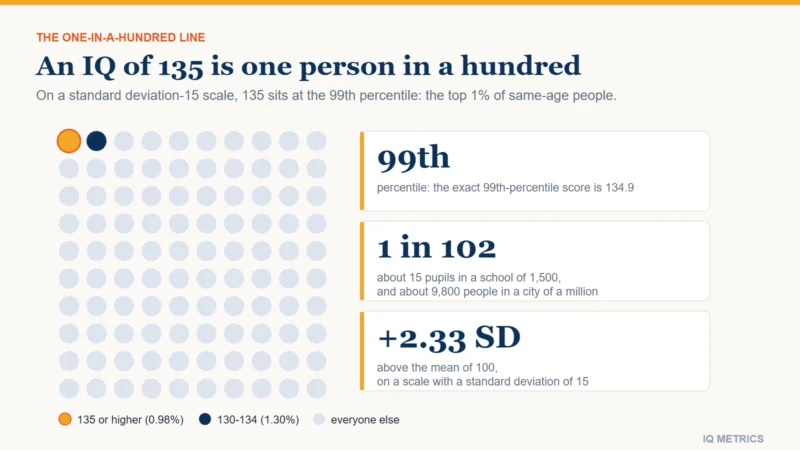 Scores & Scales
What an IQ of 135 Means
An IQ of 135 is the 99th percentile: one person in 102 on the Wechsler scale, but only 1 in 14 on the Cattell scale. Rarity of every score from 130 to 139, the cut-off Terman really used, how precise a 135 is, and what it predicts.
 Scores & Scales
What an IQ of 140 Means
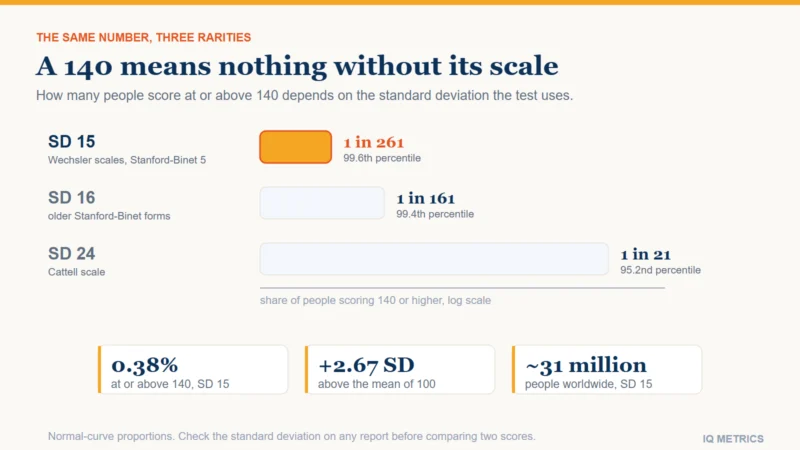
An IQ of 140 is the 99.6th percentile on the standard scale: about 1 person in 261 scores that high, roughly 3,800 in a city of a million. See the 140 IQ percentile on three scales, how it compares with 130 and 145, what a 140 on one index means and how precise the score is.
 Scores & Scales
Mensa IQ Score Requirements
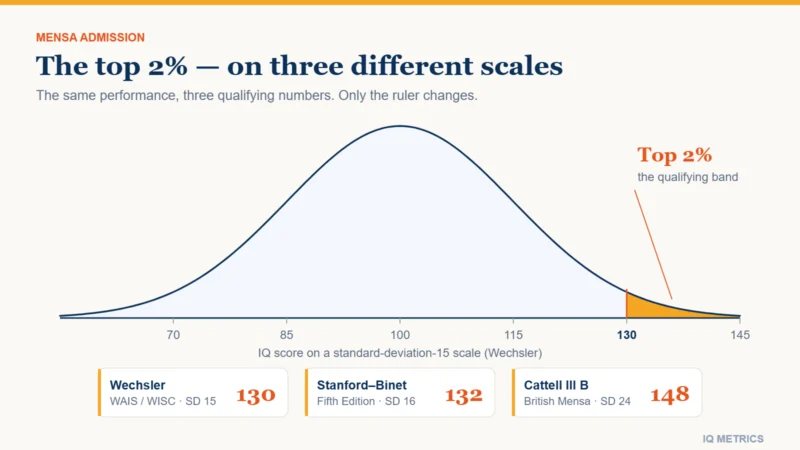
Mensa admits the top 2% of scorers, but "the top 2%" is a rank, not a number, and the number it maps to changes with the test you sat. Here is what qualifies on the Wechsler, Stanford-Binet and Cattell scales, the two routes to membership, and what the supervised admission test is actually like.