



Intelligence research,
reported plainly
Cognitive science, testing standards and the numbers behind them — written for a general reader, with every score carrying the scale it was measured on and the range around it.
Top story
Myths & Fact Checks →
Army Alpha and Beta Tests: Scoring, Letter Grades and the Mental Age of 13 Myth
Army Alpha was a written group test of eight parts (maximum 212 points) and Army Beta its pictorial twin (maximum 118). The Army tested 1,726,966 men by January 1919, printed a mental age of 13.08 for white draftees, and then said it could not conclude the country was three years below the norm.
Latest stories
All news →
DAS-II Scores Explained: GCA, Cluster Scores, T Scores and Classification Ranges
The DAS-II reports a General Conceptual Ability (GCA) score with a mean of 100 and a standard deviation of 15, and subtest T scores with a mean of 50 and a standard deviation of 10. There is no DAS-3: the newest edition is the 2023 Normative Update for ages 7 to 17, and Pearson prints two different score ranges.

METR Time Horizon Explained: The Latest Numbers and Why It Is Not an IQ
METR's time horizon is the task length, set by how long a skilled human takes, that an AI agent completes about half the time. The top figure in its data file is 17.4 hours (95% CI 8.5 to 55.1), which METR itself calls unreliable above 16 hours, and it is not an IQ.

Average IQ of Lawyers: What the LSAT, Bar Exam and Army Data Show
Nobody has measured the average IQ of lawyers today. The popular 128 comes from a 1945 Army test scored on a scale with a standard deviation of 20, which is about 121 on today's scale. The LSAT and the bar exam are published, and neither has an IQ equivalent.

SSAT Percentile Chart 2026-27: Scores by Grade and the IQ Question
The SSAT percentile is a rank among first-time takers in the same grade, not a mark out of 100. In the 2026-27 guide a grade 8 student needs a total of about 2013 of 2400 for the 50th percentile and 2343 for the 99th. The test does not claim to measure IQ.

GMAT Score to IQ: The Focus Percentile Chart and Why It Is Not an IQ
There is no official GMAT-to-IQ conversion: GMAC says its scores have not been equated with other tests. What it publishes is a percentile among GMAT test takers, 97.5 for a Focus total of 705, a self-selected pool of 93,196 exams in a year.

Are C-Section Babies Smarter? What the IQ Studies Show
Searches for C-section and IQ run in both directions. The largest study with an intelligence test, 1.4 million Danes, found a gap of 0.36 points on a 78-item test. A Brazilian cohort found C-section teenagers 5.8 IQ points ahead, until the researchers adjusted for family and birth factors.

MCAT Score to IQ: What the AAMC Percentile Can and Cannot Tell You
Online calculators turn a 500 into an IQ of 100. The AAMC says its percentiles only compare you with other test takers, a group already filtered by college and ambition. No study has calibrated the modern MCAT against an intelligence test, so here is the 2026-27 percentile table and the arithmetic that shows why.

Does Aphantasia Affect IQ? What the Studies Measured
No study has measured IQ in a representative sample of people with aphantasia, the lifelong absence of mental pictures. The two small studies that report IQ-style scores disagree on direction, +5.5 and -4.0 points, and neither gap was significant.

Sleep Apnea and IQ: What Studies Show in Children and Adults
In children, sleep-disordered breathing goes with IQ scores a few points lower in some studies, yet the largest cohort found no link with cognition scores and no treatment trial has shown an IQ gain. In adults, attention and executive function are affected more than IQ.
Nine beats, one standard of evidence
Each desk covers a subject we can report on continuously and check against a source. Pick the one you care about — or read everything.
Intelligence Research
New peer-reviewed findings on how reasoning, memory and general ability actually work — reported with the sample size and the error bars.
Brain Health & Aging
Sleep, exercise, diet, illness, medication and environment — what each one measurably does to thinking, and by how much.
AI & Machine Intelligence
How machine reasoning is measured, where it beats people, where it still fails, and what any of it says about human intelligence.
Education & Testing
Admissions exams, gifted programs, national score reports and school testing policy, explained without the spin from either side.
Work & Hiring Tests
The cognitive and aptitude tests employers use, how they are scored, and what a score does and does not predict at work.
Data & Rankings
Chart-led pieces on how scores are distributed across countries, states, ages, jobs and education levels — always with the caveats attached.
Scores & Scales Explained
What a specific number means on a specific scale, why every score needs a confidence range, and how the scales convert.
Myths & Fact Checks
Viral IQ claims checked against the record: where the number came from, who repeated it, and what is actually documented.
Puzzles & Brain Training
A reasoning puzzle every day with the full working shown, plus honest coverage of what brain-training products can and cannot do.
Intelligence Research
All Intelligence Research →Does Aphantasia Affect IQ? What the Studies Measured
No study has measured IQ in a representative sample of people with aphantasia, the lifelong absence of mental pictures. The two small studies that report IQ-style scores disagree on direction, +5.5 and -4.0 points, and neither gap was significant.

Gen Z IQ: Is Gen Z Less Intelligent Than Its Parents? What the Data Show
A neuroscientist told the US Senate in January 2026 that Gen Z is the first generation to underperform its parents, "even general IQ". The written testimony does not say it, and the best IQ data stop with people born in 1991.
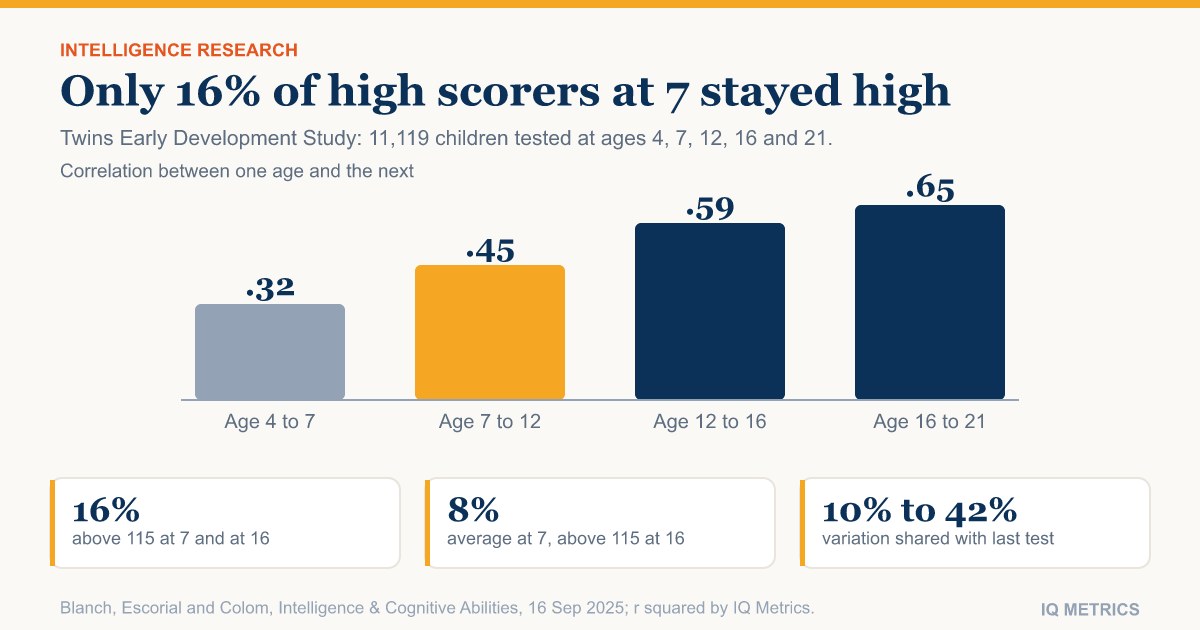
Do High-Scoring Children at Age 7 Stay High? What 11,119 Children Show
In a study that followed children from age 4 to 21, only 16% of those scoring above 115 at age 7 were still above it at 16. Test-to-test correlations of .32 to .65 explain why an early high score is a snapshot, not a verdict.
Brain Health & Aging
All Brain Health & Aging →Are C-Section Babies Smarter? What the IQ Studies Show
Searches for C-section and IQ run in both directions. The largest study with an intelligence test, 1.4 million Danes, found a gap of 0.36 points on a 78-item test. A Brazilian cohort found C-section teenagers 5.8 IQ points ahead, until the researchers adjusted for family and birth factors.
Sleep Apnea and IQ: What Studies Show in Children and Adults
In children, sleep-disordered breathing goes with IQ scores a few points lower in some studies, yet the largest cohort found no link with cognition scores and no treatment trial has shown an IQ gain. In adults, attention and executive function are affected more than IQ.

Do Smart Drugs and Nootropics Raise IQ? What the Trials Measured
We found no trial in healthy adults that used an IQ test as its outcome. The best meta-analysis of modafinil, methylphenidate and amphetamine measured recall, attention and inhibition, and found small effects of 0.12 to 0.21 standard deviations.
Written to be checked, not just clicked
Every number carries its scale
An IQ figure is meaningless without the scale it was measured on and the range around it. Every story here reports all three, or says plainly that the source did not.
Sources are listed, not implied
Each story ends with the studies, datasets and documents it draws on, named and attributed, so you can go and read them yourself.
We correct in public
Spotted an error? Write to corrections@iqmetrics.org. Corrections are made on the story and noted at the bottom of it — never quietly.
Read the research.
Then find your own number.
Our IIF-certified assessment reports your score with its scale, percentile and confidence range — and a breakdown of the cognitive domains behind it.
Start IQ Test →