
IIF Certified Assessment
Start IQ Test
IIF Certified Assessment
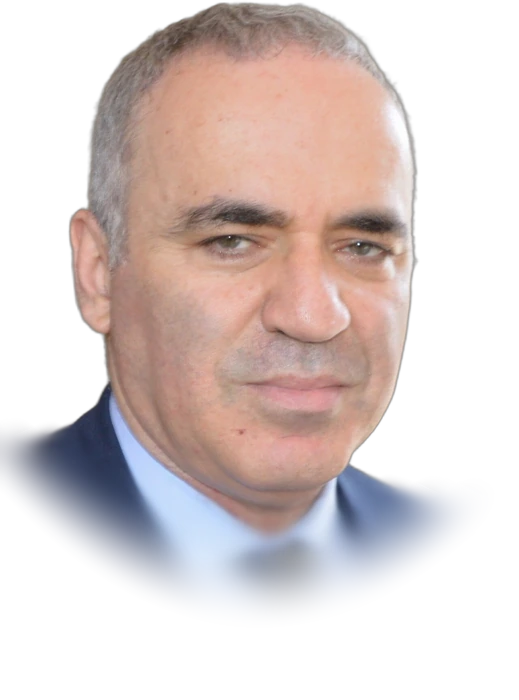
In the late 1980s a German magazine paid for a full test battery on the world champion. The result was 135 — and it is the best-documented IQ figure in competitive chess.
Two different instruments disagree here, and we have kept both in the range rather than choosing. The administered test returned 135; the competitive record is the strongest in the game’s history and would support a higher inference. A single figure that averages them would hide the more interesting fact, which is that they diverge.
Set the claim aside for a moment. If someone genuinely scored in this range, here is what that would represent.
Average is 100 by construction, and about two-thirds of people fall between 85 and 115. Take the test to place your own score on this scale.
| Score range | Classification | Share of people | What it indicates |
|---|---|---|---|
| 85 – 114 | Average | ~68% | The range most people fall into. |
| 115 – 129 | Above average | ~13.6% | Roughly one person in seven. |
| 130 – 144 | Gifted | ~2% | The threshold most high-IQ societies use. |
| Above 144 | Highly gifted | ~0.1% | Figures above this range are extrapolated from the curve rather than measured. |
Percentages are approximate and describe a normal distribution. The same number means different things on tests with different standard deviations.
Thirty questions gives you a measured position on this exact scale — your score, your percentile and the ability breakdown behind it.
Find out in 30 minutes →Garry Kasparov was born in Baku in 1963 and entered Mikhail Botvinnik’s chess school as a child. He became the youngest undisputed world champion in 1985 at 22, taking the title from Anatoly Karpov after one of the longest championship sequences in the game’s history.
He held the world number one ranking for most of the next two decades and set a rating record in 1999 that stood until 2013. His 1997 match against IBM’s Deep Blue is the most-watched chess event ever played, and his loss in it is a landmark in the public history of computing.
He retired from professional chess in 2005 and has since worked in Russian opposition politics and as a writer. He has continued to argue publicly that chess strength is trained rather than innate — a position that sits comfortably with a measured 135.
The estimate above rests on this record. Every entry here is a matter of public fact, which is more than can be said for the number itself.
Following a claim back to its first appearance is the part almost nobody does — and it is what most people are actually asking.

The testing was arranged as a magazine feature while Kasparov was world champion, and it is unusually well documented for this section: a named publication, a place, a date and a published result. An overall 135, with memory at the ceiling of the scale.
The interesting part is what happened next. The result did not displace the 190; it simply failed to spread. A documented figure of 135 is a worse story than an undocumented 190, and list culture selects on shareability rather than provenance. The measured number is available and public, and the invented one is more popular.
There is a substantive reading of the 135 as well, and it is not that Kasparov is less able than his record suggests. It is that a general test administered in an afternoon and twenty years of rated results against the strongest players alive are measuring different things. Chess strength is built from enormous pattern libraries acquired over decades; a general battery does not sample that, and was never intended to. Magnus Carlsen and Bobby Fischer both rank above Kasparov on this site, and it is worth noticing why: their ranges rest on estimates, and his rests partly on a result.
How we read a number →Exact issue and date pending audit.
The origin of the 135. Named publication and published result; we have not yet confirmed the precise issue.
Published federation records. The hardest performance data available for any player of the era.
Undisputed champion from 1985; classical title held until 2000.
Source URLs and first-appearance date pending audit.
No original located. The figure circulates widely despite a published result being available.
The figures that circulate for Garry Kasparov, what we were able to confirm, and where the two diverge.
190 is the figure that circulates, frequently as “the highest IQ ever recorded for a chess player”. Figures of 180 and 194 also appear.
Kasparov is one of very few people in this section who has actually sat a full test battery, and the number is nothing like 190. Der Spiegel commissioned the testing in Hamburg and published the result: an overall IQ of 135, with exceptional scores on memory tasks. The 190 has no such origin. It appears to be a back-formation from his rating and reputation.
The lowest figure is the measured one and the higher figures are inventions. That ordering repeats across this site often enough to be the section’s central finding.
Want a number that does hold up? Every figure on this page is somebody’s claim. Take the 30-question test and get a percentile you can check rather than a figure you have to trust.
135. A test battery commissioned by Der Spiegel in Hamburg in the late 1980s returned an overall score of 135, with memory subtests at the top of the scale. The 190 that circulates has no source.
No. There is no record of any test returning 190. The figure appears to be inferred from his chess rating and reputation, and it persists because it is a better story than the documented 135.
Because chess strength and general test performance measure different things. Elite chess rests on pattern libraries built over decades of study; a general battery does not sample that and was never designed to.
2851, reached in July 1999. It stood as the record for thirteen years until Magnus Carlsen passed it.
Carlsen ranks higher on our estimates — but note that his range is inferred from performance while Kasparov’s is anchored partly to an actual result. The two are not the same kind of number.
He has argued the opposite in his writing — that chess ability is built through training rather than given. That view is consistent with the measured figure.
You can find out in about fifteen minutes. The IQ Metrics assessment is 30 questions, scored on the same 100-mean scale used throughout this page, so your result and the estimate above are at least expressed in the same units — one measured, one inferred. Once you have a number, the leaderboard shows where it would sit, and how we score and norm it explains the benchmarking.
From the documented record rather than a test — the method is named above and set out in full under how we read a number. Compare it against the other athletes profiles, starting with Magnus Carlsen.


Portrait © Matthew Yohe, CC BY-SA 3.0. The background-removed portrait above is a derivative work and is likewise offered under the same licence. · Portrait © Debbie Rowe / The Royal Society, CC BY-SA 3.0. The background-removed portrait above is a derivative work and is likewise offered under the same licence. · Portrait by Christopher Smith, U.S. Department of Health and Human Services — a work of the U.S. federal government, public domain. Background removed for the portrait above.
Thirty questions, scored against general-population benchmarks. Your score, your percentile, your ability breakdown and a printable IIF certificate.
Find your IQ score now! →The assessment costs nothing and you always get a real result. Upgrades add precision, analysis and a certificate — never access to the test itself.
Whatever you paid comes off the next tier for 30 days. Start small without losing the money.
Not what you expected? Full refund, no questions, no form to hunt for.
Prices adjust to your country automatically, so the certificate is reachable outside high-income markets.
Coming later: an annual membership (~$89/year) for unlimited retests, practice sets and progress tracking. Monthly billing is deliberately not offered — a once-a-year assessment does not justify a monthly charge, and it would churn.



_(cropped)_2.jpg)

.jpg)
