





Do Smart People Marry Smart People? What the Research Shows
Married and long-term partners score more alike on IQ than on almost any other trait psychologists measure, personality included. The correlation is about 0.40, it shows up before the relationship starts, and it has real downstream effects on how heritability studies get interpreted.

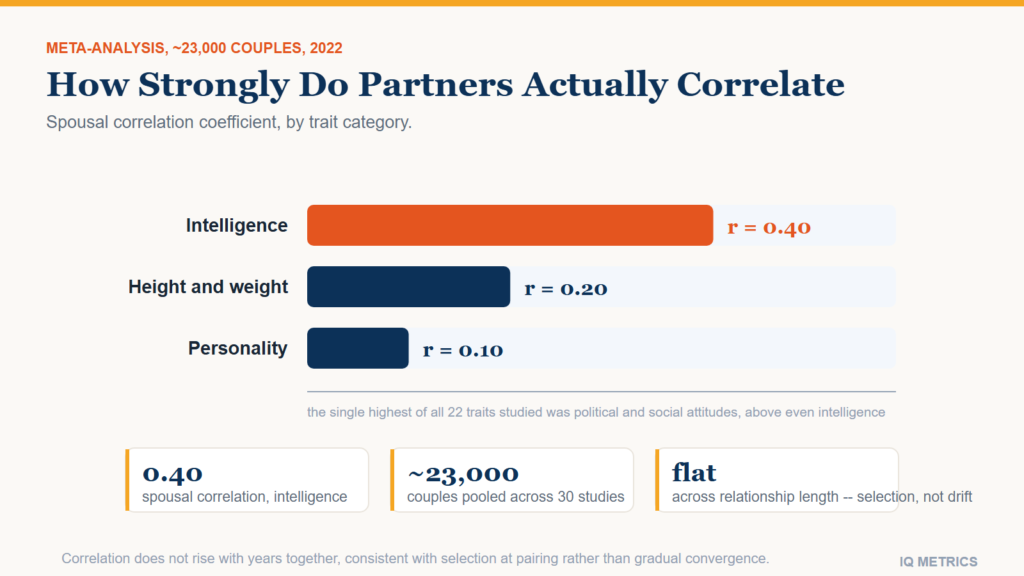
Yes, and more strongly than for most other traits. Long-term partners’ IQ scores correlate at roughly 0.40, well above the correlation for height and weight (about 0.20) and personality (about 0.10). Psychologists call this assortative mating, and for cognitive ability it is one of the largest such effects researchers have measured for any trait.
That number is not just a curiosity about dating. It shows up in how heritability studies are interpreted, it affects how extreme scores are distributed across a population, and it has a specific, well-replicated answer to the obvious follow-up question: are people choosing similar partners, or do partners grow more alike over time?
How strongly do partners actually correlate
A 2022 meta-analysis pooled roughly 30 studies and about 23,000 couples across 22 different traits, from political attitudes to substance use to physical measurements. Correlations across all 22 traits ranged from 0.08 to 0.58, and cognitive ability sat inside the highest cluster alongside social and political attitudes. For intelligence specifically, the pooled spousal correlation landed around 0.40 — roughly double the correlation for height and weight, and about four times the correlation for personality traits such as conscientiousness or extraversion.
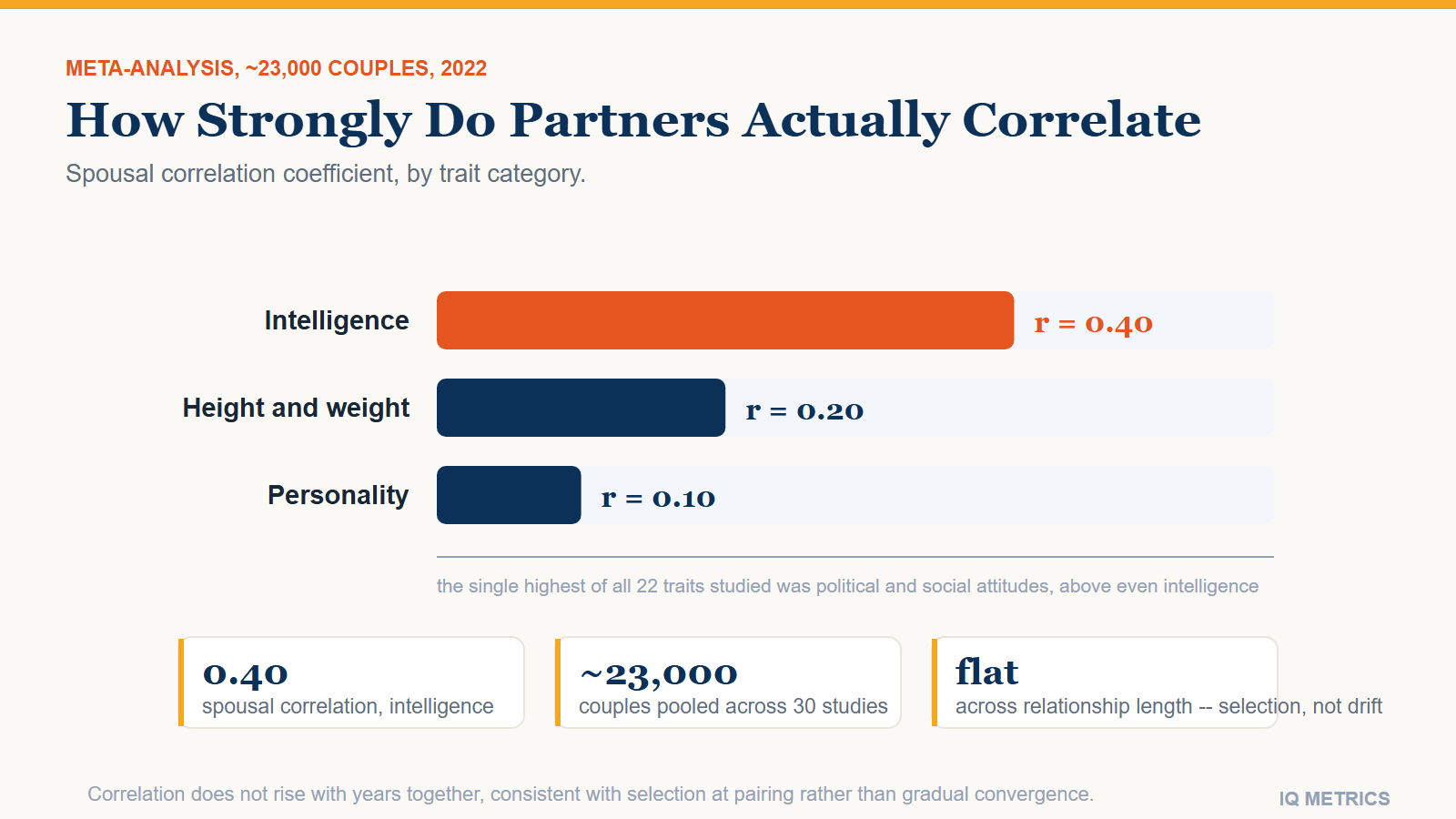
Put another way: if you know one partner’s general cognitive ability and nothing else about a couple, you can predict the other partner’s ability better than you could predict their height, their weight, or almost any personality trait you might guess at instead. Political and social attitudes edged even higher in the same analysis, which is its own reminder that people sort into relationships along more than one axis at once.
Selection, not slow convergence
There are two very different stories that could produce a 0.40 correlation. Either people choose partners who already resemble them, or partners spend years together and gradually converge — picking up each other’s vocabulary, reading habits and interests until their scores drift closer. The evidence favours the first story. The correlation does not increase with relationship length in these datasets, which is what you would expect if the similarity were set at the point of selection and simply persisted, rather than something that builds gradually across a marriage.
That matters because it rules out the tidier, more romantic explanation. Couples are not becoming alike; they largely started that way, whether through shared environments that put similar people in the same rooms — university, a profession, a social circle — or through people actively noticing and preferring similarity when they had a choice.
Nobody compares scores on a first date
Almost none of this sorting happens through anyone actually comparing test results. People sort on visible, communicable proxies for ability — years of education, choice of career, vocabulary, the kinds of conversations someone gravitates toward — and those proxies correlate with measured IQ well enough that sorting on them produces the same downstream effect as sorting on the score directly. Educational attainment in particular tends to show spousal correlations at least as high as raw cognitive ability, and often higher, which makes sense once you notice that a degree, a profession and a reading list are all things a prospective partner can actually observe, where a percentile score is not.
Shared environments do a lot of the initial filtering for free. University, competitive workplaces and specific social circles concentrate people who already resemble each other on ability and educational trajectory before anyone makes an active choice, which is part of why the correlation is already sizeable before any deliberate preference gets involved at all — and part of why the earlier finding about overestimating a partner’s intelligence still fits: once the environment has done its filtering, most of the "sorting" left to notice is really just recognising you.
Where would your own score land?
Take the IIF-certified assessment and get your score with the scale it was measured on, the percentile it corresponds to and the confidence range around it — the three figures most online tests leave out.
Find your IQ score now! →Why this matters for genetics research
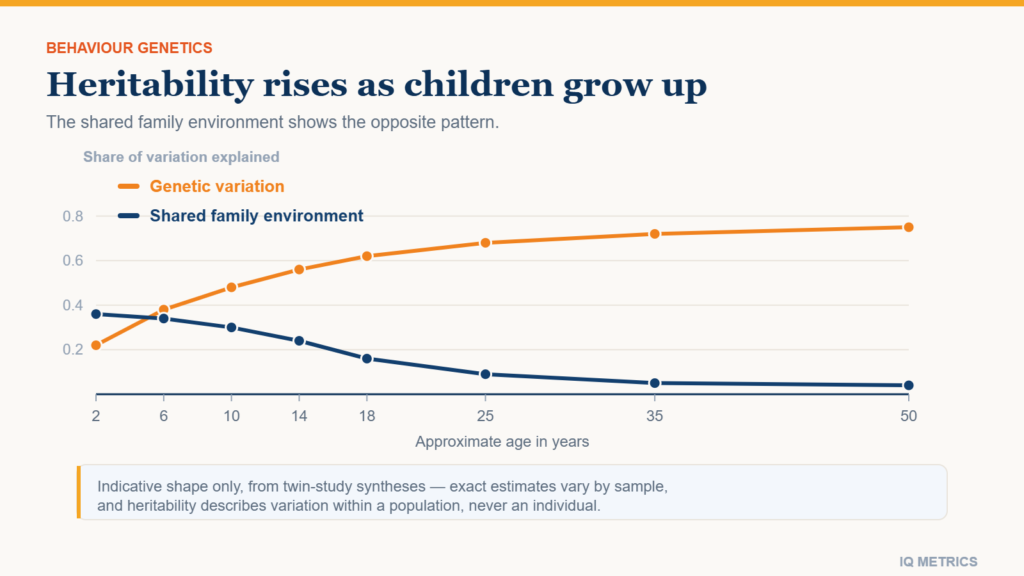
Twin and adoption studies, the backbone of what we know about how heritable IQ is, generally assume mating is close to random with respect to the trait being studied. Assortative mating breaks that assumption. When parents are more similar in cognitive ability than chance would produce, their children end up sharing more genetic variance for that trait than a simple additive model predicts, which is one reason sibling and twin correlations for IQ run slightly higher than a naive heritability calculation alone would account for. Behavioural geneticists build assortative mating into their models explicitly for this reason; ignoring it would quietly inflate certain heritability estimates.
It also interacts with socioeconomic status in a way that is easy to miss. Because people often meet partners through education and work, cognitive assortative mating and socioeconomic assortative mating travel together more often than not — which concentrates both genetic and environmental advantages (or disadvantages) inside the same households rather than spreading them evenly across a population.
There is a more specific technical wrinkle worth knowing if you ever read a twin study closely. Identical twins share essentially all their segregating genes regardless of how their parents paired up, so assortative mating cannot change an identical-twin correlation much. Fraternal twins and ordinary siblings, who share only about half their segregating genes under random mating, end up sharing somewhat more than half when their parents were drawn from an assortatively mated population — because both parents are pulling genetic variants for the trait from the same, narrower part of the distribution instead of independently sampling the whole population. A model that assumes purely random mating and ignores this will misread part of that extra sibling resemblance as shared environment or as additive genetic variance it did not actually measure, which is exactly why modern behavioural-genetic models estimate assortative mating as a term of its own rather than folding it into either category by default.
At the population level, sustained assortative mating on ability also tends to widen the spread of household outcomes over generations rather than narrow it — concentrating high scores, and the education and income that often travel with them, inside the same families instead of distributing them more evenly. Sociologists studying rising household income inequality treat "who marries whom" as one contributing thread among several, not the whole explanation, and untangling how much of it is the pairing itself versus everything that pairing correlates with remains an active, contested area of research rather than a settled number.
People are not great at judging what they are selecting for
One more finding is worth knowing before you assume this is all conscious. Research on how people rate their partners’ intelligence has found that people tend to overestimate a romantic partner’s cognitive ability even more than they overestimate their own — love, or at least attachment, appears to inflate the perception on top of whatever real similarity is already there. So the sorting itself looks fairly precise in aggregate data, even though any individual person asked to explain why they chose their partner is unlikely to describe it in terms of a matched percentile.
What this means if you have, or are raising, children
Two similarly high-scoring parents do not simply average into a guaranteed high-scoring child. Individual scores regress toward the population mean from the midparent value, a pattern Francis Galton first documented with height in the 1880s and which holds for cognitive ability too. Assortative mating does pull the midparent value itself further from the population average than random pairing would, which softens the regression somewhat compared to a scenario where partners paired up by chance — but it does not eliminate it. A child of two very high-scoring parents is likely to score high, and is also likely to score somewhat closer to average than either parent individually.
If that child is eventually tested, the practical questions are less about genetics and more about process — which instrument gets used, how stable an early score actually is, and what a single number should and should not be taken to mean. That side of it is covered in our guide to IQ testing for children.
The short version
Assortative mating for intelligence is real, large by the standards of trait correlations, and set mostly at the point partners choose each other rather than built up afterward. It is one input among many into how ability and opportunity end up distributed across families and generations — alongside heritability and socioeconomic status, not instead of them. If you are curious where your own score sits before speculating about any of this, a properly normed test is the only reliable way to find out.
Keep reading
All articles →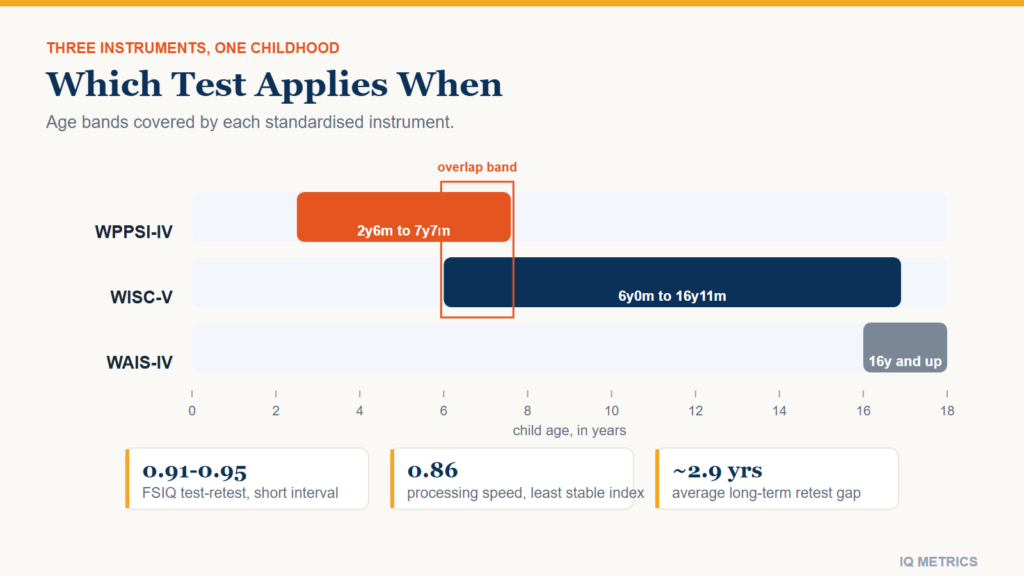 Taking a Test
IQ Testing for Children
Children are not tested on the same instrument as adults, and the test itself changes twice before age eighteen. Here is which one applies when, how reliable an early score really is, and what a parent should and should not conclude from a single number.
 Scores & Scales
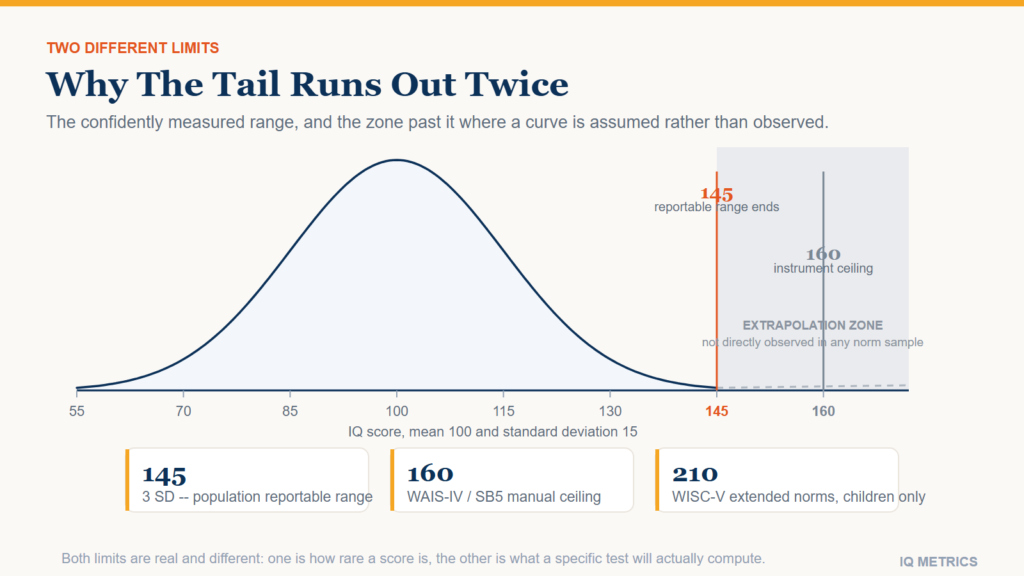
IQ Score Ceiling Effects
Two different numbers get used as "the top of the scale," 145 and 160, and they come from two different kinds of limit. One is a statement about population statistics; the other is about what a specific test manual will actually compute.
 Research & Evidence
Is IQ Genetic?
Heritability estimates for IQ rise from roughly 0.4 in childhood to 0.7 or higher in adulthood, which sounds decisive until you know what heritability measures. Here is what twin and adoption studies actually show, and the four conclusions people draw from them that the statistic does not support.