





Average IQ by Major: Which College Major Scores Highest?
Average test scores really do differ by college major, and the rank order has barely moved in 70 years. What a landmark cross-dataset analysis found, why SAT and GRE scores are not IQ scores, and what the ranking cannot tell you about one student.

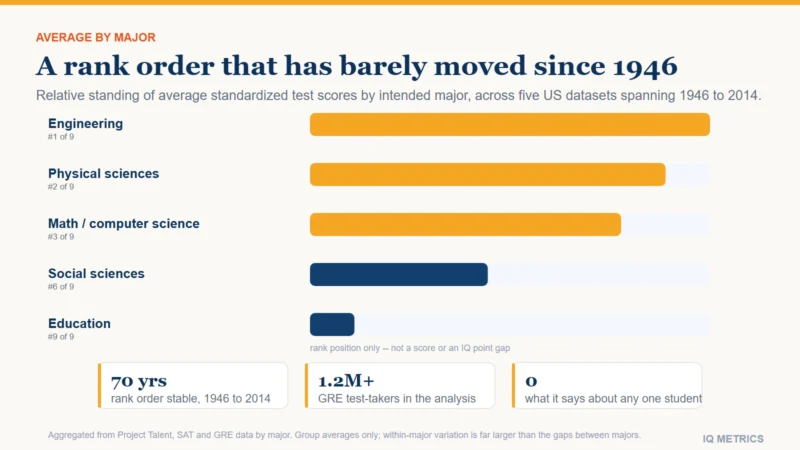
Average IQ by major is not measured, but average test scores are. Engineering ranks first and education last in both Project TALENT data and GRE data (Wai, 2011). Physical science and math or computer science take places 2 and 3. These are group averages of aptitude scores, not IQs, and the groups overlap heavily.
Below: the two rankings side by side, why it is test scores and not IQ, what the research measured, and what it cannot say about one student. New here: in Project TALENT, engineering majors averaged about 1.3 standard deviations above the sample mean and social science majors about 0.8. That gap of 0.5 would be 7.5 points on an IQ scale with an SD of 15, our arithmetic, if the composite were an IQ.
Key takeaways
- Engineering ranks first and education last in both datasets. Physical science and math or computer science swap places at 2 and 3 (Wai, 2011).
- In Project TALENT, engineering averaged about 1.3 SD above the sample mean and social science about 0.8, a half-SD gap.
- None of the data is IQ. Project TALENT measured verbal, spatial and math ability, and the GRE and SAT are aptitude tests.
- The GRE ranking uses the intended graduate major of a select group of test takers, not final degrees.
- Within any major the spread is wide and the groups overlap, so a major cannot rank two people.
What is the average IQ by major, and which major is highest?
Engineering, on average, in both datasets Jonathan Wai reported (Psychology Today, 2011). No major has a measured IQ. The ranking uses the average aptitude scores of the people in each major group.
| Rank | Project TALENT (high-school sample, later degree holders) | GRE (intended graduate major) |
|---|---|---|
| 1 | Engineering | Engineering |
| 2 | Physical science | Math or computer science |
| 3 | Math or computer science | Physical science |
| 4 | Biological science | Biological science |
| 5 | Humanities | Humanities |
| 6 | Social science | Arts |
| 7 | Arts | Social science |
| 8 | Business | Business |
| 9 | Education | Education |
The lists agree at both ends: engineering first, business eighth and education ninth. In the middle, physical science and math or computer science swap places, and arts moves ahead of social science in the GRE list.
Project TALENT is a stratified random sample of over 400,000 US high-school students, and Wai looked at those who later earned a degree. The GRE list is a select sample, because only some college graduates take the GRE, and it averages the math and verbal scores.
Is it IQ or test scores?
Test scores. Project TALENT measured verbal, spatial and math ability, and Wai reports each group in standard deviation units from the sample mean, not in IQ points. The GRE list averages math and verbal subscores, and the SAT is an admissions test.
Wai notes that Frey and Detterman showed in Psychological Science that the SAT measures general ability to a large extent and that SAT scores can be translated into IQ scores. Our SAT score to IQ guide covers that conversion. Strongly correlated is still not identical, and an admissions test is built for a different purpose than an IQ test.
So searches for IQ by major, college majors by IQ or IQ based on degree all point at the same thing: average aptitude scores by major. We use IQ here only as the familiar yardstick.
What did the research actually measure?
Psychologist Jonathan Wai lined up five datasets spanning 1946 to 2014 and compared average scores by intended field of study. They include Project TALENT and more than 1.2 million people who took the Graduate Record Examination between 2002 and 2005 and reported an intended graduate major, alongside SAT data. The ranking shows relative standing in each dataset, so it is a rank order and not a set of IQ points.
One caveat belongs up front: intended major is not the same as final degree. Students switch fields, and a plan is not a guarantee. The GRE data capture the graduate major people said they intended, not a lifetime outcome.
Why has the order barely moved in 70 years?
The stability is the finding. The same rough ranking shows up in the Project TALENT sample, in SAT data and in GRE data collected decades later. Over those years, college attendance, the applicant pool and the tests all changed. A pattern that survives that much change is more likely to reflect how students sort themselves into fields than an artifact of one test. Wai calls the average score patterns for majors quite robust, because they appear in a select sample and in a nationally representative one.
Is it one kind of ability doing all the work?
No. Wai’s Project TALENT graph splits ability into verbal, spatial and math parts, because the same total can come from different mixes. Our verbal vs non-verbal IQ scores guide covers that distinction. A student with outstanding verbal reasoning and average quantitative reasoning can post a strong composite and still fit a different profile.
Where would your own score land?
Take the IIF-certified assessment and get your score with the scale it was measured on, the percentile it corresponds to and the confidence range around it — the three figures most online tests leave out.
Find your IQ score now! →Does choosing a major change your IQ?
Nothing in the ranking shows that choosing engineering raises a score, or that choosing education lowers one. Students sort into majors partly on ability and preparation they already had, which is self-selection, not something the major causes. Does school raise IQ and does IQ predict school success cover pieces of that mechanism without showing it directly.
Access and preparation matter too. Socioeconomic status and IQ and stereotype threat in test-taking both cover factors that shape who arrives at a selective major well prepared for a standardized test. For the separate and more contested question of which fields men and women choose, IQ tests and gender differences is a better starting point.
How big is the gap between students in the same major?
Wider than the gap between majors. Wai writes that there is wide variability within each group and much overlap across groups. He warns against concluding that one person is smarter than another because of a major.
Plenty of education majors outscore plenty of engineering majors on any given test. Only the averages pull apart. A ranking like this describes large groups compared with other large groups. It says nothing reliable about one student’s ability, potential or performance.
How does it compare with IQ by occupation, MCAT scores and income?
It measures a different thing at a different age. Our average IQ by occupation article shows that the familiar job charts trace to one 1940s Army study of 18,782 men on a scale with a standard deviation of 20. A major chosen at eighteen and a career entered at thirty are not the same measurement.
Graduate admissions tests have their own pages. For MCAT score to IQ, no study converts one, and the 2026-27 AAMC table puts 500 at the 48th percentile among a selected group of test takers. For the law-school exam, see what is a good LSAT score: LSAC puts a 160 above 71% of scores and a 170 above 94.5%.
Does the score pay off later? Does IQ predict income puts the IQ-income correlation at about 0.23, roughly 5% of the variation in earnings. And grit vs IQ covers how much a trait other than ability adds.
Quick answers
- Which college major has the highest IQ? None is measured. On average test scores, engineering ranks first in both Project TALENT and GRE data (Wai, 2011).
- What is the average IQ by major? There is no such figure. The data are aptitude test scores: about 1.3 SD above the sample mean for engineering and 0.8 for social science in Project TALENT.
- Is the average IQ per major real IQ? No. Project TALENT, the GRE and the SAT are aptitude tests, not IQ tests, though the SAT correlates strongly with general ability.
- Does your major change your IQ? Nothing here shows it. Students sort into majors partly on the ability they already have.
- Is a math major smarter than a social science major? On average the scores are higher, but the groups overlap, so it cannot rank two people.
- What is the IQ based on degree? A group average of test scores by intended major, not a score for any one degree holder.
The bottom line
Average IQ by major is really average test scores by major, and that ranking has held for decades: engineering at the top, education at the bottom, wide overlap everywhere. It describes groups well and one person not at all. To see how your own reasoning scores, take the IQ test.
Sources
- Wai J (2011). How brainy is your major? Psychology Today, 1 August 2011.
Keep reading
All articles →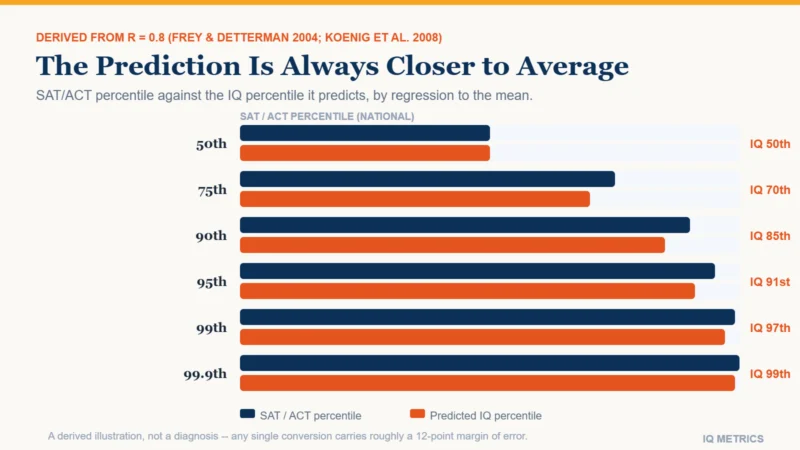 Scores & Scales
SAT and ACT Score to IQ Conversion
Neither the SAT nor the ACT is an IQ test, but studies found they correlate with general cognitive ability at 0.77 to 0.86. See predicted IQ by percentile for both tests, a worked example, IQ to SAT, and why any single conversion carries about 12 points of error either side.
 Research & Evidence
Does IQ Predict School Success?
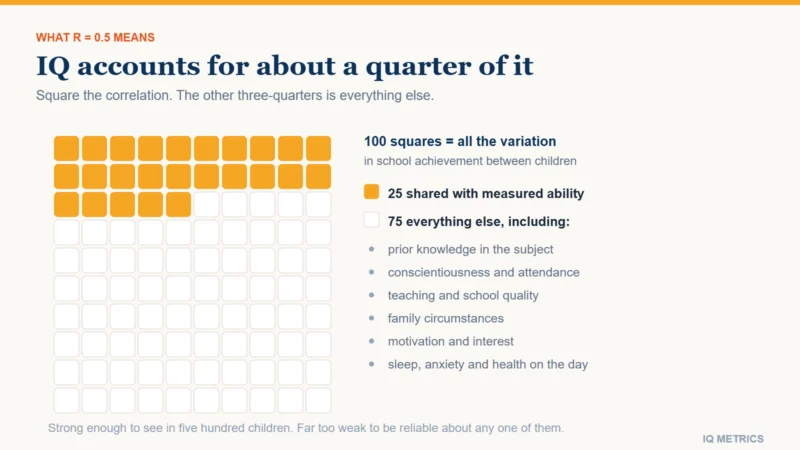
IQ predicts school achievement better than any other single measure psychologists have found, and still leaves roughly three-quarters of the variation unexplained. Both halves of that sentence get ignored by somebody. Here are the actual correlations, what they mean for one child, and what accounts for the rest.
 Understanding IQ
Grit vs IQ
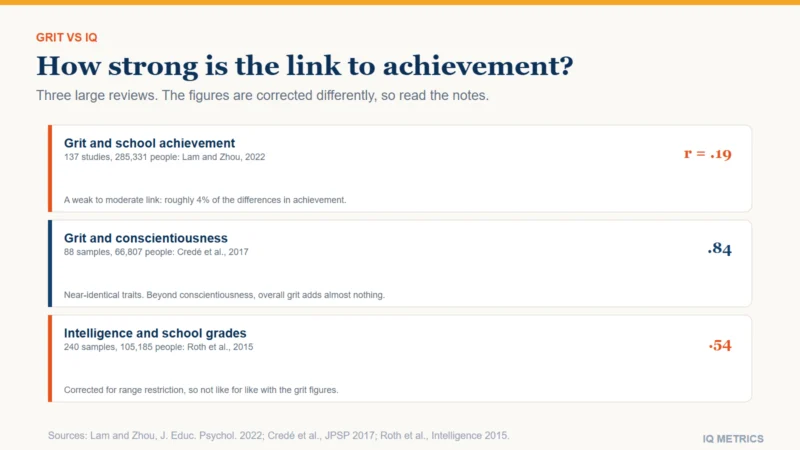
Grit is weakly to moderately linked to school achievement and overlaps almost completely with conscientiousness. See what the original grit studies, two large meta-analyses, the marshmallow test and a retracted test-motivation paper really show about grit vs IQ.