





IQ and Testosterone: Does the Correlation Chart Hold Up?
A popular online chart claims a clean link between testosterone and IQ. Real studies disagree with each other on direction and size, and the most rigorous test found no effect at all. What the actual research says, and why the meme persists.

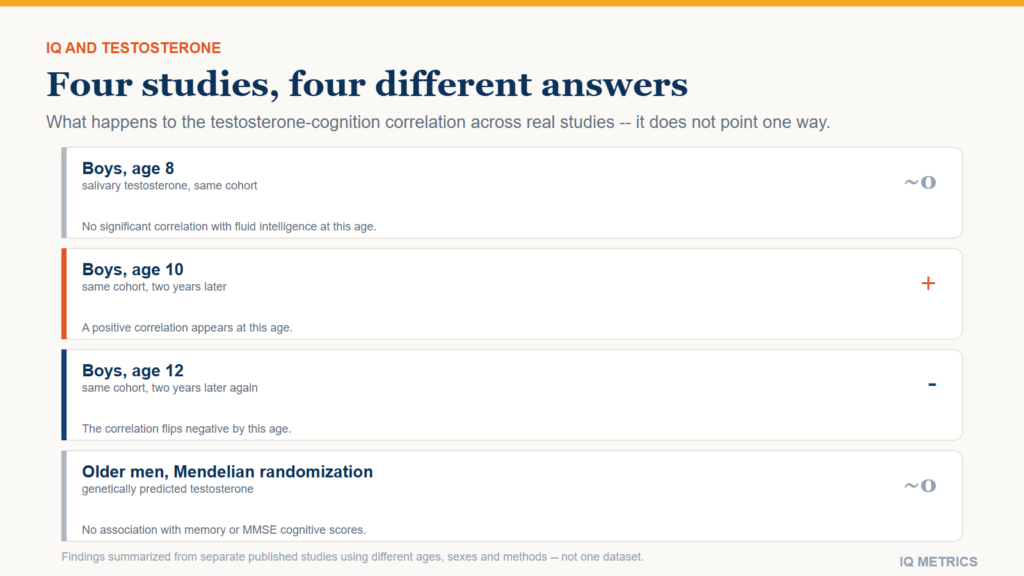
No — not a consistent one, in either direction. A chart claiming a clean relationship between testosterone and IQ circulates widely online, but real studies measuring both disagree with each other on direction, size, and even which way the correlation points, and the most rigorous test of the idea — a study designed specifically to get at cause and effect rather than mere correlation — found no relationship at all. This article covers what actual studies have found, why the results keep contradicting each other, and why the popular chart is not backed by the research it claims to summarize.
Where the "IQ and testosterone chart" comes from
Search interest in "iq and testosterone chart" and "iq and testosterone chart meme" is real and substantial, which tells you something on its own: the chart is a social-media object first and a scientific claim a distant second. Versions of it typically carry no citation at all, or misread a single study far beyond what it actually found. The appeal is obvious — a simple story about two traits people already have strong intuitions about — and that is exactly the kind of claim worth checking against the underlying research rather than the picture.
What real studies actually find
One informative study followed the same group of boys at ages 8, 10 and 12, measuring salivary testosterone and fluid intelligence at each age. At 8, there was no significant correlation at all. By 10, a positive correlation had appeared. By 12, in the same children, the correlation had flipped negative. A relationship that changes sign three times in the same group of people over four years is not a relationship a single chart can honestly summarize with one arrow.
That kind of instability is itself the finding. If testosterone straightforwardly raised or lowered cognitive ability, the direction should not reverse twice in the same cohort as puberty progresses. What actually seems to be happening is that both testosterone and cognitive development are moving on their own timelines during this period, and any correlation that shows up at one snapshot in time is easy to mistake for a stable underlying relationship that is not really there.
Why anyone expected a link in the first place
The hypothesis is not baseless. Androgen receptors, the proteins testosterone binds to in order to affect cells, are present in brain regions tied to memory and spatial processing, including the hippocampus and areas of the prefrontal cortex, and animal research has linked testosterone to effects on neurogenesis, the growth of new neurons. That gives the idea real biological plausibility — a mechanism worth testing — which is different from evidence that the effect actually shows up reliably, at a meaningful size, in human cognitive test scores. Plenty of biologically plausible mechanisms fail to produce a detectable real-world effect once they are actually measured, and this appears to be one of them — a different outcome than the much better-supported evidence for a genetic contribution to IQ, which rests on a far larger and more consistent body of twin and family research than anything testosterone has produced.
Measurement noise makes the search harder than it looks. Testosterone is not a fixed trait like height; it follows a strong daily rhythm, typically highest in the morning and declining through the day, is released in pulses rather than at a steady level, and can spike temporarily with stress, competition or even a single interaction. A one-time blood or saliva sample is a noisy snapshot of a moving target, and comparing that snapshot against a single test score taken on a different occasion adds a second layer of noise on top of the first. Some of the disagreement between studies is a real biological story; some of it is almost certainly this.
The curvilinear theory
Some research on adults has proposed a curvilinear, inverted-U pattern instead of a straight line: moderate testosterone levels associated with the best fluid-intelligence performance, with both unusually low and unusually high levels associated with somewhat worse scores. Fluid vs. crystallized intelligence explains what fluid intelligence specifically measures — on-the-spot reasoning rather than accumulated knowledge, which is the ability most of these studies actually test. Even the curvilinear pattern is not consistent across every study, and it appears to depend on age, sex and how testosterone is measured, which is a more honest, and much less shareable, story than a single chart.
Where would your own score land?
Take the IIF-certified assessment and get your score with the scale it was measured on, the percentile it corresponds to and the confidence range around it — the three figures most online tests leave out.
Find your IQ score now! →The strongest test we have says: nothing
The most methodologically convincing study on this question used Mendelian randomization in older men: rather than simply comparing testosterone levels and cognitive scores at one point in time, which cannot separate cause from effect or rule out some third factor driving both, researchers used genetic variants known to predict testosterone levels, which are assigned effectively at random at conception. That design mimics the logic of a randomized trial and largely removes reverse causation from consideration. The result: genetically predicted testosterone showed no association with delayed word-recall scores or Mini-Mental State Examination scores. When the method best suited to detecting a causal effect finds nothing, that carries more weight than another simple correlation would, in either direction.
Why prenatal exposure is a different question entirely
A separate and more active research area looks at prenatal testosterone exposure, often estimated using the ratio between the length of the second and fourth fingers, and its relationship to spatial ability specifically, not general intelligence. That research strand asks a genuinely different question — what happened during fetal development, not what someone’s hormone level measures today — and conflating the two is a common way this topic gets muddled online. A finding about prenatal exposure and spatial skill is not evidence about whether an adult with higher testosterone right now has a higher IQ.
The best-known version of this separate research strand is Simon Baron-Cohen’s "extreme male brain" theory of autism, which proposes that elevated prenatal testosterone exposure shifts cognitive style toward systemizing over empathizing. It remains a debated theory rather than settled fact within autism research, and it is worth naming here specifically because it sits right next to this topic and gets folded into it constantly online, even though it is about neurodevelopmental style and a specific diagnosis, not about IQ as this article is discussing it.
Sex differences complicate the picture further, in a way the broader research on IQ and sex differences runs into constantly. Circulating testosterone levels differ by roughly an order of magnitude between adult men and women, so a study population that is all-male, all-female, or mixed is effectively asking a different question each time, and the studies summarized above span all three designs. A correlation measured within the male range, where testosterone varies across a comparatively narrow band, is not automatically comparable to one measured across the much wider combined range, which is one more reason a single chart cannot honestly compress this literature into one line.
One counter-intuitive finding worth knowing
A study of prepubertal children found that boys of average intelligence actually had significantly higher testosterone levels than both intellectually gifted boys and boys with intellectual disability — the opposite of a simple "more testosterone, more IQ" pattern, and a useful reminder that a single study can cut against the popular narrative just as easily as it can support one. It should be read with the same caution as every other single study here: one sample, one age group, not a settled fact.
Why the meme persists anyway
A chart with a clean line is more shareable than a paragraph explaining that the real answer depends on age, sex, measurement method and study design. That gap between what spreads easily and what the evidence actually supports is not unique to this topic; average IQ by college major is a useful contrast — a genuinely stable, replicated finding that happens to be less dramatic than a meme, which may be exactly why it circulates less.
The bottom line
No study reviewed here supports a simple, stable link between testosterone and IQ in either direction. The correlation flips sign across childhood in the same children, adult findings depend heavily on age and sex, and the single most rigorous causal test available found no effect at all. The popular chart is describing a relationship the research does not actually show.
Keep reading
All articles →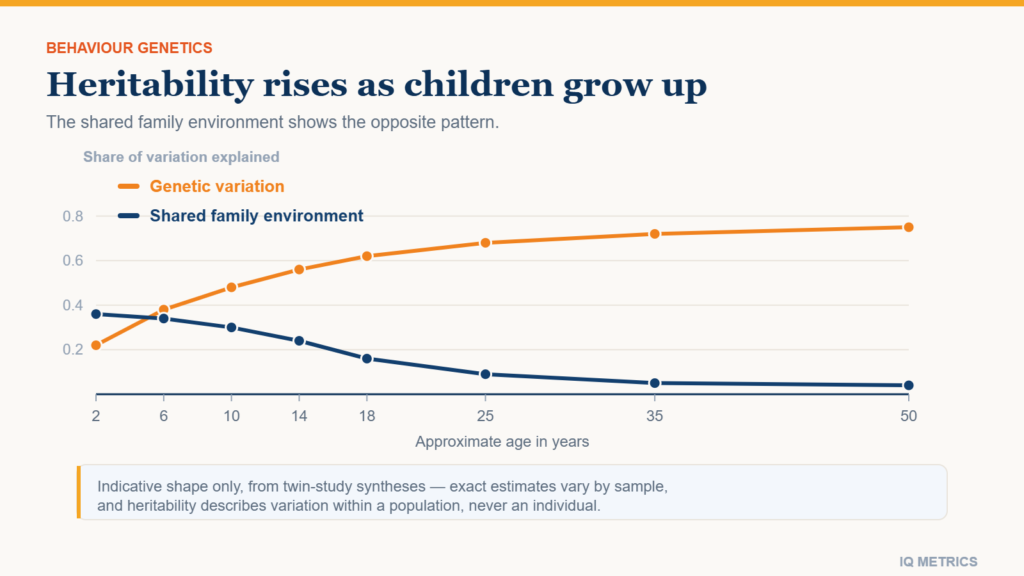 Research & Evidence
Is IQ Genetic?
Heritability estimates for IQ rise from roughly 0.4 in childhood to 0.7 or higher in adulthood, which sounds decisive until you know what heritability measures. Here is what twin and adoption studies actually show, and the four conclusions people draw from them that the statistic does not support.
 Research & Evidence
IQ Tests and Gender Differences: Fact or Fiction?
The idea that men perform better on IQ tests that evaluate cognitive abilities has helped spread this idea.
 Research & Evidence
Average IQ by College Major
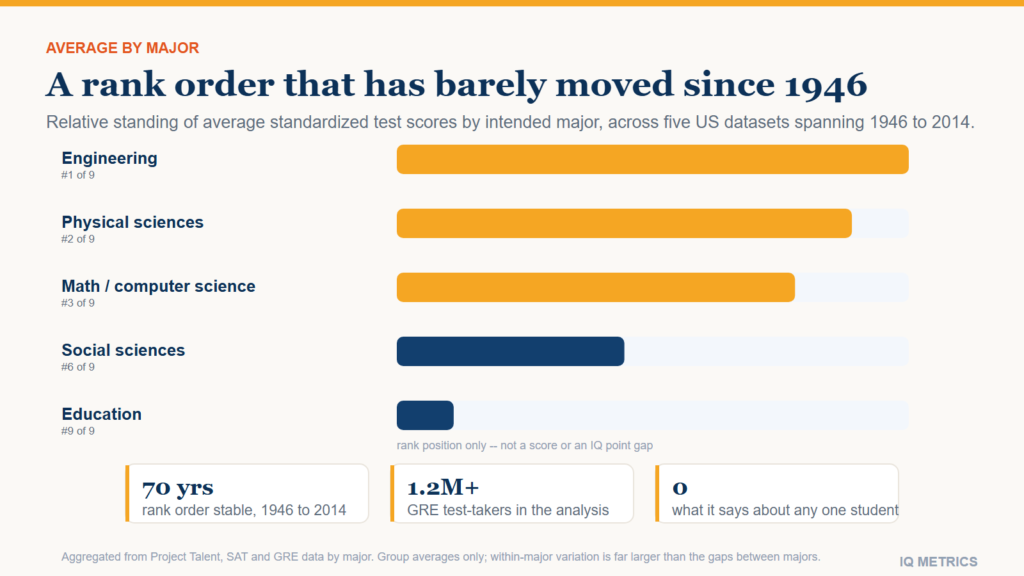
Average test scores really do differ by college major, and the rank order has barely moved in 70 years. What a landmark cross-dataset analysis found, why SAT and GRE scores are not IQ scores, and what the ranking cannot tell you about one student.