




IQ and Religion: What the Research Actually Shows
Three meta-analyses agree: higher IQ goes with slightly weaker religious belief, r about -0.14 to -0.17, or four to five IQ points, with heavy overlap. What the numbers mean, what explains them, where they weaken and what they cannot show.

Yes, but only slightly. Across roughly a century of studies, higher IQ scores go with somewhat weaker religious belief, on average. The most recent large meta-analysis, published in 2022 (89 studies, 201,457 people), puts the correlation at r = −0.14. The figure most often quoted online, −0.24, comes from an earlier 2013 meta-analysis and applies to religious belief in adult samples; across all 63 studies in that review the mean was −0.16. Either way it is a small tendency across groups. It is not a verdict on any believer or non-believer, and it does not show that religion lowers intelligence or that intelligence erodes faith.
- Direction: negative in most studies — 53 of 63 in the 2013 meta-analysis, 59 of 62 in a 2020 update, and 135 of 192 analysis specifications in 2022, with none significantly positive.
- Size: small and stable. Three meta-analyses give overall correlations of −0.16, −0.17 and −0.14, which is about 2 to 3% of the differences in IQ, or roughly 4 to 5 IQ points between groups.
- Weakest links: church attendance and other behaviour, spirituality, and samples younger than college age.
- Cause: unknown. Several explanations are proposed and none has been shown to be the cause.
This article covers what the meta-analyses found, what the correlation means in IQ points, where the “atheists score six points higher” claim comes from, the main explanations, which variable seems to come first, where the link weakens, why country-level correlations deserve caution, and why nothing here supports ranking religions, or individual people, by IQ.
What do the meta-analyses show?
The first comprehensive quantitative review came from Miron Zuckerman, Jordan Silberman and Judith Hall in Personality and Social Psychology Review (2013). They pooled 63 studies from 52 sources. Fifty-three found a negative correlation between intelligence and religiosity and 10 a positive one. The mean across all studies was −0.16 (median −0.14, weighted mean −0.13). The often-quoted −0.24 is narrower: it is the mean for religious belief in college and adult samples once college scores were corrected for restricted range. The link was weaker for religious behaviour, such as attendance, and weaker below college age, where the best estimate for belief was about −0.08.
Zuckerman and colleagues repeated the exercise in 2020 with 83 studies. The belief correlation in college and adult samples came out at −0.20 to −0.23, and the cleaned 62-study set gave an overall correlation of −0.17 (95% confidence interval −0.20 to −0.14), negative in 59 of the 62. Florian Dürlinger and Jakob Pietschnig then updated the picture in PLOS ONE (2022) with 89 studies covering 105 independent samples and 201,457 participants. Their pooled correlation was −0.14 (95% confidence interval −0.17 to −0.12). They also ran 192 “reasonable” combinations of analysis choices: 135 of them (70.4%) gave a significant negative effect and none gave a significant positive one. The link was stronger when intelligence was measured with a psychometric test than with a proxy such as grade point average, and stronger for belief than for behaviour.
| 2013 | 2020 | 2022 | |
|---|---|---|---|
| Authors | Zuckerman, Silberman and Hall | Zuckerman, Li, Lin and Hall | Dürlinger and Pietschnig |
| Studies | 63 | 83 (62 after cleaning) | 89 (105 samples) |
| Overall correlation | −0.16 (weighted −0.13) | −0.17 | −0.14 |
| Belief in adult samples | −0.24 | −0.20 to −0.23 | — |
| Negative results | 53 of 63 | 59 of 62 | 135 of 192 specifications significant; none significantly positive |
The overall estimate has barely moved across three reviews, and it is small in every one of them. The larger numbers people quote belong to narrower subsets.
How many IQ points is a correlation of -0.14?
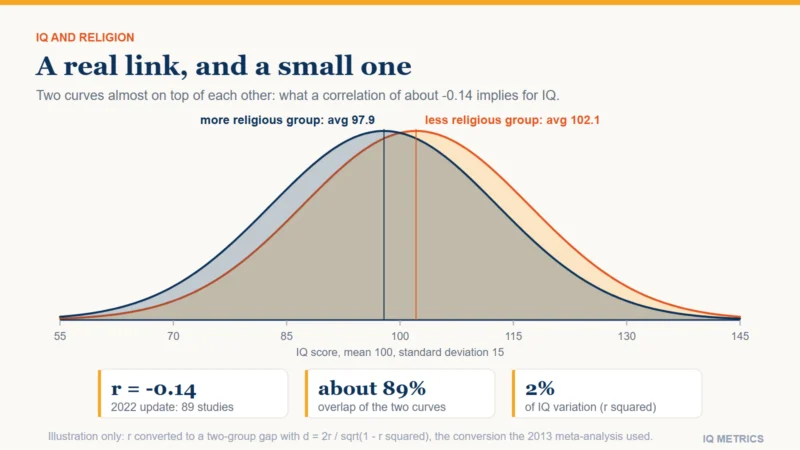
A correlation feels abstract until it is converted into something concrete. Squaring it gives the share of the differences in IQ that religiosity accounts for: r² is about 0.02 at −0.14, or 2%. The other 98% is everything else.
To express it in IQ points, the 2013 authors used the standard conversion Cohen’s d = 2r / √(1 − r²), multiplied by 15, which treats the sample as two groups. For the belief measures that gave 6.2 to 7.8 points, about 7.3 on average, between believers and non-believers. The same conversion applied to the 2022 figure of −0.14 gives d = 0.28, or about 4 IQ points, with the two groups’ IQ distributions overlapping by roughly 89%. Pick one person at random from each group and the less religious person has the higher IQ about 58% of the time, against 50% for a coin flip. These are conversions from reported correlations, not measured group gaps, but they show the scale: a few points on average and very heavy overlap.
For comparison, the margin of error on a single good IQ test is itself a few points (see the IQ score margin of error explained), so an average gap of about four points is comparable to the uncertainty in one person’s result. The overlapping curves above are the same normal curve described on the IQ bell curve page.
Where does the "atheists score six points higher" claim come from?
Mostly from one 2009 study. Helmuth Nyborg analysed 3,742 white American teenagers in the National Longitudinal Survey of Youth (NLSY97) and reported that atheists averaged 111.1 on his general-ability estimate, agnostics 109.1, and the denominations he classed as “liberal” and “dogmatic” 107.3 and 105.2. The headline is a gap of 5.89 points between atheists and the “dogmatic” group. Three caveats matter. Only a few dozen atheists were in the sample. The denomination categories were the author’s own, and he noted that they are “highly debatable”. And the study is one teenage cohort in one country. The meta-analyses above, which pool far more people, put the average gap nearer 4 to 5 points on the same conversion.
Why might IQ and religiosity be linked?
Zuckerman and colleagues proposed three interpretations, and later work has added others. Each is a hypothesis about why a correlation exists, and they are not mutually exclusive.
- Nonconformity. More intelligent people may be less likely to accept a belief simply because their community holds it, and so more likely to resist religious dogma.
- Analytic thinking. People who stop and reason through a problem, rather than following their first intuition, tend to report weaker religious belief. A 2016 meta-analysis in PLOS ONE (31 studies, 15,078 people) found a correlation of −0.18 between Cognitive Reflection Test performance and religious belief, and the 2020 update found analytic style partly mediated the intelligence link. Both are ability tests, so this may partly restate the same thing.
- The functions religion serves. Religion can supply a sense of control, self-regulation, self-worth and secure attachment. Intelligence can supply some of the same things, so more intelligent people may have less need for religious belief.
- Education. Schooling goes with both higher test scores and lower religiosity, but it explains little of the link. Across 15 studies with the relevant data, controlling for education moved the correlation only from −0.20 to −0.18. A 2016 re-analysis by Gregory Webster and Ryan Duffy argued the opposite, and the 2020 update disputed it.
In the 2016 analytic-thinking paper, 133 self-identified atheists scored 18.7% higher than 597 religiously affiliated people on a composite of analytic-thinking measures (Cohen’s d = 0.72), a far larger gap than the IQ correlations imply. That result concerns a thinking style, in small samples, and should not be read as an IQ gap. The wider point that intelligent people still make poor judgments is the subject of why smart people make bad decisions.
Which comes first, intelligence or religiosity?
Correlational data cannot say, and the 2013 authors were explicit about that. Two sets of results are, however, consistent with intelligence coming first. In four studies that measured intelligence 3 to 25 years before religiosity, the mean correlation was about −0.12. And the roughly 1,528 gifted children Lewis Terman selected in the 1920s, generally with IQs above 135 (see what an IQ of 135 means), grew up less religious than the general public in all four comparisons the 2013 authors could make, even though around 60% reported strict or considerable religious training as children.
The evidence is not one-directional, though. In the Lothian Birth Cohort 1921, a Scottish group tested at age 11 in 1932 and followed into their nineties, intelligence at age 11 was unrelated to religiosity at 83; only later-life intelligence correlated with religious belief. Neither belief nor attendance predicted cognitive change from age 11 to old age, or across the ninth decade of life. In that cohort religion neither protected nor harmed mental ability over time (Ritchie, Gow and Deary, Intelligence, 2014). The sociologist Darren Sherkat even proposed the reverse arrow for conservative Christian fundamentalism: by discouraging secular schooling and outside information, it may hold verbal ability back.
Where does the link get weaker or disappear?
Belief is not behaviour. In the Scottish cohort, religious belief was negatively related to intelligence but church attendance was not. A 2026 study in Frontiers in Psychology using two large US cohorts (NLSY79, N = 12,686; NLSY97, N = 8,984) found the same split within denominations in the NLSY97 data: among Catholics the correlation with belief was −0.09 but with religious behaviour +0.04, and among Protestants −0.06 and 0.00. Going to services for community, family or habit is a different thing from what a belief scale measures.
Spirituality is not religiosity. A 2024 analysis of the General Social Survey’s ten-word vocabulary test, a short measure of crystallised ability rather than a full IQ test (35,093 respondents across 14 cohorts spanning 1988 to 2022), found that religiosity correlated −0.13 with the score, while spirituality correlated +0.03, which is effectively nothing.
Younger samples. Both the 2013 and 2020 reviews found the link weaker below college age, at about −0.07 to −0.08.
Re-analyses disagree. Webster and Duffy re-analysed the 2013 data and argued that the negative link appeared only in samples of women and only in studies dated before 2010. The 2020 update and the 2022 meta-analysis, both with more studies, did not find those patterns to be robust. Two careful groups reaching different conclusions from overlapping literatures is a reason for humility about how stable the link is in recent samples.
Where would your own score land?
Take the IIF-certified assessment and get your score with the scale it was measured on, the percentile it corresponds to and the confidence range around it — the three figures most online tests leave out.
Find your IQ score now! →Why do country-level correlations deserve caution?
The most quoted single figure is from a 2009 paper by Richard Lynn, John Harvey and Helmuth Nyborg: across 137 nations, the correlation between national IQ estimates and the share of people disbelieving in God was 0.60. Look at their own table, though. Among the 69 countries with national IQs of 64 to 86 the correlation was 0.16, and among the 68 with IQs of 87 to 108 it was 0.54. The United States is itself an outlier, with unusually low disbelief for a high-IQ country. National IQ figures rest on small, uneven samples and on tests designed in Western countries, which is why country IQ rankings cannot bear much weight and why average IQ by country figures need heavy caveats. A correlation between countries also says nothing about individuals inside them, and wealth, schooling and life expectancy move with both variables. Webster and Duffy reported that the link became non-significant once they controlled for spatial dependence, the fact that neighbouring countries resemble each other.
Can you rank religions by IQ?
No dataset supports it. Nyborg’s teenage sample produced denominational averages, but the groups were small (some a few dozen respondents), the spread inside each was 10 to 15 points, and his own analysis found that denomination explained almost none of the variation in IQ (R² of about 0.001). Even the 2026 analysis of two large national cohorts could not compare Jewish or Muslim participants because there were too few of them. The meta-analyses above concern how strongly individuals hold religious belief, not which religion they hold, so they say nothing about traditions. The same discipline applies to any identity group; see IQ and political party for how survey comparisons of that kind should be read, and cultural bias in IQ tests for why the test itself can favour some backgrounds.
What can this research not tell you?
- Anything about one person. An r of −0.14 leaves 98% of the variation unexplained. Every belief group, and every non-belief group, contains people at every IQ level, including the roughly one person in a hundred who scores 135 or higher and people well below average.
- Which way the arrow points. Schooling, family background and country move with both variables, and schooling itself changes test scores. Education-level patterns are covered in average IQ by education level.
- Anything about wisdom, ethics or wellbeing. IQ tests sample reasoning tasks. They do not measure kindness, meaning or judgment.
Quick answers
Are atheists smarter than religious people?
On average, non-believers score a few IQ points higher in most studies, with almost complete overlap between the groups. That is a statistical tendency across large samples, not a statement about any one person.
Does religion lower IQ?
There is no good evidence that it does. In one long-running cohort, neither religious belief nor attendance predicted cognitive change from childhood to old age. The correlation describes who holds which beliefs, not a cognitive cost of holding them.
What is the average IQ of religious people?
No single figure exists. Studies report correlations and group differences on different tests, and religious people are not one group. The best summary is the meta-analytic correlation: small, negative, and mainly about the strength of belief.
Is IQ linked to spirituality?
Not meaningfully. In a 2024 analysis of 35,093 US respondents spirituality correlated +0.03 with a vocabulary-test score, against −0.13 for religiosity.
Is the link the same in every country and religion?
Unknown. Most of the individual-level evidence comes from Western, largely US samples, and most IQ tests were developed in Western cultures, so the pattern is best documented for the groups studied most.
The bottom line
Higher IQ scores go with slightly weaker religious belief across large samples. The best current estimate is about −0.14 to −0.17, roughly four to five IQ points between groups, with heavy overlap. The link is strongest for belief rather than behaviour, absent for spirituality, weaker in the young, contested in some re-analyses, and not evidence that religion harms thinking or that intelligence removes faith. It is a small fact about populations and a poor guide to any individual.
Sources
- Zuckerman, Silberman and Hall (2013), Personality and Social Psychology Review: the intelligence-religiosity meta-analysis.
- Zuckerman, Li, Lin and Hall (2020), Personality and Social Psychology Bulletin: the negative intelligence-religiosity relation, new and confirming evidence.
- Dürlinger and Pietschnig (2022), PLOS ONE: meta-analyzing intelligence and religiosity associations.
- Dürlinger, Goetz and Pietschnig (2024), Journal of Intelligence: do religiosity and spirituality differ in their relationship with crystallized intelligence?
- Dürlinger and Pietschnig (2026), Frontiers in Psychology: the intelligence-religiosity link by test g-loading and Christian denomination.
- Ritchie, Gow and Deary (2014), Intelligence: religiosity and later-life intelligence in the Lothian Birth Cohort 1921.
- Pennycook, Ross, Koehler and Fugelsang (2016), PLOS ONE: atheists and agnostics are more reflective than religious believers.
- Nyborg (2009), Intelligence: the intelligence-religiosity nexus in white American adolescents.
- Lynn, Harvey and Nyborg (2009), Intelligence: average intelligence predicts atheism rates across 137 nations.
Keep reading
All articles →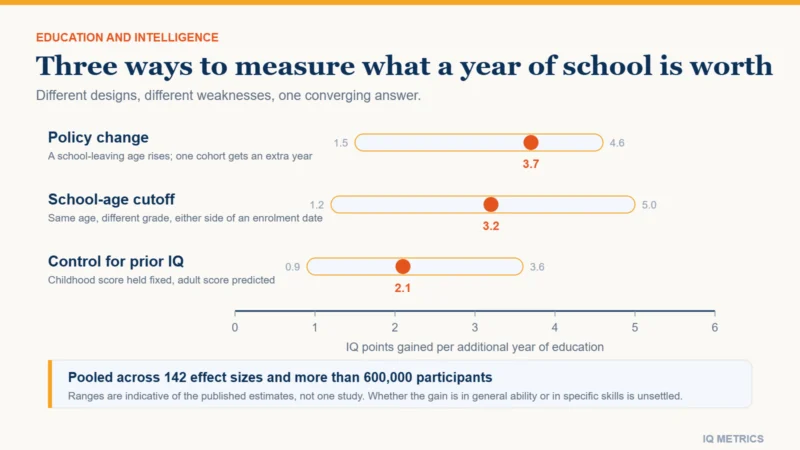 Research & Evidence
Does School Raise IQ?
Education is the environmental factor with the strongest evidence for actually raising IQ scores, and the effect is bigger than most people expect. Three independent study designs, pooled across more than 600,000 participants, point the same way. Here is the size of it, and the caveat that gets dropped.
 Mind & Everyday Life
Why Smart People Make Bad Decisions
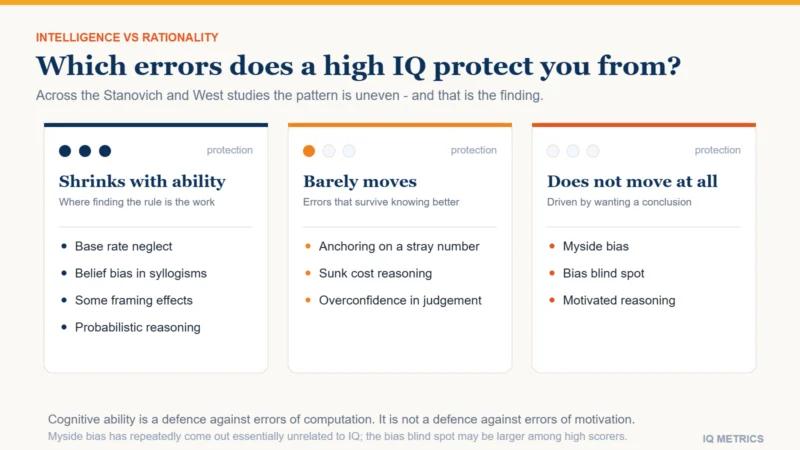
Everyone knows someone brilliant who keeps making terrible calls. That is not a paradox; it is a measurement gap. Intelligence tests and rationality tests load on different things, and several of the best-studied thinking errors turn out to be almost completely independent of how high you score.
 Research & Evidence
Cultural Bias in IQ Tests
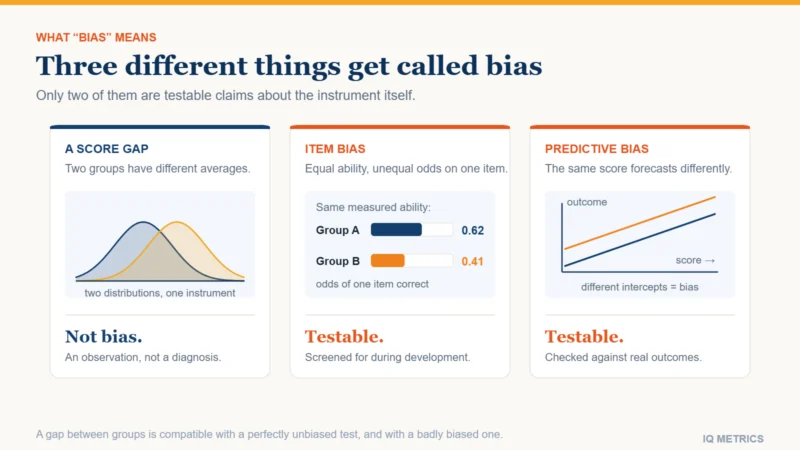
Ask whether IQ tests are culturally biased and you get two confident, opposite answers. Both are partly right, because the word means something far narrower to a psychometrician than it does in ordinary use. Here is what the item-level evidence shows, and where culture really does get into a score.