





IQ Test Questions for Kids: Sample Questions by Age, With Answers
Original IQ test questions for kids with answers, by age: sample items for 4-7, 8-12 and 13-17, a matrix puzzle worked through, how a child's score is set, how stable it is, and what practice really does.

Children’s IQ tests ask puzzle-style questions, not school questions: finish a pattern, find the odd one out, continue a number series, say how two things are alike, work out who is tallest from two clues. The wording changes with age, but the reasoning skills underneath are the same at every age. Below are 15 original sample questions with answers for ages 4 to 7, 8 to 12 and 13 to 17, one matrix puzzle worked through step by step, how a child’s answers become a score, how stable that score is, and what the research says about practising.
- What is asked: patterns and matrices, odd-one-out, analogies, number series, logic and spatial puzzles. The one-to-one tests add vocabulary, similarities and memory tasks.
- How it is scored: a child’s raw score is converted to a standard score by comparison with children of the same age, so the same answers can mean different scores at 8 and at 12.
- How stable it is: scores taken before about age 6 are a rough guide. A 2024 meta-analysis of 205 studies found that tests taken at 11 or later predicted scores at 16 with correlations above 0.80, while tests taken at 7 or younger did not reach 0.70.
- Practice: repeating the same kind of test adds a few points, so keep practice light and different from the real thing.
Every example here was written for this article. Real test items are secure and copyrighted, and we do not publish questions from our own tests either, because a published answer stops measuring anything.
What kinds of questions are on a children's IQ test?
Six families of question turn up across the main children’s tests. Each is built to measure one reasoning skill, and each has a deeper guide on this site.
| Question type | What it is designed to measure | Guide |
|---|---|---|
| Matrices and pattern completion | Fluid reasoning: working out the rule that completes a grid or sequence | Matrix puzzles |
| Odd one out and classification | Concept formation: seeing what things have in common | Odd-one-out questions |
| Analogies and word relationships | Verbal reasoning: understanding how ideas relate | Analogy questions |
| Number series and quantitative puzzles | Quantitative reasoning: finding the rule behind numbers | Number series |
| Logic and deduction | Deductive reasoning: combining facts to reach a conclusion | Syllogism questions |
| Spatial puzzles | Visual-spatial reasoning: rotating and folding shapes in the mind | Paper folding and rotation |
The one-to-one tests add a few more. The WISC-V, for ages 6 to 16, has ten primary subtests: Similarities, Vocabulary, Block Design, Visual Puzzles, Matrix Reasoning, Figure Weights, Digit Span, Picture Span, Coding and Symbol Search, and seven of them feed the full-scale IQ. Our own kids IQ tests group their puzzles into five areas: pattern recognition, abstract reasoning, analytical thinking, visual perception and spatial orientation. The wider adult picture is in what types of questions an IQ test asks.
Sample IQ test questions for ages 4 to 7
At this age questions are read aloud or shown as pictures, and the child answers by speaking or pointing. Nothing needs reading or writing. The examples are described in words here; on a real test the pattern and odd-one-out items would be pictures.
| Question | Answer | What it measures |
|---|---|---|
| Red square, blue square, red square, blue square, red square. What comes next? | A blue square | Pattern recognition: spotting a repeating sequence |
| Apple, banana, carrot, pear. Which one does not belong? | The carrot (the others are fruit) | Classification: seeing what things have in common |
| A bird flies. A fish ...? | Swims | Verbal reasoning: matching a relationship |
| Ben has 3 stickers and gets 2 more. How many does he have now? | 5 | Early quantitative reasoning |
| Say these numbers backwards: 3 ... 8. | 8 ... 3 | Working memory (a digit-span task, used on the WISC-V from age 6) |
What separates a four-year-old’s answers from a seven-year-old’s is rarely the type of question. It is how many steps the child can hold in mind at once. That is why individual tests start with easy items and move to harder ones, and why the same skills are still being measured a decade later.
Sample IQ test questions for ages 8 to 12
From around grade 3, group tests such as the CogAT use printed questions that the child reads alone, while the WISC-V stays one-to-one with a psychologist. The items now carry more steps and less picture support.
| Question | Answer | What it measures |
|---|---|---|
| 3, 6, 5, 10, 9, 18, ... What number comes next? | 17 (double, subtract one, then repeat) | Quantitative and pattern reasoning: finding the rule in a series |
| Glove is to hand as sock is to ...? | Foot | Verbal reasoning: the relationship inside an analogy |
| Square, triangle, rectangle, cube. Which one does not belong? | The cube (the others are flat shapes) | Classification |
| Mia is taller than Noah. Noah is taller than Omar. Who is the shortest? | Omar | Deductive reasoning: combining two facts |
| A cyclist rides 12 km in 40 minutes at a steady speed. How far does the cyclist ride in 90 minutes? | 27 km (0.3 km a minute) | Quantitative reasoning: proportional thinking |
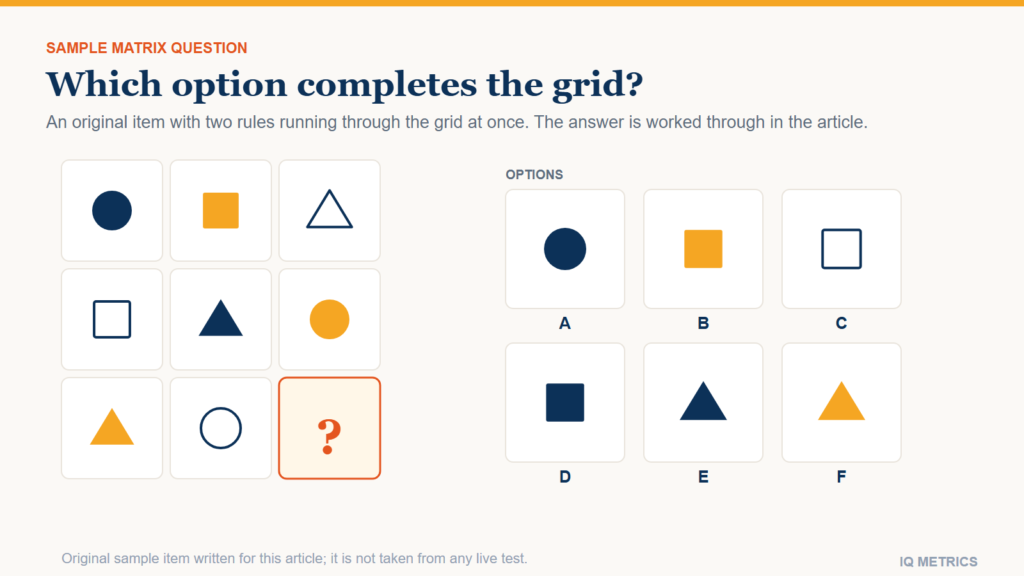
The matrix below is the format most people picture when they picture an IQ test: a grid with one cell missing and a row of options underneath. Try it before reading on. Saying the rule out loud is the method that works, as this guide to matrix puzzles explains.
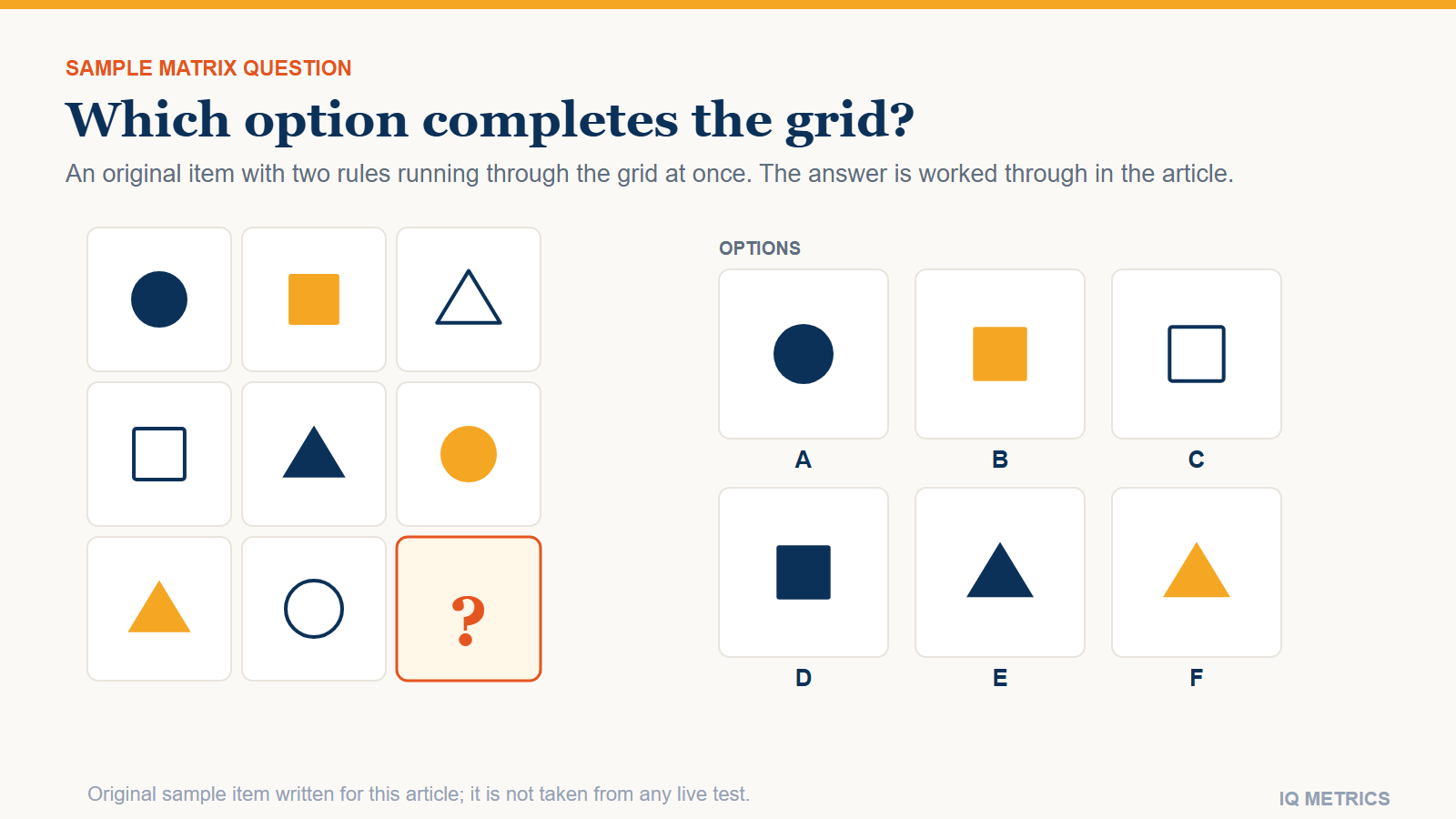
The answer is D, the navy square. Two rules run through the grid at once: every row and every column contains each of the three shapes once, and each of the three fills (navy, gold, outline) once. The bottom row already has a gold triangle and an outline circle, so its missing shape must be the square, and since gold and outline are used, its missing fill must be navy. The third column, with an outline triangle and a gold circle, gives the same answer. Each wrong option breaks a rule: A and E repeat a shape already in the row, B and C repeat a fill, and F repeats both. A matrix with this structure sits at the harder end of what children meet, and the Raven's Progressive Matrices use the same pattern-completion format.
Sample IQ test questions for ages 13 to 17
Teen items measure the same skills with more steps. Word relationships become more abstract, number rules combine operations, and logic items carry more conditions.
| Question | Answer | What it measures |
|---|---|---|
| 2, 3, 5, 9, 17, ... What comes next? | 33 (the gap doubles each time: 1, 2, 4, 8, 16) | Quantitative reasoning: a growth rule rather than a fixed step |
| Drizzle is to downpour as whisper is to ...? | Shout | Verbal reasoning: an analogy about degree |
| In what way are a poem and a symphony alike? | Both are creative compositions. Naming the shared category earns more credit than naming a detail such as “both have parts” | Verbal concept formation, as in Wechsler-style similarities questions |
| Priya finishes a race before Sam but after Tariq. Uma finishes last. Who came second? | Priya (the order is Tariq, Priya, Sam, Uma) | Deductive reasoning: ordering from several clues |
| A game is 20% off and now costs 36 dollars. What did it cost before the sale? | 45 dollars (36 is 80% of the original price) | Quantitative reasoning: working backwards from a percentage |
Notice that the same skill appears at two levels. Mia, Noah and Omar at ages 8 to 12 and the race puzzle at 13 to 17 both test combining clues; what changes is the number of steps and how abstract the language is. Researchers use the same idea across species: a 2012 study gave children aged 4 to 10 the same water-displacement puzzles that had been given to rooks and crows, as crow IQ describes.
How does a child's answer become an IQ score?
On the one-to-one tests, a psychologist adds up the points earned on each subtest, converts each raw score to a scaled score by comparing it with children of the same age, and combines the scaled scores into a composite. The WISC-V was normed on 2,200 children in 11 age groups and reports scores on a scale with a mean of 100 and a standard deviation of 15. The WPPSI-IV covers ages 2 years 6 months to 7 years 7 months and was normed on 1,700 children in nine age groups. Because the comparison is with same-age children, the same raw score is worth less at 12 than at 8. IQ scale by age explains how that works, and deviation IQ versus ratio IQ covers the older mental-age formula.
Group screening tests report something slightly different. The CogAT gives a Standard Age Score with a mean of 100 and a standard deviation of 16, plus percentiles and stanines, and its publisher is explicit that the CogAT is not an IQ test. A child’s 99th percentile is what carries over between tests, which is the point what an IQ of 135 means makes about the top 1%.
| Test | Ages | Format | What a child does |
|---|---|---|---|
| WPPSI-IV | 2 years 6 months to 7 years 7 months | One-to-one with a psychologist, 30 to 60 minutes | From age 4: information, similarities, block design, matrix reasoning, picture memory and bug search |
| WISC-V | 6 years to 16 years 11 months | One-to-one, about 60 minutes for the core subtests | Ten primary subtests from vocabulary to symbol search |
| Stanford-Binet 5 | 2 to 85 and over | One-to-one | Ten subtests covering fluid reasoning, knowledge, quantitative reasoning, visual-spatial processing and working memory, verbal and nonverbal |
| Raven's Coloured Progressive Matrices | 5 to 11 | Untimed, individual or group | 36 pattern-completion items |
| CogAT | Kindergarten to grade 12 | Group, paper or screen | Verbal, quantitative and nonverbal batteries |
| NNAT3 | Kindergarten to grade 12 | Group, 48 items, about 30 minutes | One nonverbal matrix format: find the missing piece |
The individual tests are restricted to qualified professionals, so parents cannot buy them, and any quiz advertised as a real IQ test “with answers” is unstandardised practice. WISC-V index scores explained and CogAT and NNAT scores explained cover how to read each report, and IQ testing for children covers the instruments and norms in more depth.
How stable is a child's IQ score?
Less stable than most people assume, and it depends on age. A 2024 meta-analysis in Psychological Bulletin by Breit and colleagues pooled 205 longitudinal studies and 87,408 people. Stability was low in preschoolers and rose steeply through childhood, reaching a correlation of about 0.76 at age 20 over five years. If 0.80 is the bar for decisions about an individual, general intelligence does not reach it before about age 6; at age 8 that level of stability lasts about two years, at 12 about four, and in adults about six. Tests taken at 11 or later predicted scores at 16 with correlations above 0.80, tests at 8 to 10 above 0.70, and tests at 7 or younger did not reach 0.70.
In plain terms: with a stability of 0.70, a child who scores 130 is expected to score about 121 next time, before any practice effect, purely because extreme scores drift toward the average (regression to the mean). Those are group statistics, and individual children can change a lot in either direction. The publishers say the same thing: the NNAT3 is not intended for children under 5, CogAT age norms begin at 4 years 11 months, and the National Association for Gifted Children cautions that scores under age 6 are hard to interpret. What age is most accurate for an IQ test and the margin of error explained give the wider picture.
Where would your own score land?
Take the IIF-certified assessment and get your score with the scale it was measured on, the percentile it corresponds to and the confidence range around it — the three figures most online tests leave out.
Find your IQ score now! →Should you practise IQ questions with your child?
A little familiarity helps; drilling adds little. The best evidence comes from adults. Scharfen, Peters and Holling’s 2018 meta-analysis of 122 studies and 153,185 people found a gain of about a third of a standard deviation, roughly 5 IQ points, on the second sitting of the same kind of test, half a standard deviation by the third and no further gain by the fourth. Identical forms gave bigger gains than parallel forms. The samples averaged 12 to 70 years old, so it says little about young children, and coaching studies were excluded. In children, Pearson’s NNAT3 retest study (524 children, kindergarten to grade 4, retested after about 18 days) found a gain of 3.8 points. A few points, mostly from familiarity, matter only near a cut-off. What practice actually changes and how to prepare for an IQ test go further.
- Keep it playful. Puzzles, pattern games, riddles and number games build the same reasoning without a test atmosphere.
- Do not drill real test items. Some selective schools say preparation can count against an applicant; Hunter College Elementary’s admissions page warns that prepared children may be disqualified.
- Leave time before a retest. The CogAT publisher’s guidance is at least three months, six preferred, or switching to a different form.
- Practise the format, not the answers. Familiarity with how a matrix or analogy is laid out is what practice really buys.
What do schools do with the scores?
Programmes differ, and there is no universal cut-off. At the time of writing, Chandler Unified School District in Arizona asks for the 97th percentile on any one CogAT battery or the 95th on the composite, and offers a retest after six months. The Rockwood district in Missouri asks for the 95th percentile on two of three composites plus achievement and nonverbal-reasoning criteria. At the selective end, the Davidson Young Scholars programme asks for an individual IQ score of 145 or higher for ages 5 to 16. The National Association for Gifted Children advises against relying on any single assessment. Gifted cutoff scores explains why one line misses children it should find, and signs of a gifted child covers what giftedness looks like at home.
Are online IQ tests for kids accurate?
They are a different thing from the tests above. Real children’s tests are restricted to qualified users and given under standard conditions. The International Test Commission’s guidelines say that the meaning of a score assumes a proctored, standardised setting, and an unsupervised online test cannot verify who is answering. An online puzzle set can still be a low-stakes way for a child to meet the question types. Our own age-banded sets are 15 picture puzzles for ages 4 to 7, 25 puzzles for ages 8 to 12 and 30 puzzles for ages 13 to 17. They are not a clinical assessment, and for a decision about school placement the right route is a school psychologist.
Quick answers
What is on a 5-year-old's IQ test?
On the one-to-one WPPSI-IV, information and similarities questions, block designs, matrix puzzles, picture memory and a bug-search task. Group screening tests for this age use picture puzzles.
Can a 5-year-old take an IQ test?
Yes. The WPPSI-IV starts at 2 years 6 months. But scores before about age 6 are a rough guide, so most gifted programmes weigh them cautiously.
What tests do 10- and 12-year-olds take?
The WISC-V one-to-one, or group tests such as the CogAT, NNAT3 and OLSAT at school.
Is there a real IQ test for kids with answers?
Not for the public. The real tests are restricted to qualified professionals, so any “with answers” version is unstandardised practice.
What IQ score is gifted for a child?
There is no single rule. Many districts use the 95th to 97th percentile on a group test, while some selective programmes ask for 145 or higher.
Do practice questions raise a child's IQ?
They raise familiarity, and repeat scores by a few points. They do not change underlying ability.
The bottom line
A children’s IQ test is a set of reasoning puzzles whose difficulty rises with age and whose score is a rank among same-age children. Use sample questions to learn the format, not to drill, treat a score before about age 6 as a rough guide, and never as a label. For what a very high rank looks like, see what an IQ of 135 means.
Sources
- Breit, Scherrer, Tucker-Drob and Preckel (2024), Psychological Bulletin: the stability of cognitive abilities, a meta-analytic review of longitudinal studies.
- Scharfen, Peters and Holling (2018), Intelligence: retest effects in cognitive ability tests.
- Pearson: WISC-V scales and subtests.
- Pearson: NNAT3 manual, levels A to D.
- Riverside Insights: CogAT overview.
- National Association for Gifted Children: assessments and tests.
- Davidson Institute: Young Scholars eligibility and testing.
- International Test Commission: guidelines on computer-based and internet-delivered testing.
Keep reading
All articles →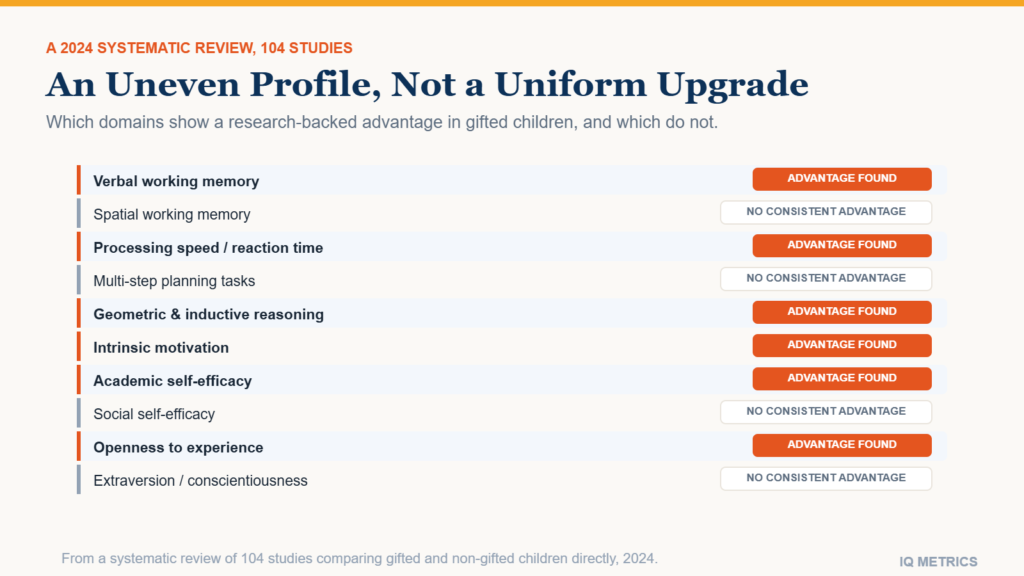 Understanding IQ
Signs of a Gifted Child
The "reads early, has a big vocabulary" checklist misses what a 2024 systematic review actually found: an uneven cognitive profile, a documented speed-accuracy tradeoff, asynchronous development, and real gaps in who gets identified. What the research says, and what to do with a hunch.
 Scores & Scales
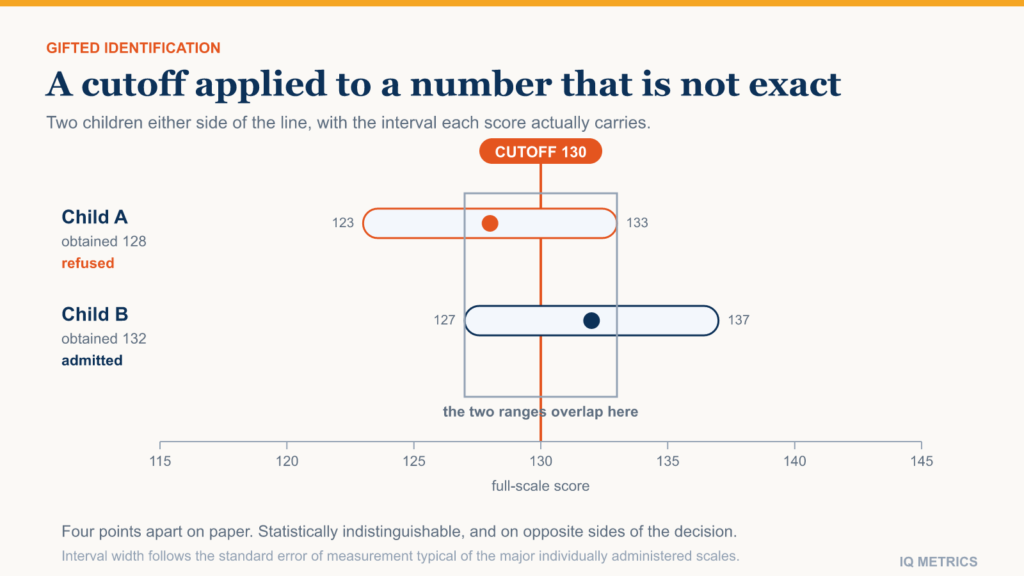
Gifted Cutoff Scores
Most gifted programmes draw their line at an IQ of 130. The number is a statistical convention rather than a boundary in nature, and three well-documented features of how the score is produced and used mean a strict cutoff reliably excludes children who belong on the other side of it.
 Taking a Test
What Age is Most Accurate to Take an IQ Test?
Scientists, teachers, and parents have always wondered how intelligence works. Although intelligence tests are widely accepted as credible measures of mental capacity, the scientific community disagrees on the best age to take one.