





What Does an IQ of 80 Mean? Is It Low, Borderline or Low Average?
An IQ of 80 is the 9th percentile on the standard scale: about 1 person in 11 scores 80 or lower. Major test charts call it the bottom of the Low Average band, and the band just below it is called borderline on some. See what 80 means, how accurate it is and what it predicts.

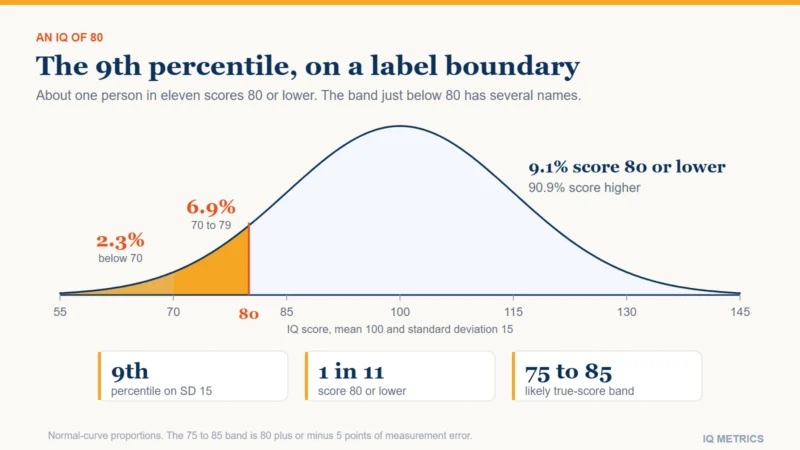
An IQ of 80 is the 9th percentile on the standard scale (mean 100, standard deviation 15): about 1 person in 11 scores 80 or lower and 10 in 11 score higher. It is the lowest score in the Low Average band of the Wechsler children's test (WISC-V), the Stanford-Binet 5 and the Woodcock-Johnson, and it sits one point above the band those charts call Very Low, Borderline or Low. It is not an intellectual disability, which is assessed from a reference point of about 70 plus evidence of difficulty in everyday life, and “dumb” is not a category on any chart. This guide shows where 80 sits on the bell curve, why its label depends on the chart and on the margin of error, what borderline intellectual functioning means, and what a score of 80 does and does not predict.
- Percentile: 9th (9.1%) on a standard deviation 15 scale; 10.6th on standard deviation 16 and 20.2nd on standard deviation 24 (our normal-curve arithmetic).
- Rarity: about 1 person in 11 scores 80 or lower, which is 2 or 3 pupils in a class of 30.
- Label: Low Average (80 to 89) on the WISC-V, the Stanford-Binet 5 and the Woodcock-Johnson; the band just below is called Very Low, Borderline impaired or delayed, or Low, depending on the test.
- Accuracy: read a reported 80 as roughly 75 to 85, a range that spans two labels.
- Disability: no. The reference point is about 70, and the US Social Security listing writes in 70 and 75.
- Prediction: a meta-analysis found IQ correlates .56 with education, .43 with occupation and .20 with income (Strenze, 2007): tendencies in groups, not limits on a person.
The figure shades everything below 80: 9.1% of people, of whom 2.3% score under 70 and 6.9% score 70 to 79. Our guides to an IQ of 70 and an IQ of 85 cover the scores either side, and an IQ of 90 covers the band above.
What percentile is an IQ of 80?
On the standard scale an 80 sits 1.33 standard deviations below the average (z = -1.33), which puts it at the 9th percentile. The table places the scores around it on the same curve, and our IQ percentile calculator does the same for any score.
| IQ score | Scoring at or below | Rarity |
|---|---|---|
| 70 | 2.3% | 1 in 44 |
| 75 | 4.8% | 1 in 21 |
| 80 | 9.1% | 1 in 11 |
| 85 | 15.9% | 1 in 6.3 |
| 90 | 25.2% | 1 in 4.0 |
| 100 | 50.0% | 1 in 2.0 |
The printed number depends on the scale. Most modern tests use a standard deviation of 15, but older Stanford-Binet editions used 16 and the Cattell scales use 24, and the same performance prints as a different number on each. Our explainer on standard deviation 15 versus 16 walks through the arithmetic, and the IQ score converter moves a score between scales. A percentile is a position within a norm sample of people, which is also why parrots have no IQ score; our guide to parrot IQ shows what researchers measure instead.
| Scale | Percentile of a printed 80 | Score at the 9th percentile |
|---|---|---|
| Standard deviation 15 (Wechsler, current Stanford-Binet) | 9.1% | 80.0 |
| Standard deviation 16 (older Stanford-Binet, some school tests) | 10.6% | 78.7 |
| Standard deviation 24 (Cattell) | 20.2% | 68.0 |
Is an IQ of 80 low, borderline or low average?
It depends on the chart, and 80 lands exactly on a label boundary. The table shows where 80 falls on the charts we cover.
| Chart | Band that contains 80 | Band below it |
|---|---|---|
| WISC-V (Wechsler, children) | 80 to 89: Low Average | 70 to 79: Very Low |
| Stanford-Binet 5 | 80 to 89: Low average | 70 to 79: Borderline impaired or delayed |
| Woodcock-Johnson (WJ IV chart) | 80 to 89: Low Average | 70 to 79: Low |
Two things follow. Every chart places 80 above its lowest bands and none calls it a disability category. And because 80 is the first score of its band, a 79 on the same test would print a different word. A one-point gap is smaller than the error in the measurement (see below), so the label a person gets near 80 can come down to chance on the day. Simpler charts, including our own, lump the stretch from 70 to 85 together as borderline to low average. The detailed band tables are in our guides to WISC-V scores, the Stanford-Binet and the Woodcock-Johnson, and the simplified ranges are in IQ ranges and IQ classifications.
What is borderline intellectual functioning?
Borderline intellectual functioning is the term for scores in the stretch just above the intellectual disability range. The DSM-IV-TR defined it as an IQ of 71 to 84. DSM-5 dropped the IQ boundaries, leaving the concept without a clear definition, a change a 2016 paper in BJPsych Bulletin called one of the least highlighted in DSM-5 (Wieland and Zitman). On the normal curve about 13.2% of people score 71 to 84 (our arithmetic, counting each score from its lower edge up to the next whole number), so the old definition covered roughly 1 person in 8, and 80 falls inside it.
It is not a diagnosis of disability. The same authors describe it as a frequently unrecognised condition relevant to the diagnosis and treatment of psychiatric disorders. A 2025 systematic review in Psychiatry Investigation reviewed 45 studies covering 93,396 people with an IQ of 71 to 84 and found higher rates of psychiatric problems, including anxiety, mood, personality and neurodevelopmental disorders, than in average-IQ groups, with outcomes typically between those of average-IQ and mild intellectual disability groups (Cho and colleagues). That is an association across studies, not evidence that a score of 80 causes any outcome. A 2026 paper on disability certification in India adds that people with this profile are often overlooked there because the condition is not recognised as a benchmark disability (Kumar and colleagues), a reminder that the label means different things in different systems.
Is an IQ of 80 an intellectual disability?
No. Intellectual disability is diagnosed from low scores on a standardised test, commonly a reference point of about 70, together with evidence of difficulty in everyday functioning that began in the developmental period. An 80 is about 10 points above that reference, which is more than the roughly 5 points of error either side of a single score. Benefit rules show how fixed the numbers are: the US Social Security listing for intellectual disorder writes in 70, or 71 to 75 with a verbal or performance score of 70 or below, and each sits inside a three-part test (see our news explainer on what the score rules say). An 80 meets neither number. Our guide to low IQ versus learning disability explains why a learning disability is a different thing again, and our guide to an IQ of 70 covers the threshold itself.
How accurate is a score of 80?
Not very, at the level of single points. Every score carries a standard error of measurement, commonly 2 to 3 points on a full-scale adult battery, which gives a 95% interval of about 5 points either side. A reported 80 is best read as 75 to 85. That range crosses the line between the 70 to 79 and 80 to 89 labels, so whether a report prints “Low Average” or the label below it for someone near 80 can come down to chance on the day. Our explainer an IQ score is a range, not a number shows how to read the band, and how to read an IQ test report shows where a real report prints it. A score from an online test depends on how that test was normed, so compare it with a clinical report only with care.
Where would your own score land?
Take the IIF-certified assessment and get your score with the scale it was measured on, the percentile it corresponds to and the confidence range around it — the three figures most online tests leave out.
Find your IQ score now! →Does the age of the test change a score of 80?
It can. Test norms go out of date because raw performance has risen over the last century. A meta-analysis of 271 samples from 1909 to 2013 estimated gains of 0.28 full-scale IQ points a year, roughly 3 points a decade, and found that the gains have decreased in more recent decades (Pietschnig and Voracek, 2015). As an illustration only, twenty years at 0.28 a year is 5.6 points, which would turn an 80 on stale norms into roughly a 74 on fresh ones and move it from the Low Average band into the one below on the charts above. The real gap depends on the country and the test, and the effect has slowed, so treat the arithmetic as a reason to ask which edition produced a score. Our news piece on why IQ norms expire covers the evidence.
What happens when a score of 80 is retested?
Scores regress toward the average when they are repeated, because part of what put the first score so far below 100 was chance. For two tests on one scale, the expected second score is 100 plus the correlation between the tests times the distance of the first score from 100, which for an 80 is minus 20, twice the pull on a 90. The table applies that formula using correlations reported in studies of how stable cognitive scores are.
| Gap between tests | Correlation between scores | Expected next score |
|---|---|---|
| Age 7 to age 12 | .45 | 91.0 |
| Age 12 to age 16 | .59 | 88.2 |
| Age 16 to age 21 | .65 | 87.0 |
| Adults at age 20, five years apart | .76 | 84.8 |
These are group averages on an idealised model, not predictions for one person, and an individual's score can move in either direction. The first three rows come from one study of 11,119 children whose tests changed with age (what 11,119 children show), so a change in the test itself adds to the shift. The adult row is the mean rank-order stability for age 20 and a five-year gap in a meta-analysis of 205 longitudinal studies (Breit and colleagues, 2024). Our page on regression to the mean explains the effect.
What does an IQ of 80 predict?
Test scores predict later outcomes in groups, but loosely. A meta-analysis of longitudinal studies found correlations of .56 with educational attainment, .43 with occupational level and .20 with income (Strenze, 2007). Squared, those figures say how much of the spread in an outcome goes with the score: about 31% for education, 18% for occupation and 4% for income. Most of the variation in how people do sits outside the test, so an 80 shifts the odds and sets no ceiling on an individual.
For the detail behind those numbers, see does IQ predict school success, does IQ predict income and average IQ by education level. For what can and cannot move a score, see can you improve your IQ and does school raise IQ.
Quick answers about an IQ of 80
- Is an IQ of 80 low? It is below average, at the 9th percentile. The major charts call it Low Average, the first score of that band.
- Is 80 an intellectual disability? No. The reference point is about 70, and a diagnosis also needs evidence of difficulty in everyday functioning.
- Is an IQ of 80 borderline? The band just below is called borderline on some charts, and the old DSM-IV-TR definition of borderline intellectual functioning, 71 to 84, includes 80.
- Is 80 IQ dumb? “Dumb” is not a term any test manual uses. A score describes performance on one test and carries about 5 points of error either side.
- What percentile is an IQ of 80? The 9th on a standard deviation 15 scale, the 10.6th on standard deviation 16 and the 20.2nd on standard deviation 24.
- How rare is an IQ of 80? About 1 person in 11 scores 80 or lower.
- Can someone with an IQ of 80 study, work and drive? A score alone does not decide it. Licences, jobs and courses rest on their own tests and requirements, and an 80 sits well above the levels written into disability rules.
Sources
- Strenze, T. (2007): Intelligence and socioeconomic success: a meta-analytic review of longitudinal research, Intelligence, 35(5), 401-426.
- Pietschnig, J. and Voracek, M. (2015): One century of global IQ gains: a formal meta-analysis of the Flynn effect (1909-2013), Perspectives on Psychological Science, 10(3), 282-306.
- Breit, M., Scherrer, V., Tucker-Drob, E.M. and Preckel, F. (2024): The stability of cognitive abilities: a meta-analytic review of longitudinal studies, Psychological Bulletin, 150(4), 399-439.
- Wieland, J. and Zitman, F.G. (2016): It is time to bring borderline intellectual functioning back into the main fold of classification systems, BJPsych Bulletin, 40(4), 204-206.
- Cho, M., Ko, E., Choi, H., Han, D.G., Kim, H.J., Kim, B. et al. (2025): The mental health profile of borderline intellectual functioning: a systematic review, Psychiatry Investigation, 22(11), 1230-1242.
- Kumar, D., Abhishek, P. and Sivakumar, T. (2026): From gaps to action: possible strategies to address challenges in the assessment of specific learning disabilities and borderline intellectual functioning under the Rights of Persons with Disabilities Act, 2016, Indian Journal of Psychiatry, 68(5), 483-491.
- Percentile and rarity figures are computed from the normal distribution. The bands, the scale conversion and the standard error of measurement are those described in our own guides to the Stanford-Binet, the Woodcock-Johnson, WISC-V scores and IQ score margin of error.
Keep reading
All articles →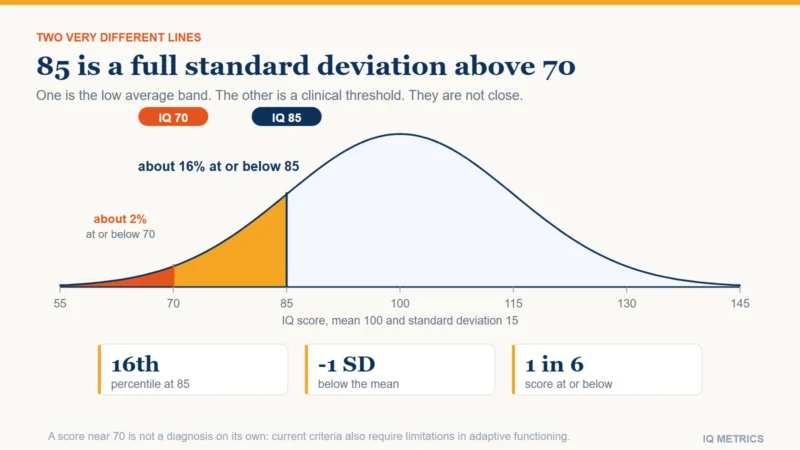 Scores & Scales
What an IQ of 85 Means
A score of 85 sits exactly one standard deviation below the population mean, at roughly the 16th percentile. It is the bottom edge of what test manuals call low average, it is well clear of any clinical threshold, and on its own it says considerably less about a person than the number appears to.
 Scores & Scales
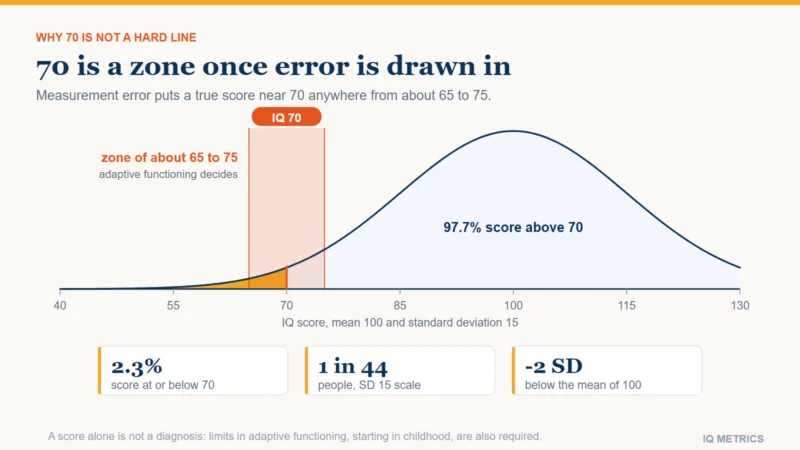
What an IQ of 70 Means
An IQ of 70 sits two standard deviations below the mean, at about the 2nd percentile. It is the score most often linked with intellectual disability, but a diagnosis never rests on the number alone: measurement error turns the line into a zone, and adaptive functioning decides who is inside it.
 Scores & Scales
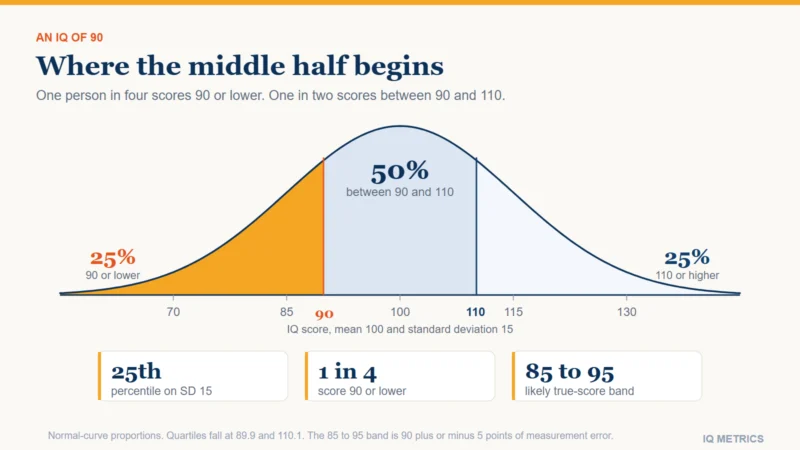
What Does an IQ of 90 Mean?
An IQ of 90 is the 25th percentile on the standard scale: about 1 person in 4 scores 90 or lower. Major test charts call it the bottom of the Average band, while simpler charts call it low average. See what 90 means, how accurate it is and what it predicts.