





Dr Kawashima's Brain Training (Brain Age): Does It Work?
Dr Kawashima's Brain Training (Brain Age) has two randomised trials, 32 people each, four weeks against Tetris: gains on executive function and speed, none on Raven's matrices. Who funded them, what reviews of brain training find, and the Switch version.

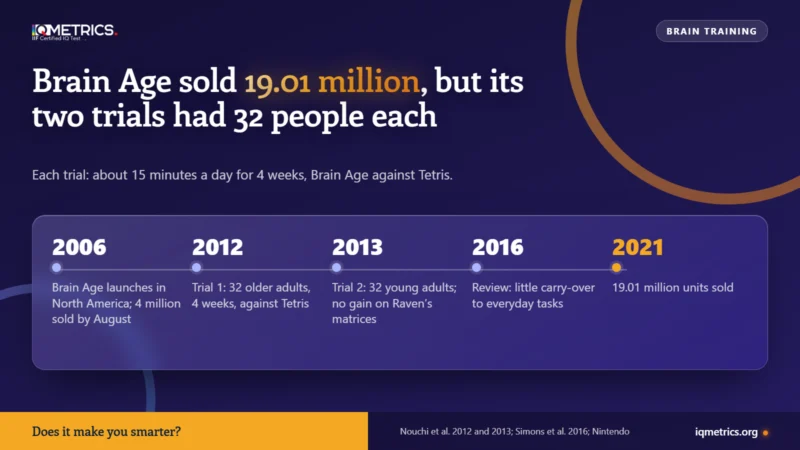
Dr Kawashima's Brain Training, sold in North America as Brain Age, has two published randomised trials, and Kawashima co-wrote both. In 32 older adults and 32 young adults, four weeks of play beat Tetris on tests of executive function and processing speed, but not on Raven’s matrices, the fluid-intelligence test. Large reviews of brain training find gains on the practised tasks and little carry-over to everyday skills.
Below: what the game is, what each trial measured, who gained from the studies, what independent reviews found, and whether the Nintendo Switch version changes anything. Every number is from the papers or from Nintendo’s own pages.
What is Dr Kawashima's Brain Training?
It is a Nintendo puzzle game built around short mental exercises. The same game is called Brain Age: Train Your Brain in Minutes a Day in North America and Dr Kawashima’s Brain Training: How Old Is Your Brain? in Europe. Nintendo of America says it was inspired by the work of Professor Ryuta Kawashima, a Japanese neuroscientist. The papers below list his university as Tohoku University in Sendai.
Nintendo’s own claims are modest. A 2007 Nintendo UK news item says the games are inspired by the research of Dr Kawashima and designed to help stimulate your brain and challenge memory, maths and perception skills. We found no Nintendo statement promising a higher IQ. The Nintendo Switch version, Dr Kawashima’s Brain Training for Nintendo Switch, has a UK release date of 3 January 2020 on Nintendo’s page, with new exercises and classic ones. We found no sales figure for it.
| Date | What happened | Source |
|---|---|---|
| 17 April 2006 | Brain Age launches in North America | Nintendo of America press release |
| 10 August 2006 | More than 4 million sold worldwide, 3 million of them in Japan | Nintendo of America press release |
| 2012 and 2013 | Two randomised trials published; the first ran in Sendai from March to August 2010 | PLoS ONE papers (below) |
| 2016 | Simons and colleagues review the brain-training evidence | Psychological Science in the Public Interest |
| 3 January 2020 | Switch version, UK release date | Nintendo UK |
| 31 March 2021 | 19.01 million units of Brain Age sold, life to date | Nintendo investor relations |
The 19.01 million is Nintendo’s worldwide count of units, including copies bundled with hardware, as of 31 March 2021. It is the last DS figure Nintendo published that we could find.
At launch, Nintendo of America said the series builds on word and number puzzles and acts as a treadmill for the mind. A treadmill builds fitness for running. Whether mental practice builds fitness for thinking in general is exactly what the studies below test.
The game spread fast. Its sequel, Brain Age 2, sold 14.88 million units by the same date. In May 2007 Nintendo UK said more than 10 million people worldwide were including Brain Training in their daily lives. That is a count of people, not copies, so do not add it to the sales figures.
Does Dr Kawashima's Brain Training work?
It improved scores on some thinking tests in two small trials, but those trials did not show a higher IQ or better everyday thinking. Both compared the game with Tetris, not with doing nothing, and both were short.
| Nouchi and colleagues, 2012 | Nouchi and colleagues, 2013 | |
|---|---|---|
| Who | Older adults, mean age about 69 | Young adults, mean age about 20.5 and 20.9 |
| Size | 32 randomised, 28 finished | 32 randomised, 31 finished |
| Test | Brain Age against Tetris, about 15 minutes a day, at least 5 days a week, 4 weeks | Same schedule against Tetris |
| Gains against Tetris | Executive function and processing speed | Executive function, working memory and processing speed |
| No gain | Global cognition (MMSE) and attention | Fluid intelligence (Raven’s matrices, p = 0.126), short-term memory and reading |
| Journal | PLoS ONE 7(1): e29676 | PLoS ONE 8(2): e55518 |
A fair reading is narrow. Four weeks of play changed scores on speed and task-switching tests in these samples. That is a result about those tests, not about an IQ score; our guide to what an IQ of 136 means shows what a number on the IQ scale tells you. It needs a larger, independent trial before anyone calls it a general gain.
The design is better than a no-treatment comparison. The control group played Tetris, a game that Nintendo published in 2006, for the same time each day. So any difference is not just the effect of taking part in a study. Both trials are listed in the UMIN clinical trial registry (UMIN000002825 and UMIN000005618), which is a point in their favour. The weakness is size: 32 people per trial.
The 2013 paper is titled with the word “boosts”, yet the fluid-intelligence test, the closest of the group to what IQ tests measure, did not improve. In that trial the Tetris group did better than the Brain Age group on one attention test and one visuo-spatial test. The authors of the 2012 paper wrote that the results need replication in large samples. The 2013 authors said they did not assess long-term benefit.
Who paid for the studies, and does Kawashima gain?
The funder named in both papers is the Japan Science and Technology Agency (RISTEX), not Nintendo. But the competing-interest statement reads: “RK is the creator of the Brain Age. Tohoku University, where RK belongs, has received royalties generated by the Brain Age’s sales.”
The 2012 authors are listed at the Institute of Development, Aging and Cancer, Tohoku University, in Sendai, so the research and the royalty both sit within one university. That is a disclosure, not a flaw in the data. It is a reason to want a replication by a team with no stake in the game. The authors themselves asked for replication in larger samples.
Do brain-training games improve everyday thinking?
Independent reviews say the evidence is weak. Players get better at what they practise, but that skill rarely carries over to other tasks or to daily life.
The 2016 review by Simons and colleagues was written against a public dispute. In 2014 an international group of more than 70 scientists issued a consensus statement objecting to brain-game marketing claims, and a group of 133 scientists and practitioners countered. The review examined the studies that leading brain-training companies cite.
| Source | What it covered | Finding |
|---|---|---|
| Simons and colleagues (2016), Psychological Science in the Public Interest | Studies cited by leading brain-training companies | Extensive evidence of gains on trained tasks; little evidence of gains on distant tasks or everyday performance; no cited study met all best practices |
| Owen and colleagues (2010), Nature | 11,430 people training online for six weeks | No evidence of transfer to untrained tasks, even closely related ones |
| Sala and Gobet (2019), Trends in Cognitive Sciences | Meta-analyses of cognitive training | No appreciable benefit for general cognition |
| Melby-Lervag, Redick and Hulme (2016), Perspectives on Psychological Science | 87 publications, 145 comparisons of working-memory training | No convincing evidence of reliable far-transfer gains against a treated control |
None of these tests Brain Age itself, and we did not check whether Simons and colleagues reviewed it. They show the pattern the two Nouchi trials sit inside. Our news piece on whether brain training apps work covers the wider field, and video games and IQ covers games more broadly.
Can brain training prevent dementia?
No study has shown it. A 2014 statement from the Stanford Center on Longevity and the Max Planck Institute for Human Development says no studies have demonstrated that brain games cure or prevent Alzheimer’s disease or other dementias. It adds that gains from the games are unlikely to last long after you stop playing.
The US Federal Trade Commission acted against a different product. In January 2016 Lumosity agreed to pay $2 million, with a $50 million judgment suspended, after the FTC said it lacked the science for its ads. That case was not about Nintendo.
Where would your own score land?
Take the IIF-certified assessment and get your score with the scale it was measured on, the percentile it corresponds to and the confidence range around it — the three figures most online tests leave out.
Find your IQ score now! →Is there a Dr Kawashima game for Nintendo Switch, and is it better?
Yes, and there is no published trial of it that we could find. Nintendo’s UK page describes new exercises, some using the right Joy-Con’s IR Motion Camera, plus classic exercises. Whether those exercises transfer to other skills has not been tested in a paper we know of.
How can you track your own thinking speed?
Use a plain test and repeat it. Our reaction time test and digit span test show how much you improve with practice on a single task. A practice gain on one task is what the reviews expect. It does not mean a broader skill has improved, and where thinking speed peaks across life is covered in our study of peak brain age.
Quick answers
- Does Dr Kawashima’s Brain Training make you smarter? Two small trials found gains on executive-function and processing-speed tests but not on Raven’s matrices. Reviews find little transfer to everyday life.
- Does Brain Age work? It improves performance on practised or similar tasks. Transfer to daily life is not shown.
- How many copies did Brain Age sell? 19.01 million worldwide as of 31 March 2021, per Nintendo.
- Did Nintendo pay for the studies? The funding statements name the Japan Science and Technology Agency. Kawashima’s university receives royalties from the game.
- Is there a Switch version? Yes. Dr Kawashima’s Brain Training for Nintendo Switch has a UK release date of 3 January 2020.
The bottom line
Dr Kawashima's Brain Training is a well-made practice game with two small, short trials behind it, both co-written by its creator. They found gains on some tests against Tetris and none on fluid intelligence. Play it for fun, and expect to get better at the games.
Sources
- Nouchi and colleagues (2012), PLoS ONE 7(1): e29676: brain training game and the elderly, randomised trial.
- Nouchi and colleagues (2013), PLoS ONE 8(2): e55518: brain training game and young adults, randomised trial.
- Simons and colleagues (2016), Psychological Science in the Public Interest 17(3): do brain-training programs work?
- Owen and colleagues (2010), Nature 465; Sala and Gobet (2019), Trends in Cognitive Sciences 23(1); Melby-Lervag, Redick and Hulme (2016).
- Stanford Center on Longevity and Max Planck Institute, consensus statement, 20 October 2014.
- FTC press release, 5 January 2016: Lumosity settlement.
- Nintendo: top-selling DS software list (investor relations, as of 31 March 2021), Nintendo of America press releases of 30 January and 10 August 2006, and Nintendo UK pages for the 2007 and Switch releases.
Keep reading
All articles →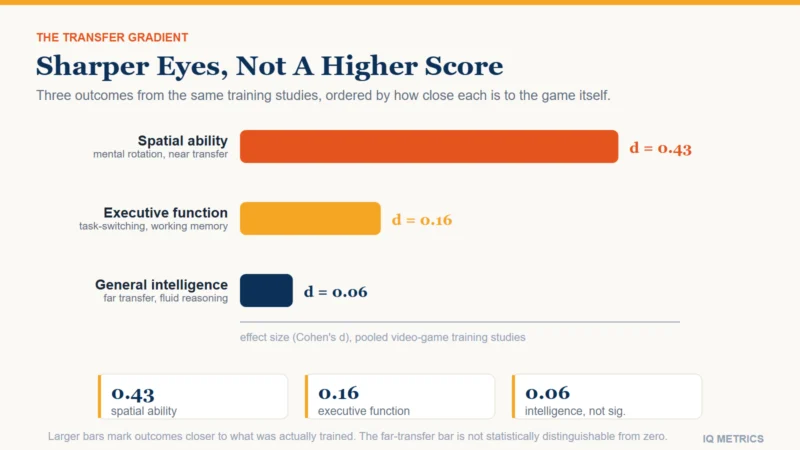 Mind & Everyday Life
Do Video Games Raise Your IQ?
Action video games produce real, replicated gains in spatial ability and attention, some of the best near-transfer evidence in this batch. Push the test further away, toward the general reasoning an IQ test measures, and the effect all but disappears once the research is pooled properly.
 Understanding IQ
Processing Speed and IQ
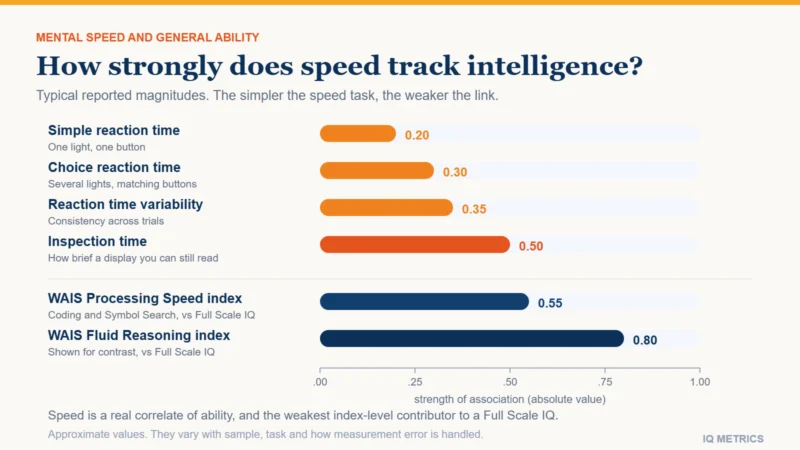
Fast thinkers are assumed to be smart thinkers, and there is a real finding underneath the stereotype: people who score higher on IQ tests do respond faster on tasks with no reasoning content at all. But the link is weaker than the folklore, and on a professional battery the speed index is the least g-loaded.
 Understanding IQ
Reaction Time Test
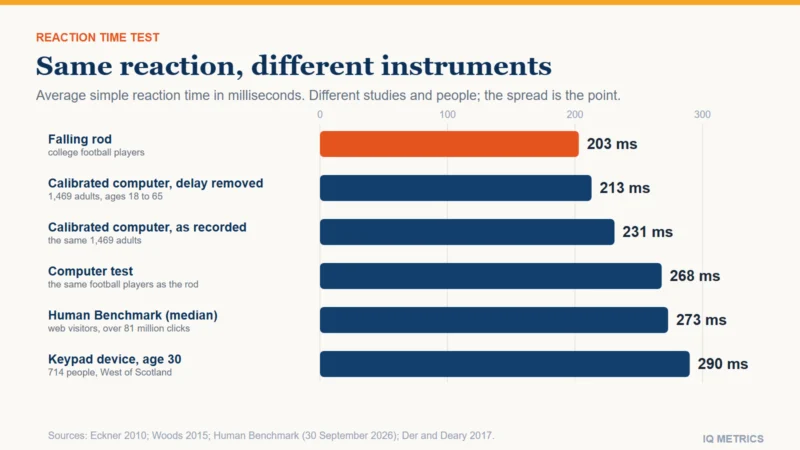
A reaction time test depends on the equipment: 203 ms with a falling rod, 231 ms on a calibrated computer, 273 ms online. See the ruler drop conversion table, why online scores run slow, driving and sprint reaction times, and what really changes your speed.