





Cow IQ: How Smart Are Cows?
Cows have no IQ score, but a 2017 review of cattle studies finds fast learning, memory for herd mates of at least 12 days and for a maze of 6 weeks, and no published object permanence test. How cows compare with pigs and dogs, and what is unknown.

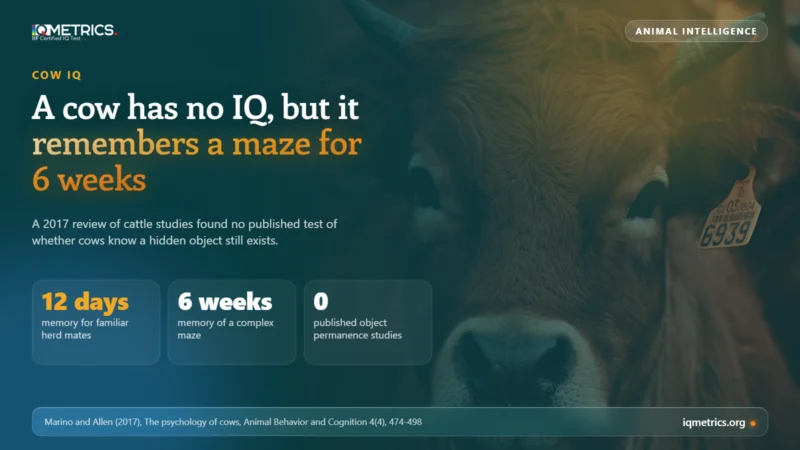
Cow IQ is not a score anyone can measure, because no IQ test exists for cattle. What scientists have measured is narrower and still striking: cows learn where food is within days, tell herd mates apart in photographs, remember a maze for six weeks and show excitement when they solve a task. A 2017 review by Lori Marino and Kristin Allen found no published tests of object permanence in cows.
Below: why a cow cannot have an IQ, the experiments the review lists, what cows feel, how they play and bond, how they compare with pigs and dogs, and what is still unknown. Every cow study here is described from the review, which is open access.
Is there such a thing as cow IQ?
No. An IQ is a position on a bell curve for people of the same age, and nothing like it exists for cows. There is no standard test and no norm sample, so researchers test one skill at a time, usually in small groups of farm animals. Our guide to what an IQ of 136 means shows what a real score needs. The same holds for pigs and horses.
How smart are cows?
Smart enough to learn fast and remember for weeks. The Marino and Allen review (Animal Behavior and Cognition, 2017) gathers what cattle studies show, much of it from farm research. The authors say direct studies of cow learning outside farm settings are relatively few, so some conclusions are inferred from related work.
| Ability | What the cows did | Study cited in the review |
|---|---|---|
| Learn a place | Learned a feeder location after two ten-minute tests a day for five days; 77% kept it after a six-week break | Kovalchik and Kovalchik, 1986 |
| Learn a sound | Responded to an alarm sound within seven trials | Kiley-Worthington and Savage, 1978 |
| Tell shapes apart | Discriminated geometric shapes, colours and the same shape in different sizes | Baldwin, 1981; Gilbert and Arave, 1985; Rehkaemper and Goerlach, 1997 |
| Tell people apart | Learned to approach the handler who gave food, though both wore the same clothes | Taylor and Davis, 1998 |
| Remember a maze | Kept a complex maze for up to six weeks | Hirata, Tomita and Yamada, 2016 |
| Remember a cue | Kept a link between a plastic tub and food for at least a year | Hirata and Takeno, 2014 |
Most of these tests had a simple reward, and the review does not give effect sizes. They show what cattle can learn when trained. They do not show how a typical cow ranks against another species.
There is a reason the list reads like a farm manual. The review notes that few studies of cow learning and memory were done outside an applied setting, such as training cows to use automatic feeders or testing food preferences.
Cows were studied because farms needed answers, not because anyone set out to rank their minds. That shapes what we know, and what nobody has thought to test. Steers, for example, remembered where food buckets stood for at least 48 hours (Ksiksi and Laca, 2002), a result that came from grazing research.
Do cows recognise each other, and people?
Yes, in the experiments reviewed. Heifers learned in a few trials to pick out familiar herd mates in a Y-maze and kept the memory for at least twelve days (Hagen and Broom, 2003). In photographs, heifers told cow faces from faces of other species (Coulon and colleagues, 2007) and treated familiar and unfamiliar cow faces as different groups (Coulon and colleagues, 2011).
Recognition matters in family life too. In an older study, mothers recognised their own calves up to 12 hours after separation, and no longer at 24 hours (Hudson and Mullord, 1977). In a study of 110 lactating dairy cows watched over four one-month periods, cows kept close to particular herd mates rather than mixing at random (Boyland and colleagues, 2016).
Do cows play, bond and comfort each other?
Yes, by the evidence the review collects. Calves play with balls, run and buck, and play-fight with each other. Social play starts at about two weeks old and peaks at about four months (Reinhardt and colleagues, 1978). Play drops when calves are weaned early, kept on a smaller milk allowance or in pain, and rises when they are housed in pairs.
Company calms them. Stressed cows seek out cows that are not stressed (Ishiwata and colleagues, 2007). Heifers weighed with a mirror showing their own front view had lower heart rates than heifers with a side view or no mirror (Piller and colleagues, 1999). And mothers form strong bonds with a calf after as little as five minutes of contact (Hudson and Mullord, 1977).
Individuals differ as well. In 48 heifers, 29 bulls and 60 steers, the share of visible eye white tracked how agitated each animal looked in a chute, which the review cites as an objective measure of temperament (Core and colleagues, 2009). None of this is intelligence, but it is part of what the word has to cover when we compare species.
Do cows have feelings that change how they think?
The review says the evidence points that way. Emotion shows up in cattle as changes in eye whites, ear posture and nose temperature, and it also shifts judgement.
In one study, 13 calves learned to approach a white screen and avoid a red one. Before separation from their mothers they approached an in-between shade 72% of the time. After separation the figure fell to 62%, although they still sorted true white and red well (Daros and colleagues, 2014). The authors read this as a gloomier outlook after distress. A separate study found a similar bias in very young calves for at least 22 hours after hot-iron disbudding, a procedure that removes the horn buds (Neave and colleagues, 2013).
Success seems to feel good too. Heifers that controlled when a reward arrived reached reliable performance within twelve trials, and they grew more excited than a control group that got the same rewards without controlling them (Hagen and Broom, 2004). The authors suggest a sense of control, which is an interpretation, not a measurement.
Where would your own score land?
Take the IIF-certified assessment and get your score with the scale it was measured on, the percentile it corresponds to and the confidence range around it — the three figures most online tests leave out.
Find your IQ score now! →Are cows smarter than pigs?
No study ranks them. The few head-to-head results in the review point both ways.
| Test | Result | Source |
|---|---|---|
| Tunnel-trolley test (extrapolating where a moving food trolley will come out) | Cows passed but were not as consistent as pigs and goats | Albright, Kilgour and Whittlestone, 1982 |
| Hebb-Williams maze | Cows performed favourably compared with pigs, sheep, goats and dogs | Kilgour, 1981 |
| Joystick-cursor task | Four pigs learned it; no cow equivalent that we found | Croney and Boysen, 2021, in our pig guide |
| Brain cells | One pig cortex held 307 million neurons; we found no cattle count | Kazu and colleagues, 2014, in our pig guide |
Pigs are also studied as models for human brain research, as our pig guide notes. That may explain part of the gap, since the cow work in the review is mostly applied farm research. Two old tests with different results cannot settle it. Read them as a reminder that each species is good at some tasks. The pig IQ guide sets out the pig side in full.
Are cows smarter than dogs?
No study answers that either. In the one test the review reports that includes dogs, a maze from 1981, cows performed favourably against dogs, pigs, sheep and goats. That is a single old test, described second-hand.
Dogs have been tested on many more tasks, which is not the same as being cleverer. See dog IQ for the dog evidence and elephant IQ and orca IQ for animals whose brains have been measured more. The smartest animals study lists what is known across species.
What do we still not know about cow intelligence?
A lot. The review says there are no actual published studies of object permanence in cows, the skill of knowing an object still exists when it is out of sight. It also names numerosity, learning set and time perception as areas that beg to be addressed.
The review is also written with a clear aim: to describe cows on their own terms rather than as food animals. That makes it a useful map of the evidence. The studies inside it are mostly small and mostly done for farm management, so treat each result as one data point.
Quick answers
- What is the IQ of a cow? There is none. No validated test produces a cow IQ.
- Are cows smart? They learn tasks quickly, remember places and herd mates for days to weeks, and tell individual cows apart.
- Are cows smarter than pigs? No study says. In two old tests cows were less consistent than pigs on one and did well on the other.
- Are cows smarter than dogs? Not tested head to head beyond one 1981 maze study reported in the review.
- Do cows have feelings? The review lists evidence of fear, play, stress sharing and a gloomier outlook after distress.
The bottom line
A cow has no IQ, but it is no simple grazer. Cows remember herd mates for at least twelve days and a maze for six weeks, and no one has yet tested whether they grasp that hidden objects still exist. Compare animals by what each does, not by a single score.
Sources
- Marino and Allen (2017), The psychology of cows, Animal Behavior and Cognition 4(4), 474-498: the review described throughout, open access.
- Animal Behavior and Cognition, article page for the review.
- The studies named in the tables (Hagen and Broom, Coulon, Daros, Hirata, Kilgour, Albright and others) are cited as the review describes them; we did not read each original paper.
- Croney and Boysen (2021), Frontiers in Psychology, and Kazu and colleagues (2014), Frontiers in Neuroanatomy, as described in our pig IQ guide.
Keep reading
All articles →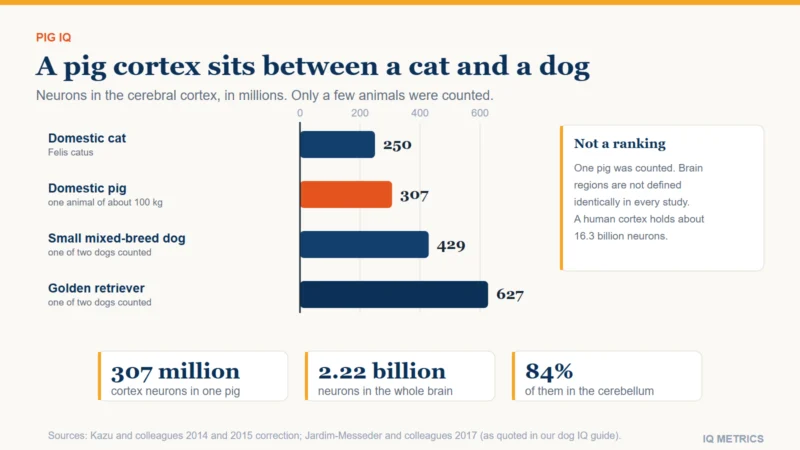 Understanding IQ
Pig IQ
Pigs have no IQ score: no validated test gives one. Studies measure single skills instead. Four pigs acquired a joystick video task, pigs follow each other to food and read some human cues, a mirror result failed to replicate, and one pig cortex held 307 million neurons, between a cat and a dog.
 Understanding IQ
Horse IQ
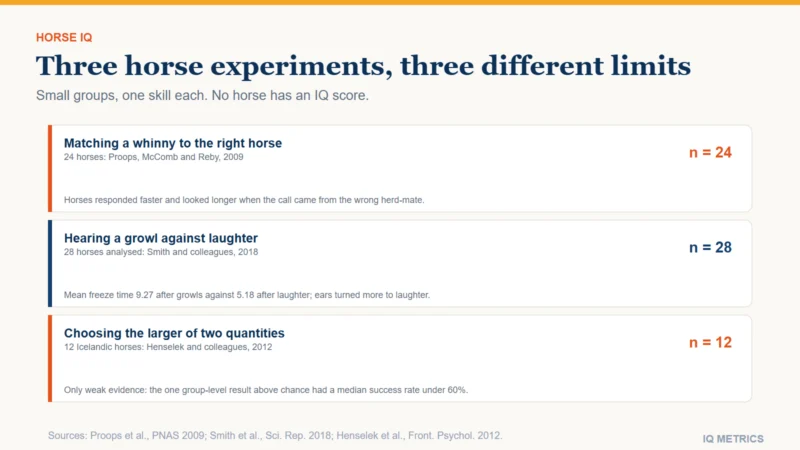
Horses have no IQ score: no validated test gives one. Studies measure single skills instead. Horses matched a herd-mate's call to the right horse, reacted to human laughter and growls, and gave weak evidence on quantity. Their brain weighs about 599 g. Clever Hans shows why animal tests need controls.
 Research & Evidence
Orca IQ
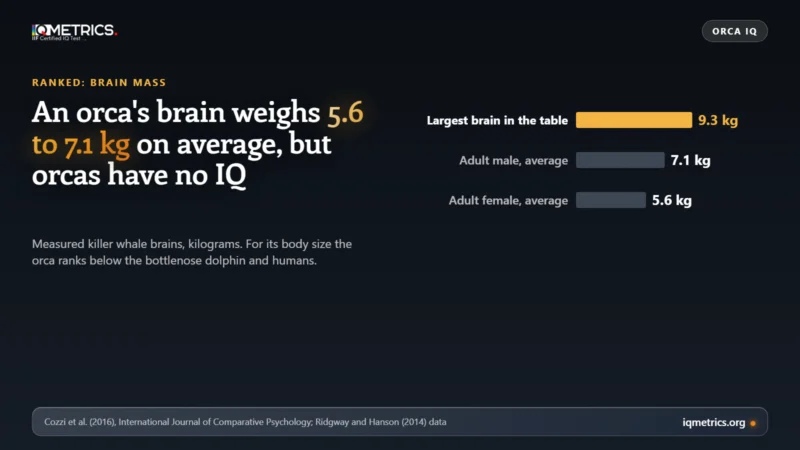
How smart are killer whales? An orca brain averages about 5.6 kg in females and 7.1 kg in males, yet ranks below the bottlenose dolphin and humans for its body size. What is known about neurons, leadership by older females and pod sounds, and why orcas have no IQ.