





Soccer IQ: What It Means, How It Is Measured and Which Brain Skills Predict It
Soccer IQ means game intelligence, not an IQ score. In 25 Swedish men, a pen-and-paper executive-function test predicted goals and assists two seasons later (r = 0.54). See how soccer IQ is measured, how elite players score, how weak the link to IQ is and whether you can train it in youth players.

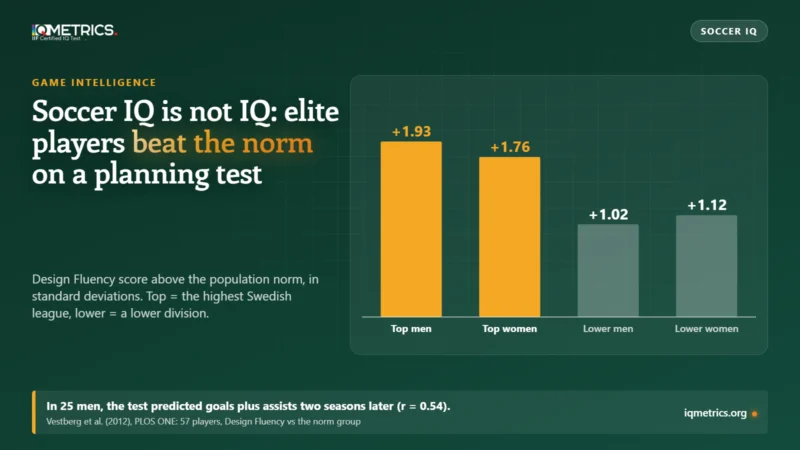
Soccer IQ is another name for game intelligence: how well a player reads a match and adapts at speed. It is not an IQ score. In a 2012 study of 57 Swedish players, results on an executive-function test predicted goals and assists two seasons later (r = 0.54, in 25 men). The test measured planning and self-control, not general IQ.
Below: what soccer IQ means, how researchers measure it, what the Swedish studies found, how weak the link to IQ is, and whether you can train it. New here: the best evidence rests on one pen-and-paper task, connecting dots with as many different lines as you can in 60 seconds, and the tests that predicted goals did not need any soccer knowledge.
Key takeaways
- Soccer IQ, or football IQ, means game intelligence. It has no norm group and no IQ scale.
- Swedish top-division players scored 1.76 to 1.93 standard deviations above the population norm on Design Fluency, and lower-division players 1.02 to 1.12 (Vestberg et al., 2012).
- In 25 men, the test score predicted goals plus assists two seasons later (partial r = 0.54). That is a small sample, and a correlation is not proof of cause.
- Executive functions relate to IQ only in part: updating working memory tracks intelligence, but inhibiting and shifting do not (Friedman et al., 2006).
- Training evidence is thin: an 8-week program did not raise executive functions in 31 youth players (Heilmann et al., 2024).
What does soccer IQ mean?
Soccer IQ means game intelligence: the ability to read a game and quickly adapt your behaviour. Researchers use that exact definition (Vestberg et al., Scientific Reports, 2020). Football IQ means the same thing outside the US.
It covers choices such as where to run, when to pass and when to hold the ball. Sport scientists group the skills behind it as executive functions: planning, working memory, switching strategy and holding back a planned move. None of that is an intelligence quotient, which compares a person with a norm group of people the same age. See our guide to what your IQ score really means.
Can soccer IQ be measured?
Yes, in two ways, and neither gives an IQ. Researchers give players standard executive-function tests, or they ask coaches to rate game intelligence.
The Swedish studies used the Design Fluency test from the D-KEFS battery. The player joins the dots in a square with one line, as many different ways as possible, in 60 seconds, and may not repeat a solution. It needs working memory to avoid repeats, and self-control to drop a habit. Two control tests, the Stroop colour-word test and the Trail Making test, added a verbal side. A full session took 40 minutes.
| Study | Players | Main test | What it found |
|---|---|---|---|
| Vestberg et al. (2012), PLOS ONE | 57 (31 men, 26 women); 25 men followed up | Design Fluency | Top-division players beat lower-division players; score predicted goals plus assists two seasons later (r = 0.54) |
| Vestberg et al. (2017), PLOS ONE | 30 players aged 12 to 19 | Design Fluency and an n-back working memory task | Both related to goals (r = 0.35 and 0.44, combined 0.55), also after controlling for intelligence |
| Vestberg et al. (2020), Scientific Reports | 51 elite players | Design Fluency and coach ratings | National team players beat premier league players; moderate link to coach-rated game intelligence |
Do elite soccer players have better executive function?
Yes, on these tests, and the gap grows with the level of play. In the 2012 study both groups beat the population norm, and the top division beat the lower one.
On Design Fluency, top-division men scored 1.93 standard deviations above the norm group and top-division women 1.76. Lower-division men scored 1.02 above and lower-division women 1.12. The authors write that the top-division players “belong to the 5% best individuals in the population on this test”. The gap between divisions held for men and women alike (p < 0.0005 for division, with no effect of gender).
Later work found the same ladder at the very top. Among 51 elite players, those in national teams outperformed premier league players (Vestberg et al., 2020), and young elite players aged 12 to 19 scored 0.86 standard deviations above the norm on Design Fluency (2017).
Did executive function really predict goals and assists?
In one small group, yes. The 2012 score predicted goals plus assists over the next two and a half seasons with a partial correlation of 0.54 in 25 male players.
The team followed 13 top-division and 12 lower-division men from January 2008 to May 2010. They controlled for position, division and age, because forwards score more and the second division is easier to score in. The correlation was 0.54, with p = 0.006 on a one-tailed test. Squared, 0.54 is 0.29: the test accounts for about 29% of the spread in points (our arithmetic), and 71% is something else.
Read it with care. Twenty-five men is a small sample. Goals and assists leave out defending and organising play, as the authors note. Coaches chose the players. And a link does not prove that the skill causes success: the authors allow that “good players actually develop better executive functions”. This study tested Swedish league players, not Messi or Ronaldo.
Where would your own score land?
Take the IIF-certified assessment and get your score with the scale it was measured on, the percentile it corresponds to and the confidence range around it — the three figures most online tests leave out.
Find your IQ score now! →Is soccer IQ the same as IQ?
No. Executive functions overlap with IQ only in part, and the Swedish authors say they correlate less with general IQ than with each other.
A 2006 study of young adults split executive function into three parts. Updating working memory was highly correlated with intelligence. Inhibiting responses and shifting mental sets were not (Friedman et al., Psychological Science). In the 2017 study of young players, the link to goals stayed after the authors controlled for intelligence.
So a high soccer IQ does not require a high IQ score, and a high IQ score does not guarantee soccer IQ. To see what real IQ questions look like, try our intelligence test sample. People who search for Messi football IQ or Ronaldo football IQ may mean game intelligence or an IQ score, and this study measured neither player. For the IQ figures that circulate, see our profiles of Lionel Messi, Cristiano Ronaldo and Tom Brady, or our list of athletes by IQ. For another sport, see the smartest NBA players.
How to improve soccer IQ: can you train it?
Nobody has shown a reliable way to raise it with a short program. The best-known trials are small and mixed.
In 2024, Heilmann and colleagues gave 13 players aged 13 to 15 an 8-week soccer-focused cognitive training program and compared them with 18 who trained as usual. Executive functions did not improve more in the training group. The authors suggest a ceiling effect in already skilled players. A 2020 trial of 38 boys aged 12 to 13 found that 20 minutes a week of on-field training for 8 weeks improved peripheral reaction time (Schumacher et al.). That is one narrow skill, not soccer IQ as a whole.
You can measure the building blocks yourself. Our Stroop test tests self-control, our sequence memory test tests working memory, and our reaction time test tests speed. We found no study showing that scores on these games carry over to match performance. For the wider talent question, read talent vs practice and why working memory and reasoning are not the same.
Quick answers
- What is soccer IQ? Game intelligence: reading a match and adapting at speed. It is not an IQ score.
- Can it be measured? Partly: with executive-function tests such as Design Fluency, or with coach ratings. There is no soccer IQ norm group.
- Does executive function predict success? In 25 Swedish men it predicted goals plus assists two seasons later (r = 0.54). The sample is small.
- Is soccer IQ the same as IQ? No. Only the working-memory updating part tracks intelligence closely.
- How do you improve soccer IQ? No short program has shown a clear effect on executive function in youth players.
The bottom line
Soccer IQ is game intelligence, and it is not an IQ score. The Swedish studies tie it to planning, working memory and self-control, with a clear ladder from lower to top division and one small prediction study. To see where your own reasoning stands, take the IQ test.
Sources
- Vestberg T, Gustafson R, Maurex L, Ingvar M, Petrovic P (2012). Executive functions predict the success of top-soccer players. PLOS ONE 7, e34731.
- Vestberg T, Reinebo G, Maurex L, Ingvar M, Petrovic P (2017). Core executive functions are associated with success in young elite soccer players. PLOS ONE 12, e0170845.
- Vestberg T, Jafari R, Almeida R, Maurex L, Ingvar M, Petrovic P (2020). Level of play and coach-rated game intelligence are related to performance on design fluency in elite soccer players. Scientific Reports 10, 9852.
- Friedman NP, Miyake A, Corley RP, Young SE, DeFries JC, Hewitt JK (2006). Not all executive functions are related to intelligence. Psychological Science 17, 172-179.
- Heilmann F, Knöbel S, Lautenbach F (2024). Improvements in executive functions by domain-specific cognitive training in youth elite soccer players. BMC Psychology.
- Schumacher N, Reer R, Braumann KM (2020). On-field perceptual-cognitive training improves peripheral reaction in soccer: a controlled trial. Frontiers in Psychology 11, 1948.
Keep reading
All articles →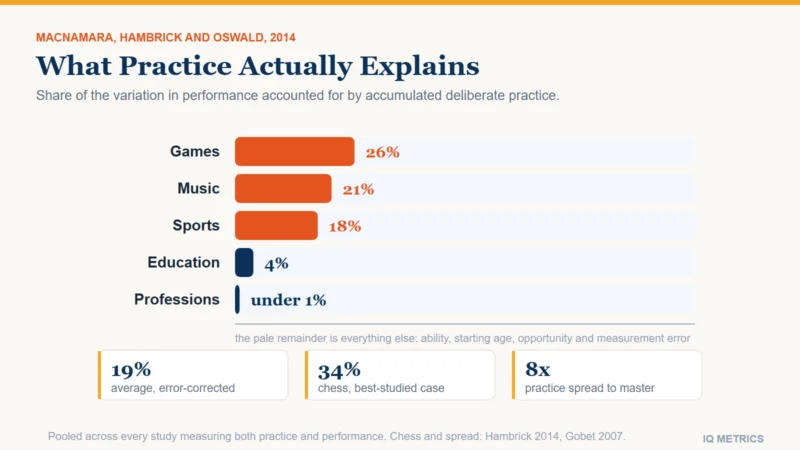 Research & Evidence
Talent vs Practice
The 10,000-hour rule made a strong claim: expert performance is built by practice, not given by talent. When researchers pooled the studies that had actually measured it, practice explained about a quarter of the difference between people in games and almost none in professional work. Here is what fills the rest of the gap.
 Research & Evidence
Human Brain Facts
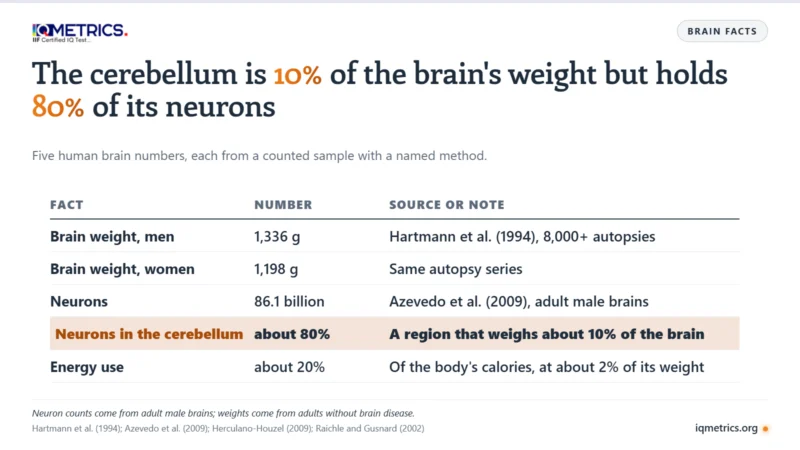
Human brain facts, each with its source: about 1,336 g in men and 1,198 g in women, 86.1 billion neurons and about 20% of the body's calories. The surprise is that the cerebellum holds about 80% of the neurons. Colour, weight, neurons and energy, with the study and method behind each.
 Mind & Everyday Life
Average Reaction Time for Drivers
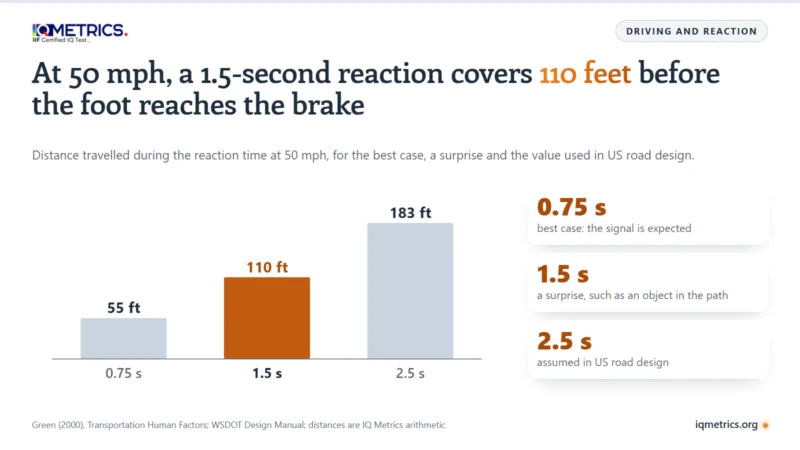
The average reaction time for drivers is about 0.75 seconds if the signal is expected and about 1.5 seconds for a surprise. See the distance covered at 30, 50 and 70 mph, why road designers assume 2.5 seconds, and what age and IQ change.