





How Smart Are Jumping Spiders? Planning, Sleep and a Brain That Fits on a Pinhead
How smart are jumping spiders? Some planned a detour to prey they could no longer see: 251 spiders chose the correct walkway and 15 the wrong one. See what they remember, how REM-like sleep shows in 77-second bouts, why no one has counted their neurons and how they compare with bees, crows and octopuses.

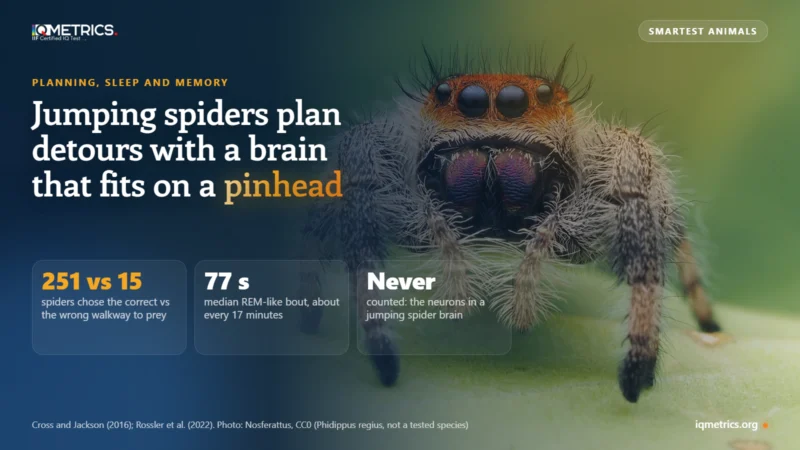
How smart are jumping spiders? Smart for an animal whose brain, researchers say, would fit on a pinhead. Some species plan a route to prey, hold what they saw in memory for 90 seconds and show a REM-like sleep state. In one detour test, 251 spiders chose the walkway that led to prey and 15 chose the wrong one. No jumping spider has an IQ, and no one has counted the neurons in a jumping spider’s brain.
Below: what the planning, memory and sleep studies tested, how a brain this small could do it, and how spiders compare with bees, crows and octopuses. New here: the sleep study timed the bouts at about 77 seconds every 17 minutes, close to a rat’s 86 seconds. And the strongest results are for Portia and its spider-eating relatives, not for all jumping spiders.
Key takeaways
- No jumping spider has an IQ. IQ ranks people against a norm group, so scientists use tests of planning, memory and sleep instead.
- In a 2016 test of 15 spider-eating species, 251 spiders chose the walkway that led to prey and 15 chose the wrong one (counts from a 2020 review).
- No one has counted the neurons in a jumping spider’s brain. Estimates for much larger spiders run to tens of thousands, against about 85 billion in a human brain.
- In newly hatched spiderlings, retinal movement bouts lasted a median 77 seconds and came about every 17 minutes (Rößler et al., PNAS, 2022).
- Most planning studies share the same authors, and some researchers explain the results through the spider’s body and silk, not only its brain.
How smart are jumping spiders, really?
Are jumping spiders smart? Some are, by the usual tests of animal cognition, but the strongest evidence comes from Portia and its spider-eating relatives, not from every jumping spider. Portia hunts other spiders, a dangerous diet, and the genus has 21 species (World Spider Catalog, 2024, as cited by Cross).
Jumping spider intelligence needs a definition. The researchers who study Portia define intelligence as flexible problem solving and cognition as reliance on an internal picture of the world. They argue that Portia works out solutions by thinking before it acts, not only by trial and error (Cross et al., Frontiers in Psychology, 2020). That is an argument, and other scientists read the same results differently, as the section on brain size explains.
There is no spider IQ. IQ compares a person with a norm group of people, and no such group or test exists for spiders, as in our guide to whether mice are smart.
How big is a jumping spider's brain?
Jumping spider brain size is very small. Fiona Cross, who studies Portia, writes that it solves life-or-death problems “while using a brain that would comfortably fit on a pinhead” (Comparative Cognition and Behavior Reviews, volume 19).
How many neurons does it hold? Nobody knows. Cross and colleagues state that “nobody has ever literally counted the number of neurons in a salticid’s brain” and that the estimate even for much larger spiders is “in only the tens of thousands”. Round numbers for jumping spiders circulate in popular articles, but we found no count in a primary source, so this page gives none.
The same review puts the human brain at about 85 billion neurons (Eberhard and Wcislo, 2011), so a human has hundreds of thousands of times more than those larger spiders. Our human brain facts page explains the counts. Size alone is a weak guide to ability: see what the brain size and IQ correlation really is.
Jumping spiders see in fine detail for their size, which gives a small brain a lot to work with. Embodied cognition offers another reading. It holds that the body, the eyes and the silk do part of the computing. The review lists it as an alternative to the idea of an internal plan.
Can jumping spiders plan a route?
Yes, in lab tests: some spider-eating species pick the walkway to prey they can no longer see. The best-known test is a tower with two walkways.
In 2016, Cross and Robert Jackson tested 15 spider-eating species. Each spider sat on a tower facing two boxes out of reach, one holding lures made from prey spiders and the other dead leaves. The platform stood in water, which these spiders avoid, so each had to walk down and follow one of two walkways. Once the spider left the tower, the lures were removed. Sometimes the correct walkway meant walking away from the lures first.
All 15 species chose the correct walkway significantly more often than the wrong one (Journal of the Experimental Analysis of Behavior). A 2020 review counts 251 spiders on the correct walkway and 15 on the wrong one, about 94% of those that chose (our arithmetic). Each spider was tested once and had never seen the apparatus, so trial and error does not explain it.
A 2019 study asked whether a detour was needed at all. After seeing prey, Portia africana more often took a direct causeway when one existed, and a detour when it did not. After seeing leaf pieces, it never took the detour (Cross and Jackson, Journal of Experimental Biology). The two-route choice itself goes back to Tarsitano and Jackson (Animal Behaviour, 1997).
Can jumping spiders remember and count?
They can hold a prey in memory for at least 90 seconds, and one species treats 1 and 2 prey as separate numbers. Both results come from Portia africana.
In a 2014 experiment a spider saw a prey lure, then a shutter hid it for 90 seconds. When the shutter lifted, fewer spiders attacked if the prey species or colour had changed. Changing only the lure’s orientation made no difference (Cross and Jackson, Animal Cognition, as described in the 2020 review).
In 2017 the same pair changed the number of prey in a scene. The spiders reacted when it changed from 1 to 2, 1 to 3, 1 to 4, 2 to 3, 2 to 4 or 2 to 6, but not from 3 to 4 or 3 to 6. The authors suggest Portia treats 1 and 2 as discrete numbers and 3 or more as “many” (Interface Focus).
Not everything is planning. When Portia fimbriata had to escape from an island surrounded by water, it solved the problem by trial and error, leaping or swimming (Jackson, Carter and Tarsitano, Behaviour, 2001). To test your own short-term memory limit, try our sequence memory test in the Brain Games.
Do jumping spiders sleep and dream?
They sleep, and one species shows a REM-like state. Dreaming is a question the study raises, not something it shows.
Daniela Rößler and colleagues filmed 34 Evarcha arcuata spiderlings, 1 to 9 days after they emerged, overnight from 7 pm to 7 am. At that age the spiders’ skin is translucent, so the team could watch the retinal tubes move. Movement came in bouts with a median length of 77 seconds, about every 17 minutes (PNAS, 2022). Bouts came with leg twitching and curling, and both the bouts and the gaps grew longer through the night, by 11% and 38%.
The paper compares these figures with mammals: rats average 86 seconds per REM bout, and mice have 10 to 15 minutes between bouts. In three adults the leg-curling bouts came about every 28 minutes. The authors say the twitching and eye movements meet core behavioural criteria of REM sleep, and that this raises the question of whether jumping spiders may be experiencing visual dreams. The study did not test for dreaming.
Where would your own score land?
Take the IIF-certified assessment and get your score with the scale it was measured on, the percentile it corresponds to and the confidence range around it — the three figures most online tests leave out.
Find your IQ score now! →How do jumping spiders compare with bees, crows and octopuses?
A jumping spider has the smallest brain of the four and the only one never counted, yet its planning results sit alongside theirs. Each animal shows a different strength.
| Animal | Brain cells | Best-known results |
|---|---|---|
| Jumping spider (Portia) | Never counted; tens of thousands estimated for much larger spiders | Plans detours, holds prey in memory for 90 seconds, treats 1 and 2 as separate numbers |
| Honeybee | Fewer than a million (smartest insect) | Counts up to four landmarks and orders zero below one |
| Octopus | About 500 million neurons (octopus IQ) | Opens jars, tells people apart, carries coconut shells |
| Common raven | About 2.2 billion neurons (smartest animals table) | Crows and ravens make tools and plan ahead (crow IQ) |
| Human | About 85 to 86 billion neurons | Has IQ tests, normed on people |
The counts cover different tissue and come from different methods, so read the table loosely. For the sea, see our report on the smartest animal in the ocean.
How sure are these findings?
Fairly, for Portia, and less for other jumping spiders. Most planning studies cited here share authors (Jackson and Cross), and independent replication would add weight. Cross lists embodied and extended cognition as alternative explanations, and the sleep study used three adults and spiderlings of one species. Even so, each result is a measured count from an experiment, not an anecdote.
Quick answers
- How smart are jumping spiders? Smart enough that some species plan detours, remember prey for 90 seconds and show REM-like sleep, with a brain that would fit on a pinhead.
- Do jumping spiders have an IQ? No. IQ needs a norm group of people.
- How big is a jumping spider’s brain? Tiny, and its neurons have never been counted; estimates for much larger spiders are tens of thousands.
- Do jumping spiders dream? They show REM-like sleep. Whether they dream is untested.
The bottom line
Jumping spiders are not people with eight legs, but Portia’s detours, memory and sleep show that a very small brain can do flexible things. More in our animal series: are sharks smart and are mice smart. For a score of your own, take the IQ test, or see what real IQ questions look like in our intelligence test sample.
Sources
- Cross FR, Carvell GE, Jackson RR, Grace RC (2020). Arthropod intelligence? The case for Portia. Frontiers in Psychology 11, 568049.
- Cross FR. Comparative cognition: insights from miniature brains. Comparative Cognition & Behavior Reviews 19, 21-24.
- Cross FR, Jackson RR (2016). The execution of planned detours by spider-eating predators. Journal of the Experimental Analysis of Behavior 105, 194-210.
- Cross FR, Jackson RR (2019). Portia’s capacity to decide whether a detour is necessary. Journal of Experimental Biology 222, jeb203463.
- Cross FR, Jackson RR (2017). Representation of different exact numbers of prey by a spider-eating predator. Interface Focus 7, 20160035.
- Tarsitano MS, Jackson RR (1997). Araneophagic jumping spiders discriminate between detour routes that do and do not lead to prey. Animal Behaviour 53, 257-266.
- Jackson RR, Carter CM, Tarsitano MS (2001). Trial-and-error solving of a confinement problem by a jumping spider, Portia fimbriata. Behaviour 138.
- Rößler DC, Kim K, De Agrò M, Jordan A, Galizia CG, Shamble PS (2022). Regularly occurring bouts of retinal movements suggest an REM sleep-like state in jumping spiders. PNAS 119, e2204754119.
- Photo: Nosferattus, Phidippus regius female 01, Wikimedia Commons, CC0 (public domain dedication).

Keep reading
All articles →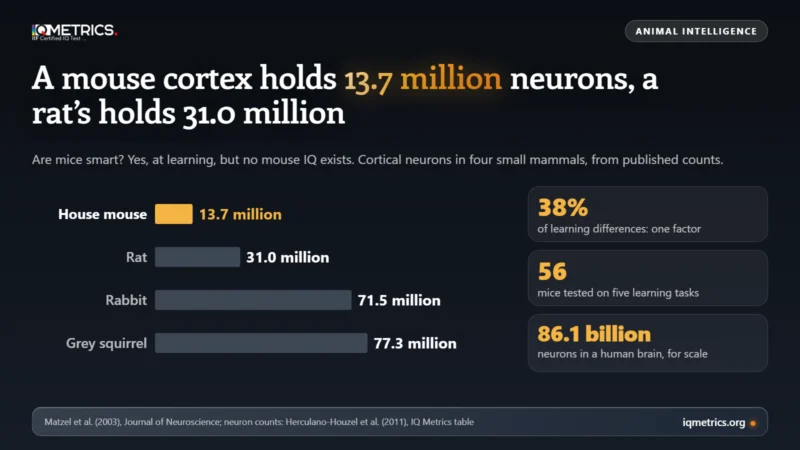 Mind & Everyday Life
Are Mice Smart?
Are mice smart? Yes, at learning, though no mouse IQ exists. In a 2003 study of 56 mice, one shared factor explained 38% of the differences across five learning tasks. See mouse neuron counts against a rat, rabbit and squirrel, and what mice remember.
 Understanding IQ
Octopus IQ
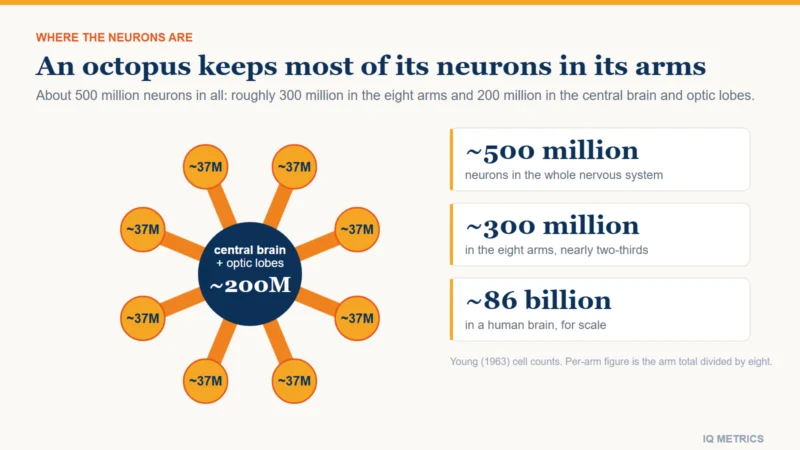
An octopus has no IQ, but it has about 500 million neurons, most of them in its arms. The neuron count, the tool-use and recognition studies, why short lives leave no room for teaching, and why UK law now treats octopuses as sentient.
 Understanding IQ
Crow and Raven IQ
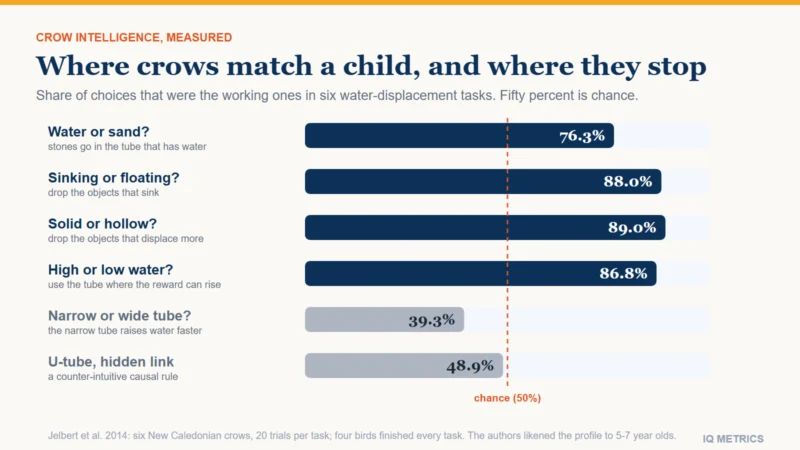
A crow has no IQ, but tests show what corvids can do: bend wire, plan hours ahead, count their own calls. The 7-year-old comparison traces to one 2014 study of six crows, who were at chance on two of six puzzles.