





Are Raccoons Smart? Locks, Memory and What the Lab Tests Found
Are raccoons smart? In a 1907 study one raccoon needed 24 trials, not 107, to relearn a four-lock box after 286 days, and a raccoon's cortex holds 438 million neurons, 1.75 times a cat's. See the lock, memory and neuron studies, why raccoons wash food, and why no raccoon IQ exists.

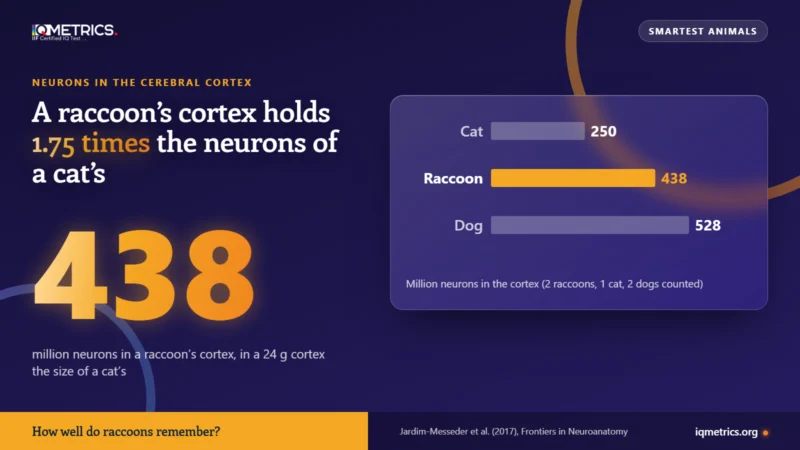
Are raccoons smart? Yes, by the tests that exist, though no raccoon IQ has been measured. In a 1907 study, raccoons opened latches and a four-lock puzzle box, and after 286 days one needed 24 trials to relearn what first took 107. A raccoon’s cortex also holds about 438 million neurons, 1.75 times a cat’s in a cortex of the same size.
Below: what each study tested, how raccoons solve locks, how long they remember, why they wash food, and how their brains compare with a cat’s and a dog’s. New here: the most-quoted raccoon test is one 1907 lab study, and it also found no sign of raccoons copying each other.
Key takeaways
- There is no raccoon IQ. IQ compares a person with a norm group of people, and no such group or test exists for raccoons.
- Locks: raccoons in H. B. Davis’s 1907 study opened latches, bolts and combinations of four locks, and learned by many small changes, not one leap.
- Memory: one raccoon needed 24 trials instead of 107 to relearn a four-lock box after 286 days (Davis, 1907). Simple latches stayed learned for over a year.
- Flexibility: more than two-thirds of 20 captive raccoons solved a puzzle box in more than one way (Daniels et al., 2019).
- Brain: 438 million cortical neurons in a 24 g cortex, against 250 million in a cat’s cortex of the same size and 528 million in a dog’s, which is 2.7 times heavier (Jardim-Messeder et al., 2017; two raccoons, one cat, two dogs).
Are raccoons smart, and do they have an IQ?
Raccoons are smart in the ways studies have tested, but they have no IQ. IQ compares one person with a large sample of people of the same age, and no such norm group or test exists for raccoons.
So any “raccoon IQ” you see online is a joke or a guess. Scientists test one skill at a time instead: opening locks, remembering a solution, solving a problem in more than one way. This guide follows that approach. For other animals tested one skill at a time, see our guides on squirrels, mice and pigs.
| Study | What it measured | Raccoons | Limit |
|---|---|---|---|
| Davis, 1907 | Opening latches, bolts and combinations of four locks; memory; imitation | 12 raccoons secured from the wild, observed over three years | Old study, small group |
| Daniels et al., 2019 | Solving a puzzle box with several solutions | 20 captive raccoons | Captive animals, one box |
| Benson-Amram et al., 2016 | Opening puzzle boxes across 39 carnivore species | Species-level result not read | We read the abstract only |
| Jardim-Messeder et al., 2017 | Counting neurons in carnivoran brains | 2 raccoons, 1 cat, 2 dogs | Tiny samples; neurons are not intelligence |
How do raccoons solve problems such as locks and latches?
By trial and error that gets shorter with practice. In 1907 H. B. Davis of Clark University gave raccoons food in a wooden box shut by a lock, and they worked the lock open.
The locks were a button, a slide bolt, a T-latch, a plug, a lever and a push bar, used one at a time, then in groups of two or three, then as combinations of four locks that had to be worked in a set order. Each raccoon got 40 trials on each lock. Davis counted a simple lock as perfected when the animal opened it in one second.
What he saw was slow improvement. The raccoons dropped useless movements and joined the useful ones, in a series of small changes. With the four-lock boxes they learned the order of the locks before they learned how hard to pull. Experience also carried over: a raccoon that had mastered several locks dealt with a new one faster than it had dealt with the first few.
A 2019 study found the same flexibility in a modern test. Daniels and colleagues (Animal Cognition) gave 20 captive raccoons a box with several ways in. More than two-thirds solved it in more than one way. Raccoons that tried a wider range of actions found more solutions, and the authors also report that fear of new things (neophobia) and persistence predicted performance.
How good is a raccoon's memory?
Good for locks. Davis found that simple latches stayed learned after more than a year with no practice, and that a hard four-lock box was relearned far faster than it was first mastered.
In his crucial test, raccoon No. 1 worked a four-lock box over 332 days, with gaps of 9 hours up to 286 days that included hibernation. After the longest gap it needed only 24 trials to reach the standard that first took 107. That is about 22% of the original effort. It is one animal, and Davis says the memory of the complex box was “imperfect”, but the relearning was fast.
Davis did not see raccoons copy each other. He writes that no certain case of imitation was observed. That matches the one goat study, where goats that watched a demonstrator learned no faster: see our guide on whether goats are smart. Both are small studies, so the result is a lead, not a rule.
Why do raccoons wash their food?
Nobody has settled it. In 1907 Davis listed three explanations and found that none of them, alone or together, made the origin or purpose of the habit clear.
The ideas were a lack of saliva, a way of checking that the catch is fresh, and a way of cleaning or softening the food. Davis noted that a captive raccoon with no water takes its food to a dry basin, or rubs it between its dry paws, and that Audubon never saw his tame raccoon wash its food. Davis thought the key might lie in the animal’s ancestral traits. We did not read a later study that settles it.
Are raccoons smarter than cats and dogs?
No study has put them head to head, so “are raccoons smarter than dogs” has no tested answer. The brain counts give a clue: a raccoon has far more neurons than a cat in a cortex of the same size, and fewer than a dog.
Jardim-Messeder and colleagues (Frontiers in Neuroanatomy, 2017) counted neurons in eight carnivoran species. Their raccoon cortex weighed 24.5 g and held 438 million neurons. A cat’s cortex weighed 24.2 g and held 250 million. A dog’s weighed 65.5 g and held 528 million. The authors write that raccoons have dog-like numbers of neurons in a cat-sized brain, and that this makes them comparable to primates in how densely packed the neurons are.
| Animal | Brain mass | Cortex neurons | Whole-brain neurons |
|---|---|---|---|
| Cat (1 animal) | 34.9 g | 250 million | 1.22 billion |
| Raccoon (2 animals: 395 and 512 million) | 34.2 g | 438 million | 2.15 billion |
| Dog (2 animals: 429 and 627 million) | 86.5 g | 528 million | 2.25 billion |
Read that table loosely. Only two raccoons, one cat and two dogs were counted, and more neurons do not simply mean more intelligence. The same count found that a brown bear’s far larger cortex holds only about as many neurons as a cat’s. For scale, an adult human brain holds about 86 billion neurons, about 40 times the raccoon’s total, as our human brain facts page explains. For the animals this count was built on, see our guides to cat IQ and dog IQ.
On behaviour, Davis compared his raccoons with monkeys tested on locks a few years earlier. He wrote that the learning curves “seem to show a nearly equal facility”, with the warning “so far as they permit a comparison”. A 2016 test of 39 carnivore species found that relatively larger brains opened puzzle boxes more often, and that manual dexterity did not predict success (Benson-Amram et al., PNAS). Manual dexterity alone did not predict success across species.
Where would your own score land?
Take the IIF-certified assessment and get your score with the scale it was measured on, the percentile it corresponds to and the confidence range around it — the three figures most online tests leave out.
Find your IQ score now! →How do city raccoons differ from rural ones?
We found no published comparison of city and country raccoons on a puzzle test. What exists is a study of captive animals, and a species description.
Daniels and colleagues describe the raccoon as an abundant generalist found often in urban habitats, which is why they chose it to study flexible problem solving. Their 20 raccoons were captive, so the study cannot say whether city life changes the results. Davis warned of another source of difference: his animals showed wide differences in temperament, which he called fundamental to reading any test of their intelligence.
What do we still not know about raccoon intelligence?
- The classic test is old: 12 raccoons, one lab, 1907. The modern one has 20 captive animals.
- The neuron count covers two raccoons, so the 438 million figure could shift with more animals.
- The 1959 mapping of the raccoon’s touch cortex (Welker and Seidenstein) is closed access, and we could not read it, so we quote no numbers from it.
- No raccoon IQ exists, and no study ranks raccoons against cats or dogs on the same task.
- How city life changes raccoon problem-solving is untested in the studies we found.
To test your own problem-solving with puzzles, try our brain games, or take the IQ test, which is built and normed for people.
Quick answers
- Are raccoons smart? Yes, at learning and remembering locks, and at finding more than one solution. No raccoon IQ exists.
- How smart are raccoons? After 286 days one raccoon needed 24 trials to relearn a four-lock box that first took 107 (Davis, 1907).
- Are raccoons smarter than cats and dogs? Untested head to head. Their cortex holds 438 million neurons, against 250 million for a cat and 528 million for a dog.
- Why do raccoons wash food? Unsettled. Davis listed three explanations in 1907 and found none enough.
- Do raccoons have an IQ? No. IQ needs a norm group of people.
The bottom line
Raccoons are not people with masks, but a century of lab tests shows an animal that learns locks by small steps, remembers the order for months and finds more than one way into a box. The weakest points are the small samples and the age of the best-known test. More in our animal series: are goats smart and are mice smart.
Sources
- Davis HB (1907). The raccoon: a study in animal intelligence. The American Journal of Psychology 18(4):447-489. Read in the JSTOR Early Journal Content copy.
- Daniels SE, Fanelli RE, Gilbert A, Benson-Amram S (2019). Behavioral flexibility of a generalist carnivore. Animal Cognition 22:387-405.
- Benson-Amram S, Dantzer B, Stricker G, Swanson EM, Holekamp KE (2016). Brain size predicts problem-solving ability in mammalian carnivores. PNAS 113:2532-2537.
- Jardim-Messeder D, Lambert K, Noctor S, et al. (2017). Dogs have the most neurons, though not the largest brain. Frontiers in Neuroanatomy 11:118.
- Neuron ratios (1.75 times a cat’s cortex, 40 times fewer than the human brain) and the 22% relearning figure are our arithmetic from the numbers above.
Keep reading
All articles →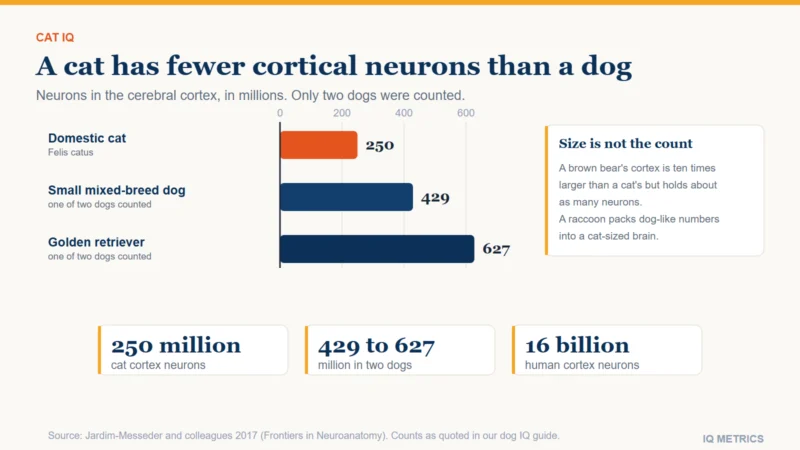 Understanding IQ
Cat IQ
Cats have no IQ: no validated test gives one. Studies measure narrower skills. Cats tell their own names from other words and follow a pointing finger as well as dogs do, but struggle with hidden-object puzzles, and a cat's cortex holds about 250 million neurons against 429 to 627 million in the dogs counted.
 Understanding IQ
Dog IQ
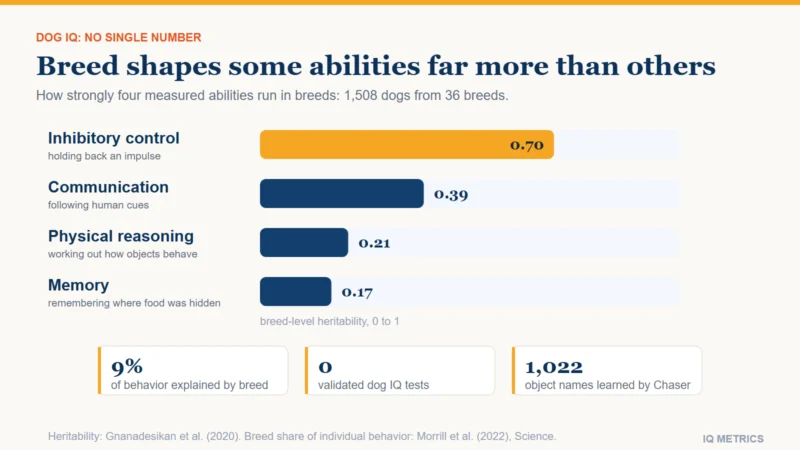
Dogs have no IQ score: no validated test gives one. See dog IQ compared with humans, what researchers measure instead (words, memory, self-control, a gifted border collie that learned 1,022 names), how breeds differ, and how a dog cortex compares with a cat, a pig and a person.
 Mind & Everyday Life
Are Squirrels Smart?
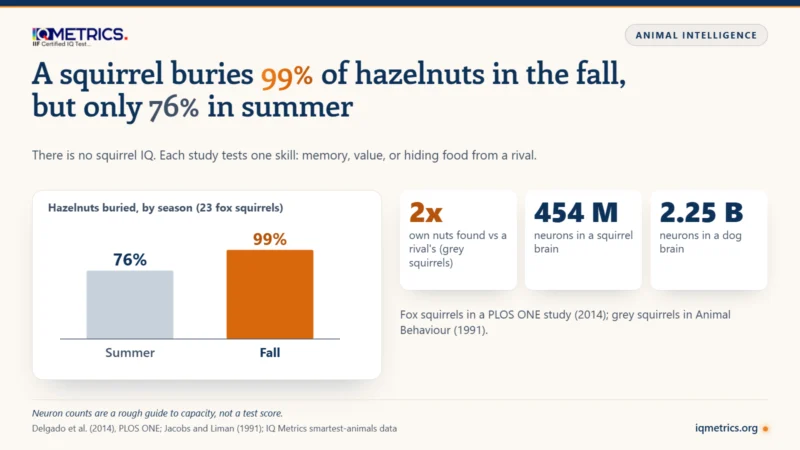
Are squirrels smart? Yes, for rodents: grey squirrels recover their own buried nuts at about twice the rate of a rival's, and fox squirrels bury 99% of hazelnuts in the fall but 76% in summer. There is no squirrel IQ. Each study, with journal, year and number of animals.