





Pig IQ: How Smart Are Pigs Compared With Dogs and Humans?
Pigs have no IQ score: no validated test gives one. Studies measure single skills instead. Four pigs acquired a joystick video task, pigs follow each other to food and read some human cues, a mirror result failed to replicate, and one pig cortex held 307 million neurons, between a cat and a dog.

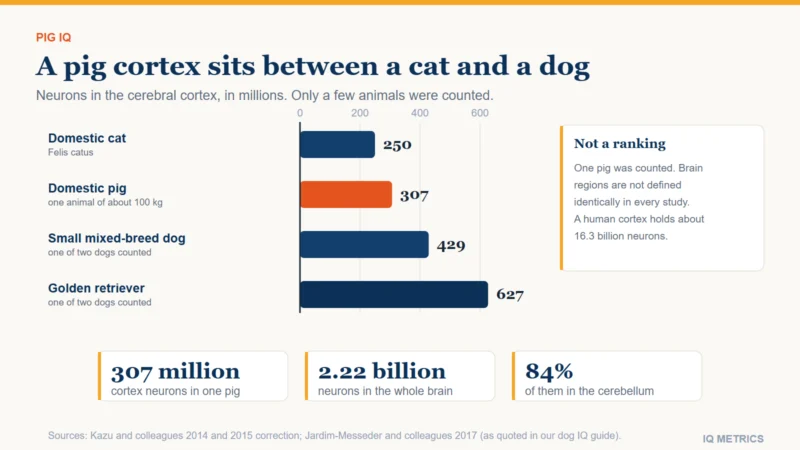
Pigs do not have an IQ score. No validated intelligence test produces one for any pig, so a number quoted as a pig IQ is not a test result. What researchers have measured is a set of separate abilities, nearly always in small groups: four pigs acquired a joystick-controlled cursor task, 16 pigs foraging in pairs showed that a pig remembers where food was and that a second pig follows the first to find it, 17 piglets used a person’s pointing to find a reward, and a well-known mirror result failed to replicate in 22 piglets. The brain behind this is modest in neuron counts: one domestic pig’s cerebral cortex held about 307 million neurons, more than a cat’s (about 250 million) and fewer than a small dog’s (429 million). This guide sets out what the studies found, how pigs compare with dogs, cats and humans, and why “pigs are smarter than dogs” cannot be tested on today’s evidence.
- Pig IQ: none. There is no norm sample and no standard test, so researchers test one skill at a time, usually in a handful of animals.
- Brain: one domestic pig of about 100 kg had a brain of 64 g holding 2.22 billion neurons, 307 million of them in the cerebral cortex (Kazu and colleagues, 2014, with the 2015 correction; one animal).
- Video task: two Panepinto micro pigs and two Yorkshire pigs acquired a joystick-operated cursor task, and all four were above chance on first attempts at the one-walled targets (Croney and Boysen, 2021).
- Social foraging: in an “informed forager” task, pigs remembered a food site and uninformed pigs found food by following them (Held and colleagues, 2000; 16 pigs).
- Mirror: contested. A 2009 study reported pigs using a mirror to find food; a 2014 replication with two groups of 11 piglets found very few that did (Gieling and colleagues).
Is there a pig IQ test?
No. An IQ score is a position on a bell curve: a test is given to thousands of people, the results are ranked and each person’s rank is printed on a scale whose average is 100 (see what an IQ of 100 means for what the middle of that scale is). Nothing like that exists for pigs. There is no standard test, no norm sample and no agreed way to compare a Yorkshire pig with a micro pig, so researchers run single experiments, each measuring one narrow skill in a small group, and report whether the animals beat chance. Our explainer on how IQ tests work shows what a real score needs that a pig experiment lacks. (“Guinea pig IQ” is a different question: guinea pigs are rodents, not pigs. This guide covers the domestic pig, Sus scrofa domestica.)
Two reviews explain why the evidence is hard to stack up. A 2011 review of pig learning and memory in Animal Cognition found that behavioural studies show pigs can perform learning and memory tasks, but that results have not been replicated or proven replicable because validated, specially suited paradigms are lacking. A second 2011 review of cognitive tasks for pigs, in Neuroscience & Biobehavioral Reviews, noted that most tasks have only been established at a single research facility and would benefit from further validation. Both are about method, not about pigs being dull: the measuring is immature. Popular lines such as “a pig is as clever as a three-year-old child” borrow the idea of mental age (see IQ and mental age), but we found no published test that produced such a number for pigs.
How big is a pig's brain, and what does it hold?
Smaller than the body suggests, and more crowded than it looks. A 2014 count in Frontiers in Neuroanatomy used the isotropic fractionator method on the brains of five hoofed mammals, the domestic pig among them, and a 2015 corrigendum corrected parts of its main table. The pig was a single animal of about 100 kg from a local breeder in South Africa. Its brain weighed 64.2 g, of which the cerebral cortex (counted together with the hippocampus) was 42.2 g. The whole brain held 2.22 billion neurons: 307 million in the cortex, 1.86 billion in the cerebellum and the rest elsewhere. About 84% of the pig’s neurons therefore sit in the cerebellum and about 14% in the cortex.
| Animal | Neurons in the cerebral cortex | Study |
|---|---|---|
| Domestic cat | About 250 million | Jardim-Messeder and colleagues, 2017 |
| Domestic pig (one animal of about 100 kg) | 307 million | Kazu and colleagues, 2014 |
| Small mixed-breed dog | 429 million | Jardim-Messeder and colleagues, 2017 |
| Golden retriever | 627 million | Jardim-Messeder and colleagues, 2017 |
| African elephant (one adult male) | 5.6 billion | Herculano-Houzel and colleagues, 2014 |
| Human | About 16.3 billion | As quoted by Herculano-Houzel and colleagues, 2014 |
Read the table with care. The animals counted are few, the regions are not defined identically in every study, and more neurons do not simply mean more intelligence. With those caveats, the pig’s 307 million is about 1.2 times the cat figure, about 72% of the small mixed-breed dog’s and about half the golden retriever’s, and it is 1.9% of the human cortex. Across the whole brain, 2.22 billion neurons is about 2.6% of the 86 billion average for a human. Our guides to dog IQ, cat IQ and elephant IQ give the other rows in more detail.
The authors flag two oddities. The pig is an outlier in the relationship between brain mass and body mass, with a much larger body than expected for its brain, which they note is a probable consequence of domestication. And although hoofed mammals have a highly folded cortex, the paper’s conclusion is that the artiodactyl cortex is more convoluted than primate cortices with similar numbers of neurons: wrinkles are not a neuron count. A big body and a folded brain are poor shortcuts for how many cells do the computing.
Can pigs play a video game?
Four of them acquired one. In a 2021 study in Frontiers in Psychology, two Panepinto micro pigs and two Yorkshire pigs were trained to move a joystick that controlled a cursor on a monitor. The pigs had to steer the cursor into targets with three, two or one walls, placed at random positions on the screen, and a reward followed when the cursor made contact. The authors say the task needed a conceptual understanding as well as skilled movement. At the end of training all four pigs were significantly above chance on first attempts to contact the one-walled targets.
Two cautions come with the headline. Four animals is a very small sample, and the authors themselves note that the joystick method was limited by the pigs’ dexterity and vision, suggesting that touchscreens or other computer-interfaced technology would suit future studies better. The result shows what pigs can learn when trained, not how quickly or how well a typical pig does it.
Do pigs follow other pigs and read human cues?
Yes to both, within limits. In the 2000 “informed forager” study in Animal Behaviour, 16 pigs foraged in pairs in an arena where food was hidden in one of eight buckets. One pig of each pair first searched alone and learned where the food was. In the pair trial the other pig, which did not know, was heavier and could push its partner off the baited bucket. The informed pigs found the food with fewer bucket investigations than a random searcher would need, so they remembered the site. The uninformed pigs investigated a bucket right after their partner more often than chance predicts, and needed fewer investigations than a random searcher in pair trials but not in solo trials, which means they used the other pig as a guide.
People are a second source of cues. A study in Animal Cognition tested 17 piglets, 7 weeks old and with little human contact, in an object choice task: two bowls, one baited. Across five experiments the piglets used nearby pointing and, with some constraints, pointing from a distance, as well as the experimenter’s body and head orientation. Most of them struggled when the experimenter pointed from the wrong bowl towards the right one, and they did not follow a gaze directed into empty space. The authors ask whether the pigs grasped the communicative intent or simply used attention-drawing and learned associations, and the paper does not settle it. Our guides to dog IQ and cat IQ describe pointing tests in those species.
Where would your own score land?
Take the IIF-certified assessment and get your score with the scale it was measured on, the percentile it corresponds to and the confidence range around it — the three figures most online tests leave out.
Find your IQ score now! →Can pigs use a mirror?
This is the pig result most often repeated and the one that did not hold up. A 2009 study in Animal Behaviour reported that pigs given time with a mirror could use it to find food: a bowl was placed where it could be seen only in the mirror, and mirror-experienced pigs went around a barrier to reach it. Published coverage of the study gave the numbers as seven of eight pigs finding the bowl in about 23 seconds on average. A 2014 attempt to replicate it, in Applied Animal Behaviour Science, used two groups of 11 piglets and followed the original procedure as closely as the authors could. Only two pigs of the first group found the hidden bowl. After steps to make more pigs notice the mirror, only one mirror-experienced pig and none of the mirror-naive pigs took the detour. The authors concluded that the pigs did not understand what the mirror image represents, and that mirror use may be at the upper limit of what these animals can do at that age.
Neither study is a self-recognition test of the kind used for apes and elephants, where an animal touches a mark on its own body (see elephant IQ). The question here was whether a mirror can serve as a tool for finding food. The honest summary is that one study found the skill, one failed to find it, and the question is open.
Are pigs smarter than dogs?
No study answers it. The claim rests on separate experiments with different animals, tasks and training, and on neuron counts that are close enough to be inconclusive: one pig’s 307 million cortical neurons sit between a cat and a dog, and the two dogs counted held 429 and 627 million. On behaviour, dogs have been tested on far more tasks, which is not the same as being cleverer. A 2015 review by Marino and Colvin pulls the pig studies together and concludes that they point to a complex psychology, and it calls for more noninvasive research in settings where pigs can express natural abilities. It is a narrative review, so it argues for more work, not for a ranking.
For the other animals in our series, see chimpanzee IQ, crow IQ, parrot IQ, octopus IQ, dolphin IQ and gorilla IQ. The fair summary is that pigs belong with the animals that show flexible learning, social foraging and some reading of human cues, but no study ranks them against dogs, and a single pig IQ would be invented.
Why do pig results come from so few animals?
Because pig cognition has been studied in pockets. The studies above used 4, 16, 17 and 22 pigs, and the brain counts rest on one animal. They also mix farm breeds with micro pigs, which differ in size and in how they handle a joystick or a bowl. Pigs are studied partly because their brains resemble the human brain more closely than a rodent’s in anatomy and biochemistry, which makes them attractive models in neuroscience (Kornum and Knudsen, 2011), and partly for welfare, so the tasks are often built for other purposes than ranking species. None of that makes the findings wrong. It limits how far they stretch: read “pigs can play a video game” as “four trained pigs did”, and wait for replication.
Quick answers about pig IQ
- What is the IQ of a pig? There is none. No validated test produces a pig IQ.
- What is pig IQ compared to a human? No test compares them. The one pig cortex counted held about 1.9% of the neurons in a human cortex.
- Pig IQ vs dog IQ: who wins? Nobody has tested them on the same tasks. The pig’s cortical neuron count (307 million) is between a cat’s and a dog’s.
- Are pigs smart? They learn tasks, remember where food was, follow other pigs to food and use some human cues, in small studies that need replication.
- Can pigs play video games? Four pigs acquired a joystick-operated cursor task.
- Can pigs recognise themselves in a mirror? That has not been shown. A 2009 report of pigs using a mirror to find food did not replicate in 2014.
- Is a guinea pig a pig? No. Guinea pigs are rodents.
Sources
- Kazu, R.S., Maldonado, J., Mota, B., Manger, P.R. and Herculano-Houzel, S. (2014): Cellular scaling rules for the brain of Artiodactyla include a highly folded cortex with few neurons, Frontiers in Neuroanatomy, 8, 128; corrected in 9, 39 (2015).
- Croney, C.C. and Boysen, S.T. (2021): Acquisition of a joystick-operated video task by pigs (Sus scrofa), Frontiers in Psychology, 12, 631755.
- Held, S., Mendl, M., Devereux, C. and Byrne, R.W. (2000): Social tactics of pigs in a competitive foraging task: the ‘informed forager’ paradigm, Animal Behaviour, 59(3), 569-576.
- Nawroth, C., Ebersbach, M. and von Borell, E. (2014): Juvenile domestic pigs (Sus scrofa domestica) use human-given cues in an object choice task, Animal Cognition, 17, 701-713.
- Broom, D.M., Sena, H. and Moynihan, K.L. (2009): Pigs learn what a mirror image represents and use it to obtain information, Animal Behaviour, 78, 1037-1041.
- Gieling, E.T., Mijdam, E., van der Staay, F.J. and Nordquist, R.E. (2014): Lack of mirror use by pigs to locate food, Applied Animal Behaviour Science, 154, 22-29.
- Gieling, E.T., Nordquist, R.E. and van der Staay, F.J. (2011): Assessing learning and memory in pigs, Animal Cognition, 14(2), 151-173.
- Kornum, B.R. and Knudsen, G.M. (2011): Cognitive testing of pigs (Sus scrofa) in translational biobehavioral research, Neuroscience & Biobehavioral Reviews, 35(3), 437-451.
- Marino, L. and Colvin, C.M. (2015): Thinking pigs: a comparative review of cognition, emotion, and personality in Sus domesticus, International Journal of Comparative Psychology, 28.
- Jardim-Messeder, D. et al. (2017): Dogs have the most neurons, though not the largest brain, Frontiers in Neuroanatomy, 11, 118.
- Herculano-Houzel, S. et al. (2014): The elephant brain in numbers, Frontiers in Neuroanatomy, 8, 46 (human averages of 86 billion neurons in the brain and 16.3 billion in the cortex).
Keep reading
All articles →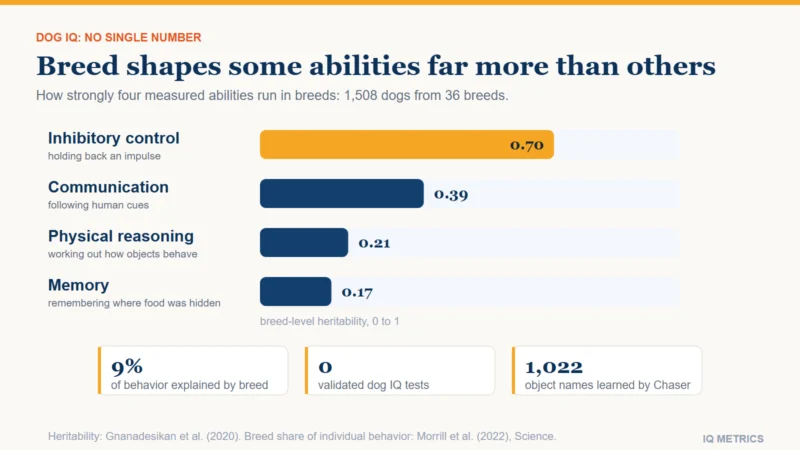 Understanding IQ
Dog IQ
Dogs do not have an IQ: no validated test gives them one. Researchers can measure trainability, memory, self-control and a small general factor, and those results say more about how dogs think than any breed ranking, at-home dog IQ test or "as smart as a toddler" comparison ever could.
 Understanding IQ
Cat IQ
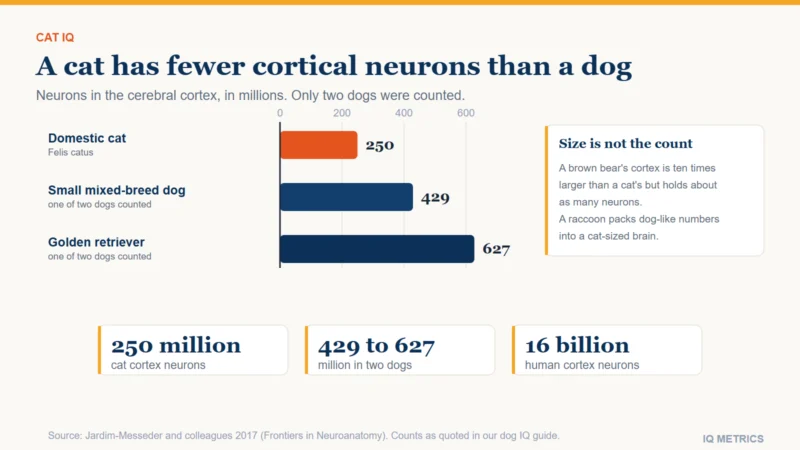
Cats have no IQ: no validated test gives one. Studies measure narrower skills. Cats tell their own names from other words and follow a pointing finger as well as dogs do, but struggle with hidden-object puzzles, and a cat's cortex holds about 250 million neurons against 429 to 627 million in the dogs counted.
 Understanding IQ
Elephant IQ
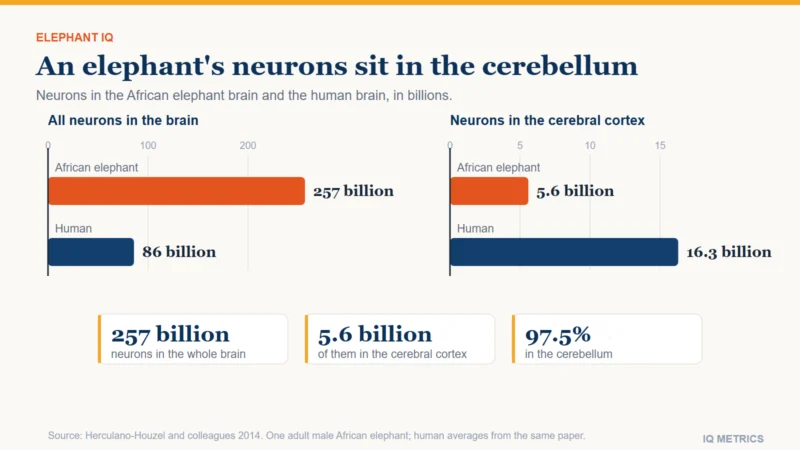
Elephants have no IQ score: no validated test gives one. Studies measure single skills instead. One of three Asian elephants passed the mirror mark test, six waited for a partner before pulling a rope, and wild herds use name-like calls, yet one elephant's cortex held 5.6 billion neurons, a third of the human count.