





What Is Cognitive Development for Early Childhood? Milestones From Birth to 5 and When an IQ Test Fits
Cognitive development for early childhood is how thinking, learning, memory and problem-solving grow from birth to age 5. See the CDC's cognitive milestones by age, how Piaget's stages and serve and return fit, and which test is valid when: no IQ score before 2 years 6 months.

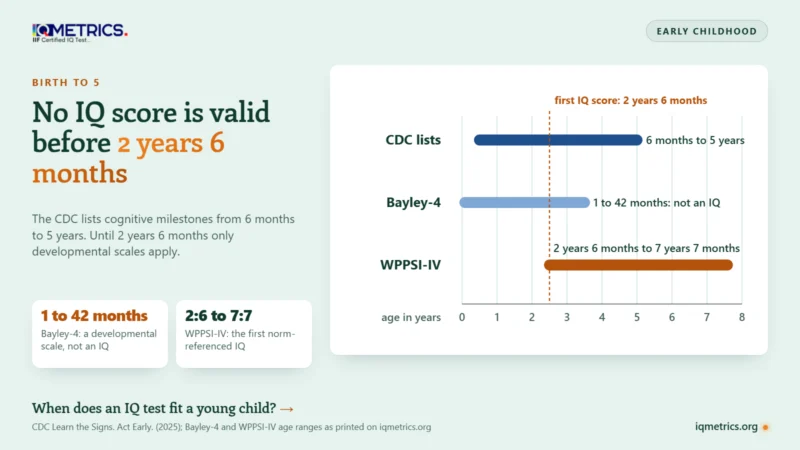
Cognitive development for early childhood is how a child’s ability to think, learn, remember and solve problems grows from birth to age 5. The CDC’s checklists run from a 6-month-old exploring things with the mouth to a 5-year-old counting to 10. No IQ score is valid before age 2 years 6 months, when the WPPSI-IV starts.
New here: one table pairs each CDC cognitive milestone with the instrument that fits that age. From 6 months to 2 years 6 months only developmental scales apply, never an IQ test. Below: the milestones, how Piaget’s stages and “serve and return” fit, what a parent can do, and when an IQ score makes sense.
Key takeaways
- Milestones: the CDC defines them as things most children (75% or more) can do by a certain age. Its checklists do not replace a validated developmental screening tool.
- Cognitive items: a block in a cup at 1 year, more than one toy at once at 2, a drawn circle at 3, a few colors named at 4, counting to 10 at 5.
- Tests: the Bayley-4 covers 1 to 42 months but is a developmental scale. The first norm-referenced IQ is the WPPSI-IV, from 2 years 6 months.
- Screening: the American Academy of Pediatrics recommends standardized developmental screening at 9, 18 and 30 months (CDC).
What is cognitive development for early childhood?
It is the growth of thinking in the first five years: attention, memory, problem-solving, pretend play and early number and language skills. The CDC groups these under “learning, thinking, problem-solving.” A baby who looks for a dropped spoon and a 5-year-old who counts to 10 are both showing it.
Cognitive skills are one of four strands on the CDC lists, beside social-emotional, language and movement. The strands overlap. Pointing at a picture in a book is language and thinking at once.
Children reach milestones at different speeds. The CDC’s advice is plain: if a child is not meeting one or more milestones, has lost skills, or you have other concerns, talk with the child’s doctor and ask about developmental screening.
What are the early childhood cognitive development milestones from birth to 5?
The CDC lists the early childhood cognitive development milestones by age, and it counts a milestone only if most children (75% or more) can do it by then. The right-hand column is our addition: the instrument that is valid at that age.
| Age | CDC cognitive milestones (most children) | What fits at this age |
|---|---|---|
| 6 months | Puts things in her mouth to explore them; reaches to grab a toy she wants | Parent screener or Bayley-4: a developmental scale, not an IQ |
| 9 months | Looks for objects when dropped out of sight; bangs two things together | Standardized screening at 9 months (AAP) |
| 1 year | Puts something in a container, like a block in a cup; looks for things he sees you hide | Bayley-4 (1 to 42 months): not an IQ |
| 18 months | Copies you doing chores; plays with toys in a simple way, like pushing a toy car | Standardized screening at 18 months (AAP); Bayley-4 |
| 2 years | Holds something in one hand while using the other; tries switches, knobs or buttons on a toy; plays with more than one toy at the same time | Bayley-4 to 42 months; WPPSI-IV from 2 years 6 months: the first IQ |
| 3 years | Draws a circle when you show how; avoids touching hot objects when warned | WPPSI-IV, younger band (2:6 to 3:11) |
| 4 years | Names a few colors; tells what comes next in a well-known story; draws a person with three or more body parts | WPPSI-IV, older band (4:0 to 7:7); our kids IQ test for ages 4 to 7 (a screener) |
| 5 years | Counts to 10; names some numbers from 1 to 5; uses words about time; pays attention for 5 to 10 minutes (screen time does not count); writes and names some letters | WPPSI-IV; our kids IQ test for ages 4 to 7 |
The CDC’s cognitive lists carry no IQ-style number at any age. The instruments that give one start well after the 1-year list. For why no valid baby IQ test exists, see our baby IQ test guide.
What are some examples of early childhood cognitive development?
Looking for cognitive development in early childhood examples? The CDC’s own items are the plainest ones, and each age has a few:
- At 9 months a baby looks for a spoon or toy that dropped out of sight.
- At 1 year a child puts a block in a cup and looks for a toy hidden under a blanket.
- At 2 years a child tries buttons and knobs on a toy and plays with two toys at once, like toy food on a toy plate.
- At 3 years a child draws a circle after being shown how.
- At 5 years a child counts to 10, names some letters and uses words like “yesterday” and “tomorrow.”
Searching for a hidden toy is the idea Piaget called object permanence. Our guide to Piaget’s stages explains it, with conservation and what newer research says.
How do Piaget's stages fit birth to 5?
The stages of cognitive development birth to 5 in Piaget’s theory are two: sensorimotor, from birth to about 2, and the early part of preoperational, from about 2 to 7. The ages are bands, not deadlines.
Stages and milestones answer different questions. A stage is a theory of how a child’s thinking changes. A milestone is a checklist of what most children do by an age. We link the Piaget guide rather than retell it, so the two pages do not repeat each other.
What is serve and return?
Serve and return is the Harvard Center on the Developing Child’s name for the back-and-forth between a young child and a caring adult. When a baby babbles, gestures or cries and an adult answers with eye contact, words or a hug, the exchange helps build and strengthen neural connections. That is serve and return brain development in one sentence.
The Center adds that the persistent absence of these exchanges can activate the body’s toxic stress response. It frames this as a risk to development, not as a test score. Our post on toxic stress and IQ covers what the Bucharest orphanage study found.
Where would your own score land?
Take the IIF-certified assessment and get your score with the scale it was measured on, the percentile it corresponds to and the confidence range around it — the three figures most online tests leave out.
Find your IQ score now! →How can you support cognitive development in toddlers?
Here is how to support cognitive development in toddlers, using the CDC’s own tips for a 2-year-old:
- Give toys that teach how to make things work and how to solve problems, such as a toy with a button that does something.
- Do simple puzzles of shapes, colors or animals, and name each piece as it goes in.
- Play with blocks and take turns building towers and knocking them down.
- Sing songs that name body parts, then pause to see if your child joins in.
- Keep steady sleep routines: children this age need 11 to 14 hours of sleep a day, including naps.
- Limit screen time to no more than 1 hour a day of a children’s program with an adult present.
None of these is an IQ treatment. For what a famous early programme did to IQ scores, read preschool and IQ. For food and brain growth, see nutrition and IQ.
When does an IQ test become valid for a young child?
A norm-referenced IQ score is possible from 2 years 6 months, on the WPPSI-IV, which covers 2:6 to 7:7 in two age bands.
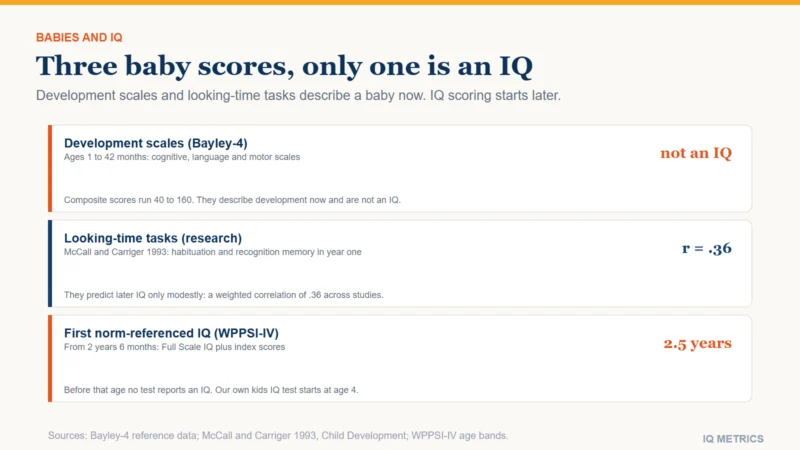
Before that, the Bayley-4 describes what a child aged 1 to 42 months can do now. Its composites run from 40 to 160 but are not IQs, and it was not built to forecast adult intelligence. Our WPPSI-IV guide has the subtests and the age bands.
Early scores also move. Looking-time tasks in the first year predict later IQ with a weighted correlation of about .36 (McCall and Carriger, 1993, as reported in our baby IQ guide). That explains about 13% of the differences in later scores, which is too little to predict any one child.
Parents sometimes ask about giftedness and Mensa. American Mensa does not test anyone under 14, and our Mensa test preparation guide has the rules.
From age 4, our kids IQ test for ages 4 to 7 is a home screener, not the WPPSI-IV. The kids IQ test also has versions for 8 to 12 and 13 to 17. For the batteries used at each age, see IQ testing for children.
When should you talk to a doctor about development?
Talk to the child’s doctor if a child is not meeting one or more milestones, has lost skills it once had, or you have any other concern. The CDC says not to wait. The American Academy of Pediatrics recommends standardized developmental screening at 9, 18 and 30 months, and autism screening at 18 and 24 months or whenever a parent or provider has a concern.
Quick answers
- What is cognitive development for early childhood? The growth of thinking, learning, memory and problem-solving from birth to 5. The CDC calls it “learning, thinking, problem-solving.”
- What are the cognitive milestones at 1, 2, 3, 4 and 5? A block in a cup and finding a hidden toy; two toys at once; a drawn circle; a few colors named; counting to 10.
- When can a child take an IQ test? From 2 years 6 months, on the WPPSI-IV, given by a trained examiner.
- What is serve and return? The back-and-forth between a child and a caring adult that helps build neural connections (Harvard Center on the Developing Child).
- Do baby tests predict adult IQ? Only weakly. Looking-time tasks in the first year reach a correlation of about .36.
Sources
- CDC, Learn the Signs. Act Early.: CDC’s developmental milestones, checklists for 6 months to 5 years (pages updated April 2025; read 13 November 2026).
- Harvard University, Center on the Developing Child, Serve and Return (read 13 November 2026).
- Age ranges of the Bayley-4 and the WPPSI-IV, and the McCall and Carriger (1993) correlation, as printed on our baby IQ guide and WPPSI-IV guide.
- Piaget’s stage ages as printed on our Piaget guide.
Keep reading
All articles →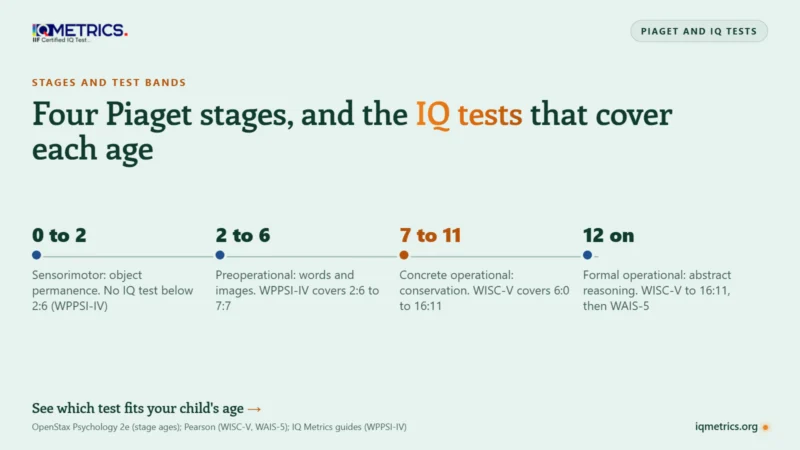 Understanding IQ
Piaget's Stages of Cognitive Development
Piaget's four stages of cognitive development with their ages, object permanence, conservation and what modern studies say, set against the age bands of the IQ tests that fit each stage: WPPSI-IV from 2 years 6 months, WISC-V from 6 to 16 and WAIS-5 from 16. Includes everyday examples.
 Understanding IQ
Baby IQ Test
No test can give a baby an IQ. Bayley scores describe development, not intelligence, looking-time tasks predict later IQ only modestly (r = .36), and real IQ scoring starts at 2 years 6 months. See what each early score means.
 Research & Evidence
Preschool and IQ
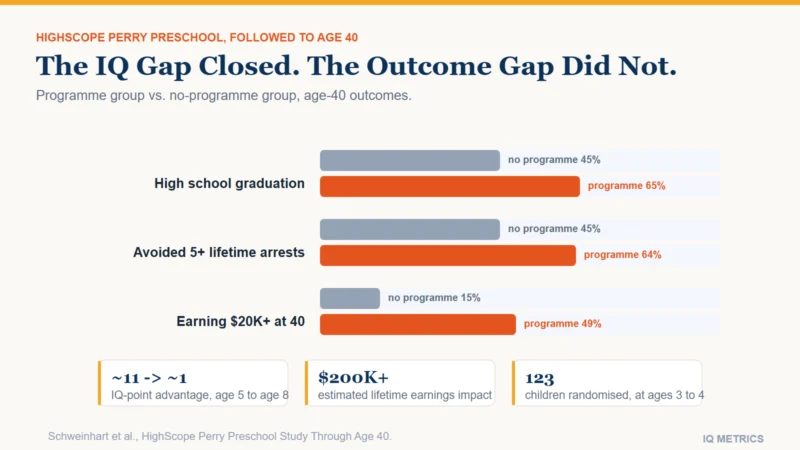
The most famous experiment in early-childhood education raised participants' IQ scores by as much as 13 points -- then watched that advantage shrink to almost nothing within a few years. Their income, education and arrest records stayed different for the rest of their lives. Why would outcomes outlast the score that supposedly predicts them?