





Are Bears Smart? What Studies Show About Counting, Tool Use and Memory
Bears are smart by the few tests that exist: black bears compared dot quantities on a touchscreen, a wild brown bear used rocks as tools, and 15 of 21 Arctic brown bears used spatial memory. No bear has an IQ score. See what each study measured and how a bear's brain compares with a dog's and a cat's.

Are bears smart? Yes, by the few studies that exist, though no bear has an IQ score. Black bears compared dot quantities on a touchscreen, a wild brown bear rubbed itself with barnacle-covered rocks, and 15 of 21 Arctic brown bears used time-dependent spatial memory. No test has put bears and dogs side by side.
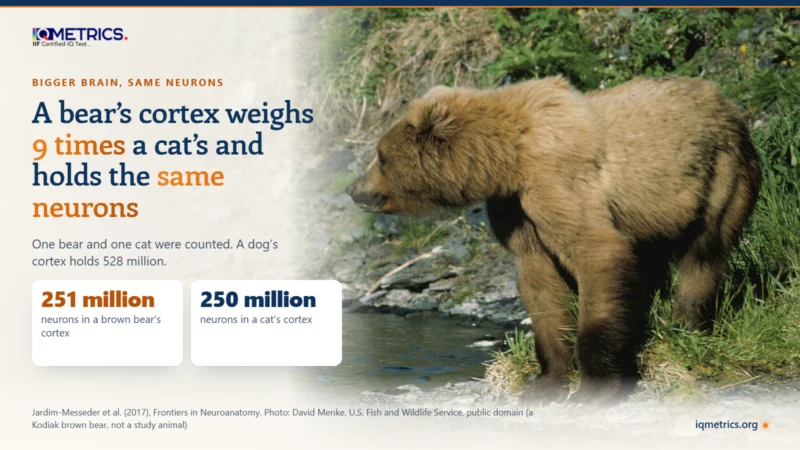
New here: a brown bear’s cortex weighed 222 g, about 9 times a cat’s, yet held 251 million neurons, the same as the cat’s 250 million (one bear, one cat). Below: what each study measured and what it did not, and how bears compare with dogs, cats and people.
Key takeaways
- Counting: three black bears judged dot quantities on a touchscreen and used number, not only total area (Vonk and Beran, Animal Behaviour, 2012).
- Tools: one wild subadult brown bear in Alaska used barnacle-encrusted rocks to rub its neck and muzzle. It is the first report of tool use in a wild brown bear (Deecke, Animal Cognition, 2012).
- Memory: 15 of 21 brown bears in the Canadian Arctic used time-dependent spatial memory to plan their movements (Thompson and others, Movement Ecology, 2022).
- Brain: a brown bear’s cortex held 251 million neurons, like a cat’s 250 million and half a dog’s 528 million. It was one bear (Jardim-Messeder and others, 2017).
Are bears smart?
Yes, in the ways that have been tested, but the evidence is thin. How smart is a bear? Smart enough to compare quantities, use an object and remember places. In 2012 Vonk and Beran noted that studies of bear cognition were notably missing from the comparative record. A few papers have been added since.
The animals studied are few: three black bears in the touchscreen study, one wild brown bear in the tool report, 21 brown bears in the memory study. Nobody has given a bear an IQ test. There is no bear IQ, and any number you see for one is invented.
Why study bears at all? Vonk and Beran point to their status as generalist carnivores that face complex foraging challenges but live without complex social structures.
How smart are bears compared with dogs and humans?
Nobody can say, because no test has put bears and dogs side by side. The one common yardstick is brain cells, and it does not favour the bear.
| Animal | Cortex weight | Cortex neurons | Animals counted |
|---|---|---|---|
| Cat | 24 g | 250 million | 1 |
| Brown bear | 222 g | 251 million | 1 |
| Raccoon | 24.5 g | 438 million | 2 |
| Dog | 65.5 g | 528 million | 2 |
| Human | - | about 16 billion | Azevedo and others, 2009 |
The bear’s cortex is about 9 times heavier than the cat’s but holds the same number of neurons, so its cells are spread thin: 1,130 neurons per milligram, against 10,334 in the cat. A dog’s cortex holds 2.1 times as many neurons as the bear’s. A human cortex holds about 65 times as many, by our arithmetic from 86.1 billion neurons with 19% in the cortex (our human brain facts page).
Neurons are not a test of intelligence, and one bear is one bear. The figure says only that a big brain is not the same as many cortex neurons. People have a yardstick that bears lack, an IQ score, and our post on what an IQ of 128 means shows what that score does and does not say. For dogs, see dog IQ and human brain versus dog brain; for cats, a plain link: cat IQ.
Can bears count?
They can compare quantities. In 2012 Vonk and Beran tested three captive American black bears on a touchscreen. One bear chose the larger of two arrays of dots, and two bears chose the smaller.
On some trials the number of dots matched their total area. On others it did not. With still dots, all three bears scored above chance on both kinds, so they were not judging by area alone. Moving dots were harder, and only one bear managed them when area and number disagreed. The authors found a pattern like earlier results with monkeys.
This is “more or fewer”, not saying “seven”. A 2021 study added a rule-learning task: one black bear learned on a touchscreen that a white background meant choose left for three pieces of food, and a black background meant choose right for one (Vonk, McGuire and Johnson-Ulrich, Zoo Biology).
Do bears use tools?
Rarely, and the best evidence is one animal. Deecke (2012) reported a wild subadult brown bear in south-eastern Alaska that picked up barnacle-encrusted rocks in shallow water and rubbed its neck and muzzle with them.
The bear turned the rocks over in its forepaws first, which Deecke reads as strong motor skill. The rubbing probably eased irritated skin or removed food from the fur. Bears habitually rub against fixed objects and overturn rocks while foraging, so Deecke suggests the habit may have moved to a loose object. It was the first report of tool use in a wild brown bear, and tool use had been seen in only four species of non-primate mammal. Deecke called for systematic research on bear cognition.
Where would your own score land?
Take the IIF-certified assessment and get your score with the scale it was measured on, the percentile it corresponds to and the confidence range around it — the three figures most online tests leave out.
Find your IQ score now! →How good is a bear's memory?
Good enough to steer by. Thompson and others fitted a memory model to location data from brown bears in the Canadian Arctic. They found that 15 of 21 bears, or 71%, used complex, time-dependent spatial memory to choose where to go.
That is memory for where things are and when, not a memory test in a lab. The authors also found a high degree of individual variation in how bears used memory.
The setting matters. Arctic brown bears live at the edge of the species’ range in harsh conditions, where, the authors write, effective use of memory could spell the difference between survival and mortality.
How big is a bear's brain?
In the one brown bear measured, a 350 kg zoo animal, the brain weighed 315 g. A dog’s brain weighed 86 g and a cat’s 35 g. The bear brain held 9.6 billion neurons, and 9.3 billion of them, about 97%, sat in the cerebellum.
Raw size is not the whole story. The bear’s brain was 0.09% of its body weight, against 0.8% for the cat. A heavy brain in a very heavy animal is not a sign of more neurons.
Which bear is the smartest?
Nobody knows, because no study compares bear species on one test. The work we found covers American black bears (touchscreen tasks, 2012 and 2021) and brown bears (a wild tool report, Arctic memory data and the brain count). We found no peer-reviewed cognition test on polar, sun or sloth bears.
For other animals tested more often, see our posts on raccoons and goats, the pig and orca pages, and the smartest animals study. To test your own reasoning, take the IQ test or try the Brain Games.
Quick answers
- Are bears smart? Yes, in the tests that exist. Black bears compared dot quantities, a wild brown bear used rocks as tools, and 15 of 21 Arctic brown bears used spatial memory.
- What is a bear’s IQ? There is none. No IQ-style test exists for bears, so any number is invented.
- How smart are bears compared to humans? No test compares them. A human cortex holds about 65 times the neurons of the one bear counted.
- Can bears use tools? One wild brown bear in Alaska used barnacle-covered rocks to rub its neck and muzzle, the first such report for a wild brown bear.
- How big is a bear’s brain? 315 g in a 350 kg brown bear, with 251 million cortex neurons, the same as a cat.
Sources
- Vonk J, Beran MJ (2012). Bears “count” too: quantity estimation and comparison in black bears, Ursus americanus. Animal Behaviour 84(1), 231-238 (abstract read).
- Vonk J, McGuire MC, Johnson-Ulrich Z (2021). Bearing fruit: piloting a novel judgment bias task in an American black bear. Zoo Biology (abstract read).
- Deecke VB (2012). Tool-use in the brown bear (Ursus arctos). Animal Cognition 15, 725-730 (abstract read).
- Thompson PR, Lewis MA, Edwards MA, Derocher AE (2022). Time-dependent memory and individual variation in Arctic brown bears (Ursus arctos). Movement Ecology (abstract read).
- Jardim-Messeder D and others (2017). Dogs have the most neurons, though not the largest brain. Frontiers in Neuroanatomy 11, 118 (full text read; Table 1).
- Azevedo FAC and others (2009), human neuron counts, as reported on our human brain facts page.
Keep reading
All articles →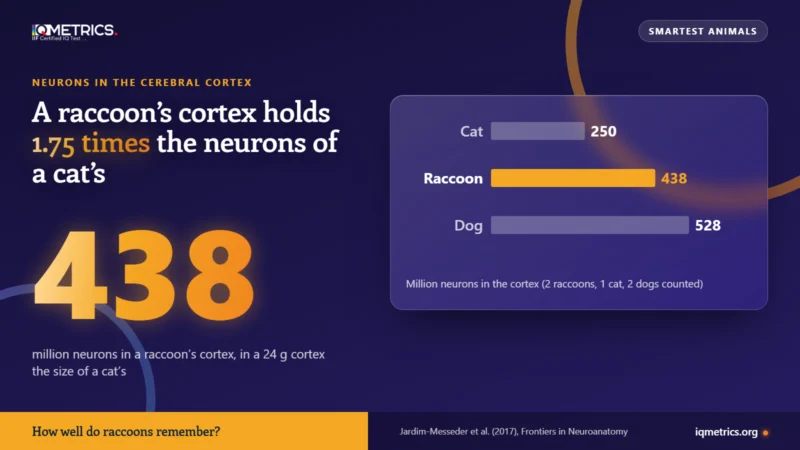 Mind & Everyday Life
Are Raccoons Smart?
Are raccoons smart? In a 1907 study one raccoon needed 24 trials, not 107, to relearn a four-lock box after 286 days, and a raccoon's cortex holds 438 million neurons, 1.75 times a cat's. See the lock, memory and neuron studies, why raccoons wash food, and why no raccoon IQ exists.
 Understanding IQ
Dog IQ
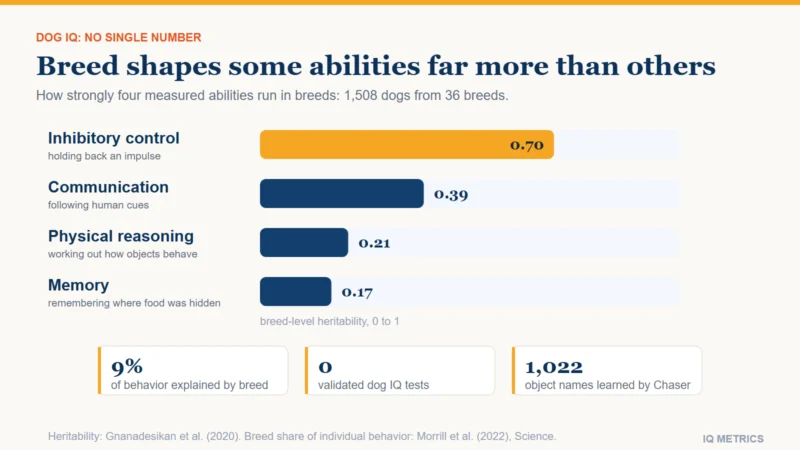
Dogs have no IQ score: no validated test gives one. See dog IQ compared with humans, what researchers measure instead (words, memory, self-control, a gifted border collie that learned 1,022 names), how breeds differ, and how a dog cortex compares with a cat, a pig and a person.
 Understanding IQ
Cat IQ
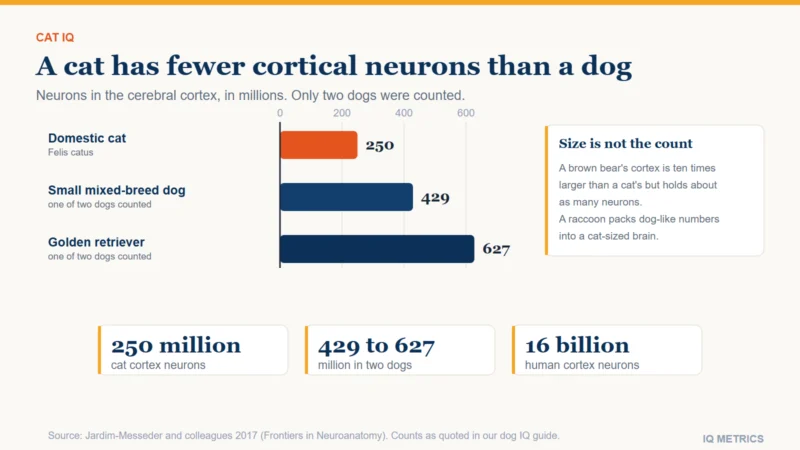
Cats have no IQ: no validated test gives one. Studies measure narrower skills. Cats tell their own names from other words and follow a pointing finger as well as dogs do, but struggle with hidden-object puzzles, and a cat's cortex holds about 250 million neurons against 429 to 627 million in the dogs counted.