





Are Foxes Smart? What Studies Show About Problem-Solving, Hunting and the Farm-Fox Experiment
Are foxes smart? Tame fox kits read human gestures as well as dog puppies, and wild red foxes pounce more accurately on one compass bearing. No study gives a fox an IQ. See what each study found, how foxes compare with dogs, cats and raccoons, and what remains unproven.


Are foxes smart? Yes at the tasks studies have tested, but nobody has measured a fox IQ. Tame farm-bred fox kits read human gestures as well as dog puppies do. Wild red foxes pounce more accurately from one compass direction. Both results come from single research groups, and neither is an IQ.
New here: the one same-task test of foxes against dogs gave a surprise. Tame fox kits matched dog puppies, and kits from an unselected fox line did worse. Neither line was ever bred or tested for the skill. In the best-known animal self-control test the fox is missing, while its relatives the dog, wolf and coyote are in it. Below: what each study found and what it did not.
Key takeaways
- No study gives a fox an IQ. Studies test single skills, and we found none that compares foxes with cats or raccoons on one task.
- Fox kits bred over 45 years to be tame were as skilful as dog puppies at using human gestures, and better than kits not bred for tameness (Hare and others, 2005).
- In 592 recorded hunting jumps by 84 wild red foxes, successful pounces in high cover clustered close to magnetic north. The authors suggest magnetic alignment (Cerveny and others, 2011). It is a proposal, not proof.
- In a puzzle-box test of 39 carnivore species, 6 of 25 individuals from the dog family opened the box, against 7 of 13 from the raccoon family and 15 of 52 from the cat family.
- Our smartest-animals study of 250 species has no red fox row.
Are foxes smart?
Foxes do well at some tested tasks, but no study measures their intelligence as a whole. How smart are foxes? The honest answer is a list of single skills.
Fox IQ is not a number that exists. IQ tests are built for humans, and animal studies use tasks made for one species at a time. For what an IQ number does mean for people, see our page on an IQ of 134. The table sets out what has been tested in foxes, and what has not.
A fair test would give one task to foxes, dogs and cats raised in similar ways, with enough animals to rule out luck. The gesture study did this for fox and dog kits. The puzzle-box study did it for 39 species, but with 140 animals in all, that is only about 3.6 animals per species. Small groups are one reason these results are hints, not rankings.
| Test | Result for foxes | Source |
|---|---|---|
| Using human gestures such as pointing | Tame fox kits matched dog puppies and beat kits from an unselected line | Hare and others, 2005, Current Biology |
| Hunting accuracy of wild red foxes | 592 jumps by 84 foxes; successful high-cover pounces clustered on one bearing | Cerveny and others, 2011, Biology Letters |
| Opening a food puzzle box | The dog family scored 6 of 25 individuals. The text names no fox | Benson-Amram and others, 2016, PNAS |
| Self-control (cylinder and A-not-B tasks) | No fox tested. Dog, gray wolf and coyote were | MacLean and others, 2014, via our dataset |
| Brain size and neuron count | No fox row in our smartest-animals dataset | Our research study |
| IQ | None published | No source found |
Are foxes smarter than dogs?
No study shows that. Are foxes smarter than dogs? The only direct comparison we found gave a tie on one task: using human gestures.
In that test, tame fox kits were as skilful as dog puppies. We found no study that compares wild red foxes with pet dogs on a general measure. The closest wider comparison is the self-control tests in our smartest-animals data, which hold the dog, the gray wolf and the coyote but no red fox.
| Animal | Cylinder task, correct | A-not-B task, correct |
|---|---|---|
| Dog | 79.1% (66 dogs) | 89.4% (66 dogs) |
| Gray wolf | 77.3% (11 wolves) | not tested |
| Coyote | 95.0% (8 coyotes) | 28.6% (7 coyotes) |
| Red fox | not tested | not tested |
The table shows why one number cannot rank the dog family. The coyote scored highest on one task and lowest on the other. A fox would likely differ again, but no fox was tested, so we cannot say how. For the dog side, see our dog IQ guide and our report on the smartest dog breeds.
What did the farm-fox experiment show about reading human gestures?
It showed that foxes bred only for tameness got better at using human gestures. Hare and colleagues tested fox kits from a population bred for 45 years to approach people fearlessly and without aggression (Current Biology, 2005).
Those kits were as skilful as dog puppies at using human gestures. They were also more skilled than kits from a second, control population not bred for tameness. The key point is what the researchers did not do. Neither fox population was ever bred or tested for the ability to use human gestures.
That points to a by-product. The authors argue that this social skill grew as a side effect of selecting against fear and aggression, with no direct selection for the skill itself. They also suggest the same may have happened in domestic dogs. We read the paper’s abstract, not its full text, so sample sizes and task details are not given here.
Where would your own score land?
Take the IIF-certified assessment and get your score with the scale it was measured on, the percentile it corresponds to and the confidence range around it — the three figures most online tests leave out.
Find your IQ score now! →Do foxes hunt using the Earth's magnetic field?
One study suggests so, but it is a proposal and not a proven result. Cerveny and colleagues recorded how red foxes aim their mousing pounces, and the successful ones clustered on one bearing.
Red fox problem solving in the wild is hard to test, so this team used observation. Twenty-three wildlife biologists and hunters watched 84 wild red foxes at 65 sites in the Czech Republic between April 2008 and September 2010. They recorded the body direction of 592 hunting jumps in 95 hunting series, using a compass.
- The jumps leaned north-east (mean heading 43 degrees), whatever the time of day, season, cloud cover or wind.
- The outcome was clear in 200 jumps. In high grass or snow, 74% of the successful attacks clustered about 20 degrees clockwise of magnetic north.
- High-cover attacks within the 340 to 40 degree segment succeeded 72.5% of the time, and those from 160 to 220 degrees 60%. Other alignments succeeded under 18%.
The authors suggest foxes may use the magnetic field as a range finder when they cannot see the prey. That is a hypothesis built on observation, with no experiment that changed the field. We did not search for later studies that test or repeat it. The result is about hunting accuracy, not intelligence.
How do foxes compare with cats and raccoons?
No study we found tests foxes, cats and raccoons on the same task. The nearest evidence is a puzzle-box study of whole families, and brain data for the cat and the raccoon.
Benson-Amram and colleagues gave puzzle boxes to 140 zoo animals from 39 carnivore species. Foxes belong to the dog family, but the paper’s text names no fox, so we cannot read a fox result from it. Species with larger brains for their body size opened the box more often.
| Family | Species tested | Individuals tested | Opened the box | Share |
|---|---|---|---|---|
| Dog family (includes foxes) | 7 | 25 | 6 | 24.0% |
| Cat family | 13 | 52 | 15 | 28.8% |
| Raccoon family | 3 | 13 | 7 | 53.8% |
| Bears | 5 | 13 | 9 | 69.2% |
Our smartest-animals dataset adds brain numbers. A raccoon’s brain weighs 34.2 g, about the same as a cat’s 34.9 g, yet it holds 2.15 billion neurons to the cat’s 1.22 billion. That is 1.77 times as many. A dog’s brain weighs 86.5 g and holds 2.25 billion. The dataset has no red fox row, so a fox sits in these comparisons only by family. See our pages on cat IQ and raccoon intelligence, and the smartest animals study, for the full lists.
For other small mammals people ask about, see whether squirrels are smart and whether rabbits are smart. To test your own short-term memory, try the memory game in our Brain Games section.
Quick answers
- Are foxes smart? At the tasks tested, yes: tame kits read human gestures like dog puppies. No study measures overall intelligence.
- How smart are foxes? Smart enough to match dog puppies on one gesture task. No fox IQ exists.
- Are foxes smarter than dogs? Not shown. The only direct comparison, on human gestures, was a tie with tame fox kits.
- Do foxes use the magnetic field? One study of 592 jumps suggests it. It is a proposal, not proof.
- What is fox intelligence compared with a cat or raccoon? No same-task study found. The dog family opened a puzzle box less often (24%) than raccoons (53.8%).
Sources
- Hare, B. and others (2005). Social cognitive evolution in captive foxes is a correlated by-product of experimental domestication. Current Biology 15, 226-230 (abstract read on 18 November 2026).
- Cerveny, J. and others (2011). Directional preference may enhance hunting accuracy in foraging foxes. Biology Letters 7, 355-357 (full text read on 18 November 2026).
- Benson-Amram, S. and others (2016). Brain size predicts problem-solving ability in mammalian carnivores. PNAS 113, 2532-2537 (full text read on 18 November 2026).
- Brain figures and self-control task results as listed in our smartest animals study (Jardim-Messeder and others 2017; MacLean and others 2014; the 2014 paper was not re-opened). Photo: Kristine Sowl, US Fish and Wildlife Service, public domain.
Keep reading
All articles →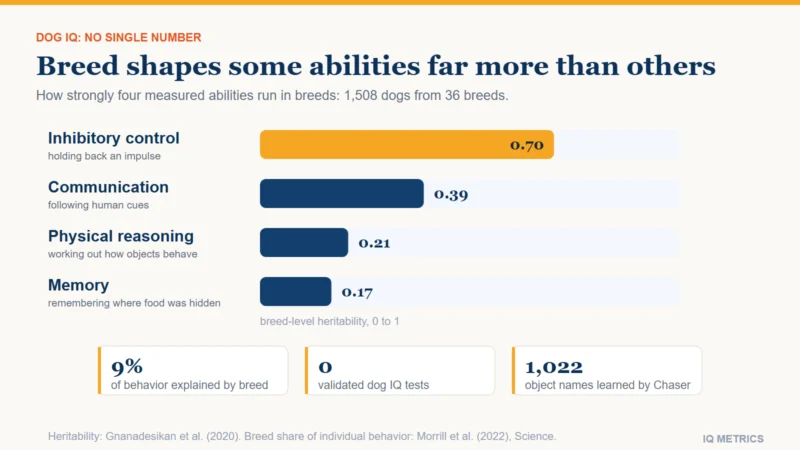 Understanding IQ
Dog IQ
Dogs have no IQ score: no validated test gives one. See dog IQ compared with humans, what researchers measure instead (words, memory, self-control, a gifted border collie that learned 1,022 names), how breeds differ, and how a dog cortex compares with a cat, a pig and a person.
 Mind & Everyday Life
Are Raccoons Smart?
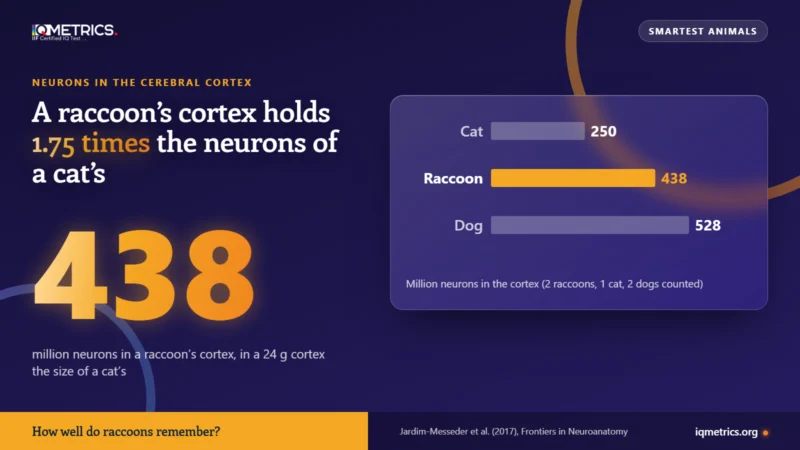
Are raccoons smart? In a 1907 study one raccoon needed 24 trials, not 107, to relearn a four-lock box after 286 days, and a raccoon's cortex holds 438 million neurons, 1.75 times a cat's. See the lock, memory and neuron studies, why raccoons wash food, and why no raccoon IQ exists.
 Mind & Everyday Life
Are Squirrels Smart?
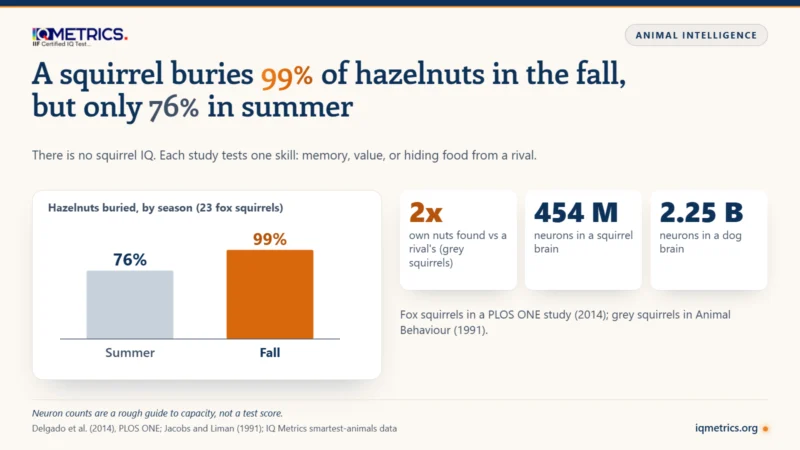
Are squirrels smart? Yes, for rodents: grey squirrels recover their own buried nuts at about twice the rate of a rival's, and fox squirrels bury 99% of hazelnuts in the fall but 76% in summer. There is no squirrel IQ. Each study, with journal, year and number of animals.