





Average IQ in Germany: What PISA, Adult Skills and Online Data Show
Average IQ in Germany is 100 on a German test. Germany's 15-year-olds scored 464 in PISA 2025 maths, adults rank 10th of 31 in adult skills, and an online test gives 99.32. See the UK, US and neighbour comparisons.

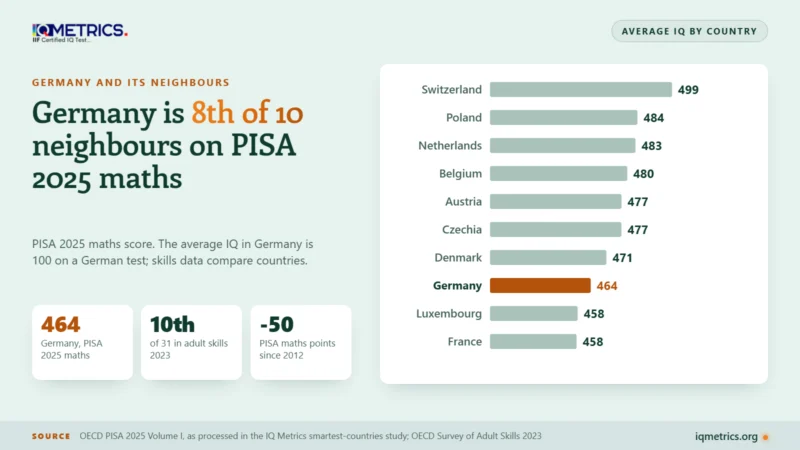
The average IQ in Germany is 100 on any German-normed test, because every IQ test sets its own average at 100. To compare countries, use skills data instead. In PISA 2025, German 15-year-olds scored 464 in maths, 24th in our school ranking. German adults rank 10th of 31 in the 2023 adult skills survey. An online test that drew 34,350 German takers gives 99.32.
This guide puts the three kinds of figure side by side and compares Germany with the US, the UK and its neighbours. It shows how far German school scores have fallen since 2012, and why no honest number exists for 1940.
What is the average IQ in Germany?
On a test normed in Germany, the average is 100 by construction. A norm group is a large sample of people who took the test. Its mean is set to 100, with a standard deviation (SD) of 15 points. A German who scores 100 is average among Germans. That says nothing about Germany against France.
Four other numbers get called the average IQ in Germany. They answer different questions, and none is an IQ test of all Germans.
| Source | Germany | Sample | What it measures |
|---|---|---|---|
| Online test (International IQ Test 2026 table) | 99.32, 38th of 137 | 34,350 volunteers | People who chose to take one website’s test |
| Pooled IQ studies (our average IQ by country page) | 100.74 | 8,445 people in 12 studies | Published studies of Germans, on different tests |
| PISA 2025 maths (OECD) | 464 (standard error 3.1) | Representative samples of 15-year-olds | School maths skill, not IQ |
| Survey of Adult Skills 2023 (OECD) | 267, 10th of 31 | Representative samples of adults aged 16 to 65 | Literacy, numeracy and problem solving |
How does the average IQ in Germany compare with the US and the UK?
On school skills Germany matches the US in maths and trails both countries in reading and science. On adult skills Germany matches England and beats the US by 15 points. None of this is an IQ gap. It is a skills gap, measured on different people in different years.
| Measure | Germany | UK | US |
|---|---|---|---|
| PISA 2025 maths | 463.8 | 487.6 | 462.9 |
| PISA 2025 reading | 465.3 | 494.2 | 489.5 |
| PISA 2025 science | 485.5 | 511.4 | 501.6 |
| Adult skills 2023 (mean of three) | 266.7 | 266.3 (England) | 251.5 |
| Online IQ test 2026 | 99.32 | 101.57 | 101.04 |
Look at the maths row. Germany and the US differ by one point, with a standard error near six, so they are statistically tied. The gap to the UK is 24 points, about six standard errors, so it is not noise. For the same comparison between the UK and the US, read our post on the average IQ in the UK vs the US.
How does Germany compare with its neighbours?
Germany ranks 8th of 10 neighbours on PISA 2025 maths, ahead of only Luxembourg and France. Adults tell a better story. German adults rank 10th of 31 in the adult skills survey. That puts them behind the Netherlands (5th), Denmark (7th) and Belgium (8th), level with Switzerland (11th, 266.5), and ahead of Czechia, Austria, France and Poland (30th).
- Belgium and the Netherlands: adults at 272.0 and 275.9, school maths at 479.7 and 483.3
- Switzerland: the top maths score of the ten (499.2), adults level with Germany
- Poland: school maths at 484.1, but adults 30th of 31 at 233.6
- France: the lowest adult score of the big neighbours (253.1) and the lowest maths score after Luxembourg
The German-speaking neighbours split. Switzerland’s PISA maths score is 35 points above Germany’s and Austria’s is 13 points above. In adult skills Germany (266.7) is level with Switzerland (266.5) and 8.5 points above Austria (258.1). So the school gap does not carry over to adults.
How much have German school scores fallen since 2012?
Germany’s PISA average fell 43.6 points between 2012 and 2025, the 5th-largest drop among the 59 countries with data. Maths fell 49.7 points, reading 42.4 and science 38.6. The maths drop is about 8.8 times its standard error of 5.6, so chance does not explain it.
Only the Netherlands, at 48.7 points, fell about as far among Germany’s neighbours. The US lost 7.5 points and the UK 4.7 over the same years. PISA measures school skills, not IQ, so a falling average does not mean falling IQ. Our guide to whether PISA is an IQ test explains the difference, and our report on PISA 2025’s record lows covers the wider debate about norms that age.
| Subject | 2025 score | Change since 2012 | Standard error |
|---|---|---|---|
| Maths | 463.8 | -49.7 | 5.6 |
| Reading | 465.3 | -42.4 | 7.6 |
| Science | 485.5 | -38.6 | 7.6 |
Where would your own score land?
Take the IIF-certified assessment and get your score with the scale it was measured on, the percentile it corresponds to and the confidence range around it — the three figures most online tests leave out.
Find your IQ score now! →Where do German adults rank in the adult skills survey?
German adults rank 10th of 31 countries in the OECD’s 2023 Survey of Adult Skills, with a mean of 266.7 across three tests. Their scores are 266.1 in literacy, 272.8 in numeracy and 261.0 in adaptive problem solving. Japan is 2nd at 285.5, Sweden 3rd at 280.7 and the US 21st at 251.5.
Adults aged 16 to 65 sit this survey, so it reflects schooling over several decades, not only today’s pupils. For a map of how the two surveys combine, see our smartest countries in the world study.
| Country | Literacy | Numeracy | Problem solving | Rank of 31 |
|---|---|---|---|---|
| Netherlands | 278.6 | 283.9 | 265.3 | 5 |
| Denmark | 273.0 | 279.1 | 264.4 | 7 |
| Belgium | 274.7 | 279.3 | 262.0 | 8 |
| Germany | 266.1 | 272.8 | 261.0 | 10 |
| Switzerland | 266.3 | 276.1 | 257.1 | 11 |
| Czechia | 260.2 | 267.3 | 250.1 | 14 |
| Austria | 254.4 | 267.0 | 253.0 | 15 |
| France | 254.8 | 256.5 | 247.9 | 19 |
| Poland | 235.7 | 238.8 | 226.3 | 30 |
The table shows a steady pattern. German adults are strongest in numeracy (272.8) and weakest in problem solving (261.0), the same order as all eight neighbours. The Netherlands leads Germany by 12 points in literacy, 11 in numeracy and 4 in problem solving.
Why does the online average IQ for Germany read 99.32?
It comes from one website’s annual table, updated on 1 January 2026 from people who took its test during 2025. Germany ranks 38th of 137 with 99.32, and its 34,350 takers are one of the five largest national samples. With an SD of 15 the standard error is only 0.08 points. That makes the number precise for the volunteers, but not for Germany.
To put the sample in proportion, 34,350 takers are about 4.1 in every 10,000 German residents. The takers chose to take the test, so they are not a sample of the population. Our report on the 2026 online ranking explains the problem, using South Korea’s first place in the same table.
Is the average IQ in Germany falling?
No test series follows German IQ across the years in the data we hold, so nobody can say. What exists is a school-skills trend. PISA scores fell in Germany by 43.6 points on average between 2012 and 2025, and the Netherlands fell further. Of the 59 countries in our index with 2012 data, 50 lost ground. A falling PISA average can reflect teaching, curricula, screens or how students approach the test. It is not proof that people became less able.
What was the average IQ in Germany in 1940?
Nobody measured it. No nationwide IQ test existed in 1940, so any figure for that year is a retrospective estimate and not a measurement. The first large international school test that covered Germany, PISA, began in 2000. Even good IQ norms drift: our report on why IQ norms expire shows why a test normed decades ago stops describing today’s population.
How should you use these numbers?
- Treat 100 as the German average on a German test, and nothing more.
- Compare countries with PISA and the adult skills survey, which sample people at random and publish their errors.
- Read the online table as a picture of web visitors, not of a nation.
- Do not read a skills gap as an IQ gap: schooling, language and test habits all change the scores.
To see where your own score sits, take the IQ test and use the IQ percentile calculator. For other countries, see the posts on Canada and Australia, or the full average IQ by country table.
One more German resource: a study of how growing up in East or West Germany relates to thinking skills after 50 is in our report on East Germany and cognitive health in later life.
Keep reading
All articles →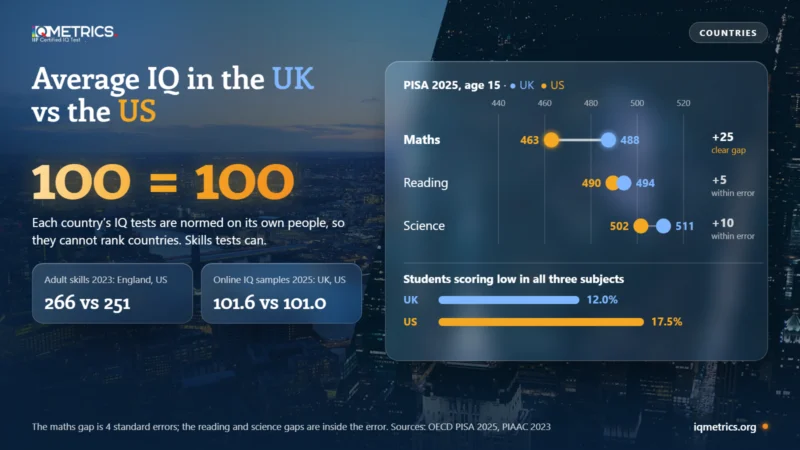 Scores & Scales
Average IQ in the UK vs the US
The average IQ in the UK vs the US is 100 in both, because each country's tests are normed on its own people. See what can be compared: PISA 2025 maths (UK 488, US 463), adult skills (266 vs 251), online samples, the Flynn effect in each country and where the real gaps sit.
 Scores & Scales
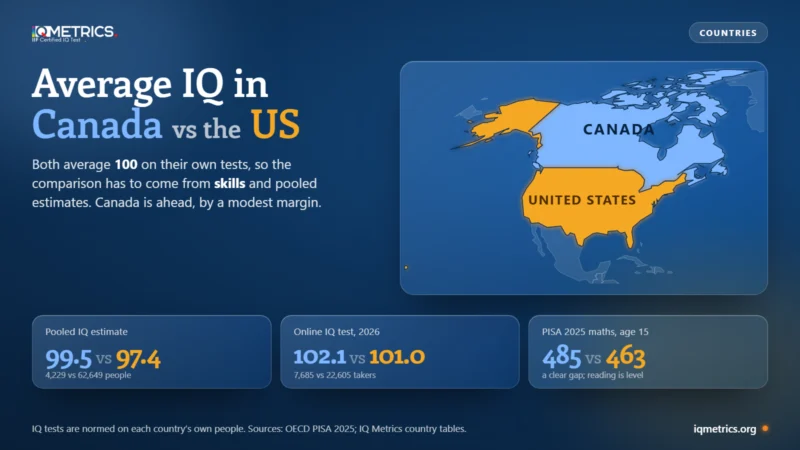
Average IQ in Canada (vs the US)
Average IQ in Canada vs the US: both are 100 on their own tests, so compare skills instead. Canada is ahead on PISA 2025 maths by 22 points and on adult skills by 16. See the provinces, why Canadian and US WAIS-IV norms give different scores, and how far Canada has fallen since 2012.
 Understanding IQ
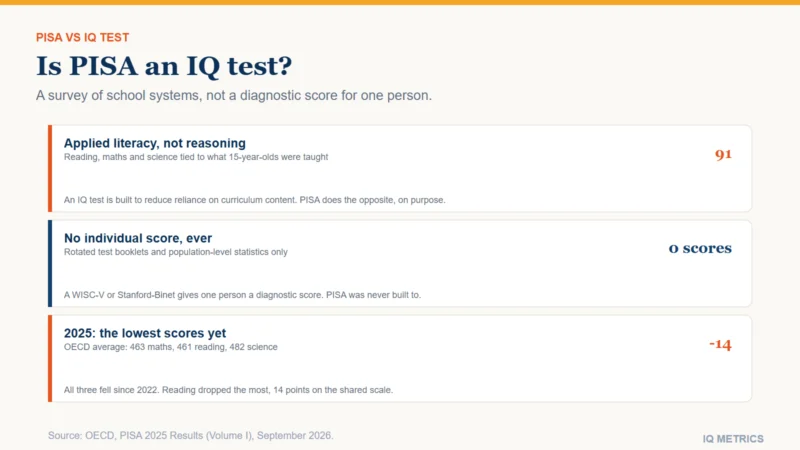
PISA Test vs IQ Test
Is PISA an IQ test? No. PISA surveys applied school literacy across whole education systems and returns no individual score, while an IQ test diagnoses one person. See the new PISA 2025 results, published September 2026, and the real debate over using PISA as a national IQ proxy.