



What was Bertrand Russell’s IQ?
A Nobel Prize is real. The number next to it on the page isn’t.
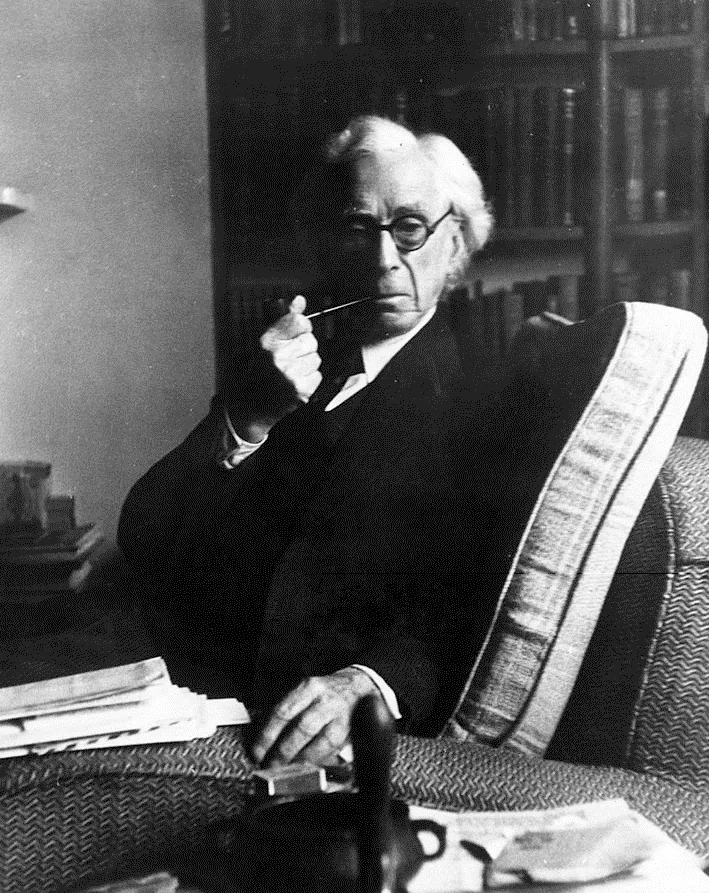
Bertrand Russell won the 1950 Nobel Prize in Literature and graduated Cambridge as Seventh Wrangler — both real, dated, checkable. The “180” attached to him instead has no source at all, and he doesn’t even qualify for the one historical study, Cox’s 1926 survey, that grounds several other figures on this site.
Bertrand Russell’s estimated IQ
- Graduated Trinity College, Cambridge, as Seventh Wrangler in the Mathematical Tripos (1893) and with First-class honours in the Moral Sciences Tripos (1894), then elected a Fellow of Trinity in 1895.
- Co-authored Principia Mathematica with Alfred North Whitehead (1910–1913), a three-volume attempt to derive mathematics from formal logic that shaped twentieth-century mathematical logic — and whose own formal system Kurt Gödel later used to prove such a foundation could never be complete.
- Awarded the Nobel Prize in Literature in 1950, “in recognition of his varied and significant writings in which he champions humanitarian ideals and freedom of thought.”
- Awarded the De Morgan Medal (1932) and the Sylvester Medal (1934), two of the highest honors in British mathematics.
No IQ test result for Russell has ever been published, and he was never a subject of Catharine Cox’s 1926 historiometric study — her subjects had to be born 1450–1850, and Russell was born in 1872 and still alive when she published. This range reflects an exceptional, independently verifiable academic record rather than any recovered score.
- Born
- 18 May 1872, Trellech, Wales
- Died
- 2 February 1970, Penrhyndeudraeth, Wales
- Education
- Trinity College, Cambridge — Seventh Wrangler, 1893; Fellow, 1895
- Major work
- Principia Mathematica (with A. N. Whitehead, 1910–1913)
- In Cox’s 1926 study?
- No — her subjects were born 1450–1850; Russell was born in 1872
What an IQ of 160–175 actually means
Set the claim aside for a moment. If someone genuinely scored in this range, here is what that would represent.
Average is 100 by construction, and about two-thirds of people fall between 85 and 115. Take the test to place your own score on this scale.
| Score range | Classification | Share of people | What it indicates |
|---|---|---|---|
| 85 – 114 | Average | ~68% | The range most people fall into. |
| 115 – 129 | Above average | ~13.6% | Roughly one person in seven. |
| 130 – 144 | Gifted | ~2% | The threshold most high-IQ societies use. |
| Above 144 | Highly gifted | ~0.1% | Figures above this range are extrapolated from the curve rather than measured. |
Percentages are approximate and describe a normal distribution. The same number means different things on tests with different standard deviations.
Thirty questions gives you a measured position on this exact scale — your score, your percentile and the ability breakdown behind it.
Find out in 30 minutes →Who Bertrand Russell was
Bertrand Russell was born in Trellech, Wales, in 1872 and orphaned by age four. He entered Trinity College, Cambridge, in 1890, graduating Seventh Wrangler in mathematics in 1893 and with First-class honours in philosophy in 1894, then was elected a Fellow of Trinity in 1895. With Alfred North Whitehead he published the three-volume Principia Mathematica (1910–1913), attempting to derive all of mathematics from formal logic — a project whose limits were later exposed by Kurt Gödel’s 1931 incompleteness theorems, which used Principia’s own system as their working example.
Russell was awarded the Nobel Prize in Literature in 1950 for his humanitarian and philosophical writing, having already received the London Mathematical Society’s De Morgan Medal (1932) and the Royal Society’s Sylvester Medal (1934). He remained publicly active as a writer, logician and anti-war campaigner until his death in Wales in 1970, aged 97.
 By Elora Mercer, Celebrity Research WriterFigures checked by Leon Falkner, Data & Research Analyst
Reviewed by Aarav Vardhan, Editor-in-Chief · Last reviewed August 2026

Where the 180 figure came from
Following a claim back to its first appearance is the part almost nobody does — and it is what most people are actually asking.
Russell is the cleanest illustration on this site of a number and a fact sitting side by side with identical confidence and completely different footing. geniuses.club lists his Nobel Prize, his 1932 De Morgan Medal and his 1934 Sylvester Medal — all real, all dated, all checkable — in the same small table as “IQ Score: ≈180,” sourced to nothing.
He is also a useful negative case for the historiometric method used elsewhere on this site: Cox’s 1926 study is frequently assumed to cover “the great historical geniuses” generally, but its actual scope was specific — 301 people born 1450 to 1850, using documented childhood evidence. Russell fails on both counts: born too late, and still alive when Cox published. Whatever “180” is, it isn’t that.
Principia Mathematica’s logicist program also connects to Alan Turing, profiled elsewhere on this site: Gödel’s 1931 incompleteness theorems, which used Russell and Whitehead’s own formal system to show its founding goal was unreachable, directly shaped the questions about computability Turing took up a few years later.
How we read a number →Confirms Russell does not appear in Cox’s alphabetical listing of study subjects.
“in recognition of his varied and significant writings in which he champions humanitarian ideals and freedom of thought.”
Source of the circulating “≈180” figure, listed with no citation alongside verified facts.
No test result appears in any biography, letter, or primary document found; a widely repeated “self-estimate” claim could not be traced to any primary source.
The sources behind our estimate
The figures that circulate for Bertrand Russell, what we were able to confirm, and where the two diverge.
“180” (sometimes “at least 180”) is the figure most commonly attached to Russell on ranking sites and social media.
geniuses.club lists “IQ Score: ≈180” in the same table as Russell’s real Nobel Prize and real 1932/1934 medals, with identical formatting and no source cited for the IQ line specifically. A widely repeated claim that Russell “estimated his own IQ at 180” could not be traced to any autobiography, letter or biography. And unlike some other historical figures on this site, Russell is not in Cox’s 1926 study at all — her subjects were born 1450–1850, and Russell, born in 1872, was both too late and still alive when the study was published.
The popular figure sits just outside our own range — close enough to look plausible, which is exactly what makes an unsourced number this durable.
Want a number that does hold up? Every figure on this page is somebody’s claim. Take the 30-question test and get a percentile you can check rather than a figure you have to trust.
Bertrand Russell — frequently asked
What was Bertrand Russell’s IQ?
No documented score exists. The figure of 180 that circulates on ranking sites appears with no citation — one site lists it in the same table as his real Nobel Prize and medals, with identical formatting but no source for the IQ line.
Did Bertrand Russell win a Nobel Prize?
Yes — the Nobel Prize in Literature, 1950, “in recognition of his varied and significant writings in which he champions humanitarian ideals and freedom of thought.”
Where did Bertrand Russell study, and how did he do?
Trinity College, Cambridge, from 1890. He graduated Seventh Wrangler in the Mathematical Tripos (1893), took a First in Moral Sciences (1894), and was elected a Trinity Fellow in 1895.
Was Bertrand Russell included in any historical “genius IQ” study?
No. Catharine Cox’s 1926 study of historical geniuses covered only subjects born between 1450 and 1850. Russell was born in 1872 and was still alive when the study was published, so he was never eligible.
What is Principia Mathematica and why does it matter?
A three-volume work (1910–1913) with Alfred North Whitehead attempting to derive all of mathematics from formal logic. It became one of the most influential works in the history of logic — and in 1931, Kurt Gödel used its own formal system to prove that no such foundation could ever be both complete and self-proving.
Was Bertrand Russell a mathematician or a philosopher?
Both. He trained as a mathematician at Cambridge before moving into philosophy, and the Nobel committee recognized the full range of that work — logic, mathematics, and humanitarian writing — in 1950.
How does my IQ compare with Bertrand Russell?
You can find out in about fifteen minutes. The IQ Metrics assessment is 30 questions, scored on the same 100-mean scale used throughout this page, so your result and the estimate above are at least expressed in the same units — one measured, one inferred. Once you have a number, the leaderboard shows where it would sit, and how we score and norm it explains the benchmarking.
Where does this estimate come from?
From the documented record rather than a test — the method is named above and set out in full under how we read a number. Compare it against the other writers profiles, starting with Voltaire.
- Take the 30-question IQ test — get a measured score and percentile of your own
- Average IQ by country — how the scale behaves across populations
- How IQ Metrics scores its assessment — the method behind our own number
- More on how IQ testing works — reliability, error and what a score can and cannot say
- More writers profiles — same field, same method
More writers

Photograph by an unknown photographer (1923), public domain. Background removed for the portrait above. · Photograph by Gtl12345, CC BY-SA 4.0. Cropped and with background removed for the portrait above. · Photograph by Friedrich Hermann Hartmann (c. 1875), public domain. Background removed for the portrait above.


An estimate is an inference.
Yours can be measured.
Thirty questions, scored against general-population benchmarks. Your score, your percentile, your ability breakdown and a printable IIF certificate.
Find your IQ score now! →